
The Importance of Financial Forecasting for Business Growth
13 January 2025

Financial forecasting is a strategic process that requires modeling anticipated cash inflows and outflows to maintain liquidity and support business growth.
Rules reviewed: 20 October 2026. Read the linked primary sources for the applicable period, commencement dates and conditions.
For South African small and medium enterprises (SMEs), financial forecasting transforms historical accounting records into decision-useful forward-looking projections 1. By distinguishing cash movements from accounting profit and mapping monthly seasonality timing across a defined forecast horizon 2, owner-managed businesses can anticipate liquidity shortfalls, fulfil statutory obligations to the South African Revenue Service (SARS) 3 4, and satisfy statutory solvency and liquidity evaluations under company law 5 6.
Monthly seasonality timing and forecast horizon
Defining the Managerial Decision
A financial forecast provides a structured operational plan to manage working capital and capital expenditure across a designated forecast horizon. For South African SMEs, the core management decision revolves around balancing monthly cash inflow seasonality—such as festive retail surges or post-harvest agricultural cycles—against fixed operational and statutory disbursements 2.
Operating activities represent the principal revenue-producing activities of an entity 2, and modeling their monthly cash timing allows management to determine whether operational liquidity will remain sufficient or if short-term financing must be arranged.
Distinguishing Forecasts from Predictions or Commitments
A financial forecast is an analytical tool based on explicit, evidence-backed assumptions rather than a guaranteed prediction or lender commitment. Under the IFRS Conceptual Framework for Financial Reporting, general purpose financial reporting aims to supply decision-useful information regarding the amount, timing, and uncertainty of future cash flows to investors, lenders, and creditors 1 7.
— Practical point from this guide
In practice, a forecast establishes hypothetical baseline expectations to guide managerial action; it does not constitute a promise of performance or an assurance of credit approval from financial institutions.
Delineating Legal, Regulatory, and Advisory Boundaries
To maintain regulatory clarity, South African businesses must distinguish among statutory legal obligations, administrative regulator guidance, and Evolv advisory recommendations:
- Statutory Law: The Companies Act 71 of 2008 mandates that companies maintain accurate and complete accounting records 8 for seven years 9 and perform a formal solvency and liquidity test before approving distributions or financial assistance 5 6. Similarly, the Income Tax Act 58 of 1962 and the Value-Added Tax Act 89 of 1991 set strict statutory rules for tax liabilities and filing periods 3 10 11.
- Regulator Guidance: Documents such as the SARS Tax Guide for Small Businesses (2025/2026) supply administrative frameworks for tax registration thresholds, provisional tax estimates, and eFiling processes 3 12.
- Evolv Recommendations: Specific methodologies for 13-week or 12-month rolling cash flow forecasting, seasonality profiling, and scenario stress-testing represent professional accounting advisory recommendations designed to enhance financial control, rather than statutory mandates.
Build assumptions from actual records: monthly seasonality timing
Grounding Inputs in Primary Accounting Records
Building a reliable financial forecast requires extracting baseline inputs directly from historical accounting records, bank statements, customer contracts, and supplier payment terms. Section 28(1) of the Companies Act 71 of 2008 requires every company to keep accurate and complete accounting records in an official language of South Africa 8.
Section 24(1)(b) of the Companies Act requires companies to retain accounting records for seven years 9, whereas section 29 of the Tax Administration Act 28 of 2011 mandates a five-year retention period from the date of tax return submission 13. Baseline revenue and cost of sales figures should be derived using standard accounting principles, where cost of sales equals opening stock plus purchases less closing stock 14.
Accountable Owners and Monthly Seasonality Drivers
Each line item in the cash flow model must be assigned to an accountable operational owner (for example, the sales director for debtor collections or the finance manager for statutory tax payments). Monthly seasonality timing reflects predictable fluctuations in cash timing:
- Debtor Collection Patterns: Contractual payment terms (e.g., 30 days post-invoice) frequently stretch in practice due to seasonal administrative delays, impacting operational cash inflows 2.
- Creditor Disbursement Schedules: Trade payables for inventory purchases must be aligned with payment terms to prevent supply disruptions.
- Statutory Tax Due Dates: Tax liabilities create non-negotiable cash outflows that must be explicitly scheduled:
- PAYE: For the 2026/2027 tax year, 1 March 2026–28 February 2027, SARS lists an annual normal-tax threshold of R99,000 for individuals under 65. Employers must register for employees’ tax within 21 business days of becoming an employer unless none of their employees is liable for normal tax. Calculate PAYE using the applicable age, remuneration and payroll-period rules. EMP201 payments are due within seven days after month-end; if the due date is a weekend or public holiday, use the preceding business day. SARS employer guide: 2026/2027 tax year
- Value-Added Tax (VAT): Registered vendors on two-monthly Category A or B tax periods must account for 15% standard rate output tax less allowable input tax, paying net VAT to SARS by the statutory deadline 16 17 18. Vendors on the invoice basis must declare output tax in the period an invoice is issued, regardless of whether customer payment has been received 11.
- Provisional Tax: Entities must execute first provisional tax payments six months into the year of assessment and second payments on the last day of the year of assessment, with an optional third payment available to prevent interest charges 3.
Construct the base scenario: forecast horizon
Horizon Selection and Structural Components
A 12-month rolling forecast horizon aligned with the entity's financial year of assessment 12 19 provides an optimal window for strategic planning, while a weekly 13-week forecast horizon offers detailed tactical liquidity tracking. Under IAS 7 Statement of Cash Flows, cash movements are structured into three distinct categories 2:
- Operating Activities: Cash receipts from customer sales less cash paid to suppliers, staff, and tax authorities 2.
- Investing Activities: Cash outflows for purchasing plant, machinery, or long-term assets, less proceeds from asset disposals 2.
- Financing Activities: Inflows from equity capital or loan borrowings, less debt repayments and owner distributions 2.
Under IAS 7, cash comprises cash on hand and demand deposits, while cash equivalents are defined as "short-term, highly liquid investments that are readily convertible to known amounts of cash" 20.
Reproducible Hypothetical Base Scenario Model
To demonstrate the mathematical mechanics of a 3-month rolling cash forecast, consider a hypothetical South African private company operating as a Small Business Corporation (SBC) under section 12E of the Income Tax Act 21. The figures below are purely illustrative and do not constitute predictions or financial guarantees:
Base Parameters & Initial Balances
- Opening Bank Balance (Month 1): R100 000 (Hypothetical cash balance).
- Monthly Gross Sales: R250 000 in Month 1, R200 000 in Month 2 (seasonal decline), and R280 000 in Month 3 (seasonal peak). Collection terms: 80% collected in the month of sale, 20% collected in the following month.
- Monthly Cost of Goods & Operating Expenses: R140 000 paid in the month incurred.
- Monthly PAYE & Staff Costs: R20 000 paid on the 7th of each following month 4.
- Bi-monthly VAT Outflow: R15 000 payable in Month 1 (Category A/B vendor) 17 18.
- Provisional Tax Payment: R35 000 due in Month 2 (1st provisional tax payment) 3.
Step-by-Step Mathematical Calculation
##### Month 1:
- Cash Inflows: (80% of R250 000 current sales) + (R0 prior month collections) = R200 000.
- Cash Outflows: R140 000 (Operating expenses) + R20 000 (PAYE) + R15 000 (VAT) = R175 000.
- Net Cash Flow Month 1: R200 000 − R175 000 = +R25 000.
- Closing Cash Balance Month 1: R100 000 + R25 000 = R125 000.
##### Month 2:
- Cash Inflows: (80% of R200 000 current sales = R160 000) + (20% of Month 1 sales = R50 000) = R210 000.
- Cash Outflows: R140 000 (Operating expenses) + R20 000 (PAYE) + R35 000 (Provisional Tax) = R195 000.
- Net Cash Flow Month 2: R210 000 − R195 000 = +R15 000.
- Closing Cash Balance Month 2: R125 000 + R15 000 = R140 000.
##### Month 3:
- Cash Inflows: (80% of R280 000 current sales = R224 000) + (20% of Month 2 sales = R40 000) = R264 000.
- Cash Outflows: R140 000 (Operating expenses) + R20 000 (PAYE) = R160 000.
- Net Cash Flow Month 3: R264 000 − R160 000 = +R104 000.
- Closing Cash Balance Month 3: R140 000 + R104 000 = R244 000.
Test the downside and timing changes: monthly seasonality timing
Stress-Testing Monthly Seasonality Timing Risk
A single optimistic projection conceals underlying operational risks. Stress-testing requires altering key timing variables to model downside scenarios, specifically testing what happens when seasonal demand drops or customer collection periods extend during off-peak months.
Downside Scenario Adjustments
Using the baseline model above, suppose a downside event occurs in Month 2: customer collections lag so that only 60% of current sales are collected (instead of 80%), and an unexpected delay in stock delivery defers sales inflows into Month 3, while fixed operating expenses, PAYE 4, and provisional tax obligations 3 remain constant:
- Downside Inflows Month 2: (60% of R200 000 sales = R120 000) + (20% of Month 1 sales = R50 000) = R170 000.
- Fixed Outflows Month 2: R140 000 (Operating) + R20 000 (PAYE) + R35 000 (Provisional Tax) = R195 000.
- Downside Net Cash Flow Month 2: R170 000 − R195 000 = −R25 000.
- Downside Closing Cash Month 2: R125 000 − R25 000 = R100 000.
Although the buffer remains positive in this hypothetical case, the R40 000 cash reduction highlights how seasonality and tax timing can erode liquidity reserves if collections slow down.
Solvency and Liquidity Considerations under Company Law
Section 4 of the Companies Act 71 of 2008 sets out the statutory solvency and liquidity test 5. A company satisfies the test if, considering all reasonably foreseeable financial circumstances 5:
- Solvency: The fairly valued assets of the company equal or exceed its fairly valued liabilities 5.
- Liquidity: The company will be able to pay its debts as they become due in the ordinary course of business for 12 months following the test or distribution 5 6.
Stress-testing cash flow forecasts provides directors with essential evidence when evaluating liquidity prior to authorising distributions or financial assistance under statutory rules 6 22.
Compare forecast with actual results: forecast horizon
Version Control and Update Rhythms
To remain effective, forecasts must be systematically updated against actual performance. Evolv recommends establishing a formal monthly comparison cycle where the original baseline forecast (Version 1.0) is retained for benchmark analysis, while a rolling updated forecast (Version 1.1) incorporates actual bank and ledger results.
Variance Analysis: Distinguishing Accrual Profit from Cash Movements
Variances between forecasted and actual figures must be classified into timing differences (e.g., a customer paying on the 2nd of the following month instead of the 30th) and permanent variances (e.g., an uncollectable bad debt or an unbudgeted price increase).
Management must strictly separate accounting net profit from liquid cash flow 23 24:
- Accounting Profit: Calculated as gross sales less cost of sales and allowable operating expenses on an accrual basis 14 23. Revenue is recognised when earned, regardless of cash receipt 25.
- Cash Flow: Reflects actual bank movements. A business can report an accounting profit while experiencing a severe liquidity shortage due to inventory buildup, capital expenditure, or unpaid trade receivables 2.
Tax Computation Adjustments
Net accounting profit forms the starting point for calculating taxable income, but statutory tax adjustments are required 24:
- Corporate Income Tax: Standard companies are taxed at 27% on taxable income for years of assessment ending on or after 1 April 2025 26.
- Small Business Corporations: For qualifying section 12E entities with years of assessment ending from 1 April 2026 to 31 March 2027, the SARS table starts at 0% up to R99,000; the next band is 7% of the amount above R99,000 up to R365,000, followed by the applicable 21% and 27% bands. Verify all qualification tests and use the full table for the relevant year. SARS company and Small Business Corporation tax tables
- Micro Businesses: Qualifying micro businesses with turnover up to R1 million can elect the simplified turnover tax regime under the Sixth Schedule 28 29 30.
Next steps for Cash flow forecasting
Actionable Implementation Framework
When financial forecasts highlight impending liquidity shortfalls or temporary headroom, management should execute specific operational adjustments:
- Shortfall Mitigation: Negotiate extended payment terms with key trade suppliers, enforce stricter credit limits on slow-paying accounts, or defer non-essential capital investments 2.
- Headroom Utilization: Allocate surplus liquidity toward reducing high-interest debt, building an operational buffer for off-peak seasonal periods, or funding pre-approved expansion projects 2.
Recommended Implementation Checklist
- Extract 12 to 24 months of historical bank, sales, and expense records from primary accounting files 8 9.
- Map all fixed statutory payment dates, including monthly PAYE (EMP201) 4, bi-monthly VAT (VAT201) 17, and bi-annual provisional tax returns 3.
- Construct a 12-month base case forecast model categorizing cash flows into operating, investing, and financing activities 2.
- Run downside sensitivity scenarios adjusting monthly seasonality timing and customer collection delays.
- Schedule a monthly variance review meeting to compare actual ledger results against forecast versions and update rolling assumptions.
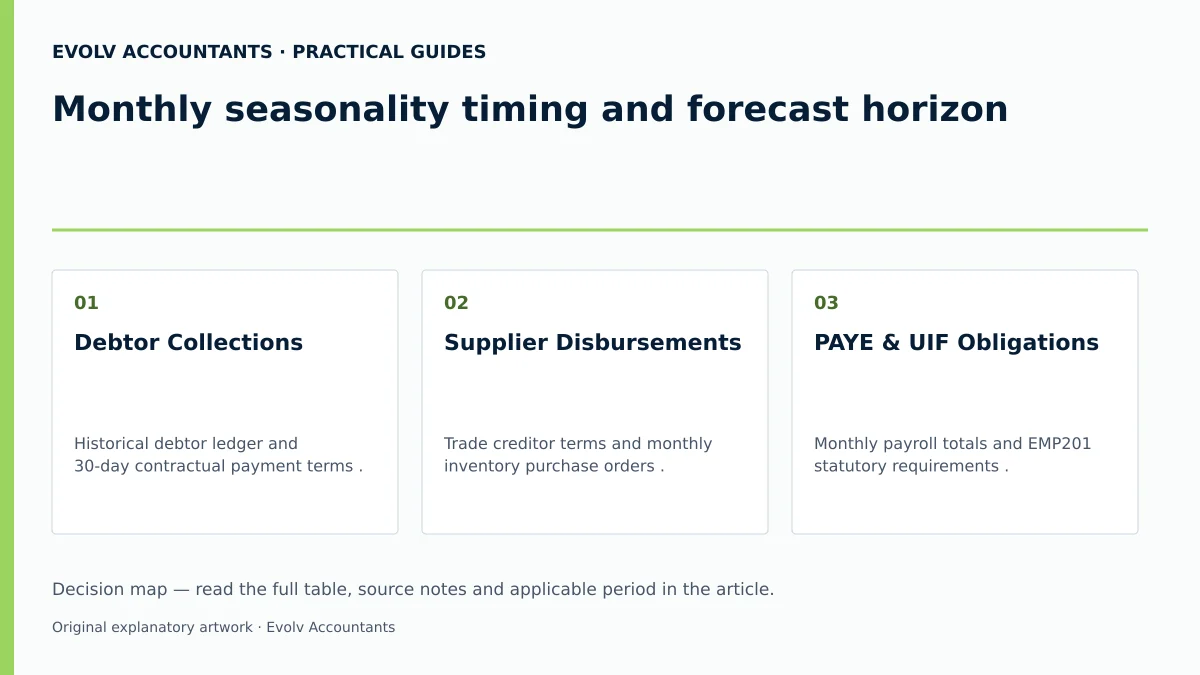
Scenario and Variance Schedule
| Period or driver | Evidence based input | Base case | Downside assumption | Action or review trigger |
|---|---|---|---|---|
| Debtor Collections | Historical debtor ledger and 30-day contractual payment terms 2 8. | 80% collected in month of sale, 20% in following month. | Collections drop to 60% in month of sale due to seasonal lag. | Debtor collection period exceeds 45 days; trigger formal credit review. |
| Supplier Disbursements | Trade creditor terms and monthly inventory purchase orders 14 25. | Supplier invoices paid strictly at 30 days post-statement. | Supplier requires 50% upfront deposit for peak season stock. | Cash reserve falls below 1.5 months of operational overheads. |
| PAYE & UIF Obligations | Monthly payroll totals and EMP201 statutory requirements 4 15. | Full payroll tax remittance paid by the 7th of each month 4. | Remuneration increases due to seasonal overtime requirements. | Payroll costs exceed 35% of monthly operating cash inflows. |
| VAT Net Outflow | Bi-monthly VAT 201 return calculations at 15% standard rate 16 17. | Net VAT liability remitted bi-monthly on Category A/B schedule 17. | Output tax due on credit sales where customer payment is delayed 11. | VAT liability exceeds available liquid short-term demand deposits 20. |
| Provisional Income Tax | Estimated annual taxable income and Fourth Schedule rules 3 27. | 1st provisional tax payment remitted at Month 6 of tax year 3. | Taxable income higher than expected due to non-deductible add-backs 24. | Provisional tax estimate differs by more than 20% from actual ledger trend. |
Frequently Asked Questions
How does the Companies Act record retention period differ from SARS tax record rules when gathering forecast baseline data?
Section 24(1)(b) of the Companies Act 71 of 2008 requires companies to maintain accounting records and annual financial statements for seven years 9 31. In contrast, section 29 of the Tax Administration Act 28 of 2011 mandates that taxpayers retain books of account, ledgers, and supporting documents for five years from the date a tax return is submitted 13. When gathering baseline historical data for cash forecasting, Evolv recommends adhering to the seven-year statutory retention standard to ensure complete legal and tax compliance 9 13.
Why must cash flow forecasts separate accounting net profit from liquid cash flow?
Accounting net profit measures profitability on an accrual basis by matching gross sales against cost of sales and operating expenses incurred during a period 14 23 24. However, accounting profit includes non-cash items and uncollected credit sales 25. Cash flow tracks actual liquidity—the movement of cash and cash equivalents arising from operating, investing, and financing activities 2 20. A business can be profitable on paper while failing to meet its immediate cash obligations if capital is tied up in trade receivables or stock 2 14.
What statutory tax payment dates must be integrated into a South African SME cash flow forecast?
A cash flow forecast must incorporate three primary tax payment schedules: 1. PAYE and UIF: Submitted monthly on form EMP201 within seven days after the end of the month during which tax was deducted 4. 2. Value-Added Tax (VAT): Paid bi-monthly (Category A or B) or monthly (Category C) based on output tax less allowable input tax 17 18. 3. Provisional Tax: Paid twice annually (six months into the year of assessment and on the final day of the year of assessment), with an optional third payment to settle residual liability 3.
How does Small Business Corporation (SBC) tax status impact cash flow forecasting compared to standard corporate tax?
Standard companies pay a flat 27% income tax rate on taxable income for years of assessment ending on or after 1 April 2025 26. Qualifying SBCs under section 12E of the Income Tax Act benefit from progressive tax brackets (0%, 7%, 21%, and 27%) 21 27, as well as immediate or accelerated depreciation allowances on plant and machinery 32. Incorporating SBC tax rates into provisional tax estimates reduces forecasted tax outflows, preserving liquid working capital for operational growth 3 27.
Does a 12-month cash flow forecast satisfy the statutory solvency and liquidity test under the Companies Act?
Under section 4 of the Companies Act 71 of 2008, a company satisfies the solvency and liquidity test if its fairly valued assets equal or exceed its liabilities, and it appears the company can pay its debts as they become due in the ordinary course of business for 12 months following the test 5 6. A 12-month cash flow forecast provides essential documentary evidence for directors to evaluate operational liquidity, but it must be accompanied by a fair valuation of assets and liabilities to satisfy the full statutory requirement 6 33. Ask Evolv about monthly seasonality timing and forecast horizon. Share the relevant records so the support required can be scoped.
Related guides
- Building a 13 week cash flow forecast
- Cash flow forecast versus profit forecast
- Reading the Financials: Cash Flow and the Balance Sheet for Directors
Sources
- IFRS - Conceptual Framework for Financial Reporting
- IFRS - IAS 7 Statement of Cash Flows
- https://www.sars.gov.za/wp-content/uploads/Ops/Guides/Legal-Pub-Guide-Gen09-Tax-Guide-for-Small-Businesses.pdf
- https://www.cipc.co.za//wp-content/uploads/Legal/Regulations/CompaniesAct71_2008.pdf
- SARS employer guide: 2026/2027 tax year
- SARS company and Small Business Corporation tax tables