
Small Business Corporation tax: who qualifies in South Africa
16 January 2026

Qualifying for Small Business Corporation tax status requires meeting four strict legal tests under Section 12E throughout the relevant year of assessment 1 2.
Small Business Corporation (SBC) status provides eligible South African small and medium enterprises (SMEs) with substantial income tax relief through concessionary graduated normal tax rates—starting at 0% on initial brackets—alongside accelerated capital expenditure depreciation allowances under Section 12E of the Income Tax Act 3 4 5. Rather than paying the flat 27% Corporate Income Tax (CIT) rate applicable to standard companies 6, qualifying entities pay tax on a sliding progressive scale 3 7.
Accessing these legal tax savings requires rigorous, independent verification of all statutory eligibility tests across every financial year 1 8.
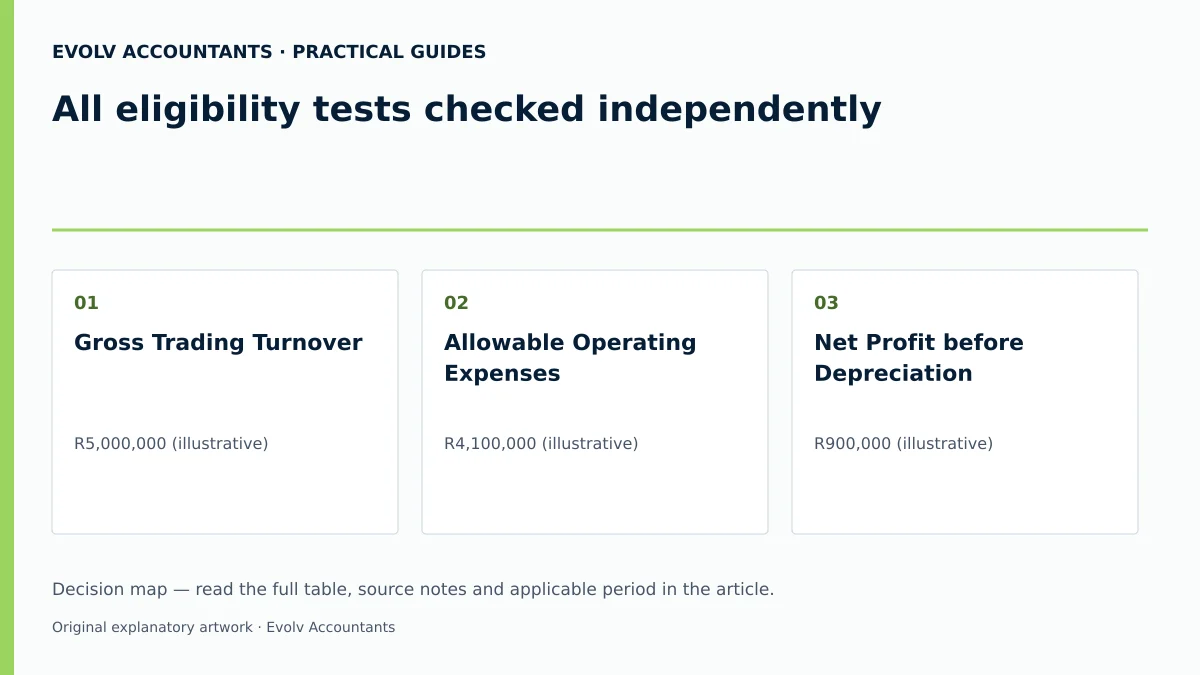
All eligibility tests checked independently
Legal Entity and Shareholder Requirements
The legal entity requirement dictates that the taxpayer must be a juristic person incorporated in South Africa as a close corporation, co-operative, private company, or personal liability company 8 11 12 13. Foreign entities do not qualify unless they have formally transferred their registration to South Africa under the Companies Act as a domesticated company 13.
100% of the holders of shares or members' interest must be natural persons at all times during the entire year of assessment 2 14. If a juristic person holds even a single share, or if shares are transferred to a company for a single day, SBC status is immediately forfeited for that entire tax year 14. Shares held via a trust qualify only if all trust beneficiaries are natural persons who hold a fully vested right in those shares throughout the year of assessment 15.
Crucially, shareholders or members are prohibited from holding any shares or equity interest in any other company at any time during the year of assessment 16 17. Section 12E(4)(a)(ii) provides narrow statutory exceptions where holding shares in another entity is permitted, including 17 18 19 20 21 22 23 24:
- Listed public companies and portfolios in collective investment schemes 17 25;
- Share block companies, sectional title bodies corporate, and homeowners associations 17 21;
- Venture capital companies approved under Section 12J 19 24;
- Inactive or dormant companies that have never traded and hold assets with a total market value not exceeding R5,000 19 20 24;
- Companies in the formal process of liquidation, winding up, or deregistration 20 26.
Gross Income and Tainted Activity Thresholds
The gross income of the entity must not exceed R20 million for a full 12-month year of assessment 27 28. Gross income includes all trading turnover, sales, and non-capital receipts accrued to or received by the business 27.
In addition, the business activity test dictates that not more than 20% of the total receipts, accruals (excluding capital receipts), and capital gains combined may consist of "investment income" and "personal service" income 29 30 31. Investment income includes interest, local and foreign dividends, royalties, annuities, and rental derived from immovable property 31.
Regulator guidance clarifies that short-term serviced accommodation (such as a guesthouse or lodge) is treated as active trading income rather than property rental, whereas long-term exclusive leases exceeding one month constitute rental investment income 32.
Inputs rates periods and exclusions: all eligibility tests checked independently
Every tax rate, statutory threshold, and depreciation allowance must be applied strictly according to the specific tax year of assessment.
Standard Corporate Tax vs. SBC Graduated Tax Rates
The standard Corporate Income Tax (CIT) rate for companies is 27% for years of assessment ending on or after 31 March 2023 (down from 28% in prior periods ending between 1 April 2020 and 30 March 2023) 6. In contrast, an eligible SBC benefits from the following graduated marginal rate brackets 7 33 34:
SBC Tax Rates for Years of Assessment Ending 1 April 2026 to 31 March 2027
- R1 – R99,000: 0% of taxable income 7;
- R99,001 – R365,000: 7% of taxable income above R99,000 7;
- R365,001 – R550,000: R18,620 + 21% of taxable income above R365,000 7;
- R550,001 and above: R57,470 + 27% of taxable income above R550,000 7.
SBC Tax Rates for Years of Assessment Ending 1 April 2025 to 31 March 2026
- R1 – R95,750: 0% of taxable income 7;
- R95,751 – R365,000: 7% of taxable income above R95,750 7;
- R365,001 – R550,000: R18,848 + 21% of taxable income above R365,000 7;
- R550,001 and above: R57,698 + 27% of taxable income above R550,000 7.
SBC Tax Rates for Years of Assessment Ending 1 April 2022 to 30 March 2023
- R1 – R91,250: 0% of taxable income 34;
- R91,251 – R365,000: 7% of taxable income above R91,250 34;
- R365,001 – R550,000: R19,163 + 21% of taxable income above R365,000 34;
- R550,001 and above: R58,013 + 28% of taxable income above R550,000 34.
Accelerated Capital Depreciation Allowances
Qualifying SBCs can claim accelerated tax depreciation on qualifying capital assets brought into use for trade 5 35:
- Manufacturing Assets (Section 12E(1)): Plant or machinery used directly in a process of manufacture (or similar process) brought into use for the first time qualifies for a 100% write-off in that year of assessment 5 36 37.
- Non-Manufacturing Assets (Section 12E(1A)): Other depreciable machinery, equipment, implements, and utensils qualify for a 3-year write-off at 50% in Year 1, 30% in Year 2, and 20% in Year 3, with no pro-rata apportionment required for assets used for part of a year 38 39. Alternatively, the SBC may elect standard Section 11(e) wear-and-tear write-offs 38 40.
Personal Services Exclusions and Employee Exceptions
Section 12E(4)(d) specifically defines personal services across 24 fields, including accounting, consulting, engineering, health, information technology, law, and management 41 42. A short quotation from regulator guidance confirms that personal service "means any service in the field of accounting, actuarial science, architecture, auctioneering, auditing, broadcasting, consulting, draftsmanship, education, engineering..." 41 42.
Income derived from these fields is classified as "tainted" personal service income if rendered personally by a shareholder or connected person 41 42. However, a statutory exception applies: if the entity employs three or more full-time, non-shareholder employees (who are not connected persons to shareholders) engaged in rendering that service throughout the tax year, the income is reclassified as active trade income and excluded from the 20% limit 43 44 45.
An SBC must not be a "Personal Service Provider" (PSP) under the Fourth Schedule 46 47. A company is a PSP if services are rendered personally by a connected person and the worker would be deemed an employee of the client, or works under the client's control/supervision, or derives more than 80% of income from one client 47 48 49 50. PSPs are subject to deduction restrictions under Section 23(k) 51 52.
The calculation in a worked example: documented completion and exceptions
The following reproducible worked example demonstrates the arithmetic calculation of SBC tax relief compared to standard corporate income tax for an eligible private company during the 2025/2026 year of assessment (ending between 1 April 2025 and 31 March 2026). All values are illustrative.
Table 1: SBC Tax Calculation vs. Standard CIT (Year of Assessment 1 April 2025 – 31 March 2026)
| Input | Value or verified-source placeholder | Formula or step | Result | Independent check |
|---|---|---|---|---|
| Gross Trading Turnover | R5,000,000 (illustrative) | Primary gross income 27 | R5,000,000.00 | Verified <= R20,000,000 limit 27 |
| Allowable Operating Expenses | R4,100,000 (illustrative) | Deductible trading expenses | R4,100,000.00 | Supported by financial records |
| Net Profit before Depreciation | R900,000 (illustrative) | R5,000,000 - R4,100,000 | R900,000.00 | Mathematical subtotal |
| s12E(1A) Asset Purchase Cost | R400,000 (illustrative) | New commercial equipment brought into use | R400,000.00 | Verified asset purchase agreement |
| Year 1 Capital Allowance (50%) | 50% of cost 38 | R400,000 x 50% | R200,000.00 | Full 50% deduction (no pro-rata) 39 |
| Final Taxable Income | Calculated taxable base | R900,000 - R200,000 | R700,000.00 | Base for SBC tax brackets |
| Total SBC Normal Tax Payable | Published 2025/26 upper-bracket formula 7 | R57,698 + (R700,000 - R550,000) x 27% | R98,198.00 7 | R57,698 + R40,500 = R98,198.00; use the published fixed amount |
| Standard Company CIT (27%) | 27% flat rate 6 | R700,000 x 27% 6 | R189,000.00 | Standard CIT benchmark 6 |
| Net Direct Tax Saving | Illustrative difference at the same taxable income | R189,000.00 - R98,198.00 | R90,802.00 | Arithmetic check; not a promised saving |
Reconcile the answer to the underlying records: all eligibility tests checked independently
Filing an accurate ITR14 return requires reconciling accounting records with statutory tax wizard declarations 10 53 54. Small businesses must submit signed Annual Financial Statements (AFS), comprising an Income Statement, Balance Sheet, and Notes 10.
— Practical point from this guide
Numbered Records Verification Checklist
- Entity Incorporation Record: Reconcile CIPC registration documents to confirm incorporation as a private company, close corporation, or co-operative in South Africa 8.
- Share Register & Beneficial Ownership: Audit the share register and beneficial ownership disclosures (mandatory for tax years 2022 onwards) to confirm 100% natural person ownership 14 55.
- Cross-Directorship Audit: Confirm shareholders hold no prohibited equity in other unlisted entities 16.
- Gross Income Reconciliations: Match total sales and non-capital receipts in the Income Statement against the R20 million threshold 27 28.
- 20% Tainted Income Calculation: Aggregate investment income and personal service earnings; verify they do not exceed 20% of total non-capital receipts plus capital gains 29 30.
- Payroll & Employment Audit: Verify payroll registers for a minimum of 3 full-time non-shareholder employees if personal services are rendered 44 51.
- Fixed Asset Register & s12E Claims: Reconcile purchase contracts and commissioning dates to support 100% manufacturing or 50:30:20 non-manufacturing depreciation claims 5 38.
Edge cases that change the calculation: documented completion and exceptions
Variable Periods / Partial Tax Years
Where a qualifying business carries on trade for less than 12 months during a tax year (e.g. newly incorporated entities or liquidations), the R20 million gross income limitation is reduced proportionately 28 56:
Reduced Threshold = R20,000,000 × ( (Number of Months Traded ÷ 12) )
Part of a month is reckoned as a full month 28 56. For example, trading for 6 months and 10 days counts as 7 months, yielding a reduced ceiling of R11,666,667 (R20m × (7 ÷ 12)) 57.
Loss of SBC Status in Subsequent Years
To claim Section 12E(1A) capital allowances, an entity must qualify as an SBC in both the year the asset is acquired AND the year it is first brought into use 58 59. If the business subsequently loses its SBC status in Year 2 or Year 3 (e.g. gross income exceeds R20 million), it is legally permitted to continue claiming the remaining 30% and 20% allowances, provided the asset remains in trade use 60 61 62 63.
Subsidised Assets and Asset Relocation Costs
If an SBC receives an exempt government grant under Section 12P or small business entity funding under Section 10(1)(zK), Section 23O reduces the allowable asset cost base for depreciation by the grant amount 64 65 66 67. Under Section 12E(3), expenses incurred in moving Section 12E capital assets are deductible in two equal annual installments (50% in the year moved and 50% in the following year) 68 69.
Next steps for Small business corporation tax
Before submitting the ITR14 company return on eFiling, taxpayers should execute independent eligibility verification, prepare full asset schedules, and ensure financial statements align with wizard declarations 4 10 53.
Frequently Asked Questions
Can a company qualify as an SBC if a shareholder holds shares in a listed company?
Yes. Holding shares in a JSE-listed company or a collective investment scheme portfolio is an explicit statutory exception under Section 12E(4)(a)(ii) and does not disqualify the company 16 17.
How is the R20 million turnover limit calculated if a business trades for only 8 months?
If trading covers 8 months, the gross income ceiling is reduced proportionately to R13,333,333 (R20,000,000 × (8 ÷ 12)) 28 56.
Does an IT or consulting firm automatically get disqualified under the personal service rule?
No. Personal service income is permitted provided investment and personal service income combined do not exceed 20% of total non-capital receipts 29 41. Furthermore, if the firm employs 3 or more full-time, non-shareholder staff rendering that service throughout the year, the income is not classified as personal service income 43 44.
If an SBC loses its status in Year 2, does it lose the remaining Section 12E(1A) capital allowances?
No. As long as the asset was acquired and brought into use when the company qualified as an SBC, the remaining 30% (Year 2) and 20% (Year 3) deductions continue to apply 60 61 62 63.
How does Section 12E SBC status differ from the ITR14 "Small Business" return classification?
The ITR14 wizard classifies companies with assets up to R10 million and turnover up to R20 million as "Small Businesses" purely for form wizard customisation 70 71. This administrative return type is NOT identical to qualifying as a Section 12E Small Business Corporation 72 73. Ask Evolv about all eligibility tests checked independently. Share the relevant records so the support required can be scoped.
Related guides
- Small business corporation tax rates and worked examples
- The SBC gross income limit and how to test it
- The Proactive SARS Audit Guide: Keeping Your Business Ledger Sanitised
Sources
- https://www.sars.gov.za/wp-content/uploads/Legal/Notes/LAPD-IntR-IN-2012-09-Small-Business-Corporations.pdf
- Small business relief | South African Revenue Service
- Companies, Trusts and Small Business Corporations (SBC) | South African Revenue Service
- https://www.sars.gov.za/wp-content/uploads/IT-GEN-04-G01-How-to-complete-the-Income-Tax-Return-ITR14-for-Companies-External-Guide.pdf