
B-BBEE affidavits versus verification certificates
16 July 2026

A B-BBEE affidavit is available only where the applicable code permits it. Enterprise size, ownership and sector rules determine whether verification is required.
Choosing between a Broad-Based Black Economic Empowerment (B-BBEE) sworn affidavit and a verification certificate requires evaluating enterprise revenue thresholds, ownership percentages and sector rules.
The R10 million EME and R50 million QSE limits described here are the Generic Codes limits. Establish the applicable sector code first: sector-specific eligibility and evidence rules can change the answer. B-BBEE Commission guidance.
Small and medium enterprises (SMEs) in South Africa must present proper B-BBEE evidence to participate in preferential procurement and commercial supply chains 1 2 3. Under the Broad-Based Black Economic Empowerment Act 53 of 2003, as amended by Act 46 of 2013, businesses with annual total revenue of R10 million or less qualify as EMEs under the Generic Codes and may use the permitted sworn-affidavit route.
A CIPC certificate is an alternative only where its application conditions are met; the cited Commission guide specifies companies and CCs with turnover below R10 million. Qualifying Small Enterprises (QSEs) with annual turnover above R10 million and up to R50 million that are at least 51% black-owned also qualify to use a sworn affidavit 4 9 10.
Conversely, QSEs with less than 51% black ownership and Generic Enterprises with an annual turnover exceeding R50 million must undergo formal audit verification by a South African National Accreditation System (SANAS) accredited verification agency to obtain a B-BBEE verification certificate 9 11 12 13 14 15 16.
Eligibility documents verification scope and authority
Statutory foundation and document definitions
The legislative framework governing South African economic transformation is established by the B-BBEE Act and the Codes of Good Practice issued under Section 9(1) of the Act 17 18 19 20. A sworn affidavit is a written statement of facts voluntarily made under an oath or affirmation administered by an independent Commissioner of Oaths 12 21 22. Government introduced B-BBEE sworn affidavits specifically to reduce regulatory burdens and the cost of doing business for small entities 4 23.
A CIPC B-BBEE certificate, issued via CIPC e-services or self-service terminals during annual return filings, carries the exact same legal status as a sworn affidavit for EMEs 5 6 24.
In contrast, a B-BBEE verification certificate is an official document issued by a SANAS-accredited verification agency or professional 11 13 25. Verification involves an independent assessment, audit and validation of both disclosed and undisclosed financial, payroll and operational data to ensure that the overall score allocated across the scorecard elements is free from material misstatements 22 25 26.
Eligible affidavit forms and CIPC certificates
Qualifying EMEs and black-owned QSEs must utilise the official sworn affidavit templates designed by the Department of Trade, Industry and Competition (the dtic), which can be downloaded from the dtic or B-BBEE Commission portals or reproduced on the enterprise's official letterhead 23 27 28.
To be legally valid, a sworn affidavit must record the deponent's full name and identity number, capacity (owner, member or director), registered enterprise name and business address, total annual revenue for the recent financial year under review, exact percentage of black ownership (including black female and black designated group percentages), corresponding B-BBEE status level, empowering supplier status, and matching signature dates for both the deponent and the Commissioner of Oaths 13 24 29 30 31.
— Practical point from this guide
CIPC certificates are restricted to close corporations and companies with an annual turnover of less than R10 million whose status is listed as "In Business" with up-to-date annual return filings 6 24 32. The certificate reflects total black ownership, black female ownership, a unique tracking barcode, issue and expiry dates, and the official logos of both the dtic and CIPC 30 33 34.
Verification agency scope and SANAS accreditation
Entities that do not qualify for the affidavit route must engage a SANAS-accredited verification professional 11 13 25. The verifier's scope requires applying the applicable verification and SANAS accreditation requirements to audit five core scorecard elements: Ownership, Management Control, Skills Development, Enterprise and Supplier Development, and Socio-Economic Development 6 26 27 35 36.
A SANAS verification certificate must display the measured entity's physical location, VAT number, unique certificate number, scorecard type (Generic or QSE), elemental scores, SANAS accreditation symbol, and technical signatory signature 32 37 38 39 40.
| Document Type | Eligible Business Category | Annual Revenue Threshold | Verification Required? | Issuing Authority / Mechanism |
|---|---|---|---|---|
| Sworn Affidavit | EMEs of any ownership level; QSEs with at least 51% black ownership 4 7 8 9 10 12 | R0 to R10m (EME) / >R10m to R50m (QSE) 7 8 9 12 15 | No audit required; self-declaration under oath 4 12 | Deponent before an independent Commissioner of Oaths 12 21 22 |
| CIPC Certificate | Eligible EMEs & Start-ups (Companies & CCs) | Less than R10 million under the cited CIPC conditions | No audit required; automated system application 5 6 24 | CIPC e-Services / Self-Service Terminals 6 29 |
| Verification Certificate | Non-Black QSEs (<51% Black Owned) & Generic Entities 9 11 12 14 15 16 | Above R10m (Non-black QSE) / Above R50m (Generic) 9 12 14 15 16 | Full SANAS audit across all applicable scorecard elements 22 25 26 | SANAS-Accredited B-BBEE Verification Agency 11 13 25 |
Compare the criteria that matter: eligibility documents verification scope
Financial turnover and ownership criteria
Under Statement 000 of the Amended Generic Codes of Good Practice (Government Gazette 36928), financial revenue and black ownership percentage dictate compliance eligibility 18 19 41:
- Exempted Micro-Enterprises (EMEs): Annual total revenue of R10 million or less 7 8 42 43. An EME with less than 51% black ownership is automatically deemed a Level Four Contributor (100% B-BBEE procurement recognition) 7 8. An EME with at least 51% black ownership qualifies for elevation to Level Two (125% recognition), while a 100% black-owned EME qualifies for elevation to Level One (135% recognition) 8 44 45.
- Qualifying Small Enterprises (QSEs): Annual total revenue above R10 million and up to R50 million 9 15 46 47. A QSE that is 100% black-owned achieves automatic Level One status via a sworn affidavit, while a QSE that is at least 51% black-owned achieves automatic Level Two status via a sworn affidavit 9 10. QSEs with less than 51% black ownership cannot use an affidavit and must be audited by a SANAS verifier across all scorecard elements 9 10 11 12.
- Generic Enterprises: Annual total revenue exceeding R50 million 12 14 16. Must undergo a full SANAS verification audit under the Generic Scorecard 11 13 14 16.
Cost, administrative burden and verification scope
Sworn affidavits eliminate professional verification fees and extensive administrative preparation, enabling small suppliers to issue evidence immediately upon completing recent financial year-end statements or management accounts 4 23 30.
Conversely, SANAS verification requires compiled supporting evidence, including the financial records required for that engagement, payroll records for Management Control and Employment Equity, SETA-approved Workplace Skills Plans (WSP) and Annual Training Reports (ATR) for Skills Development, procurement spend ledgers for Preferential Procurement, and proof of monetary or non-monetary contributions for Enterprise, Supplier and Socio-Economic Development 22 26 48 49 50 51 52 53 54 55.
Priority elements, discounting and compliance constraints
When a business is measured under a SANAS verification scorecard, it must comply with statutory priority elements 56 57:
- Ownership: 40% sub-minimum target on Net Value (based on the time-based graduation factor) 56 57 58 59 60 61.
- Skills Development: 40% sub-minimum target of the total weighting points for Skills Development 56 62 63 64.
- Enterprise and Supplier Development: 40% sub-minimum target across Preferential Procurement, Supplier Development, and Enterprise Development 56 63 65 66 67.
For QSE scorecards, Ownership is a compulsory priority element, alongside either Skills Development or Enterprise and Supplier Development 65 68. Large Generic Enterprises must comply with all three priority elements 63 65. Non-compliance with any applicable 40% sub-minimum requirement results in the measured entity's overall achieved status level being discounted by one level down 68 69 70 71. Sworn affidavits for eligible EMEs and black-owned QSEs are exempt from scorecard discounting and priority element sub-minimum audits 4 9 10 12.
How the obligations differ: authority
Legislative mandates and regulator guidance
Stakeholders must distinguish between binding statutory law, regulatory guidance issued by the B-BBEE Commission, and professional accounting advisory recommendations provided by Evolv Accountants:
- Statutory Law: The B-BBEE Act 53 of 2003 (as amended) and gazetted Codes of Good Practice create binding legal obligations for organs of state, public entities and private entities engaging in economic activity with state institutions or measured suppliers 2 3 17 18.
- Regulator Guidance: B-BBEE Commission Practice Guide 01 of 2022 (replacing Practice Guide 01 of 2018 as of 01 November 2022) serves as non-binding regulatory guidance 4 72 73. It outlines the Commission's official stance for determining the validity of sworn affidavits, CIPC certificates and SANAS verification certificates to ensure market consistency 17 21 27 72.
- Evolv Recommendations: Independent accounting, tax and statutory compliance guidance tailored to secure supplier proof while maintaining tax and financial reporting integrity.
Deponent duties and Commissioner of Oaths rules
Under Practice Guide 01 of 2022, a sworn affidavit must be deposed to by an authorised owner, member or director whose identity matches CIPC registration records 24 29. The Commissioner of Oaths must be an independent party; a Commissioner of Oaths cannot be an employee or ex officio officer of the measured entity, as South African law prohibits a person from commissioning an affidavit in which they hold a financial or operational interest 22 31.
The date of signature for both the deponent and the Commissioner of Oaths must be identical 13 31.
A B-BBEE sworn affidavit or verification certificate is valid for a period of exactly 12 months calculated from its date of commissioning or issuance 31 33 38. Trading with an invalid, expired or fraudulent affidavit or certificate constitutes a criminal offence under Section 13O(1)(a) of the B-BBEE Act 74 75. The B-BBEE Act defines an offence where a person "knowingly misrepresents or attempts to misrepresent the broad-based black economic empowerment status of an enterprise" 74 76.
Conviction can lead to contract cancellation under Section 13A, corporate fines of up to 10% of annual total turnover, and individual imprisonment for up to 10 years 75 76.
Evolv professional accounting recommendations
Evolv Accountants recommends that SMEs maintain an internal B-BBEE evidence file containing signed annual financial statements, CIPC disclosure certificates, shareholder registers, identity documents of black shareholders, and verified turnover calculations prior to deposing to any affidavit 24 30.
Two business situations with different outcomes: eligibility documents verification scope
Scenario A: Emerging IT enterprise electing affidavit path
- Fact Pattern: Enterprise A is a small furniture retailer. For this hypothetical example, assume the Generic Codes apply after checking sector scope.
- Illustrative total annual revenue: R6.5 million (based on signed management accounts for the recent financial year end).
- Illustrative ownership structure: 51% held by a black female member; 49% held by a non-black member.
- Criteria Application: Total revenue is below the R10 million threshold, qualifying Enterprise A as an EME 7 8. Because black ownership is 51%, Enterprise A qualifies for enhanced B-BBEE recognition under Statement 000 44 45.
- Outcome: Enterprise A does not require a SANAS verification audit 4 12. It completes the gazetted dtic EME sworn affidavit, confirming revenue below R10 million and 51% black ownership, obtaining automatic Level Two Contributor status (125% B-BBEE procurement recognition) 12 27 44 45.
Scenario B: Manufacturing QSE seeking high-value tender verification
- Fact Pattern: Enterprise B is a commercial manufacturing company supplying industrial components.
- Illustrative total annual revenue: R28 million.
- Illustrative ownership structure: 30% held by a black partner; 70% held by non-black shareholders.
- Criteria Application: Revenue places Enterprise B in the QSE category (above R10 million up to R50 million) 9 15. However, because black ownership is below the 51% threshold required for a QSE sworn affidavit, Enterprise B cannot use an affidavit 4 9 10 12.
- Outcome: Enterprise B must undergo a full SANAS verification audit under the QSE Scorecard 9 11 13. To secure its B-BBEE rating, Enterprise B must comply with the compulsory Ownership priority element (40% Net Value sub-minimum) and either Skills Development or Enterprise and Supplier Development sub-minimums to avoid a 1-level status discount 56 57 65 68 69 71.
Decision comparison matrix
| Criterion | Option A: B-BBEE Sworn Affidavit / CIPC Certificate | Option B: SANAS-Accredited Verification Certificate | Evidence or Assumption | Implication for This Reader |
|---|---|---|---|---|
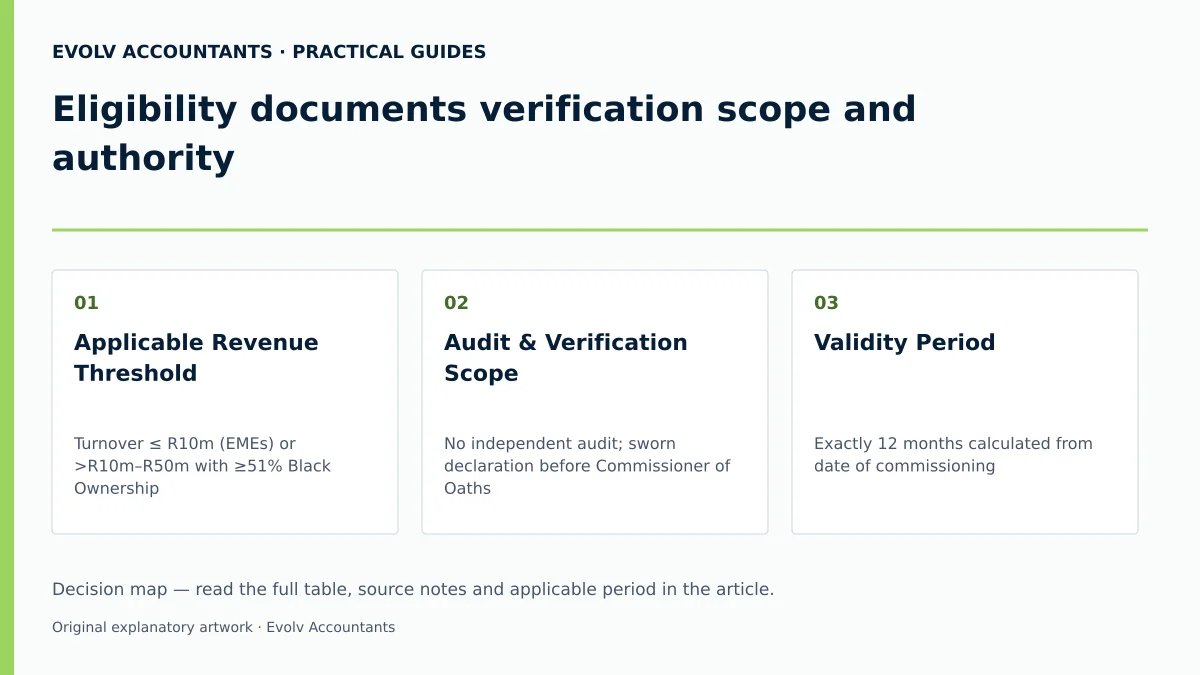
| Applicable Revenue Threshold | Turnover ≤ R10m (EMEs) or >R10m–R50m with ≥51% Black Ownership 4 7 8 9 10 12 | Turnover > R50m (Generic) or >R10m–R50m with <51% Black Ownership 9 11 12 14 15 16 | Statement 000, Government Gazette 36928 7 8 9 15 18 19 | Correct document selection depends on verifying annual total turnover 7 9 30. |
| Audit & Verification Scope | No independent audit; sworn declaration before Commissioner of Oaths 4 12 21 | Full independent audit of all applicable 5 scorecard elements 22 25 26 | B-BBEE Commission Practice Guide 01 of 2022 4 17 22 25 | Option A eliminates verifier fees; Option B requires extensive documentary proof 4 23 26. |
| Validity Period | Exactly 12 months calculated from date of commissioning 31 | Exactly 12 months calculated from date of issuance 33 38 | Practice Guide 01 of 2022, Section B & D 31 33 38 | Suppliers must schedule annual renewals prior to document expiration 30 31 33 38. |
| Priority Element Discounting | Exempt from priority element sub-minimum audits and discounting 4 9 12 | Subject to 40% sub-minimum targets; non-compliance discounts status by 1 level 56 57 69 71 | Statement 000, Para 3.3 & 3.4 56 57 69 71 | Option B entities must actively manage Ownership, Skills and ESD targets 56 57 63 65. |
| Misrepresentation Penalties | Severe criminal liabilities under Section 13O and 13A of B-BBEE Act 74 75 | Severe criminal liabilities under Section 13O and 13A of B-BBEE Act 74 75 | B-BBEE Act 53 of 2003 as amended 17 74 75 | Falsified revenue or ownership data risks corporate fines up to 10% of turnover 75 76. |
When the comparison needs specialist input: authority
Sector code misalignments and specialised sector rules
A measured entity operating in a industry sector where an amended sector code has been gazetted under Section 9 of the Act must be measured exclusively under that sector code 57 77. Generic affidavits cannot be used where sector specific affidavits exist (e.g., AgriBEE, Construction, Defence, Financial Services, Forestry, ICT, Legal, and Transport) 78.
- Construction Sector Code: EMEs with annual turnover of R1.8 million or less for Built Environment Professionals (BEPs) and R3 million or less for Contractors obtain automatic recognition levels 23 28. However, if an EME elects to enhance its B-BBEE level by contributing to skills development, it must achieve the 40% skills sub-minimum and undergo SANAS verification 5 23 28.
- Transport Sector Code: Because the Integrated Transport Sector Code has not been aligned to the amended Generic Codes, Transport EMEs retain the option of obtaining an accounting officer letter or a SANAS verification certificate 1 79.
- Financial Services Sector Code: EMEs must only obtain a sworn affidavit, while 51% and 100% black-owned QSEs have the option to undergo SANAS verification if required 5 79.
Tender thresholds for start-ups and enhanced level elections
Start-up enterprises are measured as EMEs during their first year post-incorporation regardless of expected turnover 80 81 82. However, if a start-up enterprise tenders for a contract or seeks economic activity covered by section 10 exceeding R10 million but below R50 million, it is legally required to submit a SANAS-verified QSE scorecard using annualised data 12 16 28 81. For tenders of R50 million or more, a Generic scorecard is mandatory 12 14 28 83.
An EME or QSE may voluntarily elect to undergo SANAS verification on a higher scorecard if it wishes to maximize points to secure major commercial supply contracts 11 23 45 84.
Complex corporate structures and statutory tax/accounting integration
Complex corporate arrangements involving multi-tiered shareholding, trusts, Broad-Based Ownership Schemes, Employee Share Ownership Programmes (ESOPs), or modified flow-through principles require specialist oversight 85 86 87 88 89 90 91 92. B-BBEE compliance directly intersects with corporate governance, financial statement reporting, Employment Equity submissions and SARS tax compliance. Artificial business splitting or restructuring designed to fraudulently claim EME or QSE status constitutes a statutory offence under the B-BBEE Act 93 94.
Specialist accounting input ensures that turnover calculations match audited financial records and tax filings.
Next steps for B-BBEE supplier evidence
To establish compliant B-BBEE supplier evidence, SMEs should follow this structured action plan:
- Conduct Turnover Verification: Audit signed annual financial statements or management accounts for the recent financial year end to verify total annual revenue 7 9 30.
- Audit Black Ownership Registers: Review CIPC registration documents, share registers, identity copies and trust deeds to confirm exact black ownership, black female ownership and black designated group percentages 24 29.
- Determine Sector Code Alignment: Check whether the business falls under the Generic Codes or a specific gazetted Sector Code (e.g., Construction, ICT, AgriBEE) 57 77 78.
- Select Correct Evidence Mechanism: Download the corresponding gazetted dtic affidavit template for EMEs or black-owned QSEs, apply via CIPC, or appoint a SANAS-accredited verifier 5 6 13 23 25 27.
- Execute Affidavit Correctly: Ensure the deponent is a duly authorised director/owner and that an independent Commissioner of Oaths signs on the exact same date 13 22 29 31.
- Maintain Evidence File: Store supporting ownership, financial, tax and payroll records in an internal compliance registry available for client due diligence reviews 30 95.
Ask Evolv about eligibility documents verification scope and authority. Share the relevant records so the support required can be scoped.
Frequently Asked Questions
Can an EME with revenue below R10 million choose to get a SANAS verification certificate instead of an affidavit?
Yes. Under paragraph 4.4 of Statement 000, an EME is permitted to be measured under the QSE scorecard by a SANAS-accredited agency if it wishes to maximize its scorecard points and achieve a higher B-BBEE recognition level 11 23 45 84.
What is the exact validity period of a B-BBEE sworn affidavit or CIPC certificate?
A B-BBEE sworn affidavit or CIPC certificate is valid for exactly 12 months from the date it is commissioned by a Commissioner of Oaths or generated by the CIPC system 31 33 38.
Can our company's internal HR manager act as the Commissioner of Oaths for our B-BBEE affidavit?
No. Under B-BBEE Commission Practice Guide 01 of 2022 and the Justice of Peace and Commissioners of Oaths Act 16 of 1963, a Commissioner of Oaths cannot be an employee or ex officio officer of the measured entity, as they hold an interest in the enterprise 22 31.
How do we determine whether to use the generic dtic affidavit or a sector-specific affidavit?
If your business operates in an industry with a gazetted Section 9 sector code (such as Construction, Agriculture, ICT, Property, or Financial Services), you are legally required to use that specific sector code affidavit template 57 77 78.
What are the criminal penalties for presenting an invalid or fraudulent B-BBEE affidavit to a client?
Under Section 13O(1)(a) and Section 13A of the B-BBEE Act, misrepresenting B-BBEE status can lead to immediate contract cancellation, corporate fines up to 10% of annual turnover, and imprisonment for up to 10 years for responsible individuals 74 75 76.
Related guides
- Who can use a QSE sworn affidavit
- Who can use an EME sworn affidavit
- Compliance and Regulations: Keeping Your Business on Track
Sources
- https://www.bbbeecommission.co.za/wp-content/uploads/2023/09/Practice-Guide-01-of-2022-Determining-validity-of-a-B-BBEE-CertificateSworn-AffidavitCIPC-Certificate-19-Oct-2022-002.pdf
- https://www.gov.za/sites/default/files/gcis_document/201409/36928gen1019.pdf
- https://www.thedtic.gov.za/wp-content/uploads/BEE-code_gud_practice10102013.pdf
- B-BBEE SWORN AFFIDAVITS – B-BBEE Commission | Department of Trade & Industry