
Who can use an EME sworn affidavit
30 April 2026

An EME under the Generic Codes is an enterprise with annual total revenue of R10 million or less. Use the permitted affidavit or eligible CIPC-certificate route to confirm its status.
Under the Generic Codes, an EME has annual total revenue of R10 million or less and uses the permitted affidavit or eligible CIPC-certificate route to confirm its B-BBEE status.
Sector rules and CIPC’s own application conditions must be checked.
The R10 million EME and R50 million QSE limits described here are the Generic Codes limits. Establish the applicable sector code first: sector-specific eligibility and evidence rules can change the answer. B-BBEE Commission guidance.
Under South African Broad-Based Black Economic Empowerment (B-BBEE) law, small and medium enterprises (SMEs) qualifying as Exempted Micro Enterprises (EMEs) can self-determine their B-BBEE compliance using a gazetted sworn affidavit or a CIPC-issued certificate rather than undergoing formal verification 1 2 3. Eligibility depends strictly on total annual revenue thresholds, verified black ownership percentages, and industry-specific sector code requirements 2 4.
EME turnover ownership and sector tests
Reader Entity Identification and Registration Separation
For South African SMEs—including private companies (Pty Ltd), close corporations (CC), sole proprietorships, partnerships, and trusts—it is vital to separate general corporate registration from B-BBEE status eligibility 5 6. Registration with the Companies and Intellectual Property Commission (CIPC) establishes legal corporate existence, whereas B-BBEE eligibility is determined periodically based on financial revenue, economic interest, and voting rights held by black citizens 5 7 8.
Effective Periods and Legislative Framework
Under the B-BBEE Codes of Good Practice (Notice 1019 of 2013) issued under Section 9(1) of the B-BBEE Act 53 of 2003 as amended by Act 46 of 2013, an EME affidavit remains valid for exactly 12 months from the date it is solemnly signed and commissioned by a Commissioner of Oaths 1 9. In regulator guidance, the B-BBEE Commission Practice Guide 01 of 2022 (effective 1 November 2022, replacing Practice Guide 01 of 2018) confirms that trading with an expired or invalid affidavit violates Section 13O of the B-BBEE Act 10 11.
Evolv Recommendations suggest aligning affidavit commissioning dates with annual tax and financial statement sign-offs to prevent administrative gaps in supplier procurement evidence.
— Practical point from this guide
The qualification tests to check: eme turnover ownership
Test 1: The Generic Annual Total Revenue Test
Under Statement 000, Paragraph 4.1 of the Amended Generic Codes of Good Practice, any enterprise with an annual total revenue of R10 million or less qualifies as an EME 2. Total revenue encompasses gross income derived from all business operations under South African Generally Accepted Accounting Practice (SA GAAP), evidenced by audited financial statements, reviewed financial statements, or annual management accounts 12 13.
Test 2: The Black Ownership and Status Level Test
An EME’s B-BBEE status level and procurement recognition level are directly dictated by its measured level of black ownership 2 14:
- 100% Black Owned EME: Qualifies for elevation to Level 1 Contributor status with a 135% B-BBEE procurement recognition level 14.
- At least 51% Black Owned EME: Qualifies for elevation to Level 2 Contributor status with a 125% B-BBEE procurement recognition level 3 14.
- Less than 51% Black Owned EME: Qualifies for automatic Level 4 Contributor status with a 100% B-BBEE procurement recognition level 2.
Test 3: The Sector Code Alignment Test
Under Paragraph 3.2.3 of Statement 000, an enterprise operating in a sector governed by a gazetted Sector Code issued under Section 9 of the Act must be measured exclusively under that specific Sector Code 4 15. Certain Sector Codes establish different EME revenue thresholds or specific verification requirements:
- Construction Sector Code: Establishes automatic EME recognition thresholds of R1.8 million or less for Built Environment Professionals (BEPs) and R3 million or less for Contractors 16. Construction EMEs exceeding these specific thresholds or seeking level enhancement must comply with skills development sub-minimums and undergo SANAS verification 16.
- Integrated Transport Sector Code: Unaligned transport EMEs may choose between an accounting officer letter or a SANAS-accredited verification certificate 17.
- Financial Services Sector Code: Mandates that EMEs obtain sworn affidavits rather than verification certificates 18.
- Other Gazetted Sector Codes: Specific official affidavit templates exist for AgriBEE, Defence, Forestry, ICT, and Legal sectors 19.
Test 4: Start-Up Enterprise and Large Contract Tendering Rules
Under Paragraph 6 of Statement 000, a Start-up Enterprise (formed less than 1 year prior) is measured as an EME during its first year regardless of expected turnover 20 21. However, under Section 10 contract tendering rules, if a Start-up Enterprise tenders for a contract or seeks economic activity covered by section 10 valued above R10 million but below R50 million, it must submit a QSE scorecard; for tenders of R50 million or higher, it must be measured under the Generic scorecard 22 23.
Statutory Definitions and Exclusions
Under Schedule 1 of the Codes, "Black People" is defined generically as African, Coloured, or Indian natural persons who are South African citizens by birth or descent, or who became naturalised prior to 27 April 1994 (or would have been entitled to naturalisation prior to that date) 7. Statutory law strictly prohibits artificial business splitting; initiatives that divide an entity to manipulate turnover below the R10 million threshold constitute a criminal offence under the B-BBEE Act 24 25.
Evidence behind the eligibility decision: sector tests
Required Evidence Records and Responsible Parties
To substantiate EME eligibility, specific documentation must be compiled by designated enterprise officers and external professionals:
- Financial Revenue Record: Recent financial year-end statements or management accounts approved by the Accounting Officer or Director 12.
- Ownership Record: Share register, CIPC disclosure certificate, or trust deed verified by the Director or Managing Member 5 12.
- Sector Affidavit Record: Gazetted dtic or B-BBEE Commission sworn affidavit template signed by the Deponent and commissioned by an independent Commissioner of Oaths 26 27.
The Eleven Validity Requirements under Regulator Guidance
Practice Guide 01 of 2022 sets out eleven mandatory checks to establish the legal validity of an EME sworn affidavit 1 5 12 27 28 29:
- Deponent Identity: Full names and national identity number of the deponent as per ID document 28.
- Deponent Capacity: Clear designation of deponent as Director, Owner, or Member authorised to bind the entity 5 28.
- Enterprise Details: Exact corporate entity name and registration number matching CIPC records, alongside full physical address 5.
- Ownership Breakdown: Stated percentages for total black ownership, black female ownership, and black designated groups 5 12.
- Revenue Basis: Total annual revenue indicated and confirmed as based on audited financials, reviewed financials, or management accounts 12.
- Financial Year-End: Exact financial year-end (day/month/year) for the recent financial year under review 12.
- Status Level Selection: Correct selection of Level 1, Level 2, or Level 4 B-BBEE status based on black ownership percentage 27.
- Empowering Supplier Claim: Indication of Empowering Supplier status (EMEs automatically qualify as Empowering Suppliers) 27 30.
- Signature Date Alignment: Identical date of signature for both the deponent and the Commissioner of Oaths 27.
- Commissioner Independence: The Commissioner of Oaths must be completely independent and cannot be an employee, director, or ex officio officer of the enterprise (pursuant to the Justices of the Peace and Commissioners of Oaths Act 16 of 1963) 29.
- Validity Period: Exactly 12 months validity calculated from the date of commissioning 1.
Alternatively, under Government Gazette 38765, CIPC-issued B-BBEE certificates for EMEs with annual turnover under R10 million carry identical legal standing to sworn affidavits, provided they reflect the dtic and CIPC logos, barcode, issue/expiry dates, and ownership percentages 1 31 32.
A qualifying case and an excluded case: eme turnover ownership
Hypothetical Case 1: Qualifying EME (Apex Logistics Pty Ltd)
- Fact Pattern: Apex Logistics (Pty) Ltd is, despite its hypothetical name, a furniture retailer assumed to fall under the Generic Codes after checking sector scope. For its financial year ended 28 February 2026, its gross annual total revenue was R6.5 million (illustrative value based on audited accounts) 2 12. The shareholding is held 55% by an African female citizen by birth and 45% by a non-black director 7 12.
- Analysis: Revenue is below the R10 million generic threshold 2. Black female ownership of 55% exceeds the 51% black ownership threshold 14 33.
- Result: Qualifies as an EME Level 2 Contributor (125% procurement recognition level) 14. The Director signs a gazetted dtic EME affidavit, commissioned by an independent police officer 26 29.
Hypothetical Case 2: Excluded Entity (Summit Engineering CC)
- Fact Pattern: Summit Engineering CC is a Built Environment Professional (BEP) firm operating under the Construction Sector Code. For its financial year ended 31 March 2026, its annual turnover was R2.5 million (illustrative value) 12 16. It holds 100% black ownership but relied on a standard generic EME affidavit signed by an in-house commissioner of oaths 26 29.
- Analysis: The Commission guide’s R1.8 million BEP figure concerns automatic recognition without verification; it is not, by itself, the complete EME/QSE classification threshold. At R2.5 million the business cannot infer its category or evidence route from that figure alone. It must apply the full Construction Sector Code. Furthermore, using an in-house employee as a Commissioner of Oaths invalidates the affidavit under Practice Guide 01 of 2022 29.
- Result: The generic affidavit and conflicted commissioning cannot establish valid supplier evidence. Confirm the correct construction category and verification route before issuing replacement evidence; do not assume a QSE scorecard merely because turnover exceeds R1.8 million.
What changes the answer: sector tests
An EME’s right to rely on a sworn affidavit can change during its financial year due to operational or structural changes:
- Turnover Growth: Under the Generic Codes, revenue above R10 million requires reassessing QSE or Generic status. Sector codes have their own classification rules; the R1.8 million BEP automatic-recognition limit must not be substituted for the full Construction Sector Code’s entity-category test.
- Ownership Changes: Dilution or sale of black shareholding directly alters B-BBEE recognition (e.g., dropping from 100% black ownership to 50% reduces status from Level 1 to Level 4) 2 14.
- Sector Activity Shift: Shifting core business operations into a sector with a mandatory gazetted Sector Code (such as Financial Services or AgriBEE) invalidates generic affidavits and mandates sector-specific affidavit forms 15 19.
- Expiry of 12-Month Period: Operating with an affidavit older than 12 months invalidates supplier procurement spend recognition and exposes the firm to misrepresentation investigations under Section 13O 1 11.
Next steps for B-BBEE supplier evidence
Decision Checklist for SMEs
- [ ] Verify Annual Revenue: Confirm total revenue for the recent financial year is R10 million or less (or within applicable sector code thresholds) via financial statements 2 12.
- [ ] Calculate Black Ownership: Verify exercisable voting rights and economic interest held by black natural persons as defined by law 7 12.
- [ ] Select Correct Template: Download the latest gazetted dtic template or applicable Sector Code affidavit template from official channels 19 26.
- [ ] Complete All 11 Validity Elements: Ensure full enterprise details, financial year-end, revenue basis, and ownership percentages are recorded 5 12 27 28.
- [ ] Commission Independently: Execute the affidavit before an independent Commissioner of Oaths on the same calendar date 27 29.
Eligibility Decision Table
| Test | Facts to obtain | Evidence | Applicable source | Result or unresolved question |
|---|---|---|---|---|
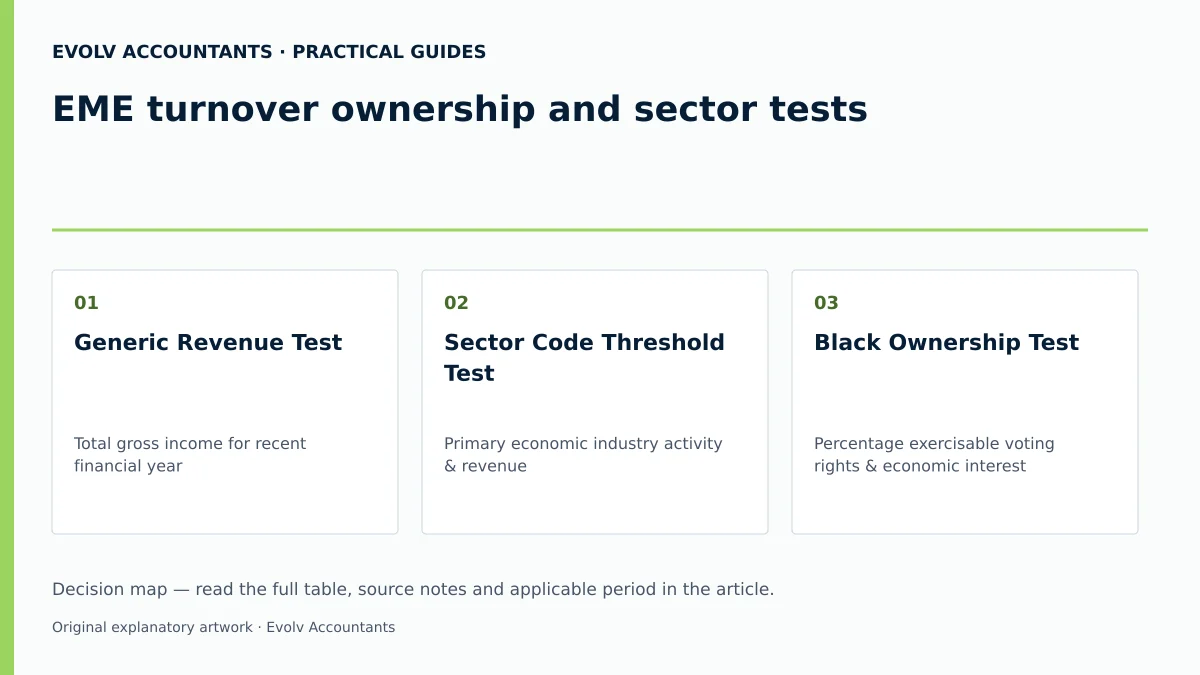
| Generic Revenue Test | Total gross income for recent financial year | Annual financial statements or signed management accounts | Statement 000, Para 4.1 2 12 | Eligible as EME if Total Revenue ≤ R10,000,000 |
| Sector Code Threshold Test | Primary economic industry activity & revenue | Financial statements & CIPC industry classification | Practice Guide 01 of 2022 15 16 | Apply the full sector category and evidence rules; R1.8m is the cited BEP automatic-recognition limit |
| Black Ownership Test | Percentage exercisable voting rights & economic interest | Share register, MOI, or CIPC disclosure certificate | Statement 000, Para 4.3 12 14 | 100% = Level 1; ≥51% = Level 2; <51% = Level 4 |
| Affidavit Execution Test | Independence & date of Commissioner of Oaths | Commissioned Sworn Affidavit | Practice Guide 01 of 2022, Para 17 27 29 | Valid for 12 months if commissioned independently |
| Tender / Contract Test | Value of public or state contract being tendered | Tender documentation & procurement specifications | Statement 000, Para 6.4 22 23 | For start-ups, apply paragraph 6.4 and the applicable tender/sector rules |
Frequently Asked Questions
Q1: Can an EME choose to be verified by a SANAS agency instead of using an affidavit?
Yes. Under Statement 000, Paragraph 4.4, an EME is permitted to undergo SANAS verification using the QSE scorecard if it wishes to maximize its points and achieve a higher B-BBEE recognition level 3 36. However, Evolv Recommendations advise evaluating the cost-benefit, as affidavits provide full statutory recognition at lower expense 10.
Q2: Is a CIPC-issued B-BBEE certificate legally equivalent to a sworn affidavit?
Yes. Under Gazette 38765 and B-BBEE Commission Practice Guide 01 of 2022, a B-BBEE certificate issued by CIPC for an EME with turnover under R10 million has the exact same legal status as a sworn affidavit 1 31.
Q3: Can our company accountant or employee act as the Commissioner of Oaths?
No. Under regulator guidance in Practice Guide 01 of 2022, a Commissioner of Oaths cannot be an employee, director, or ex officio officer of the measured entity, as commissioning an affidavit in which one has an interest invalidates the document 29.
Q4: What are the legal penalties for submitting a false EME affidavit?
Misrepresenting B-BBEE status is a criminal offence under Section 13O(1)(a) of the B-BBEE Act 11 37. Conviction can lead to corporate fines up to 10% of annual turnover, contract cancellation under Section 13A, and up to 10 years imprisonment for involved individuals 37 38.
Q5: Which template should be used if our SME operates in the Construction or AgriBEE sector?
Entities operating in sectors with gazetted Sector Codes must use the specific affidavit templates approved for that sector (e.g., Amended AgriBEE or Construction Sector EME templates) rather than the generic dtic template 15 19. Ask Evolv about eME turnover ownership and sector tests. Share the relevant records so the support required can be scoped. Ask Evolv about eME turnover ownership and sector tests. Share the relevant records so the support required can be scoped.
Related guides
- B-BBEE affidavits versus verification certificates
- Who can use a QSE sworn affidavit
- Compliance and Regulations: Keeping Your Business on Track
Sources
- https://www.bbbeecommission.co.za/wp-content/uploads/2023/09/Practice-Guide-01-of-2022-Determining-validity-of-a-B-BBEE-CertificateSworn-AffidavitCIPC-Certificate-19-Oct-2022-002.pdf
- https://www.gov.za/sites/default/files/gcis_document/201409/36928gen1019.pdf
- https://www.thedtic.gov.za/wp-content/uploads/BEE-code_gud_practice10102013.pdf
- B-BBEE SWORN AFFIDAVITS – B-BBEE Commission | Department of Trade & Industry