
COIDA obligations when using subcontractors
19 October 2026

Using subcontractors requires checking their Compensation Fund registration, assessment standing and Letter of Good Standing, then applying the actual section 89 conditions.
When using subcontractors, check their employer registration, assessment standing and current Letter of Good Standing, then apply the actual section 89 conditions to any default.
Under amended section 89(1), a subcontractor employing people on the contracted work must register and pay the necessary assessments. If it fails to register or pay an assessment, those employees are deemed to be the contractor’s employees and the contractor must pay assessments in respect of them. Section 89(2)–(3) provides recovery and set-off for qualifying amounts actually paid.
Apply the full section 89(5) accident-specific location and control test where relevant; a missing or expired LOGS alone does not establish liability for every injury claim. Amended COIDA section 89; commencement dates.
Principal contractor responsibilities and documentary checks
For South African SMEs acting as principal contractors, record the assessment period required by the applicable ROE instructions and obtain current subcontractor evidence before work starts. Do not confuse an employer’s earnings period with the Fund’s own financial year.
— Practical point from this guide
The official2026 notice opened the 2025 ROE season from 1 April to 30 June 2026;31 March is not a universal operational filing deadline. 2026 ROE season notice; COIDA commencement dates.
Completing principal contractor responsibilities requires a systematic documentary audit prior to allowing any subcontractor onto a worksite. To satisfy legal standards, a principal contractor must obtain a valid, authentic Letter of Good Standing (LoGS) issued directly by the Compensation Commissioner or an authorised mutual association licensee 1 15.
Where a subcontractor defaults on registration or payment, complete task execution requires calculating the deemed payroll, remitting the required assessment directly to the Compensation Fund, and lawfully exercising statutory set-off rights against contract debts owed to the defaulting subcontractor 4 5 16 17.
Prepare the information and authority: principal contractor responsibilities
Before executing documentary checks, principal contractors must assemble specific administrative inputs, verify operational authorities, and understand statutory definitions under South African law.
Primary documentary inputs and inputs required
To establish an audit-ready compliance framework, principal contractors must collect and evaluate the following records:
- Subcontractor agreement and written mandate: A formal contract explicitly stipulating that the subcontractor must maintain active COIDA registration and provide updated compliance evidence 1 2 3.
- Compensation Fund Contract Account Number: The subcontractor's unique reference number (typically a 99-series number issued upon registration) 18 19.
- Letter of Good Standing (LoGS): Official certification confirming that the subcontractor is fully registered and up to date with all assessment invoices and filings 1 20 21.
- Payroll and earnings registers: In the event of a subcontractor default, detailed wage records showing headcount, overtime, and remuneration for workers deployed on the contract 7 22 23.
- Proof of direct assessment payments: Official Compensation Fund deposit receipts and remittance advices required to validate set-off accounting 16 17 21.
Statutory definitions and distinctions
South African legislation establishes clear distinctions between legal mandates, regulator guidance, and professional accounting practices:
- Law: Section 89 governs the assessment consequences of a subcontractor’s failure to register or pay assessments in respect of employees on the contracted work. Do not infer automatic liability for every claim merely from an expired certificate. Check the employee and contract facts under the applicable provisions. Amended section 89.
Complete the task step by step: documentary checks
Principal contractors should execute the following five-step process to verify subcontractor compliance and prevent inheriting secondary statutory liabilities.
- Request pre-engagement compliance evidence: Prior to contract signing or site mobilisation, require the subcontractor to submit their Compensation Fund registration particulars and an unexpired Letter of Good Standing 1 18.
- Audit the Letter of Good Standing: Inspect the document to verify that the subcontractor's registered trade name matches the contracting entity 11 15, the coverage period spans the active contract dates 9 11, and the certificate reflects full payment of assessment fees 1 21.
- Confirm site and operational jurisdiction: Verify whether the contracted work occurs on or about premises under the principal contractor's control or management 16 29. Check the full section 89(5) accident-location exception; off-site work does not itself cancel registration or assessment obligations 16 29.
- Monitor ongoing annual compliance: Establish calendar triggers to re-verify compliance at the relevant assessment-period end and each certificate’s expiry date 9 10 and following the annual ROE deadline published for that season (30 June for the 2025 ROE season opened in 2026) 12 13. Ensure the subcontractor submits updated Letters of Good Standing as old certificates expire 1.
- Execute statutory deeming and set-off upon default: If a subcontractor fails to maintain registration or pay assessments, obtain the subcontractor's worker payroll details 4 5 7. Calculate the required assessment according to the applicable industry risk tariff 30, pay the assessment directly to the Compensation Fund 4 5, and exercise statutory set-off against contract funds owed to the subcontractor 16 17.
Check the result against the evidence: principal contractor responsibilities
Principal contractors must not assume that contract clauses or verbal assurances equal statutory compliance. Independent verification against concrete primary evidence is legally required.
The primary benchmark of successful completion is an authentic, unexpired Letter of Good Standing on file for every active subcontractor 1. Where a subcontractor has defaulted and the principal contractor has assumed liability, completion evidence includes official Compensation Fund payment receipts displaying the correct Contract Account Number 18 21.
Under Act 130 of 1993, employers must retain all employee registers, wage records, and financial reproductions for a minimum of 5 years after the last entry date 7 31 (extended to 5 years under section 81 of the principal Act, as substituted by section 50 of Amendment Act 10 of 2022) 32 33.
Finally, set-off ledger entries reflecting exact statutory deductions made against subcontractor contract invoices must be fully reconciled and signed off by the accounting department 16 17. Amended COIDA section 81; 2026 commencement dates.
Handle exceptions and unresolved cases: documentary checks
When managing subcontractor compliance, SME principal contractors frequently encounter legal edge cases, missing documentation, and industry-specific statutory exceptions.
Subcontractor default and statutory set-off rights
If a subcontractor fails to register with the Compensation Commissioner or defaults on assessment payments, Section 89(1)(b) automatically deems the subcontractor's employees to be the employees of the principal contractor 4 5. The principal contractor must settle the outstanding assessments and any compensation claims arising from workplace accidents 1 4 5. However, Section 89(2) explicitly grants the principal contractor the legal right to recover any assessment or compensation paid from the subcontractor 4 5.
Section 89(3) authorises the principal contractor to set off amounts paid to the Compensation Fund against any contractual debt owed to the subcontractor 16 17. Furthermore, Section 89(4) allows the Compensation Commissioner to recover compensation directly from either the subcontractor or principal contractor, or recover any shortfall from the other party 16 17.
Off-premises accident exception
Section89(5) excludes liability in respect of an accident at a place outside the premises where the contractor undertook the work and otherwise outside the contractor’s control or management. Apply the wording to the actual accident and premises facts; it is not a blanket exemption from registration or assessment duties for every off-site contract. Section89(5).
Mutual associations and licensed insurers
Certain specialised industry sub-classes are legally permitted to register with licensed mutual associations rather than the centralised Compensation Fund 15 34. Specifically, employers in the Mining Industry (Class IV) and the Iron, Steel, Metal and related industries (Class XIII) may or must register with Rand Mutual Assurance (RMA) 15. Employers in the Building and Construction industry (Class V) may optionally register with Federated Employers Mutual Assurance (FEM) 15.
Letters of Good Standing issued by FEM or RMA serve as valid statutory compliance evidence equivalent to Compensation Fund certificates 1 15.
Legislative amendment status and evidence boundaries
The official Act page records general commencement on 23 January 2026, with specified provisions on 1 February or 1 April 2026. It lists section 1(g), which changes the earnings definition, and the specified section 1(h) employee subparagraphs as still awaiting commencement.
Apply each provision’s actual commencement and distinguish estimated-assessment penalties under section 83 from non-payment penalties under section 87. Official commencement schedule; Amending Act.
Next steps for COIDA and compensation
To streamline compliance governance, SME principal contractors can implement the structured task matrix and sequential checklist provided below.
Task and completion checklist
| Recommended control | Evidence | Completion check | Follow-up |
|---|---|---|---|
| Before engagement | Subcontractor identity, CF or applicable mutual-association registration and current LOGS | Entity, covered work and dates checked | Treat any pause in site access as a contract or internal-control decision, not a universal statutory rule |
| Confirm issuer | Certificate and actual registration with CF, FEM or RMA as applicable | Check through the issuer’s official verification facility or confirmation route | An industry label alone does not prove which authority holds the account |
| Establish liability facts | Contract, subcontractor employees, default and any accident-location/control facts | Apply the relevant section 89 conditions | An expired letter alone does not prove every element of liability |
| Review assessment standing | Actual return, notice and payment evidence where lawfully available | Check the applicable notice and any outstanding query | Ask the subcontractor to resolve its own account issues with the issuer |
| Consider recovery or set-off | Qualifying statutory amount actually paid and supporting receipt | Apply section 89(2)–(3) to the amount and debt concerned | Obtain advice if the basis or amount is disputed |
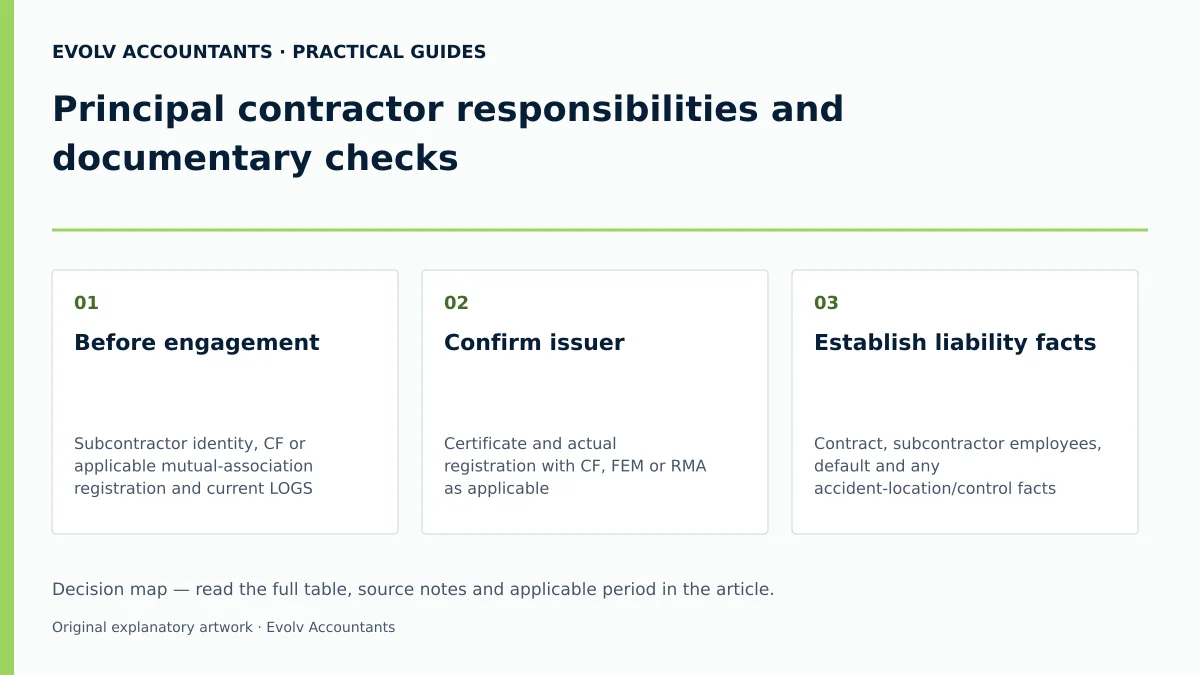
Official COIDA provisions; Official guidance; Official guidance.
Practical compliance checklist
- Embed COIDA compliance clauses into all subcontractor agreements, requiring continuous registration and valid Letters of Good Standing prior to invoice payment 1 2 3.
- Collect and verify Letters of Good Standing from the Compensation Fund, FEM, or RMA before allowing sub-contracted personnel onto any job site 1 15.
- Establish a digital compliance register tracking the expiration dates of all subcontractor Letters of Good Standing 1.
- Audit subcontractor payroll records immediately if a default notice or assessment shortfall is identified 4 5 7.
- Remit outstanding assessments directly to the Compensation Fund and apply formal ledger set-off against subcontractor invoices under Section 89(3) 4 5 16 17.
- Retain all subcontractor compliance files, wage registers, and proof of payment receipts for at least five years after the last entry under the commenced amended section 81 7 31 32 33. Amended COIDA section 81; 2026 commencement dates.
Reproducible hypothetical calculation
The following illustrative calculation demonstrates how a principal contractor calculates and sets off statutory assessment liabilities when a subcontractor defaults.
Illustrative values:
- Subcontractor A contract value: R250,000.
- Subcontractor A actual payroll for site workers: R100,000.
- Assigned Compensation Fund assessment tariff rate (Class risk rate): 1.5% 30.
- Illustrative penalty assumption: the Fund levies10% on the outstanding R1,500 assessment under the applicable section 87(1) basis; other statutory bases may differ 39 40 41 42.
Calculation:
- Base Assessment Amount = Subcontractor Deemed Payroll (R100,000) × Tariff Rate (1.5%) = R1,500 30.
- Statutory Default Penalty = Base Assessment (R1,500) × Penalty Rate (10%) = R150 39 40 41.
- Total Assessment Liability Paid by Principal Contractor = R1,500 + R150 = R1,650 4 5.
- Statutory Set-off under Section 89(3) = Reduce final contract payment to Subcontractor A from R250,000 to R248,350 (R250,000 - R1,650) 16 17.
Frequently Asked Questions
Are principal contractors automatically liable for subcontractor employee injuries?
Yes, under Section 89 of COIDA, if a subcontractor fails to register with the Compensation Fund or defaults on assessment payments, their workers are deemed to be employees of the principal contractor, transferring direct compensation liability to the principal contractor 1 4 5.
What is the primary document required to verify a subcontractor's COIDA compliance?
The primary evidence is an official, unexpired Letter of Good Standing (LoGS) issued by the Compensation Commissioner or a licensed mutual association (such as FEM or RMA), proving registration and up-to-date assessment payments 1 15.
Can a principal contractor deduct COIDA assessment payments from a subcontractor's invoice?
Yes. Section 89(3) explicitly authorises a principal contractor who has paid COIDA assessments on behalf of a defaulting subcontractor to set off that amount against any contractual debt owed to the subcontractor 16 17.
How does COIDA registration differ for subcontractors in construction or mining?
Subcontractors in Building and Construction (Class V) may optionally register with Federated Employers Mutual Assurance (FEM) 15, while those in Mining (Class IV) or Iron and Steel (Class XIII) register with Rand Mutual Assurance (RMA) 15. Both issue valid Letters of Good Standing 1 15.
How long must COIDA records and earnings registers be retained by employers?
Section81(2), as amended by section 50 of Act 10 of 2022 and commenced in 2026, requires retention for at least five years after the last entry in the register or record. Amended COIDA; Commencement dates. Ask Evolv about principal contractor responsibilities and documentary checks. Share the relevant records so the support required can be scoped.
Related guides
- Checking a contractor letter of good standing
- When an employer must register with the Compensation Fund
- Compliance and Regulations: Keeping Your Business on Track
Sources
- https://www.gov.za/sites/default/files/gcis_document/202304/48431-17-4-compensationoccupinjuriesdiseasesamendact10of2022a.pdf
- Compensation for Occupational Injuries and Diseases Amendment Act 10 of 2022 (English / Afrikaans) | South African Government
- https://www.labour.gov.za/DocumentCenter/Publications/Compensation%20for%20Occupational%20Injuries%20and%20Diseases/Notice%20of%20Temporary%20ROE%20Online%20Systems%20Shut-Down%20from%2019%20March%20to%2031%20March%202026.pdf
- Compensation Fund: obligations of the employer
- Compensation for Occupational Injuries and Diseases Act 130 of 1993 — original Act
- https://www.labour.gov.za/DocumentCenter/Publications/Compensation%20for%20Occupational%20Injuries%20and%20Diseases/Return%20of%20Earnings%20User%20Manual%2C%20August%202019.pdf
- How To Submit Earnings Statements to the Compensation Fund