
When an employer must register with the Compensation Fund
26 July 2026

An employer carrying on business in South Africa requires mandatory registration with the Compensation Commissioner to ensure legal compliance under COIDA.
Rules reviewed: 20 October 2026. Read the linked primary sources for the applicable period, commencement dates and conditions.
An employer must register with the Compensation Fund rather than wait for an injury claim. The Department’s employer guidance calls for registration within seven days of appointing employees. Follow that earlier administrative instruction and submit promptly; do not rely on the one-month wording in the original section 80 as a reason to delay. Compensation Fund registration and employer guidance; distinguish dated administrative material
Check whether an employer falls within the specific statutory exemptions, including the relevant government departments and municipalities holding exemption certificates; a small headcount or turnover is not a general SME exemption. Evolv Accountants assists SMEs with registration, payroll alignment and compliance administration. Compensation Fund registration and employer guidance; distinguish dated administrative material
Employer coverage and registration obligation
The statutory framework governs every employer operating within South Africa 2. For SME business owners, directors, and trustees, it is critical to distinguish between statutory registration—the formal administrative enrolment of the business with the Compensation Commissioner—and employee eligibility for compensation benefits 2 7. An entity becomes legally obligated to register as soon as it employs its first employee, regardless of whether any workplace accident or occupational disease claim has occurred 2 3.
Registration covers the employer's business across its operating locations 2. If an employer carries on business in more than one location or conducts distinct classes of business, separate particulars or returns may be required by the Compensation Commissioner 2 8.
The applicable assessment period for COIDA compliance is the financial year running from 1 March of the preceding year up to and including the last day of February of the following year 8 9. All registered employers must account for earnings paid during this specific annual window 8 9.
The qualification tests to check: employer coverage
Determining whether a business must register with the Compensation Fund involves applying four independent legal tests 2 5 7. SME management must evaluate each test individually rather than relying on informal headcount thresholds or turnover metrics 3.
- Business Activity Test: Does the entity or person carry on a business, trade, or operational activity within the Republic of South Africa (or on/above the continental shelf) 2 10?
- Employment Relationship Test: Has the entity entered into a contract of service, apprenticeship, or learnership with one or more individuals, whether express or implied, oral or written 7? Under COIDA, the definition of an "employee" includes:
- Full-time and part-time permanent staff paid by time or work done 7.
- Casual employees hired for the purpose of the employer's business 7.
- Executive directors or members of a body corporate, provided they act within the scope of their employment under a service contract 7.
- Workers provided by temporary employment services or labour brokers 7 11.
- Employer exemption test: Verify the particular statutory exemption or municipal certificate. Do not infer an exemption merely from public-sector links or a small payroll. Compensation Fund registration and employer guidance; distinguish dated administrative material
- Worker Exclusion Test: Does the worker fall into a statutory excluded category? Under the principal Act (Act 130 of 1993), excluded persons comprise:
- Members of the South African National Defence Force on active service 7.
- Members of the South African Police Service engaged in national defence service 7.
- Independent contractors who contract for work and engage other persons to perform the work 7.
Most provisions of Amendment Act 10 of 2022 commenced on 23 January 2026; sections 3–6 followed on 1 February, and the specified deferred provisions on 1 April. Proclamation 306 expressly leaves section 1(g), the new earnings definition, uncommenced, together with section 1(h) only so far as it concerns subparagraphs (i)–(iii) of the employee definition. Read the principal Act with the provisions actually in force. Proclamation 306 of 2026: actual commencement and exceptions Domestic workers are covered following the Mahlangu Constitutional Court ruling; the Department confirms immediate and retrospective effect to 27 April 1994. The original private-household exclusion must not be applied. Department of Employment and Labour: domestic-worker coverage after Mahlangu
Evidence behind the eligibility decision: registration obligation
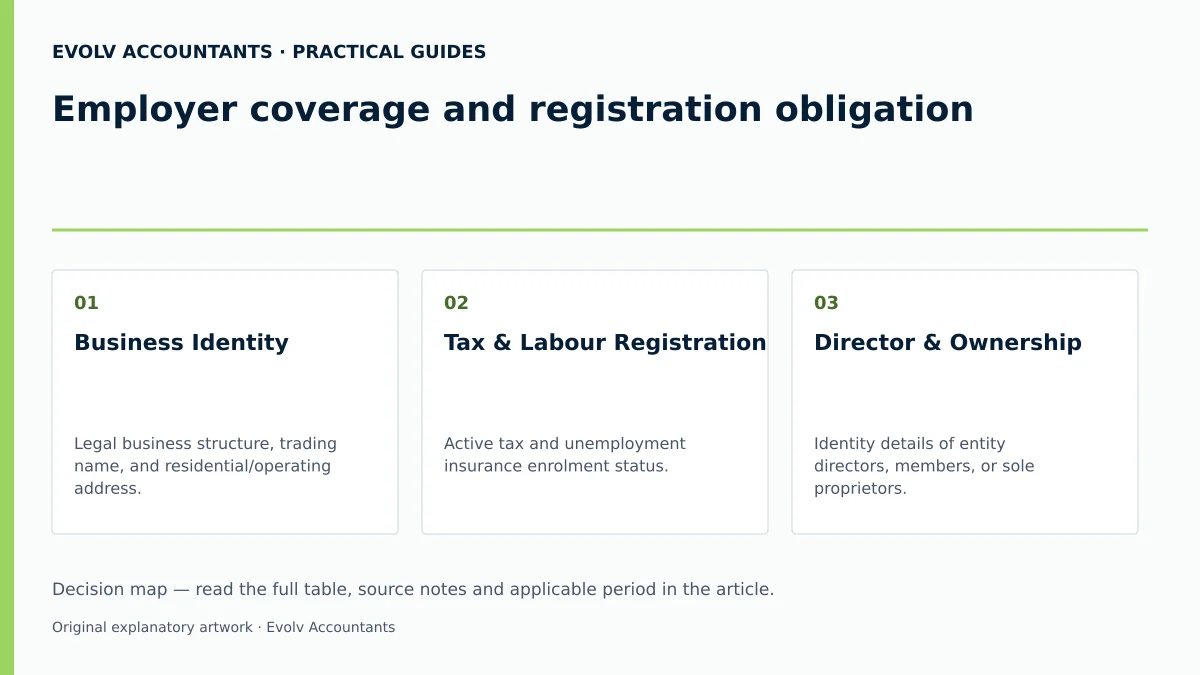
To verify eligibility and complete registration, employers must assemble specific primary document records 14. The table below outlines the evidentiary link required for each qualification test, the source passage, and the responsible officer 2 14 15.
— Practical point from this guide
| Test | Facts to obtain | Evidence record required | Applicable source reference | Responsible person / Role |
|---|---|---|---|---|
| Business Identity | Legal business structure, trading name, and residential/operating address. | CIPC registration certificate, NPO certificate, or Trust deed; Proof of business address 14. | Department Guidance & COIDA Section 80 2 14 | Company Director / Public Officer / Owner 14 |
| Tax & Labour Registration | Active tax and unemployment insurance enrolment status. | SARS/UIF Proof of Registration 14. | Department Guidance 14 | Financial Controller / Evolv Compliance Lead 14 |
| Director & Ownership | Identity details of entity directors, members, or sole proprietors. | Certified ID copies of owners, directors, or trustees 14. | Department Guidance 14 | Company Director / Owner 14 |
| Payroll & Remuneration | Total earnings paid to employees up to the statutory ceiling during assessment period. | Detailed payroll records, SARS EMP501, Return of Earnings (WAS.8) form 9 15 16. | COIDA Section 82 & Department User Manual 4 9 16 | Payroll Administrator / Evolv Advisor 15 16 |
| Sub-contractor Coverage | COIDA registration status of third-party contractors utilized by the business. | Valid Letter of Good Standing (LOGS) from each sub-contractor 17. | COIDA Section 89 & Department Guidance 17 18 | Procurement Manager / Mandator Lead 17 |
A qualifying case and an excluded case: employer coverage
To illustrate how coverage tests apply in practice, consider two hypothetical cases:
Case A: Qualifying Private Sector SME (Included)
"Apex Precision Engineering (Pty) Ltd" is a private manufacturing company operating in Gauteng. The company employs four full-time machine operators, one casual cleaner hired for workshop maintenance, and one executive director who receives a monthly salary under an employment contract.
- Test Evaluation: Apex carries on business in South Africa 2. The machine operators, casual cleaner, and executive director all meet the statutory definition of employees under COIDA Section 1 7. Apex is not a government department or exempted municipality 5.
- Result: The SME must register. The Department’s published registration guidance calls for doing so within seven days of appointing an employee. Compensation Fund registration and employer guidance; distinguish dated administrative material
Case B: Provincial Government Department (Excluded)
The "Provincial Department of Public Works" employs administrative staff and maintenance crews.
- Test Evaluation: While employing staff under service contracts 7, the department is a Provincial Government department 5 6.
- Result: The department is explicitly exempt from paying assessments to the Compensation Fund under Section 84(1)(a)(i) of COIDA 5 6.
What changes the answer: registration obligation
An employer’s COIDA compliance profile is not static. Specific operational changes trigger mandatory legal reassessments and administrative updates:
- Changes in Registered Particulars: An employer must notify the Compensation Commissioner within seven business days of any change in registered details, such as company name, physical or postal address, or change of directors 19 20.
- Change in Nature of Business: If an SME expands or alters its primary business activity (e.g. shifting from consulting to high-risk construction), it must apply for a change of business class using Form CF 1B 5. The revised classification affects the applicable assessment tariff 5 8.
- Cessation, Liquidation, or Sequestration: When a business ceases operations, closes, or enters liquidation, it is strictly prohibited from submitting Return of Earnings statements online 16. Instead, the employer must submit a formal manual notification (Form CF 1C), accompanied by a sworn affidavit, detailed payroll, SARS EMP501 returns, and final annual financial statements 5 16.
- Transfer to Mutual Associations: Employers operating in specific industrial sectors may or must register with licensed Mutual Associations rather than the main Compensation Fund 19. For example, building and construction employers (Class V) may optionally transfer to Federated Employers Mutual Assurance (FEM), while iron, steel, and metal industries (Class XIII) are subject to compulsory transfer to Rand Mutual Assurance (RMA) 19.
Next steps for COIDA and compensation
Evolv Accountants recommends that SME management execute the following sequential decision checklist to ensure complete COIDA compliance:
- Verify Legal Entity Status: Gather CIPC registration documents, director ID copies, and proof of physical business address 14.
- Audit Payroll & Employee Roster: Identify all active workers, including casual employees, temporary staff, and executive directors 7.
- Register promptly: Use the official online route or the Department’s registration channel and complete the required pack. Follow the Department’s instruction to register within seven days of appointing employees. Compensation Fund registration and employer guidance; distinguish dated administrative material
- Obtain Contract Account Number: Receive the official 99-series Contract Account Number issued by the Compensation Fund 14.
- Retain statutory records: Section 81(2), as replaced by section 50 of Amendment Act 10 of 2022 and in force from 23 January 2026, requires earnings and employee records to be kept for at least five years after the last entry. The section 81(3) non-compliance penalty commenced on 1 April 2026. COIDA Amendment Act 10 of 2022: enacted provisions; Proclamation 306 of 2026: actual commencement and exceptions
- Submit the annual return: Declare the completed assessment year’s actual earnings and the required provisional figures. Use the published notice for the relevant return year, alongside section 82. Its annual statutory baseline is 31 March, but that is not a substitute for the Fund’s actual submission window or later notices. The Department’s 21 September 2026 statement identifies Gazette 55347 and the requirement to submit outstanding 2025 returns before 31 October 2026. This dated notice does not establish the deadline for a later return year. Department of Employment and Labour, 21 September 2026: outstanding 2025 returns and Gazette 55347
- Verify Contractor Compliance: Request and verify a Letter of Good Standing from every third-party contractor before allowing work on site to prevent secondary assessment liability 17 18.
Contact Path and Registration Submission
Employers can submit registration applications and earnings returns through official Department channels:
- Online Portal: Register via cfonline.labour.gov.za 3 14.
- Email Submission: Forward registration documents to RegistrationCF@labour.gov.za 14.
- Hand Delivery: Deliver forms to Compensation Fund offices in Pretoria or provincial Labour Centres 23.
- Postal Address: Send completed forms to Compensation Fund, PO Box 955, Pretoria, 0001 23 24.
- Telephone Enquiries: Contact the Department Call Centre on 0860 105 350 or email cf-info@labour.gov.za 24.
Illustrative payroll calculation
To demonstrate how earnings are structured for annual Return of Earnings (WAS.8) reporting, consider a hypothetical SME with labelled illustrative values:
- Entity: "Vanguard Tech Solutions CC" (Hypothetical SME).
- Assessment Period: 1 March to 28 February 8 9.
- Staff Composition: 3 Systems Engineers, 1 Office Administrator, 1 Managing Member.
- Gross Earnings Breakdown (Illustrative Values):
- Engineer Staff Earnings: R300,000 22.
- Director / Member Earnings: R120,000 22.
- Accommodation and Meals: R0 22.
- Total Actual Earnings Declared: R420,000 22.
- Provisional Assessment Period Projection:
- Projected Total Earnings for Next Financial Year: R460,000 22.
Note: Annual earnings for each individual employee are capped at the maximum threshold determined by the Compensation Commissioner for that assessment year 8 9. The final assessment payable is calculated by multiplying total certified earnings by the assigned industry subclass assessment rate 8.
Frequently Asked Questions
Does a business with only one employee need to register with the Compensation Fund?
Yes. Under COIDA regulations, any employer that employs one or more employees must register with the Compensation Fund 1 3. There is no minimum employee headcount or turnover exemption for small businesses 3.
What is the official assessment period for reporting employee earnings?
The COIDA assessment period runs strictly from 1 March of a given year to the last day of February of the following year 8 9. Earnings returns (WAS.8) must reflect total remuneration paid within this specific period 8 9.
Are company directors required to be included in earnings declarations?
Yes. Executive directors and members of close corporations who have entered into a contract of service and act within the scope of their employment are defined as employees under Section 1 of COIDA 7. Their earnings must be separately declared in the Return of Earnings submission 22.
What penalties apply if an employer fails to submit returns or pay assessments on time?
Late returns, understated actual earnings and unpaid assessments engage different provisions. Distinguish an honest provisional estimate from an understated actual-earnings return. Section 83(5) requires an assessment adjustment when actual earnings differ from the estimate. Section 82(3) permits a fine of up to 10% of the difference where returned actual earnings are less than the amount actually paid, subject to the statutory ceiling. Failure to submit a return can instead engage section 83(6), including estimation and a 10% penalty on the amount assessed. A forecast variance alone does not establish which penalty applies. COIDA Amendment Act 61 of 1997, section 29: returns and under-declaration; COIDA Amendment Act 10 of 2022: enacted provisions Interest on an overdue assessment and late-payment consequences must be checked against sections 86–87 and the notice; do not assume a universal penalty calculated on the assessment.
Why must an employer request a Letter of Good Standing from contractors?
Under Section 89 of COIDA, if a contractor fails to register or pay their Compensation Fund assessments, the mandator (principal employer) becomes secondary liable to pay any outstanding assessments and compensation due for injuries to the contractor's workers 17 18 28. Obtaining a valid Letter of Good Standing proves contractor compliance and protects the principal employer 17. Describe your registration or earnings-record question and ask Evolv about the support required. Ask Evolv about employer coverage and registration obligation. Share the relevant records so the support required can be scoped.
Related guides
- COIDA registration documents for South African employers
- Submitting an annual return of earnings
- Compliance and Regulations: Keeping Your Business on Track
Sources
- Compensation for Occupational Injuries and Diseases Act 130 of 1993 — original Act
- https://www.labour.gov.za/DocumentCenter/Publications/Compensation%20for%20Occupational%20Injuries%20and%20Diseases/Return%20of%20Earnings%20User%20Manual%2C%20August%202019.pdf
- Compensation Fund: obligations of the employer
- How To Submit Earnings Statements to the Compensation Fund
- https://www.gov.za/sites/default/files/gcis_document/202304/48431-17-4-compensationoccupinjuriesdiseasesamendact10of2022a.pdf
- Department of Employment and Labour: domestic-worker coverage after Mahlangu
- Proclamation 306 of 2026: actual commencement and exceptions
- Department of Employment and Labour, 21 September 2026: outstanding 2025 returns and Gazette 55347
- COIDA Amendment Act 61 of 1997, section 29: returns and under-declaration