
Submitting an annual return of earnings
25 November 2024

Submitting an annual return of earnings requires registered South African employers to declare employee numbers and actual wage totals for the statutory assessment period.
Rules reviewed: 20 October 2026. Read the linked primary sources for the applicable period, commencement dates and conditions.
Every employer operating within the Republic of South Africa that employs one or more workers is legally obligated to complete and lodge an annual Return of Earnings declaration (Form W.As.8 or online ROE) with the Compensation Fund 1 2 3. This filing captures the enterprise's headcount and actual remuneration paid across the twelve-month statutory period, alongside provisional estimates for the upcoming year 1 4 5.
Documented submission enables the Compensation Commissioner to issue a Notice of Assessment, allowing the business to settle its annual statutory levy, maintain statutory compliance, and secure a Letter of Good Standing (LOGS) 6 7 8.
Actual earnings declaration with period controls
Reconcile the annual earnings declaration to payroll and supporting records before confirming it. Keep the submission evidence and check the resulting assessment separately.
— Evolv’s practical recommendation
Reader task and statutory context
This guide is structured for directors, financial officers, and payroll managers of South African Small and Medium Enterprises (SMEs) operating under the Compensation for Occupational Injuries and Diseases Act (COIDA), Act 130 of 1993 as amended 9 10. Completing an actual earnings declaration is a mandatory annual exercise that establishes the employer's risk assessment levy for workplace injury and disease coverage 1 11.
Assessment period and statutory dates
Section 82 uses the assessment period from 1 March to the last day of February. Section 82(1), as amended in 1997, sets the annual 31 March baseline; section 82(1A) requires an employer commencing business after the last day of February to furnish the estimated-earnings return within seven days of commencement. Do not use the superseded one-month-after-31-March wording. Use the published notice for the relevant return year, alongside section 82. Its annual statutory baseline is 31 March, but that is not a substitute for the Fund’s actual submission window or later notices. The Department’s 21 September 2026 statement identifies Gazette 55347 and the requirement to submit outstanding 2025 returns before 31 October 2026. This dated notice does not establish the deadline for a later return year. Department of Employment and Labour, 21 September 2026: outstanding 2025 returns and Gazette 55347 COIDA Amendment Act 61 of 1997, section 29: returns and under-declaration
Regulator guidance indicates that specific portal submission windows may be gazetted or communicated online by the Department of Employment and Labour (for instance, historical portal notices specified submission windows such as 1 April 2020 to 31 May 2020) 6.
Distinguishing law, regulator guidance, and advisory recommendations
- Statutory law: Most provisions of Amendment Act 10 of 2022 commenced on 23 January 2026; sections 3–6 followed on 1 February, and the specified deferred provisions on 1 April. Proclamation 306 expressly leaves section 1(g), the new earnings definition, uncommenced, together with section 1(h) only so far as it concerns subparagraphs (i)–(iii) of the employee definition. Read the principal Act with the provisions actually in force. Proclamation 306 of 2026: actual commencement and exceptions Current record retention is at least five years after the last entry under section 81(2). COIDA Amendment Act 10 of 2022: enacted provisions
- Regulator Guidance (Department of Employment & Labour / Compensation Fund): Defines operational mechanics, including the ROE portal user manual procedures (https://cfonline.labour.gov.za/OnlineSubmissions), Form W.As.8 processing, manual submission routes, and audit documentation requirements 3 6 17 18.
- Evolv Recommendations: Technical compliance recommendations to ensure payroll records reconcile with South African Revenue Service (SARS) EMP501 filings prior to submission, preventing audit flags and account blocks 6 17.
Prepare the information and authority: actual earnings declaration with period controls
Required documentation and system inputs
Before initiating the declaration, the designated payroll officer or advisor must compile the following verified inputs 1 5 17 19:
- Compensation Fund Registration Details: The official CF registration number (new contract account formats start with 99) 20.
- Payroll and Headcount Records: Month-by-month detailed payroll reports reflecting the total number of workers employed during the assessment period (1 March to end of February) 1 17.
- Remuneration Breakdown: Actual gross earnings paid to employees, separated into staff earnings and working directors' or members' earnings 1 5.
- Reconciling Evidence: SARS EMP501 annual employer declarations, proof of Unemployment Insurance Fund (UIF) registration, and compiled or audited Annual Financial Statements (AFS) 17.
Authority and representation
If an external bookkeeper, accountant, or payroll administrator completes the Return of Earnings on behalf of the employer, a formal Power of Attorney must be executed 17. Furthermore, regulator guidance dictates that for manual declarations, both the employer and the authorised agent or payroll administrator must sign the official declaration 21.
Statutory definitions of earnings and employees
- Annual Earnings: Defined under Section 1 of COIDA as the actual remuneration paid by an employer to employees during the assessment cycle, up to the maximum annual earnings ceiling prescribed by the Minister or Commissioner by notice in the Government Gazette 1 4 22 23.
- Included Employees: Includes all individuals under a contract of service, learnership, or apprenticeship, casual workers employed for the business, and working directors or members of a body corporate who have entered into a contract of service 24 25.
- Excluded Categories: Excludes independent contractors who contract for work and engage others to perform it, members of the Permanent Defence Force, and South African Police Service officers on active service 24 25.
Complete the task step by step: documented completion and exceptions
Online submission workflow
Employers using the Department of Employment and Labour ROE online platform must execute the following sequence 3 5 8 19 20 26 27:
- Portal Access and User Registration: Navigate to the official portal (https://cfonline.labour.gov.za/OnlineSubmissions or the Department of Employment and Labour’s official website) 3 26. First-time users click "Register for DEL User account" and complete the access form with South African Identity details, name, email, contact telephone numbers, and CAPTCHA verification 19.
- Credential Retrieval: Retrieve login credentials dispatched to the registered email address and log into the portal 26 28.
- Organisation Profile Linking: Enter the organisation's CF Registration Number (starting with 99) under "Application for ROE Form" and click "Get Organisation" to link the enterprise to the user profile 20.
- Verify and Update Details: Select "Change Organisation Details" under the ROE Menu to update street addresses, postal codes, and contact details 27 29.
- Data Capture: Select "Submit Returns of Earnings" from the menu. Check the terms and conditions box. For both the Final Assessment (preceding year) and Provisional Assessment (upcoming year), input:
- Review and Finalise: Click "Save Return of Earnings". A confirmation summary dialog displays the captured figures 5 8. Verify all values carefully. Selecting "Yes" submits the values directly to the Compensation Fund 8.
Manual submission alternative
Use the Fund’s current official manual-submission instructions when online submission is unavailable, retaining the signed W.As.8 and proof of delivery. Confirm the return year, submission channel and published window instead of treating an older manual’s form-issue date as the current filing deadline. Department of Employment and Labour, 21 September 2026: outstanding 2025 returns and Gazette 55347
- 1. Gather payroll summary reports, SARS EMP501, and CIPC registration documents.
- 2. Log into the Department of Employment and Labour ROE portal (or complete Form W.As.8).
- 3. Confirm organisation contact details and business classification.
- 4. Input actual employee and director headcount and earnings for 1 March – end February.
- 5. Provide provisional earnings estimates and employee headcount for the next cycle.
- 6. Submit the declaration and download the Notice of Assessment / Invoice.
- 7. Pay the assessed amount within 30 calendar days using the deposit reference.
Check the result against the evidence: actual earnings declaration with period controls
Independent proof of completion
Submission alone does not guarantee final statutory clearance. Completion is formally evidenced when the portal generates an official Notice of Assessment / Invoice screen 8. This document displays:
- The total assessment amount invoiced (ZAR) 8
- The unique Invoice Number 8
- The payment due date (30 calendar days from notice date under Section 86) 8 30 31
- The designated Deposit Reference number (matching the CF registration number) and Compensation Fund bank account details 8
Audit blocks and validation checks
The Compensation Fund routinely screens submissions against external risk parameters. An account may be marked "Employers Blocked for Audit" 6. When an account is blocked for audit, the system will prevent the generation of a Letter of Good Standing (LOGS) until supporting documentation is submitted and verified by Compensation Fund auditors 6.
Handle exceptions and unresolved cases: documented completion and exceptions
Prohibited online scenarios
Under regulator guidance, an employer must not submit an ROE online if the business has 32:
- Closed or ceased operations 32
- Undergone a change in the legal nature of the business 32
- Been liquidated or sequestrated 32
In these circumstances, manual reporting and formal deregistration or class adjustment procedures must be conducted directly with the Compensation Commissioner 32.
Error correction and assessment revision
If an employer discovers an error in submitted earnings figures or requires an audit block clearance, corrections cannot be made directly on the website once submitted 8. The employer must submit a formal application for revision of assessment within 30 calendar days from the date of the Notice of Assessment / Invoice 8 33.
To clear an audit block or revise a declaration, the employer must submit an audit pack (via email to 2019ROE.Audits@labour.gov.za or to the local centre) comprising 6 17 32:
- A formal sworn affidavit setting out the correct figures and explaining the error 17 32
- A fully completed and signed manual ROE form (WAS.8) 32
- SARS EMP501 and Tax Clearance Certificate (if exempt from Skills Development Levy) 17 32
- Proof of UIF registration 17
- Detailed payroll reports for the relevant period 17 32
- Audited or independently reviewed Annual Financial Statements 17 32
- A valid Power of Attorney if represented by an external practitioner 17 32
If an employer lacks full documentation, an estimation may be formally requested on a company letterhead accompanied by an affidavit 34.
Statutory penalties and contractor liabilities
- Under-declaration Penalty: Under Section 82(3) of Act 130 of 1993, if declared earnings are less than actual earnings paid, the Commissioner may impose a fine not exceeding 10% of the difference 12.
- Late Filing / Non-Filing: Failure to submit the return within the prescribed period empowers the Commissioner to estimate earnings under Section 82(5) and impose a penalty of 10% of the assessed amount 12 13 35.
- Mandator and Contractor Liability: Under Section 89, any principal employer (mandator) using a contractor must ensure the contractor is registered and holds a valid Letter of Good Standing 7 36. If a contractor fails to pay assessments, the mandator becomes jointly liable for compensation and outstanding assessments, but may set off such payments against debts owed to the contractor 7 36.
Next steps for COIDA and compensation
Task and completion checklist
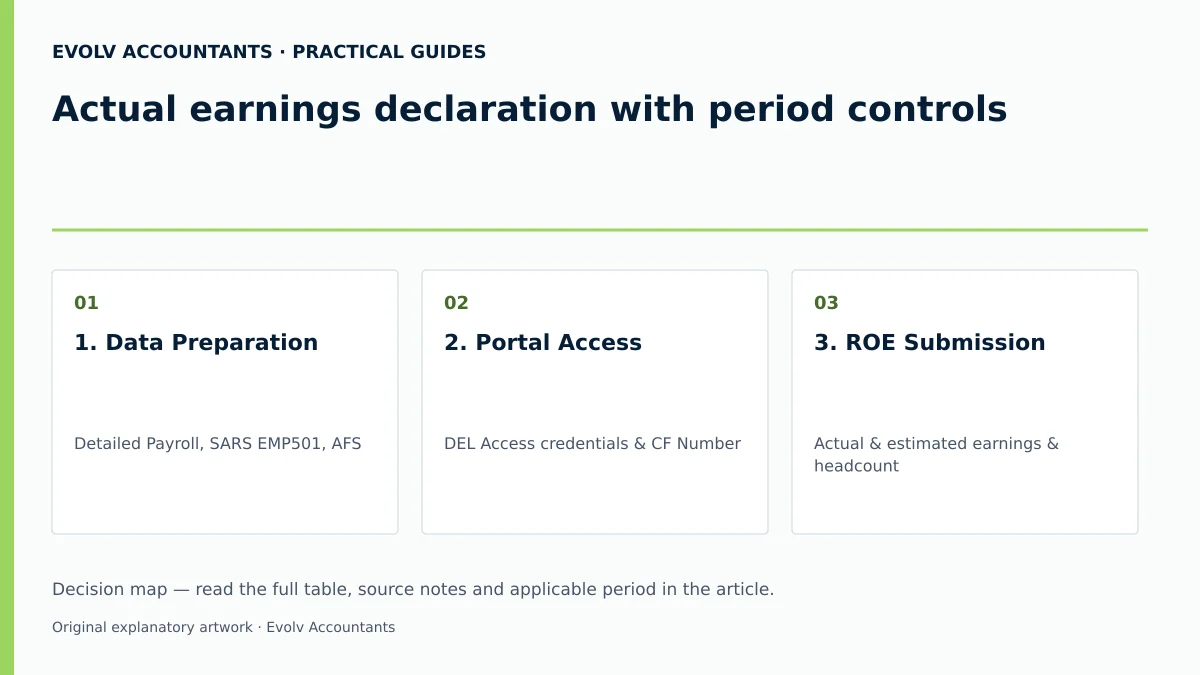
| Step | Input or evidence | Responsible person | Completion check | Exception or next action |
|---|---|---|---|---|
| 1. Data Preparation | Detailed Payroll, SARS EMP501, AFS 17 | Payroll Manager / Accountant | Gross earnings reconciled to SARS EMP501 17 | Prepare affidavit if payroll records are missing 34 |
| 2. Portal Access | DEL Access credentials & CF Number 19 20 | Authorised User / Representative | Logged into portal with CF number linked 20 26 | Submit DEL access form if user account is missing 19 |
| 3. ROE Submission | Actual & estimated earnings & headcount 5 | Director / Public Officer | Final review summary screen confirmed ("Yes") 8 | Submit manual WAS.8 if business is liquidating 32 |
| 4. Invoice Verification | Notice of Assessment / Invoice 8 | Finance Head | Invoice number and due date issued 8 | Lodge revision within 30 days if error found 8 33 |
| 5. Payment & LOGS | Proof of Payment (EFT reference) 8 | Financial Controller | Payment allocated and LOGS generated 3 6 | Submit audit pack if account is audit-blocked 6 17 |
Reproducible hypothetical example
An SME enterprise, Afritrade Logistics (Pty) Ltd, prepares its COIDA Return of Earnings for the statutory assessment period (1 March 2024 to 28 February 2025) 4.
Illustrative values (for demonstration of assessment calculation mechanics):
- Actual Employee Headcount: 12 staff members 5
- Actual Employee Earnings: ZAR 1,800,000 5
- Working Directors' Earnings: ZAR 400,000 (below the maximum gazetted earnings ceiling per director) 1 5 23
- Total Declared Actual Earnings: ZAR 2,200,000 5
- Provisional Estimates (2025/2026 cycle): Estimated Earnings ZAR 2,400,000; Headcount 12 5
Assessment Calculation Mechanics: Assuming a hypothetical gazetted category assessment rate of 1.5% (ZAR 1.50 per ZAR 100 earnings under Section 83) 11: Assessment Fee = ZAR 2,200,000 × 1.5% = ZAR 33,000
In this hypothetical calculation, R2,200,000 multiplied by the illustrative 1.5% tariff gives R33,000. Check the actual Notice of Assessment, assigned tariff and payment due date. Paying this amount can settle that assessment, but Letter of Good Standing eligibility also depends on other balances, payment allocation and any audit hold. Compensation Fund registration and employer guidance; distinguish dated administrative material
Frequently Asked Questions
What is the statutory assessment period for the COIDA Return of Earnings?
The statutory assessment period covers twelve consecutive months starting on 1st March of the preceding year and ending on the last day of February of the following year 4.
Are working directors included in the Return of Earnings headcount and salary declarations?
Yes. Under COIDA definitions, directors or members of a body corporate who have entered into a contract of service are classified as employees and their earnings must be declared up to the prescribed maximum ceiling 1 5 24.
Can an employer correct an error on the ROE portal after pressing "Yes"?
No. Once submitted online, figures cannot be edited on the portal 8. The employer must submit a formal application for revision within 30 calendar days, supported by a sworn affidavit, signed manual WAS.8 form, detailed payroll, SARS EMP501, and financial statements 17 32 33.
Why is an employer unable to generate a Letter of Good Standing after lodging a return?
A Letter of Good Standing will be blocked if the account has an outstanding assessment balance or if the Compensation Fund has flagged the submission for an audit ("Employers Blocked for Audit") 3 6. Audit clearance requires submitting supporting SARS and payroll evidence 6 17.
What risk does a principal employer incur when hiring an unregistered sub-contractor?
Under Section 89, if a contractor or sub-contractor fails to register or pay assessments, the principal mandator becomes liable for compensation payouts and unpaid assessments, subject to statutory set-off against contract fees 7 36.
Related guides
- When an employer must register with the Compensation Fund
- Estimating earnings for the Compensation Fund
- Compliance and Regulations: Keeping Your Business on Track
Sources
- How To Submit Earnings Statements to the Compensation Fund
- Compensation for Occupational Injuries and Diseases Act 130 of 1993 — original Act
- https://www.labour.gov.za/DocumentCenter/Publications/Compensation%20for%20Occupational%20Injuries%20and%20Diseases/Return%20of%20Earnings%20User%20Manual%2C%20August%202019.pdf
- Compensation Fund: obligations of the employer
- https://www.gov.za/sites/default/files/gcis_document/202304/48431-17-4-compensationoccupinjuriesdiseasesamendact10of2022a.pdf
- COIDA Amendment Act 61 of 1997, section 29: returns and under-declaration
- Department of Employment and Labour, 21 September 2026: outstanding 2025 returns and Gazette 55347
- Proclamation 306 of 2026: actual commencement and exceptions