
Estimating earnings for the Compensation Fund
9 July 2025

Estimating earnings for the Compensation Fund requires declaring actual prior payroll and projected remuneration to establish employer assessment liabilities accurately.
Rules reviewed: 20 October 2026. Read the linked primary sources for the applicable period, commencement dates and conditions.
South African small and medium enterprises (SMEs) registered under the Compensation for Occupational Injuries and Diseases Act (COIDA) must furnish an annual Return of Earnings (ROE) to the Compensation Commissioner 1 2. This mandatory submission serves a dual purpose: it reconciles actual earnings paid to employees for the completed assessment period (1 March to the end of February) and declares estimated earnings for the upcoming financial year 1 2 3.
Accurate calculation of estimated earnings assumptions and rigorous payroll evidence are vital to avoid statutory penalties, prevent audit blocks, and ensure the business maintains a valid Letter of Good Standing (LOGS) required for commercial operations 4 5 6.
Estimated earnings assumptions and payroll evidence
Reader, Jurisdiction and Applicable Period
This guide is tailored for directors, financial managers, and payroll administrators of South African SMEs operating under the jurisdiction of the Department of Employment and Labour and the Compensation Fund 1 6. The COIDA assessment year runs strictly from 1 March of a given calendar year to the final day of February of the subsequent calendar year 1 2.
Completion of this task means that the employer has submitted both final actual payroll data for the preceding assessment year and certified estimated earnings for the succeeding year, paid the resulting Notice of Assessment within prescribed timeframes, and secured independent verification of compliance 3 7 8 9.
Prepare the information and authority: estimated earnings assumptions
Required Primary Documents, Permissions and Inputs
To formulate defensible estimated earnings assumptions and compile accurate payroll evidence, the employer and appointed payroll representatives must compile the following primary records 14 15:
— Practical point from this guide
- SARS EMP501 Reconciliations & Tax Clearances: Annual payroll tax returns submitted to the South African Revenue Service to verify gross remuneration 14 16.
- Detailed Payroll Reports: Monthly payroll summaries reflecting gross salaries, wages, director remuneration, overtime, and allowances 3 14 17.
- Financial Statements: Audited, independently reviewed, or compiled Annual Financial Statements confirming total staff costs 14 16.
- Power of Attorney & System Credentials: A formal Power of Attorney if an external consultant or bookkeeper is submitting on behalf of the employer, alongside valid Department of Employment and Labour (DEL) user credentials 14 18 19.
Statutory Definitions of Earnings and Employees
Understanding what constitutes "earnings" and "employee" is critical when calculating declarations 17 20 21. Under COIDA Act 130 of 1993, "annual earnings" refers to the total remuneration paid by an employer to employees during the assessment period, up to the maximum annual ceiling prescribed by the Minister by notice in the Gazette 1 20 22.
Section 1(g) of Amendment Act 10 of 2022 contains an enacted but uncommenced Fourth Schedule-based earnings definition, but Proclamation 306 expressly leaves that provision uncommenced. Do not substitute SARS taxable remuneration automatically for the operative COIDA earnings measure. Reconcile the applicable Fund form, statutory inclusions/exclusions and annual ceiling to the payroll, documenting differences from EMP501 totals. Proclamation 306 of 2026: actual commencement and exceptions
Under the primary statutory framework, "employees" include regular staff, casual workers employed for the business, and directors or members of legal persons working under an employment contract 17 23. Employers must note that casual employees and executive directors must be included in total headcount and earnings declarations on the ROE portal 3 17.
Reproducible Hypothetical Example of Estimated Earnings Calculation
To illustrate the estimation process, consider a hypothetical South African manufacturing SME, "Cape Precision Engineering (Pty) Ltd" (illustrative values only):
- Final Assessment Period (Actual Prior Year):
- Number of Employees: 15 regular workers and 2 executive directors (Total Headcount: 17) 3.
- Actual Employee Wages Paid: R 2,400,000 3.
- Actual Executive Directors' Remuneration: R 600,000 3.
- Total Actual Earnings Declared: R 3,000,000 3.
- Provisional Assessment Period (Estimated Upcoming Year):
- Estimation Assumptions: The business projects a 5% annual salary increase across all staff and plans to recruit 1 additional technician mid-year at an estimated salary of R 180,000.
- Estimated Employee Wages: R 2,400,000 x 1.05 + R 180,000 = R 2,700,000 3.
- Estimated Directors' Remuneration: R 600,000 x 1.05 = R 630,000 3.
- Total Estimated Earnings Assumption: R 3,330,000 3.
- Estimated Staff Headcount: 18 employees 3.
When this data is entered into the ROE portal, the system calculates the provisional assessment based on the R 3,330,000 estimate 3. If the actual earnings at year-end turn out to be different, the Commissioner will adjust the assessment accordingly in the subsequent return cycle 24 25.
Complete the task step by step: payroll evidence
Employers must follow a systematic, sequential process when preparing payroll evidence and executing the online ROE declaration 3 6.
Sequenced Operational Checklist
- Reconcile Internal Payroll Records: Aggregate twelve months of monthly payroll reports (1 March to end of February) and match total gross wages and directors' earnings against the SARS EMP501 declarations 1 14.
- Apply Earnings Ceilings: Cap each individual employee's annual remuneration at the gazetted maximum threshold prescribed for the specific assessment period 1 22.
- Formulate Projected Estimates: Calculate projected payroll for the upcoming financial year based on operational budgets, planned headcount changes, and anticipated wage increases 3.
- Access the ROE Portal: Log into the official Department of Employment and Labour ROE website (cfonline.labour.gov.za) using active user credentials 6 18.
- Verify Organisation Details: Navigate to "Change Organisation Details" under the ROE Menu to ensure physical, postal, and business nature details are current 12 26.
- Capture Return Values: Select "Submit Return of Earnings", accept the legal terms and conditions, and capture the employee headcount, employee earnings, and director earnings for both Final (Actual) and Provisional (Estimated) assessments 3 26.
- Confirm and Generate Invoice: Review the summary values on the confirmation screen; click "Yes" to submit, generating the official Notice of Assessment/Invoice containing the deposit reference number and banking details 3 9.
Check the result against the evidence: estimated earnings assumptions
Independent Completion Evidence
Submitting values online does not automatically guarantee regulatory acceptance or compliance 4 9. True completion requires obtaining independent verification evidence 4 6. Employers must secure:
- System Generated Assessment/Invoice: The official invoice displaying the final assessed amount, invoice number, due date (typically 30 days from notice date), and Compensation Fund deposit reference number 8 9.
- Proof of Payment: Bank direct deposit or Electronic Funds Transfer (EFT) receipt quoting the exact deposit reference number provided on the invoice 9.
- Letter of Good Standing (LOGS): The official certificate downloaded from the portal confirming that the employer is fully registered and all assessment payments are up to date 4 6.
Verification Against Audit Blocks
If an employer is blocked for an audit, the system will prevent the automatic generation of a Letter of Good Standing 4. To clear an audit block, the employer must submit supporting payroll evidence—including SARS EMP501 forms, detailed payroll reports, and compiled annual financial statements—to the Compensation Fund's designated audit inbox (2019ROE.Audits@labour.gov.za) 14.
Section 81(2), as replaced by section 50 of Amendment Act 10 of 2022 and in force from 23 January 2026, requires earnings and employee records to be kept for at least five years after the last entry. The section 81(3) non-compliance penalty commenced on 1 April 2026. COIDA Amendment Act 10 of 2022: enacted provisions; Proclamation 306 of 2026: actual commencement and exceptions
Handle exceptions and unresolved cases: payroll evidence
Title-Specific Edge Cases and Online Submission Restrictions
Certain operational changes prevent an employer from submitting an ROE online 16. Guidance from the Department of Employment and Labour stipulates that an employer must NOT submit an ROE online if 16:
- The business has closed or ceased operations 16.
- The nature of the business has changed 12 16.
- The entity has been liquidated or sequestrated 16.
In such instances, or where incorrect earnings figures were previously declared, online editing is disabled 9 16. The employer must submit a formal manual application accompanied by an affidavit stating the correct figures, a signed manual ROE form (WAS.8), SARS EMP501 returns, detailed payrolls, and Annual Financial Statements 14 16.
Statutory Fines, Penalties and Specialist Boundaries
Distinguish an honest provisional estimate from an understated actual-earnings return. Section 83(5) requires an assessment adjustment when actual earnings differ from the estimate. Section 82(3) permits a fine of up to 10% of the difference where returned actual earnings are less than the amount actually paid, subject to the statutory ceiling. Failure to submit a return can instead engage section 83(6), including estimation and a 10% penalty on the amount assessed. A forecast variance alone does not establish which penalty applies. COIDA Amendment Act 61 of 1997, section 29: returns and under-declaration; COIDA Amendment Act 10 of 2022: enacted provisions
Under Section 83(6), if an employer fails to submit a return within the prescribed period, the Commissioner may estimate the earnings, issue an unadjustable assessment, and levy a 10 per cent penalty 28 29. Under COIDA Section 87(1), failure to pay an assessment attracts a penalty of 10 per cent of actual or estimated earnings 30.
Where complex payroll structures, multi-branch operations, or audit blocks arise, employers should engage Evolv Accountants to review payroll records, formulate defensible estimation models, and manage formal revision applications under Section 84 within 30 days of assessment issuance 7.
Next steps for COIDA and compensation
Task and Completion Checklist (Artefact)
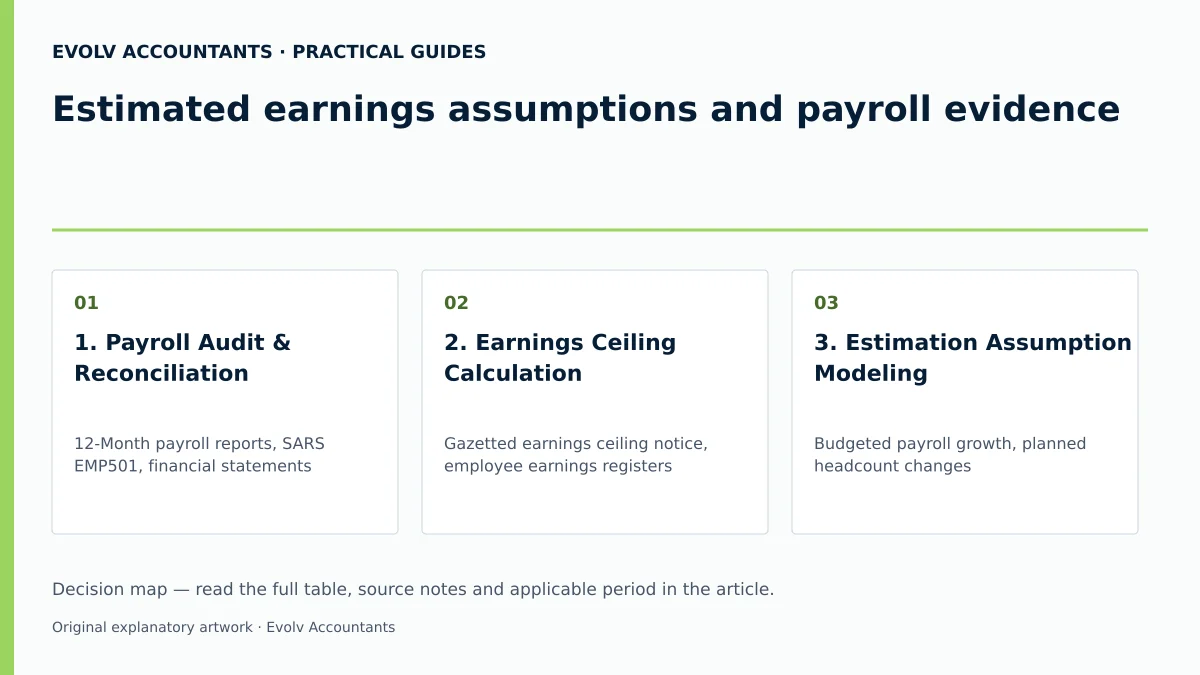
| Step | Input or evidence | Responsible person | Completion check | Exception or next action |
|---|---|---|---|---|
| 1. Payroll Audit & Reconciliation | 12-Month payroll reports, SARS EMP501, financial statements 1 14 | Payroll Administrator / Bookkeeper | Gross payroll matches SARS EMP501 and financial statements 14 | Investigate variances; adjust for non-assessable items 21 |
| 2. Earnings Ceiling Calculation | Gazetted earnings ceiling notice, employee earnings registers 1 22 | Payroll Manager / Accountant | Individual earnings capped at gazetted ceiling 1 | Highlight capped amounts for high-earning staff and directors 3 17 |
| 3. Estimation Assumption Modeling | Budgeted payroll growth, planned headcount changes 3 | Financial Director / SME Owner | Documented 12-month payroll projection assumptions 3 | Reconcile against operational expansion plans 3 |
| 4. Online ROE Capture & Submission | Active DEL portal credentials, completed WAS.8 calculation sheet 3 6 | Authorised Representative / Evolv Advisor | Portal confirmation screen displays "Completely processed" status 9 | If blocked for audit or error occurs, prepare manual audit pack 4 16 |
| 5. Payment & LOGS Retrieval | Notice of Assessment / Invoice, bank EFT facility 8 9 | Finance Department / Owner | Payment reflects on CF account; Letter of Good Standing downloaded 4 6 | Submit proof of payment quoting exact deposit reference number 9 |
Frequently Asked Questions
What is the deadline for submitting the annual Return of Earnings?
Use the published notice for the relevant return year, alongside section 82. Its annual statutory baseline is 31 March, but that is not a substitute for the Fund’s actual submission window or later notices. The Department’s 21 September 2026 statement identifies Gazette 55347 and the requirement to submit outstanding 2025 returns before 31 October 2026. This dated notice does not establish the deadline for a later return year. Department of Employment and Labour, 21 September 2026: outstanding 2025 returns and Gazette 55347
Are executive directors required to be included in ROE declarations?
Yes. Under COIDA statutory definitions and online portal entry forms, executive directors who have entered into a contract of service with a corporate entity are classified as employees and their remuneration must be declared under Directors Earnings up to the gazetted ceiling 3 17 23.
What happens if our estimated earnings assumption turns out to be higher or lower than actual payroll?
Under Section 83(5) of COIDA, if actual earnings paid during a period differ from the estimated earnings declared, the Commissioner will adjust the assessment accordingly in the next return cycle 24 25. If an estimation was unreasonably low, the Commissioner may exercise powers under Section 82(5) to estimate the earnings and apply statutory penalties 5 28.
How does a main contractor ensure protection against subcontractor COIDA liabilities?
Under COIDA Section 89 (and employer obligations guidance), mandators/contractors who engage subcontractors must obtain a valid Letter of Good Standing from each contractor 31 32. If a subcontractor fails to register or pay assessments, the main contractor becomes liable for compensation and outstanding assessments paid to those workers 31.
Can an employer correct an error on a submitted ROE online?
No. Once an ROE is submitted online and confirmed, it cannot be corrected directly on the website 9. The employer must submit a formal application for revision of assessment within 30 days of the Notice of Assessment date, supported by an affidavit, signed manual ROE form, SARS EMP501, and detailed payroll reports 7 16.
Related guides
- When an employer must register with the Compensation Fund
- Actual versus provisional earnings in a COIDA assessment
- Compliance and Regulations: Keeping Your Business on Track
Sources
- How To Submit Earnings Statements to the Compensation Fund
- Compensation for Occupational Injuries and Diseases Act 130 of 1993 — original Act
- https://www.labour.gov.za/DocumentCenter/Publications/Compensation%20for%20Occupational%20Injuries%20and%20Diseases/Return%20of%20Earnings%20User%20Manual%2C%20August%202019.pdf
- Compensation Fund: obligations of the employer
- https://www.gov.za/sites/default/files/gcis_document/202304/48431-17-4-compensationoccupinjuriesdiseasesamendact10of2022a.pdf
- Proclamation 306 of 2026: actual commencement and exceptions
- COIDA Amendment Act 61 of 1997, section 29: returns and under-declaration
- Department of Employment and Labour, 21 September 2026: outstanding 2025 returns and Gazette 55347