
Actual versus provisional earnings in a COIDA assessment
12 April 2025

A COIDA assessment requires employers to declare actual earnings paid and estimate provisional earnings for the upcoming assessment period.
Rules reviewed: 20 October 2026. Read the linked primary sources for the applicable period, commencement dates and conditions.
Under the Compensation for Occupational Injuries and Diseases Act (COIDA) Act 130 of 1993, every registered employer in South Africa must submit an annual Return of Earnings (ROE) 1 2 3. This mandatory return requires reporting actual employee earnings paid during the concluded assessment period (running from 1 March to the last day of February) alongside estimated provisional earnings expected for the next assessment year 1 2 4.
The Compensation Commissioner applies a percentage assessment tariff to annual earnings to calculate the employer’s assessment 5. Where actual earnings differ from provisional estimates, the Commissioner adjusts the assessment accordingly under Section 83(5) 5 6. Accurate, verifiable declarations across both figures protect businesses from statutory penalties, audit blocks, and the loss of a Letter of Good Standing 7 8 9 10.
Assessment basis versus provisional amounts
The statutory framework governing workplace injury compensation in South Africa requires employers to understand the technical distinction between the actual earnings assessment basis and provisional earnings estimates 2 5 11. Neither option is a standalone choice or universally superior; rather, they form two linked components of the annual COIDA assessment cycle 2 4.
Actual earnings reflect the precise remuneration paid to employees during the completed assessment year, which spans from 1 March of the preceding calendar year to the final day of February of the current year 1 2. In terms of Section 82(1) of Act 130 of 1993, the employer must "furnish the commissioner with a return in the prescribed form, certified by him as correct" 2.
Actual earnings encompass regular salaries, wages, director earnings, and taxable benefits up to the maximum annual threshold determined by the Compensation Commissioner for that specific assessment period 1 4.
Provisional amounts, in contrast, represent an employer's prospective estimate of total earnings expected to be paid to staff over the upcoming assessment year 2 4 9. Under Section 82(5) and Section 83, provisional figures serve as an interim forecasting mechanism 5 9. The Compensation Fund uses these estimates to issue interim assessment invoices, ensuring the fund maintains adequate reserves to cover potential workplace disability, medical costs, and pension claims 5 11 12.
Declaring an unrealistically low provisional amount does not reduce long-term costs. If the Commissioner considers an estimate too low, Section 82(5) empowers the Commissioner to estimate the earnings directly 9. Furthermore, when actual payroll figures are submitted in the subsequent cycle, Section 83(5) obliges the Commissioner to adjust the final assessment to match actual earnings, recovering any shortfall alongside potential penalties if the original estimate was unjustifiably understated 5 6 9 10.
Compare the criteria that matter: assessment basis
When evaluating actual earnings against provisional estimates, South African SME leadership must weigh six core operational and compliance criteria:
- Administrative Control: Actual earnings are anchored in historical payroll registers, SARS EMP501 reconciliations, and audited annual financial statements, giving management full evidentiary control 8 13. Provisional amounts rely on business sales forecasting and headcount projections, which carry inherent operational uncertainty 4 9.
- Statutory Liability: Final legal liability is calculated strictly on actual earnings paid up to the statutory maximum ceiling per employee 1 5 11. Provisional amounts establish an interim payment obligation that remains subject to final adjustment under Section 83(5) 5 6.
- Reporting Complexity: Declaring actual earnings requires compiling exact gross payroll figures, director remuneration, and accommodation or meal benefits across all business operating locations 2 4 14. Provisional reporting requires estimating overall staff growth and wage inflation for the future period 4.
- Tax and Statutory Alignment: Actual earnings reported on the Return of Earnings (Form W.As.8 or online ROE portal) must reconcile directly with annual SARS EMP501 submissions 13 15. Discrepancies between tax returns and COIDA declarations trigger Compensation Fund audit queries 7 13.
- Cash Flow Constraints: Invoices issued on actual earnings adjustments or provisional estimates are payable within 30 calendar days of the Notice of Assessment date 8 16. Short-term cash planning must accommodate potential assessment balancing invoices 16 17.
- Operational Risk: Submitting inaccurate actual earnings or failing to settle assessment invoices within 30 days leads to account blocks 7 16. An audit block prevents the automated generation of a Letter of Good Standing (LOGS), instantly disqualifying SMEs from submitting commercial tenders or entering client sites 3 7 18.
How the obligations differ: provisional amounts
Navigating COIDA obligations requires distinguishing between non-negotiable statutory rules, professional accounting recommendations, and software/product features:
— Practical point from this guide
Sourced Legal and Regulatory Rules
- Annual return timing: Use the published notice for the relevant return year, alongside section 82. Its annual statutory baseline is 31 March, but that is not a substitute for the Fund’s actual submission window or later notices. The Department’s 21 September 2026 statement identifies Gazette 55347 and the requirement to submit outstanding 2025 returns before 31 October 2026. This dated notice does not establish the deadline for a later return year. Department of Employment and Labour, 21 September 2026: outstanding 2025 returns and Gazette 55347
- Record retention: Section 81(2), as replaced by section 50 of Amendment Act 10 of 2022 and in force from 23 January 2026, requires earnings and employee records to be kept for at least five years after the last entry. The section 81(3) non-compliance penalty commenced on 1 April 2026. COIDA Amendment Act 10 of 2022: enacted provisions; Proclamation 306 of 2026: actual commencement and exceptions
- Audit Compliance: Employers blocked for audit must submit supporting evidence—including a sworn affidavit, signed manual ROE form, SARS EMP501 reconciliation, detailed payroll registers, and audited or independently reviewed Annual Financial Statements—within prescribed timeframes 7 13.
- Revision Window: An application for the revision of an assessment due to a declaration error must be lodged within 30 calendar days from the Notice of Assessment date 8.
Professional Accounting Recommendations (Evolv Advisory)
- Perform a monthly reconciliation between payroll journals and SARS EMP201 submissions to prevent year-end COIDA declaration variances.
- Conduct a quarterly forecast review of provisional earnings estimates to account for unbudgeted staff hires, overtime trends, or bonus structures before lodging the annual return.
- Establish an internal compliance audit file containing proof of submission, payment receipts, and verified sub-contractor Letters of Good Standing 4 18.
Product and Compliance Support Features
- Automated statutory payroll integration matching COIDA earner limits.
- Independent review of Return of Earnings declarations prior to portal submission.
- Turnkey assistance with Compensation Fund audit clearance and LOGS retrieval.
Two business situations with different outcomes: assessment basis
To illustrate how actual versus provisional assessment mechanics apply in practice, consider two hypothetical SME scenarios.
Situation A: Stable Service SME
- Hypothetical Business Profile: A specialized legal advisory SME employs 10 permanent staff with predictable salaries.
- Financial Facts [illustrative values]:
- Year 1 Provisional Estimate submitted: R2,500,000
- Year 1 Actual Earnings paid (concluded 28 February): R2,520,000
- Year 2 Provisional Estimate submitted: R2,650,000
- Illustrative reconciliation outcome: Actual earnings of R2,520,000 exceed the provisional R2,500,000 by R20,000, or 0.8%. Section 83(5) requires the assessment to be adjusted. A small, promptly reconciled variance does not by itself guarantee exemption from penalties or immediate issue of a Letter of Good Standing. Check the assessment, payment allocation and any audit hold separately. COIDA Amendment Act 10 of 2022: enacted provisions
Situation B: Rapid-Growth Construction SME with Sub-Contractors
- Hypothetical Business Profile: A civil engineering SME scales rapidly after securing major infrastructure contracts, expanding permanent headcount from 15 to 40 workers and hiring unverified sub-contractors.
- Financial Facts [illustrative values]:
- Year 1 Provisional Estimate submitted: R1,800,000
- Year 1 Actual Earnings paid to employees: R4,200,000
- Payments to unregistered sub-contractors: R1,000,000
- Illustrative reconciliation outcome: R4,200,000 actual earnings exceed the R1,800,000 estimate by R2,400,000, or approximately 133%. Reconcile the final assessment under section 83(5). If returned actual earnings were understated, consider section 82(3); failure to submit a return can instead engage section 83(6). Do not apply a flat 10% charge to the forecast variance merely because it is large. Separately investigate contractor registration and assessments under section 89; R1,000,000 paid to a contractor is not automatically R1,000,000 of assessable employee earnings. COIDA Amendment Act 61 of 1997, section 29: returns and under-declaration; COIDA Amendment Act 10 of 2022: enacted provisions
When the comparison needs specialist input: provisional amounts
Certain business scenarios involve technical legal and accounting complexities that require specialist professional intervention:
- Online Submission Exclusions: The Department of Employment and Labour explicitly prohibits online ROE submissions if a business has closed, ceased operations, altered the basic nature of its business, or entered liquidation or sequestration 13. Manual submission backed by formal affidavits is mandatory 13.
- Complex Contractor and Mandator Networks: Where an enterprise uses multiple tiers of contractors or sub-contractors, Section 89 establishes joint liability risks 18 21. Legal and accounting specialists must review contractor agreements and verify active LOGS documentation 18 21.
- Compensation Fund Audit Blocks: Accounts flagged for audit cannot be cleared through standard online portal edits 7 13. Resolving an audit block requires compiling a formal submission package containing detailed payrolls, SARS EMP501 forms, tax clearance certificates, signed manual returns, and sworn affidavits 13.
- Formal Assessment Revisions: If an employer discovers an error after submitting a Return of Earnings, online portal edits are disabled 17. A formal application for revision under Section 83 must be lodged within 30 calendar days of the Notice of Assessment date 8.
- Commenced and deferred amendments: Most provisions of Amendment Act 10 of 2022 commenced on 23 January 2026; sections 3–6 followed on 1 February, and the specified deferred provisions on 1 April. Proclamation 306 expressly leaves section 1(g), the new earnings definition, uncommenced, together with section 1(h) only so far as it concerns subparagraphs (i)–(iii) of the employee definition. Read the principal Act with the provisions actually in force. Proclamation 306 of 2026: actual commencement and exceptions
Next steps for COIDA and compensation
To maintain full compliance and protect your business from assessment penalties, follow this structured compliance decision record and workflow.
Employer Action Checklist
- Extract Completed Payroll Data: Compile actual earnings paid to all workers (including directors) for the assessment period ending on the last day of February 1 2 4.
- Apply Earner Ceilings: Limit individual employee earnings to the statutory maximum limit published by the Compensation Commissioner for that assessment year 1.
- Audit Sub-Contractor Compliance: Obtain valid Letters of Good Standing from every contractor engaged during the financial year 18.
- Calculate Provisional Projections: Project upcoming annual payroll based on confirmed employment contracts, planned hires, and anticipated wage increases 2 4.
- Reconcile with SARS EMP501: Cross-check total gross earnings against annual SARS tax reconciliations before lodging figures 13.
- Submit and retain proof: File through the authorised route within the published window for that return year. Keep employee and earnings records for at least five years after their last entry. Department of Employment and Labour, 21 September 2026: outstanding 2025 returns and Gazette 55347; COIDA Amendment Act 10 of 2022: enacted provisions; Proclamation 306 of 2026: actual commencement and exceptions
Decision Comparison Matrix
| Criterion | Option A: Actual Earnings Basis | Option B: Provisional Earnings Basis | Evidence or Assumption | Implication for This Reader |
|---|---|---|---|---|
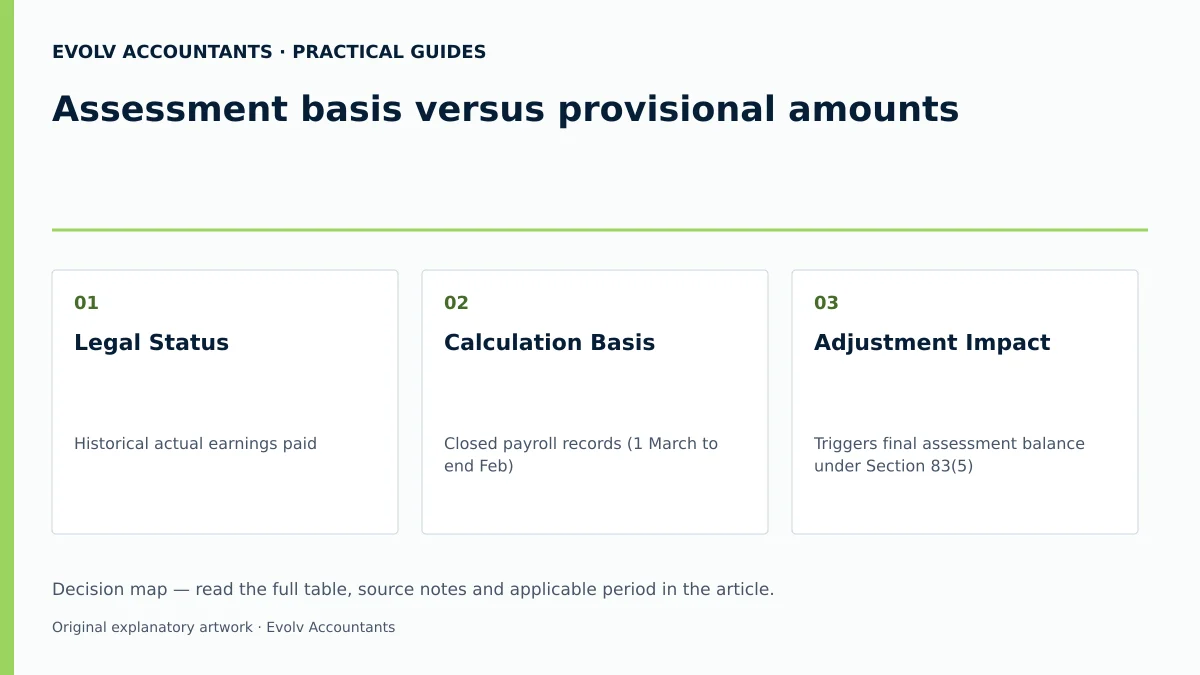
| Legal Status | Historical actual earnings paid 1 2 | Forward-looking estimate 2 9 | COIDA Act 130 of 1993, Section 82 2 | Both declarations are compulsory in the annual ROE 2 4. |
| Calculation Basis | Closed payroll records (1 March to end Feb) 1 2 | Estimated annual payroll forecast 4 9 | WAS.8 Guidelines & ROE User Guide 1 4 | Actuals must reconcile directly with SARS EMP501 13. |
| Adjustment Impact | Triggers final assessment balance under Section 83(5) 5 6 | Establishes interim invoice amount 5 | COIDA Section 83(5) & 86(1) 5 6 16 | Variances yield balancing invoices or penalties 5 9 10. |
| Audit Risk | High if variance with SARS returns exists 7 13 | High if estimate is unrealistically low 9 | Department of Labour Guidance 7 9 13 | Unresolved audits block LOGS generation 3 7. |
| Payment Deadline | 30 calendar days from Notice of Assessment 8 16 | Payable as billed on interim notice 16 | COIDA Section 86(1) 16 | Failure to pay within 30 days incurs interest 16 23. |
Reproducible Calculation Formula
Final COIDA Assessment Payable is calculated as:
Final Assessment = (Actual Annual Earnings × Assessment Tariff Code %) + Prior Period Adjustment - Provisional Payments Made
*Where Actual Annual Earnings are capped at the statutory ceiling per employee for the assessment period 1 5.*
Frequently Asked Questions
What is the exact assessment period covered by a COIDA Return of Earnings?
The assessment period runs for 12 months, starting on 1 March of a given year and ending on the final day of February of the following calendar year 1 2.
What happens if an employer submits provisional earnings that are far lower than actual earnings?
Distinguish an honest provisional estimate from an understated actual-earnings return. Section 83(5) requires an assessment adjustment when actual earnings differ from the estimate. Section 82(3) permits a fine of up to 10% of the difference where returned actual earnings are less than the amount actually paid, subject to the statutory ceiling. Failure to submit a return can instead engage section 83(6), including estimation and a 10% penalty on the amount assessed. A forecast variance alone does not establish which penalty applies. COIDA Amendment Act 61 of 1997, section 29: returns and under-declaration; COIDA Amendment Act 10 of 2022: enacted provisions
How long is an SME legally required to keep COIDA payroll records?
Section 81(2), as replaced by section 50 of Amendment Act 10 of 2022 and in force from 23 January 2026, requires earnings and employee records to be kept for at least five years after the last entry. The section 81(3) non-compliance penalty commenced on 1 April 2026. COIDA Amendment Act 10 of 2022: enacted provisions; Proclamation 306 of 2026: actual commencement and exceptions
Can an employer correct an error on a Return of Earnings online after submitting it?
No. Once a Return of Earnings is submitted on the ROE portal, it cannot be corrected online 17. The employer must submit a formal application for revision within 30 calendar days of the Notice of Assessment date, backed by a sworn affidavit, payrolls, and SARS EMP501 forms 8 13.
Is an employer liable for COIDA assessments for sub-contractors?
Yes. Under Section 89, if a contractor or sub-contractor fails to register with the Compensation Fund or pay their assessments, the principal mandator employer becomes liable to pay those assessments and any associated compensation 18 21.
Related guides
- When an employer must register with the Compensation Fund
- COIDA registration documents for South African employers
- Compliance and Regulations: Keeping Your Business on Track
Sources
- How To Submit Earnings Statements to the Compensation Fund
- Compensation for Occupational Injuries and Diseases Act 130 of 1993 — original Act
- https://www.labour.gov.za/DocumentCenter/Publications/Compensation%20for%20Occupational%20Injuries%20and%20Diseases/Return%20of%20Earnings%20User%20Manual%2C%20August%202019.pdf
- https://www.gov.za/sites/default/files/gcis_document/202304/48431-17-4-compensationoccupinjuriesdiseasesamendact10of2022a.pdf
- Compensation Fund: obligations of the employer
- Department of Employment and Labour, 21 September 2026: outstanding 2025 returns and Gazette 55347
- COIDA Amendment Act 61 of 1997, section 29: returns and under-declaration
- Proclamation 306 of 2026: actual commencement and exceptions