
COIDA registration documents for South African employers
14 September 2025

COIDA registration requires South African employers to assemble business identity, authorisation and employee records for the Compensation Fund.
Rules reviewed: 20 October 2026. Read the linked primary sources for the applicable period, commencement dates and conditions.
To satisfy the statutory mandate under South African legislation, small and medium enterprises (SMEs) must compile an evidence dossier that establishes legal corporate existence, physical operational address, director identity, and complete payroll data 1. The Department of Employment & Labour oversees this process through the Compensation Commissioner 2 3.
Employer compliance relies on matching business classification details with underlying remuneration registers, ensuring that annual assessments accurately reflect true worker exposure and wage liabilities 4 5.
Identity business classification and employee evidence
Statutory Authority and Regulatory Context
Under South African law, the primary statute governing workplace injury and disease indemnification is the Compensation for Occupational Injuries and Diseases Act 130 of 1993 (COIDA) 5 6. According to official Department of Employment & Labour guidance, the Compensation Fund does not insure the employer's business assets, but rather exists to "insure his/her workers against occupational injuries or diseases contracted during the course of employment" 2.
Most provisions of Amendment Act 10 of 2022 commenced on 23 January 2026; sections 3–6 followed on 1 February, and the specified deferred provisions on 1 April. Proclamation 306 expressly leaves section 1(g), the new earnings definition, uncommenced, together with section 1(h) only so far as it concerns subparagraphs (i)–(iii) of the employee definition. Read the principal Act with the provisions actually in force. Proclamation 306 of 2026: actual commencement and exceptions
Defining the Verification Purpose and Requesting Authority
The requesting authority for registration and assessment evidence is the Compensation Commissioner, operating via the Department of Employment & Labour 2 3. Employers are evaluated across four primary touchpoints:
— Practical point from this guide
- Initial Registration: Mandatory registration within the statutory timeframe following the appointment of one or more employees 2 9.
- Annual Return of Earnings (ROE): Annual reporting of total earnings and employee headcounts for assessment calculations 4 10.
- Audit Clearances: Verification of past declarations when an employer is flagged for an audit block 11 12.
- Assessment Revisions: Formal requests to adjust incorrect declarations within 30 calendar days of an assessment notice 13.
Evolv Accountants recommends that SMEs maintain a centralised digital archive of primary documents so that statutory verification requests from the Compensation Fund can be satisfied without operational delay.
Documents grouped by purpose: identity business classification
To streamline registration and audit workflows, documentation must be categorised based on whether it establishes corporate identity, specifies conditional sector classifications, or proves employee earnings 1 12.
Mandatory Primary Identification Records
Every commercial entity applying for registration with the Compensation Fund must furnish core identity records to RegistrationCF@labour.gov.za or through the online portal 1:
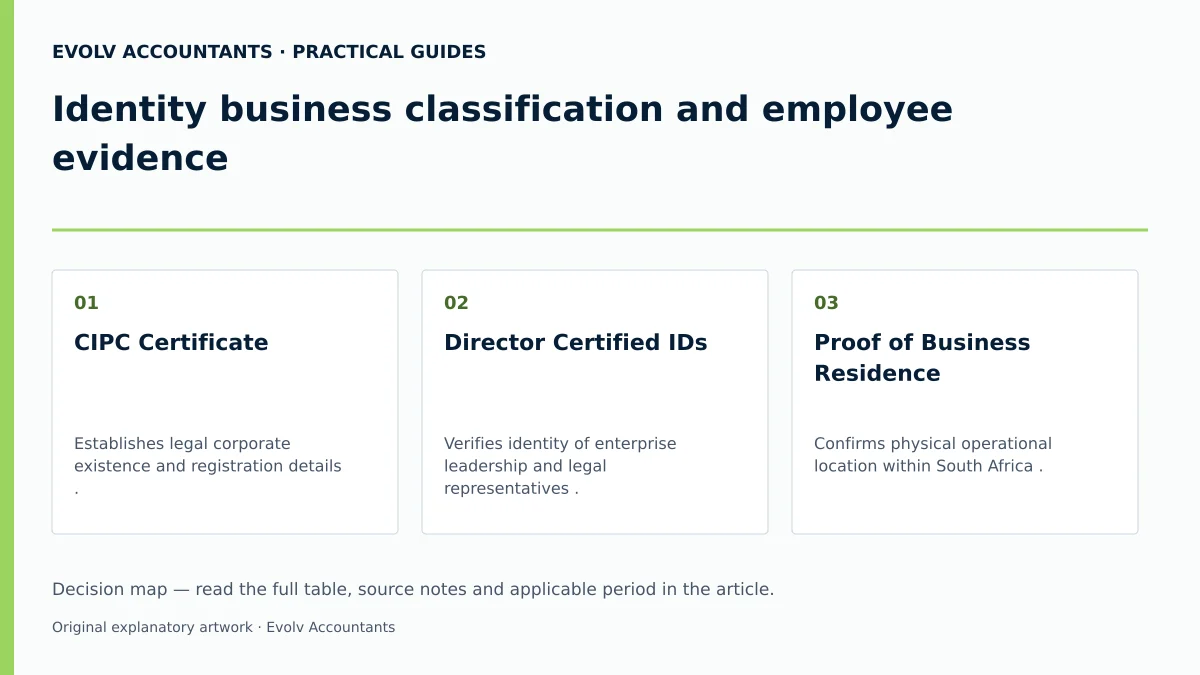
- CIPC Registration Certificate: Official proof of incorporation for private companies (Pty Ltd) and Close Corporations (CC) 1.
- Identity Documents: Certified copies of identity documents for all registered directors, members, or owners 1.
- Proof of Business Residence: Utility bills or lease agreements verifying the physical operating address of the enterprise 1.
- UIF Proof of Registration: Official confirmation of Unemployment Insurance Fund registration 1.
Conditional Entity Documentation
Depending on the legal structure of the business or specific sub-sector operations, additional conditional records are required 1 14:
- Non-Profit Organisations (NPOs): Must attach the CIPC certificate, UIF proof of registration, official NPO Certificate, owner/director ID copies, and proof of business residence 1.
- Trusts and Sole Traders: Sole proprietors must provide owner ID copies, UIF proof of registration, and proof of business residence 1.
- Mutual Association Transfers: Employers in specific industrial sub-classes are licensed under Mutual Associations rather than the main Compensation Fund 14. Class XIII (Iron, Steel, Metal and related industries) requires a compulsory transfer to Rand Mutual Assurance (RMA), whereas Class IV (Mining) transfer to RMA and Class V (Building and Construction) transfer to Federated Employers Mutual Assurance (FEM) remain optional 14.
- Power of Attorney: Required whenever external consultants, bookkeepers, or legal practitioners represent the employer during filings or audit clearances 12 15.
Recommended Payroll and Financial Supporting Schedules
To support the annual Return of Earnings (Form WAS.8) and clear audit reviews, employers should assemble 4 12:
- Detailed payroll reports showing individual employee names, gross earnings, overtime, and piece-work totals 12 16.
- SARS EMP501 reconciliation statements or a Tax Clearance Certificate if exempt from the Skills Development Levy (SDL) 12.
- Audited, independently reviewed, or compiled Annual Financial Statements (AFS) 12 15.
Check identity period and consistency: employee evidence
Aligning Assessment Periods with Payroll Evidence
The statutory assessment period under COIDA runs strictly from 1 March of a given year to the last day of February of the following year 4 17. When completing annual Return of Earnings filings, employers must report two distinct figures 4 18:
- Actual Earnings: Total salaries and wages paid to all employees during the preceding assessment year (1 March to end of February) 4 17.
- Provisional Earnings: Estimated earnings expected to be paid during the upcoming assessment year 18.
Reconcile staff and working-director earnings, applicable benefits and the prescribed annual ceiling to the ROE form and supporting payroll. The new Fourth Schedule-based earnings definition in section 1(g) of Amendment Act 10 of 2022 is not yet in force. Distinguish an honest provisional estimate from an understated actual-earnings return. Section 83(5) requires an assessment adjustment when actual earnings differ from the estimate. Section 82(3) permits a fine of up to 10% of the difference where returned actual earnings are less than the amount actually paid, subject to the statutory ceiling. Failure to submit a return can instead engage section 83(6), including estimation and a 10% penalty on the amount assessed. A forecast variance alone does not establish which penalty applies. COIDA Amendment Act 61 of 1997, section 29: returns and under-declaration; COIDA Amendment Act 10 of 2022: enacted provisions
Current statutory record retention
The operative minimum is five years after the last entry, rather than the four-year period printed in older versions of the Act and departmental pages.
- Current retention rule: Section 81(2), as replaced by section 50 of Amendment Act 10 of 2022 and in force from 23 January 2026, requires earnings and employee records to be kept for at least five years after the last entry. The section 81(3) non-compliance penalty commenced on 1 April 2026. COIDA Amendment Act 10 of 2022: enacted provisions; Proclamation 306 of 2026: actual commencement and exceptions
- Inspection and enforcement: Keep manual or electronic registers available for authorised inspection. Any penalty must be assessed under the operative provision and its commencement date, rather than an obsolete summary. COIDA Amendment Act 10 of 2022: enacted provisions
Build the records policy around the statutory five-year minimum measured from the last entry. Retain documents longer where another applicable tax rule, unresolved enquiry or legal obligation requires it.
Build a reviewer ready evidence pack: identity business classification
Structuring the Submission Index and Naming Standards
When preparing documentation for registration, audit clearance, or assessment revision, employers should construct a reviewer-ready evidence pack 12. Evolv Accountants recommends organizing the submission into four indexed folders using a standardized naming convention:
- 01_Corporate_Identity: CIPC Certificate, NPO Certificate, or Trust Deed ([EntityName]_CIPC_Certificate.pdf) 1.
- 02_Governance_and_Address: Director ID copies, Proof of Business Residence, and Power of Attorney ([EntityName]_Director_IDs.pdf) 1 12.
- 03_Tax_and_UIF_Registration: UIF Proof of Registration, SARS EMP501, or Tax Clearance ([EntityName]_UIF_Proof.pdf) 1 12.
- 04_Payroll_and_Financials: Detailed Payroll Reports, WAS.8 forms, and Compiled AFS ([EntityName]_Payroll_Report_[Year].pdf) 4 12.
Digital Submission via the Department of Employment & Labour Portal
Employers can register online by accessing the ROE website portal (cfonline.labour.gov.za) 1 9. Upon successfully submitting registration details to the Department of Employment & Labour, a unique Contract Account Number (beginning with 99...) is generated for the employer 1.
Missing or contradictory records: employee evidence
Handling Missing Records via Formal Affidavit and Estimation
Where historical payroll registers or registration records are missing or incomplete, employers must not fabricate replacement evidence 15. Regulator guidance outlines a specific remediation protocol:
- Submit a formal sworn affidavit detailing the exact reasons for the missing records and confirming the true figures 12 15.
- Provide an official estimation request written on the company's letterhead 24.
- Submit signed manual Return of Earnings forms alongside supplementary proof such as SARS EMP501 filings or compiled Annual Financial Statements 15.
Clearing Audit Blocks and Submitting Revisions
Employers flagged for an audit are blocked from generating an online Letter of Good Standing (LOGS) 11. To unblock an account, the employer must submit the complete supporting evidence pack to 2019ROE.Audits@labour.gov.za 12. Furthermore, under Section 83 of Act 130 of 1993 and regulator guidance, if an employer identifies an error on a previously submitted ROE declaration, a formal application for revision of assessment must be lodged within 30 calendar days from the date of the Notice of Assessment 13.
Next steps for COIDA and compensation
Registration Confirmation and Status Distinctions
SME management must distinguish between file upload and formal administrative acceptance 25 26. When submitting returns on the online ROE portal, the system displays a preliminary confirmation screen allowing employers to verify figures 18 26. Once submitted, the status shifts from "Not yet processed" to "Completely processed", triggering an official Notice of Assessment with a remittance reference and due date 26. Assessments must be settled within 30 calendar days of the notice date 27 28.
Maintaining Good Standing and Contractor Oversight
To maintain commercial operations and tender eligibility, employers must hold a valid Letter of Good Standing 9 11. Additionally, under Section 89 of Act 130 of 1993, any business acting as a mandator that engages contractors must verify that the contractor is fully registered with the Compensation Fund and in possession of an active Letter of Good Standing 29 30.
If a contractor fails to register or pay assessments, the mandator becomes directly liable for any compensation payouts and outstanding assessment debts incurred by the contractor's workforce 29 31.
Checked Action Plan for SME Management
- Complete online registration at cfonline.labour.gov.za or submit form documentation to RegistrationCF@labour.gov.za 1 9.
- Obtain certified ID copies of all directors and proof of business residence 1.
- Secure UIF registration proof and CIPC corporate identity certificates 1.
- Compile detailed payroll registers matching the tax year (1 March to end of February) 4 16.
- Verify contractor compliance by collecting active Letters of Good Standing prior to site work 29 30.
Purpose Mapped Evidence Checklist
| Record | Why it is needed | Required or conditional | Owner | Verification and reference |
|---|---|---|---|---|
| CIPC Certificate | Establishes legal corporate existence and registration details 1. | Required (Companies / CCs) | Directors / Public Officer | Verified against CIPC registry 1. |
| Director Certified IDs | Verifies identity of enterprise leadership and legal representatives 1. | Required | Company Secretary / Directors | Certified ID copies 1. |
| Proof of Business Residence | Confirms physical operational location within South Africa 1. | Required | Operations / Finance | Municipal utility bill or lease agreement 1. |
| UIF Proof of Registration | Demonstrates cross-regulatory employment compliance 1. | Required | HR / Payroll Manager | Department of Employment & Labour letter 1. |
| NPO Certificate | Confirms non-profit status for specialized classification 1. | Conditional (NPOs) | Trustees / NPO Board | Department of Social Development certificate 1. |
| Detailed Payroll Report | Substantiates gross employee earnings for annual ROE calculations 4 12. | Required | Payroll Administrator | Gross payroll records and EMP501 returns 4 12. |
| Power of Attorney | Authorises third-party accountants or consultants to act 12 15. | Conditional (if represented) | Public Officer / Owner | Signed CF power of attorney form 12 15. |
Reproducible Hypothetical Calculation Example
Illustrative Scenario (All values are labelled illustrative figures):
- Enterprise Name: Apex Precision Engineering (Pty) Ltd
- Assessment Period: 1 March 2024 to 28 February 2025 4
- Reported Staff Headcount: 15 employees 4 18
- Gross Declared Wages (Actual): ZAR 1,800,000 4 18
- Director Remuneration (Actual): ZAR 400,000 18
- Total Declared Earnings: ZAR 2,200,000 18
- Illustrative Assessment Rate: ZAR 1.20 per ZAR 100 gross earnings (0.012) 32
- Calculated Basic Assessment: ZAR 2,200,000 × 0.012 = ZAR 26,400 32
- Statutory Payment Window: Assessment payable within 30 calendar days of Notice of Assessment invoice 27 28.
Frequently Asked Questions
What is the exact deadline to register an enterprise after hiring staff?
According to South African legislation and official regulator summaries, an employer must register with the Compensation Fund within seven days of appointing an employee 2 5. Furthermore, any changes to registered particulars must be communicated within seven business days 14 33.
What happens if an employer submits incorrect earnings figures on the ROE portal?
Once Return of Earnings figures are submitted online, they cannot be edited directly on the portal 26. Correcting an error requires a formal manual application to the Compensation Fund, accompanied by a sworn affidavit, a signed manual WAS.8 form, SARS EMP501 returns, detailed payroll reports, compiled AFS, and a Power of Attorney 12 15.
How long must an employer retain payroll records and registers under COIDA?
Section 81(2), as replaced by section 50 of Amendment Act 10 of 2022 and in force from 23 January 2026, requires earnings and employee records to be kept for at least five years after the last entry. The section 81(3) non-compliance penalty commenced on 1 April 2026. COIDA Amendment Act 10 of 2022: enacted provisions; Proclamation 306 of 2026: actual commencement and exceptions
Are mandators liable if sub-contractors fail to register with the Compensation Fund?
Yes. Under Section 89 of Act 130 of 1993, if a contractor fails to register or pay assessments, the employees of the contractor are deemed to be employees of the mandator 29 30. The mandator becomes liable to pay the assessments and any compensation due 29 31.
Has the Compensation for Occupational Injuries and Diseases Amendment Act 10 of 2022 fully replaced the 1993 Act?
No. The principal Act remains in place with its commenced amendments. Most provisions of Amendment Act 10 of 2022 commenced on 23 January 2026; sections 3–6 followed on 1 February, and the specified deferred provisions on 1 April. Proclamation 306 expressly leaves section 1(g), the new earnings definition, uncommenced, together with section 1(h) only so far as it concerns subparagraphs (i)–(iii) of the employee definition. Read the principal Act with the provisions actually in force. Proclamation 306 of 2026: actual commencement and exceptions
Related guides
- When an employer must register with the Compensation Fund
- Submitting an annual return of earnings
- Compliance and Regulations: Keeping Your Business on Track
Sources
- Compensation Fund: obligations of the employer
- https://www.gov.za/sites/default/files/gcis_document/202304/48431-17-4-compensationoccupinjuriesdiseasesamendact10of2022a.pdf
- How To Submit Earnings Statements to the Compensation Fund
- Compensation for Occupational Injuries and Diseases Act 130 of 1993 — original Act
- https://www.labour.gov.za/DocumentCenter/Publications/Compensation%20for%20Occupational%20Injuries%20and%20Diseases/Return%20of%20Earnings%20User%20Manual%2C%20August%202019.pdf
- Proclamation 306 of 2026: actual commencement and exceptions
- COIDA Amendment Act 61 of 1997, section 29: returns and under-declaration