
Medical tax credits for main members and dependants
10 September 2025

The medical tax credit is a rebate against tax payable. Main-member and dependant months determine Section 6A relief; additional medical expenses follow separate Section 6B rules.
Medical tax credits in South Africa require verifying main member dependent months and maintaining valid credit evidence across the tax year.
South African individual taxpayers who contribute to a registered medical scheme or incur qualifying out-of-pocket healthcare expenses for themselves and eligible dependants can lower their normal tax liability through non-refundable tax rebates under Sections 6A and 6B of the Income Tax Act No. 58 of 1962 1 2 3 4 5.
For the 2026 year of assessment (covering 1 March 2025 to 28 February 2026), claiming these rebates requires accurately verifying monthly member and dependant counts, reconciling third-party tax certificates against employer IRP5 records, declaring valid out-of-pocket costs, and retaining ordinary supporting records for the applicable five-year period and ITR-DD disability confirmations for ten years from issue.
Member dependent months and credit evidence
This guide is designed for South African small and medium enterprise (SME) owners, individual taxpayers, employers, and payroll managers operating under South African revenue laws 2 12 13. It addresses personal income tax compliance administered by the South African Revenue Service (SARS) for the 2026 assessment year (1 March 2025 to 28 February 2026) while highlighting statutory credit rate adjustments enacted for the 2027 assessment year (1 March 2026 to 28 February 2027) 6 9 14 15.
Completing this task means ensuring that a main member’s active membership months, dependant counts, and unrecovered medical expenses are fully verified against primary third-party documentation 7 10 16 17. Successful completion is achieved when the Section 6A Medical Scheme Fees Tax Credit (MTC) and Section 6B Additional Medical Expenses Tax Credit (AMTC) are correctly calculated, declared on the ITR12 return (or verified within SARS auto-assessment notices), and supported by the records SARS requires.
— Practical point from this guide
Correct preparation does not guarantee that a claim will avoid verification or disallowance.
Prepare the information and authority: member dependent months
Statutory framework vs regulator guidance vs Evolv advisory
Taxpayers must distinguish between statutory tax law, SARS regulatory guidance, and professional advisory recommendations:
- Statutory Law: Enacted by Parliament in Sections 6A and 6B of the Income Tax Act No. 58 of 1962, establishing the legal right to non-refundable medical tax rebates 3 4 23 24.
- Regulator Guidance: Administrative instructions published in SARS external guides, including IT-AE-36-G05 (Comprehensive Guide to the ITR12) and Guide IT07 (Guide on the Determination of Medical Tax Credits), detailing return completion and audit standards 12 13 25.
- Evolv Advisory Recommendations: Practical compliance procedures provided by Evolv Accountants to ensure SME employers and individuals meet statutory burdens of proof before filing returns 11 26.
- Dependant: Apply the section 6B definition rather than relying on the medical scheme’s main-member label alone. It includes a spouse and qualifying children. The guide uses inclusive age limits: not over 18; not over 21 with the relevant dependency and normal-tax conditions; or not over 26 with those conditions and full-time study. A child unable to maintain themselves because of disability has additional dependency conditions. The definition also covers qualifying family members for whom the taxpayer is liable for care and support, and persons recognised as dependants under the scheme’s rules. Primary guidance.
Required documentation and evidence inputs
To substantiate claims, taxpayers must assemble and retain the following primary records:
- Medical Scheme Tax Certificate: Shows total annual contributions (source code 4005), scheme name, membership number, monthly member/dependant counts, and claims not covered by the scheme (source code 4020) 7 10 16 17 34.
- Employer Tax Certificate (IRP5/IT3(a)): Reflects employer-administered medical scheme contributions (source code 4005) and MTC granted during payroll (source code 4116) 15 35 36 37.
- Out-of-Pocket Payment Evidence: Invoices and corresponding proof of payment (bank statements or receipts) for professional medical services, hospitalisation, and prescribed medicines 7 16 17 38 39.
- Form ITR-DD (Confirmation of Diagnosis of Disability): Diagnostic confirmation completed and stamped by a registered medical practitioner if claiming disability credits 7 40 41 42 43.
- Support Affidavits: Sworn affidavits and payment receipts when paying contributions for financially dependent family members registered on separate medical schemes 16 44 45.
Complete the task step by step: credit evidence
Sequenced task checklist
- Obtain and inspect third-party certificates: Retrieve the annual medical scheme tax certificate and employer IRP5/IT3(a) certificate 7 16. Confirm that the medical scheme is included on SARS's official drop-down list of approved schemes 34 46.
- Reconcile monthly member dependant counts: Verify the monthly breakdown of main member and dependant numbers on the medical certificate 10. Multiply active months by applicable assessment-year MTC rates 4 47.
- Audit qualifying out-of-pocket costs: Collate receipts for qualifying expenses not recovered from the scheme 17 39. Ensure expenses reimbursed by gap cover or paid from medical scheme savings accounts are strictly excluded 48 49.
- Determine the appropriate AMTC formula: Classify the taxpayer into Category 1 (aged 65+), Category 2 (taxpayer, spouse, or child with a disability), or Category 3 (all other taxpayers under 65) 50 51 52 53 54 55 56.
- Review eFiling pre-population or auto-assessment: Check the pre-populated ITR12 return or auto-assessment via SARS eFiling, the MobiApp 19 57 58. If auto-assessed and complete, confirm it is complete and correct, then take no filing action; if unreflected out-of-pocket expenses or errors exist, edit and submit the return on or before 23 October 2026 20 58 59. Complete the SARS Declaration Questionnaire if prompted 46.
Statutory MTC credit rates comparison
Source: SARS Medical Tax Credit Rates Schedule 9 14 15 47 60.
| Claim Category | 2026 Year of Assessment (1 Mar 2025 – 28 Feb 2026) | 2027 Year of Assessment (1 Mar 2026 – 28 Feb 2027) |
|---|---|---|
| Main member / First dependant (where taxpayer is not a member) | R364 per month | R376 per month |
| Taxpayer and one dependant / Two dependants | R728 per month | R752 per month |
| Each additional dependant | R246 per month | R254 per month |
Reproducible hypothetical example: 2026 year of assessment
To demonstrate how Section 6A and Section 6B credits interact, consider the following reproducible example for a taxpayer under 65 with no disability:
- Taxpayer Profile: Mrs Patel (aged 42), earning a taxable salary of R400,000 for the 2026 tax year 61 62.
- Family Structure: Main member, spouse, and 2 qualifying children (4 members total) active for all 12 months 61 62.
- Medical Scheme Contributions (Source Code 4005): R48,000 paid during the year (R4,000 per month) 61 62.
- Qualifying Out-of-Pocket Expenses (Source Code 4020 / 4034): R25,000 incurred and paid 61 62.
- Step A: Section 6A Medical Scheme Fees Tax Credit (MTC)
- Monthly Rate = R728 (member + 1 dependant) + (2 x R246) (2 additional dependants)
- = R728 + R492 = R1,220 per month 9 14 63
- Annual MTC (B) = R1,220 x 12 months = R14,640 9 63
- Step B: Section 6B Additional Medical Expenses Tax Credit (AMTC) Formula
- Category 3 Formula = 25% x {[(Contributions - (4 x MTC)) + Out-of-Pocket] - (7.5% x Taxable Income)} 51 54 64 65 66
- Calculation Breakdown:
- 1. 4 x MTC = 4 x R14,640 = R58,560 54 65 66
- 2. Scheme Fees Excess = R48,000 - R58,560 = -R10,560 -> Restricted to R0 67 68 69
- 3. Total Eligible Expenses = R0 + R25,000 (out-of-pocket) = R25,000 67 68
- 4. Income Threshold = 7.5% x R400,000 = R30,000 51 54 65
- 5. Excess over Threshold = R25,000 - R30,000 = -R5,000 -> Restricted to R0 70 71
- 6. AMTC Allowance = 25% x R0 = R0 70 71
- Total Tax Reduction = R14,640 (MTC only) 9 63
*(Note: For the 2027 assessment year, the same family structure would yield an annual MTC of R15,120 based on R752 + 2 x R254 = R1,260 per month) 14 15.*
Check the result against the evidence: member dependent months
Submission of an income tax return or auto-assessment acceptance does not constitute final SARS approval 18 59 72. Taxpayers must verify output evidence to confirm complete compliance:
- Notice of Assessment (ITA34): Examine the assessment notice issued by SARS 19. Confirm that Section 6A credits appear under code 4116 and Section 6B credits appear under code 4120 36.
- Verification of Type of Assessment: Ensure auto-assessments are flagged as "original estimate assessment" 19. If SARS changes data or flags a return, verify whether a "Declaration Questionnaire" was issued to resolve verification queries upfront 46.
- Document Archival Standard: Retain all medical scheme certificates, invoices, receipts, and bank statements for at least 5 years from the return submission date 8 11 16. Form ITR-DD disability confirmations must be retained for 10 years from the date of practitioner signature 11 41.
Handle exceptions and unresolved cases: credit evidence
Title-specific edge cases
- Employer Subsidies & Former Employer Subsidies: Employer-paid medical scheme fees can be a taxable fringe benefit and may be deemed paid by the employee for credit purposes. Check the applicable exceptions and the IRP5/IT3(a) and medical tax certificate rather than assuming every employer or pensioner subsidy has identical tax treatment. Subsidies received from former employers must be declared separately under source code 4493 17 73.
- Multiple Medical Schemes: Taxpayers who belonged to more than one scheme during the tax year must complete separate medical details for each scheme (up to a maximum of 12 schemes) 34. Dual membership in the same calendar month is prohibited by law 34.
- Dependants on Separate Schemes: If a taxpayer pays contributions for a financially dependent relative (e.g., an elderly parent) on a separate scheme, the claim must be declared under code 4035 rather than main member fields 77 78.
- Gap Cover and Hospital Insurance: Products provided by short-term or long-term insurers (such as gap cover or hospital cash plans) are not registered medical schemes under the Medical Schemes Act 131 of 1998 79 80 81 82. Premiums do not qualify for MTC rebates 79 81 82.
- Disability Claims & Form ITR-DD: As defined by SARS in section 6B(1) of the Income Tax Act, disability means a "moderate to severe limitation of a person’s ability to function or perform daily activities" 74 75 76. The impairment must be diagnosed on Form ITR-DD by a registered medical practitioner 40 42. Permanent disability endorsements remain valid for 10 years, while temporary endorsements are valid for 1 year 41 43.
Specialist boundaries
Where complex evidence conflicts arise—such as disputed auto-assessments under Section 95, non-resident split-year apportionments, or multi-party contribution allocations—taxpayers should escalate matters to professional tax specialists 21.
Next steps for Individual deductions
Task and completion checklist
| Step | Input or evidence | Responsible person | Completion check | Exception or next action |
|---|---|---|---|---|
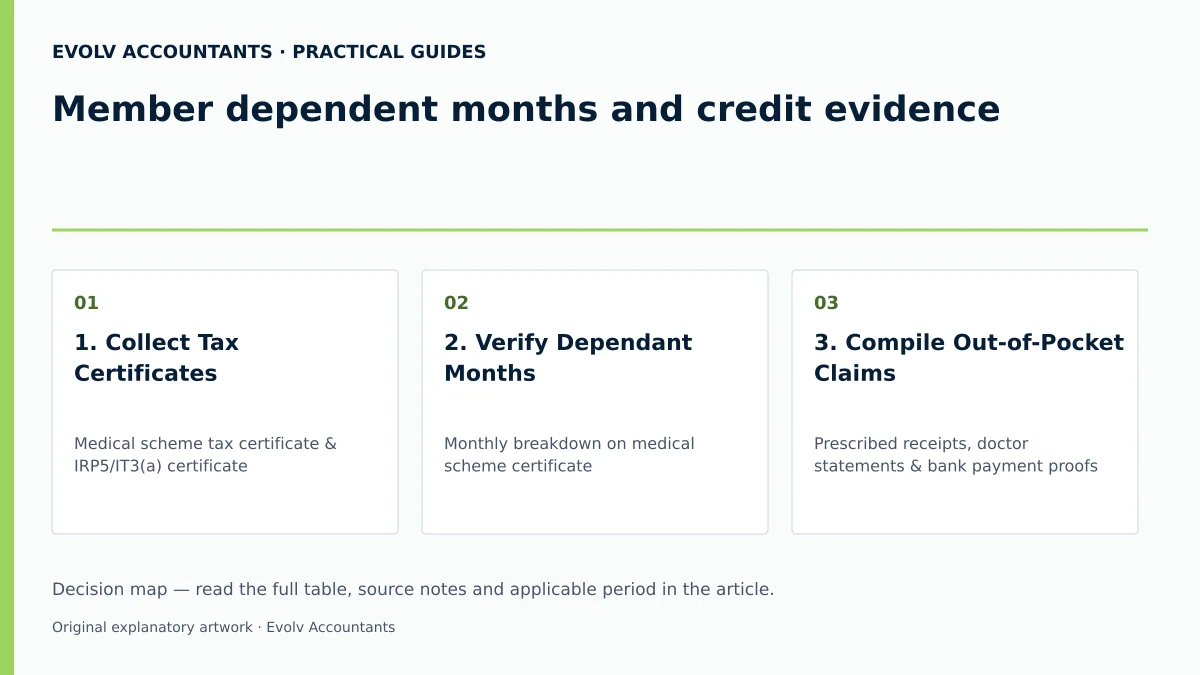
| 1. Collect Tax Certificates | Medical scheme tax certificate & IRP5/IT3(a) certificate 7 16 | Individual Taxpayer / Payroll | Contributions under code 4005 and MTC under code 4116 verified 10 35 36 | Obtain missing or amended certificates from scheme or employer 20 |
| 2. Verify Dependant Months | Monthly breakdown on medical scheme certificate 10 | Individual Taxpayer / Accountant | Active months and dependant counts reconciled 4 10 | Adjust monthly count on ITR12 if changes occurred during year 10 |
| 3. Compile Out-of-Pocket Claims | Prescribed receipts, doctor statements & bank payment proofs 7 16 39 | Individual Taxpayer | Claims exclude gap cover reimbursements & savings account funds 48 49 | Exclude unproven or reimbursed expenses from code 4020 / 4034 claims 17 |
| 4. Confirm Disability Status | Signed, stamped Form ITR-DD from HPCSA medical practitioner 7 40 42 | Medical Practitioner / Taxpayer | Form ITR-DD valid within 10-year (permanent) or 1-year (temporary) limit 41 43 | Re-commission Form ITR-DD if diagnosis period has expired 41 43 |
| 5. Audit Notice of Assessment | Notice of Assessment (ITA34) & eFiling status check 19 57 | Individual Taxpayer / Evolv Tax Advisory | Correct S6A (code 4116) and S6B (code 4120) rebates allowed on ITA34 19 36 | Use the correct correction, extension or dispute procedure and the deadline in the relevant notice; 23 October is the non-provisional filing deadline 20 58 |
Frequently Asked Questions
Can I claim medical tax credits if my employer pays my medical scheme contributions?
Yes. Contributions paid by an employer are treated as a taxable fringe benefit included in your gross remuneration and are deemed to have been paid by you, making you eligible for Section 6A and 6B credits 35 74 75 76.
What is the difference between Section 6A MTC and Section 6B AMTC rebates?
Section 6A MTC is a fixed monthly rebate granted for belonging to a registered medical scheme based on dependant numbers 3 4 47. Section 6B AMTC is an additional rebate calculated on excess scheme contributions and qualifying out-of-pocket medical costs 1 4 50 51 54.
Are gap cover insurance premiums eligible for Section 6A tax credits?
No. Gap cover and hospital plans issued by insurers are not registered medical schemes under the Medical Schemes Act 131 of 1998, so premiums cannot be claimed for MTC 79 80 81 82.
How long must medical expense documents be retained for SARS audit purposes?
All medical certificates, invoices, proof of payment, and receipts must be kept for 5 years from the return submission date 8 11 16. Form ITR-DD disability confirmations must be retained for 10 years from issue 41.
How do MTC rates differ between the 2026 and 2027 years of assessment?
For 2026 (1 March 2025 – 28 February 2026), monthly rates are R364 for the main member/first dependant and R246 per additional dependant 9 14 47. For 2027 (1 March 2026 – 28 February 2027), rates increase to R376 and R254 per month respectively 14 15.
Related guides
- Checking a SARS auto assessment before accepting it
- Maximising Tax Efficiencies via Section 11F Retirement Deductions
- Compliance and Regulations: Keeping Your Business on Track
Sources
- Additional Medical Expenses Tax Credit | South African Revenue Service
- https://www.sars.gov.za/wp-content/uploads/Ops/Guides/IT-AE-36-G05-Comprehensive-Guide-to-the-ITR12-Income-Tax-Return-for-Individuals-External-Guide.pdf
- https://www.sars.gov.za/wp-content/uploads/Ops/Guides/Legal-Pub-Guide-IT07-Guide-on-the-Determination-of-Medical-Tax-Credits.pdf
- Do you need to submit a return? | South African Revenue Service
- Medical Tax Credit Rates | South African Revenue Service
- Updated Guides for Filing Season 2026 | South African Revenue Service
- How does Auto-Assessment work | South African Revenue Service