
Registering a private company with CIPC step by step
8 June 2026

Registering a private company with the CIPC requires submitting statutory incorporation details via the official e-Services portal to obtain an official registration certificate.
Decide the assurance obligation separately from the CIPC filing format. A private company needs a statutory audit at PIS 350 or more, or PIS 100 or more with internally compiled statements, and when another audit trigger applies. The owner-managed exemption does not cancel a mandatory statutory audit. Where no audit is required, test independent review and the section 30(2A) exemption using every securities holder and beneficial-interest holder, not only the registered shareholders.
Statements count as internally compiled unless the regulatory definition of “independently compiled and reported” is met. A company not required to file audited statements may file audited or reviewed AFS; if it does neither, it files FAS. FAS does not replace preparing AFS or obtaining a required review. CIPC annual-return FAQ; Companies Regulations.
For South African small and medium-sized enterprises (SMEs), establishing a private company (Pty) Ltd involves a structured statutory workflow governed by the Companies Act 71 of 2008 and administered electronically by the Companies and Intellectual Property Commission (CIPC) 1 2 3.
Achieving full legal incorporation requires a precise sequence of actions: reserving a company name or opting for an automated enterprise number, populating corporate governance parameters, verifying initial directors against Department of Home Affairs databases, paying the prescribed statutory fee, and completing mandatory post-incorporation compliance including beneficial ownership declarations 4 5 6 7 8.
Understanding the clear boundaries between statutory law, regulatory guidance, and professional accounting recommendations ensures that a new venture achieves immediate operational readiness without compliance defaults.
— Practical point from this guide
CIPC filing sequence and completion certificate
For South African SME incorporators and company directors operating in the 2026/2027 regulatory period, registering a private company is a digital process executed on the CIPC New e-Services platform 2. Completion of company registration does not merely mean submitting online data; legally, a company is not incorporated until the CIPC issues an official Registration Certificate in Form CoR 14.3 3 9 10.
From a legal perspective, Section 14 of the Companies Act 71 of 2008 stipulates that incorporation takes effect on the date specified on the Registration Certificate (Form CoR 14.3) issued by the Commission 10 11. Regulator guidance issued in the CIPC Step-by-Step Guide for New E-Services Company Registration clarifies that once the registration is finalised, the customer who submitted the filing and the appointed directors can download the official registration documents free of charge for 30 calendar days from the date of issue 12.
Evolv Accountants recommends that directors immediately download and securely archive these primary evidence files—including the Form CoR 14.3 Registration Certificate, the Memorandum of Incorporation (MOI), the Web Disclosure notice, and the CIPC Welcoming Letter 12. Relying solely on automated portal confirmation emails is insufficient proof of corporate legal standing when opening commercial bank accounts or registering for tax with the South African Revenue Service (SARS).
Prepare the information and authority: cipc filing sequence
Before initiating the online CIPC filing sequence, incorporators must gather specific statutory inputs, verify personal identification credentials, and establish legal authority.
Mandatory Filing Inputs and Documents
- Company Name or Enterprise Number Option: Incorporators may choose to register a unique corporate name (requiring a prior or simultaneous Name Reservation notice Form CoR 9.4) or proceed without a reserved name, using the automatically assigned registration number with the suffix "(South Africa)" as the temporary legal name 5.
- Memorandum of Incorporation (MOI): Incorporators can adopt the statutory "Short Standard Form" MOI (Form CoR 15.1A) designed for private companies 3 13, or submit a customized "Long Form" MOI (Form CoR 15.1B) 3.
- Director Credentials and Verification: Every private company must have at least one initial director 14. On the New e-Services platform, all initial directors must be South African citizens holding a valid RSA Identity Document or Smart ID Card, as real-time identity verification is performed against the Department of Home Affairs (DHA) database 7 15. If an incorporator or director is a foreign national, manual lodgement with certified passport copies is required 7 16 17.
- Registered Address and Domicilium: The company must specify its official business address, postal address, and enterprise email address 6 18. Under CIPC regulatory rules, the enterprise email address is explicitly regarded as the company's domicilium citandi et executandi for all legal notices served by the Commission 6 18.
- Share Structure and Financial Year-End: Details of authorised share capital (such as 1,000 ordinary shares) and the designated financial year-end month must be defined during input 5 6.
Regulatory Payment Rules
Regulator guidance explicitly notes that on the New e-Services platform, the deposit account system is phased out for company registrations; payments must be made strictly via credit or debit card 4. Furthermore, card payment must be finalised within 5 calendar days of transaction initiation, otherwise the pending transaction is automatically deleted by the CIPC system and must be restarted from the beginning 4 19.
Complete the task step by step: completion certificate
The following numbered checklist details the exact procedural flow required on the CIPC e-Services portal to successfully register a short standard private company and obtain the completion certificate.
- Access and Authenticate: Visit the official CIPC website and select "New E-Services" 2. Log in using your verified customer code and password 2.
- Initiate Company Registration: From the main navigation bar, select Services -> Company Registration, then click + Register a new Company 2.
- Select Company Type and Name Option: Select Private Company (Pty) Ltd from the drop-down menu 5. Choose an approved Name Reservation number (Form CoR 9.4) or select Continue Without Name to incorporate using the automated enterprise registration number 5.
- Capture Enterprise Details: Enter the financial year-end month, enterprise contact number, authorised share quantity, and enterprise email address 6. Acknowledge the CIPC prompt confirming that the enterprise email serves as the official legal domicilium citandi et executandi 6 18.
- Capture Enterprise Location: Input the physical business address, postal address, and location address (if different from the business address) 18.
- Add and Verify Directors: Click + Add Director under Manage Directors 18. Enter each initial director's South African ID number, full names, surname, date of birth, and ID document issue date 7. The platform automatically validates these details against Home Affairs records 7 15. Repeat for all initial directors 18.
- Complete Director Contact & Tax Responsibility: Input cellphone numbers, email addresses, and designate whether the director will be responsible for company tax compliance 7.
- Review, Pay, and Submit: Review the aggregated enterprise summary, proceed to the payment gateway, and settle the statutory fee via credit or debit card within 5 calendar days 4. Upon successful card authorisation, submit the registration 2 4.
- Download Completion Package: Upon processing, download the official Form CoR 14.3 Registration Certificate, Short Standard MOI (CoR 15.1A), Web Disclosure, and Welcoming Letter from the portal within the 30-calendar-day free download window 12.
Reproducible Hypothetical Example
Consider Apex Logistics (Pty) Ltd, a newly established private transport SME incorporated by two directors holding RSA Smart ID Cards. The incorporators select the short standard MOI (CoR 15.1A) with 1,000 ordinary shares and a February financial year-end. They enter their operational premises in Midrand, Gauteng, and designate admin@apexlogistics.co.za as the official enterprise email.
Upon completing Home Affairs ID verification for both directors and settling the statutory registration fee via credit card, CIPC issues Form CoR 14.3 containing enterprise number 2026/123456/07. Apex Logistics immediately downloads its registration certificate within the 30-day window, establishes its company statutory register, and initiates beneficial ownership filing.
Check the result against the evidence: cipc filing sequence
Submitting an online application does not automatically guarantee accepted incorporation. Directors must independently verify completion against primary evidence.
Statutory Evidence of Incorporation
Under Section 14(1)(b) of the Companies Act, the primary legal evidence of company formation is the Form CoR 14.3 Registration Certificate issued under the seal of the Commission 3 9 10. The certificate explicitly states the company name, enterprise registration number, date of incorporation, and registered office details 10 11.
Post-Incorporation Compliance Boundaries
Once registered, a company must satisfy three critical post-incorporation evidence checks:
- CIPC Beneficial Ownership (BO) Filing: Under the General Laws (Anti-Money Laundering and Combating Terrorism Financing) Amendment Act 22 of 2022 (GLAA), all newly incorporated entities must file their beneficial ownership register with CIPC within 10 business days of incorporation 8 20 21 22. This filing captures natural persons holding directly or indirectly 5% or more of beneficial interest or effective control 8 21. 2. 3. Annual Returns & Accounting Commitments: Every company must file an Annual Return (Form CoR 30.1) within 30 business days after the anniversary date of its incorporation 1 23 24 25 26.
Handle exceptions and unresolved cases: completion certificate
Unexpected hurdles or edge cases during company formation require specific escalation pathways.
Common Registration Exceptions
- Failed Home Affairs ID Verification: If the platform fails to verify a director's ID details against Home Affairs, verify that the ID document issue date and marital status match official DHA records exactly 7 15.
- Foreign National Directors: Foreign nationals cannot be verified online via RSA ID; they must complete the CIPC Foreigner Assurance verification process by uploading a certified passport prior to filing 16 27 28 29.
- Payment Lapses: If card payment is not finalised within 5 calendar days, CIPC automatically deletes the transaction 4 19. A new registration workflow must be initiated.
- Missing Download Window: If registration documents are not downloaded within 30 calendar days, the free download access expires, and a fee of R30.00 per document is charged for subsequent downloads 12.
Audit vs Independent Review Requirements
Determining whether a small or medium-sized company requires an independent audit or an independent review depends on the Companies Act 71 of 2008, the Companies Regulations 2011, the compilation method, and the calculation of the company's Public Interest Score (PIS) 30 31 32 33 34 35 36.
Under Regulation 26(2), PIS is calculated annually as the sum of:
- 1 point per average employee during the financial year 31 34 37.
- 1 point per R1 million (or portion thereof) in third-party liabilities at year-end 31 34 37.
- 1 point per R1 million (or portion thereof) in turnover during the financial year 31 34 37.
- 1 point per individual holding a direct or indirect beneficial interest in issued securities 31 34 37.
Statutory Audit Boundaries:
- A private company must be audited if its PIS is 350 or more 32 35 38.
- A private company must be audited if its PIS is at least 100 AND its annual financial statements (AFS) are internally compiled 32 35 38.
- A private company must be audited if it holds assets in a fiduciary capacity for non-related persons exceeding R5 million at any time during the year 32 35 39.
Independent Review Boundaries:
- A private company whose PIS is between 100 and 349 with independently compiled AFS is subject to an independent review conducted under ISRE 2400 33 36 40.
- A private company whose PIS is under 100 with internally compiled AFS is subject to an independent review 33 36 41.
- Statutory Owner-Manager Exemption: Under Section 30(2A) of the Act, if every shareholder of a private company is also a director, the review exemption must be tested using every securities holder and beneficial-interest holder. It cannot override a statutory audit triggered by PIS, compilation method, qualifying fiduciary assets or another mandatory requirement.
Financial Reporting Standards Scope: In terms of Regulation 27, non-public profit companies may adopt the IFRS for SMEs Accounting Standard or full IFRS 45 46. As an overarching framework fact, the International Accounting Standards Board (IASB) updated the IFRS for SMEs Accounting Standard in February 2025, setting an effective date for periods beginning on or after 1 January 2027, while allowing continued application of the 2015 edition in the interim 47.
Next steps for Company formation
To ensure seamless execution, use the practical task checklist below to track incorporation and post-registration compliance responsibilities.
Task and Completion Checklist
| Step | Input or evidence | Responsible person | Completion check | Exception or next action |
|---|---|---|---|---|
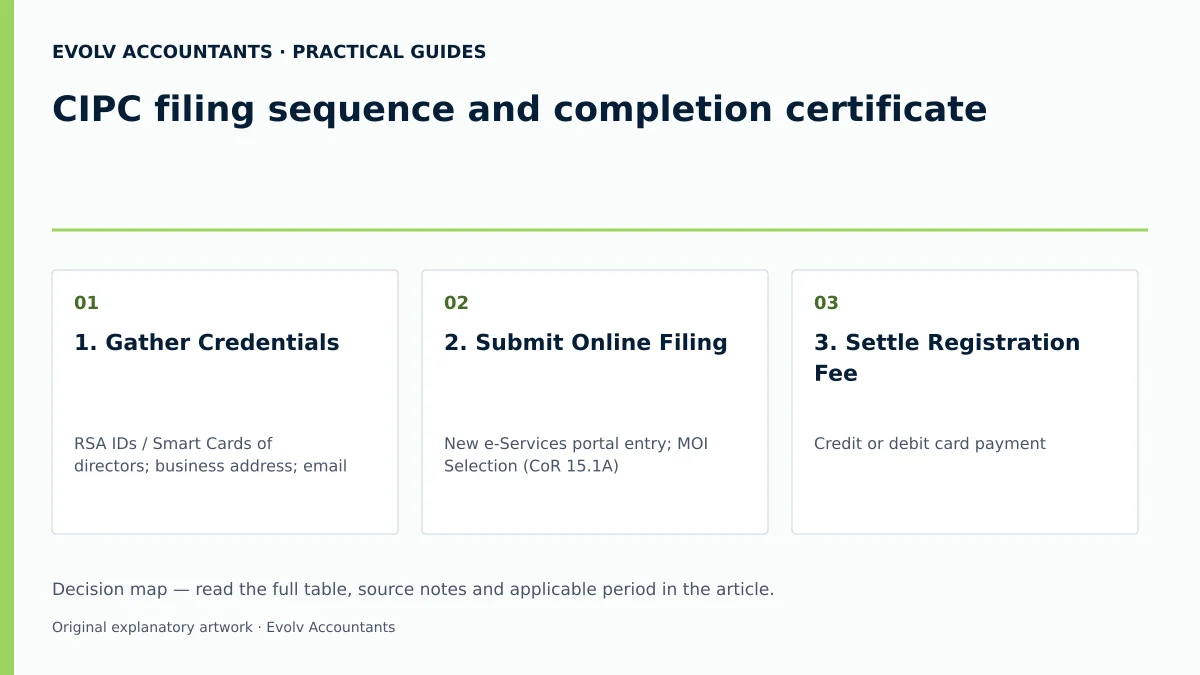
| 1. Gather Credentials | RSA IDs / Smart Cards of directors; business address; email 6 7 | Incorporator / Director | All IDs verified against DHA 7 15 | For foreign nationals, complete Foreigner Assurance first 27 28 |
| 2. Submit Online Filing | New e-Services portal entry; MOI Selection (CoR 15.1A) 2 5 | Incorporator | Form summary generated 6 | Verify domicilium email details before proceeding 6 18 |
| 3. Settle Registration Fee | Credit or debit card payment 4 | Incorporator | Payment authorisation confirmed 4 | Must pay within 5 calendar days to avoid deletion 4 19 |
| 4. Download Completion Package | Form CoR 14.3 Registration Certificate, MOI, Web Disclosure 12 | Directors | Primary PDF files downloaded 12 | Must download within 30 calendar days of issue 12 |
| 5. File Beneficial Ownership | Written signed mandate, Securities Register, natural owner details 8 49 50 | Mandated Filer / Directors | Applicable CIPC certificate or optimised-route confirmation email retained 51 | Complete within 10 business days of incorporation 8 22 |
| 6. Establish Annual Return Calendar | Incorporation anniversary date tracking 1 23 24 | Company Secretary / Accountant | Annual return deadline scheduled 23 24 | File CoR 30.1 within 30 business days of anniversary 23 24 |
Frequently Asked Questions
FAQ 1: How long does a company have to submit its first Beneficial Ownership filing after incorporation?
Under CIPC compliance guidelines, companies incorporated on or after 24 May 2023 are mandated to file their initial Beneficial Ownership declaration within 10 business days of incorporation 8 21 22.
FAQ 2: What happens if payment is not completed within 5 days on the New e-Services platform?
If payment via credit or debit card is not settled within 5 calendar days of starting the transaction, the CIPC system automatically deletes the application, requiring the incorporator to restart the submission 4 19.
FAQ 3: Can a private company be registered with only one director?
Yes. In terms of Section 66(2) of the Companies Act and CIPC incorporation rules, a private company (Pty) Ltd requires a minimum of one initial director 7 14.
FAQ 4: How does a company qualify for the owner-manager audit and review exemption?
Under Section 30(2A) of the Companies Act, if every person holding securities in a private company is also a director of that company, test the review exemption using every securities holder and beneficial-interest holder. A mandatory statutory audit, including one triggered by PIS and compilation method, is not cancelled by owner management.
FAQ 5: Does registering with CIPC automatically complete the company's tax registration?
No. While CIPC transmits registration data to SARS to generate an Income Tax reference number, compliance with CIPC statutory returns and SARS tax filings remain legally distinct processes governed by separate legislation 48.
Related guides
- Deregistration versus liquidation for a small business
- Five Routes for Foreign Investors Establishing in South Africa
- Compliance and Regulations: Keeping Your Business on Track
Sources
- https://annualreturns.cipc.co.za/docs/FAQ_Annual_Returns.pdf
- https://www.justice.gov.za/legislation/acts/2008-071-reg.pdf
- https://www.cipc.co.za//wp-content/uploads/Legal/Regulations/CompaniesAct71_2008.pdf
- https://www.cipc.co.za/wp-content/uploads/2021/03/NEW-E-SERVICES-COMPANY-REGISTRATION-STEP-BY-STEP-GUIDE-V3.3.pdf
- Beneficial Ownership (BO) Filing Compliance Inspections | CIPC
- Beneficial Ownership | CIPC
- https://www.cipc.co.za/wp-content/uploads/Forms/Companies/CoR30_1.pdf
- https://www.cipc.co.za/wp-content/uploads/2024/09/Step-by-step-guide_E-Services-Beneficial-Ownership-Filing-Complex-Structure-Final.pdf
- https://www.cipc.co.za/wp-content/uploads/2024/09/Step-by-step-guide_E-Services-Beneficial-Ownership-Filing-Non-Affected-Company-With-Beneficial-Ownership.pdf
- IFRS - The IFRS for SMEs Accounting Standard