
Deregistration versus liquidation for a small business
14 August 2025

Deregistration removes a company from the register; liquidation is a formal winding-up process. Solvency, assets, debts and outstanding obligations affect the appropriate route.
Choosing between administrative deregistration and formal insolvency requires evaluating entity solvency, outstanding liabilities and statutory compliance duties under South African company law.
Decide the assurance obligation separately from the CIPC filing format. A private company needs a statutory audit at PIS 350 or more, or PIS 100 or more with internally compiled statements, and when another audit trigger applies. The owner-managed exemption does not cancel a mandatory statutory audit. Where no audit is required, test independent review and the section 30(2A) exemption using every securities holder and beneficial-interest holder, not only the registered shareholders.
Statements count as internally compiled unless the regulatory definition of “independently compiled and reported” is met. A company not required to file audited statements may file audited or reviewed AFS; if it does neither, it files FAS. FAS does not replace preparing AFS or obtaining a required review. CIPC annual-return FAQ; Companies Regulations.
Closing a company requires reconciling its debts, assets, registration status and outstanding filings before choosing a route.
— Evolv’s practical recommendation
Administrative deregistration is a CIPC route for an entity that has ceased business and meets the statutory and documentary conditions. Winding-up is a formal process available for solvent as well as insolvent companies. Remaining assets or debts require a proper closure assessment; they do not, by themselves, make every business legally obliged to liquidate immediately.
A distressed company may also need advice on business rescue, a creditor arrangement or another lawful course. Companies Act, sections 79–83 and Chapter 6.
Administrative deregistration versus formal insolvency procedure
Defining Administrative Deregistration
Administrative deregistration is the statutory process whereby the Companies and Intellectual Property Commission (CIPC) removes an enterprise from the active register of corporate entities 9. This action occurs either voluntarily upon application by authorised company representatives when a business has ceased trading and lacks assets, or compulsively by CIPC due to continuous non-compliance with annual return filings 1 10 11 12.
Deregistration terminates the juristic personality of the company, causing the entity to cease to exist in law 7 8 13. Crucially, removal from the register does not extinguish pre-existing liabilities; any personal liability a former director, shareholder or other person already has for earlier acts or omissions survives removal. Deregistration does not automatically turn every company debt into a director’s or shareholder’s personal debt.
Defining Formal Insolvency Procedure
Formal insolvency, encompassed by voluntary or compulsory liquidation, is a statutory judicial process designed to wind up the legal affairs of an enterprise 2 14 15 16. Winding-up applies when a company cannot meet its debts as they fall due or when members resolve to distribute assets and dissolve a solvent entity under Master of the High Court supervision 2 3 17 18 19.
Unlike deregistration, liquidation appoints an independent liquidator who assumes operational authority, liquidates assets, investigates historic transactions, and distributes proceeds to creditors in statutory order of preference 2 5 20 21 22 23. Legal personality terminates only upon final judicial dissolution after complete winding-up 5 9 24.
Compare the criteria that matter: administrative deregistration
Operational Governance, Liability Exposure and Assets
Deciding between closure pathways requires analysing core operational and legal criteria:
- Governance and Decision Control: Voluntary deregistration requires approval from at least at least 50% of active directors or CC members, as stated in the cited CIPC webinar 25 26 27 28. Solvent voluntary liquidation requires a special resolution passed using the applicable special-resolution threshold (ordinarily at least 75% of voting rights exercised, subject to the MOI) 17 18 29 30.
- Director Liability: Deregistration leaves historic claims active against directors individually 5 7 8 13. Liquidation provides a framework for administering and distributing company assets. It does not erase a director’s existing personal liability for earlier acts or omissions; section 83 preserves such liability after removal from the register.
- Asset and Cash Realization: Deregistration requires that an enterprise has zero assets or that asset inadequacy prevents liquidation 1 10 11 31. Any remaining assets of a deregistered company risk reverting to state ownership as bona vacantia unless restored via court or administrative reinstatement 32 33. In liquidation, a liquidator systematically realizes assets for creditor distribution 20 21 23.
- Tax and Regulatory Clearances: Voluntary deregistration mandates that all liabilities, including South African Revenue Service (SARS) tax obligations, are fully settled prior to application 25 26 34.
Statutory Beneficial Ownership and Financial Reporting Rules
Entities evaluating closure must maintain statutory compliance until formal removal or liquidation:
- Beneficial Ownership (BO) Declarations: Under the General Laws Amendment Act 22 of 2022, private companies must file BO records with CIPC within 10 business days of any change, declaring natural persons holding 5% or more beneficial interest or control 35 36 37 38 39 40. Financial Reporting Standards and Audit/Review Rules:* Under Companies Regulation 26(2), entities calculate a Public Interest Score (PIS) incorporating employee count (1 point per average employee), third-party liabilities (1 point per R1 million liability), turnover (1 point per R1 million turnover), and beneficial interest holders (1 point per individual holder) 43 44 45 46. Audit versus Independent Review Thresholds:* An annual audit is mandatory if a company holds fiduciary assets exceeding R5 million, scores a PIS of 350 or more, or scores a PIS of 100 or more with internally compiled financial statements 47 48 49 50. Independent reviews apply to other non-owner-managed private companies under Regulation 29, unless exempted under Section 30(2A) where all shareholders are directors 51 52 53 54. IFRS Framework Scope:* Under Regulation 27, non-public profit entities may apply the International Financial Reporting Standard for Small and Medium-sized Enterprises (IFRS for SMEs), which simplifies full IFRS through five core reductions: omitting irrelevant topics, restricting complex policy options, simplifying measurement rules, reducing disclosures, and using plain English text 55 56 57 58 59 60.
Decision Comparison Matrix
| Criterion | Option A (Administrative Deregistration) | Option B (Formal Insolvency Procedure) | Evidence or assumption | Implication for this reader |
|---|---|---|---|---|
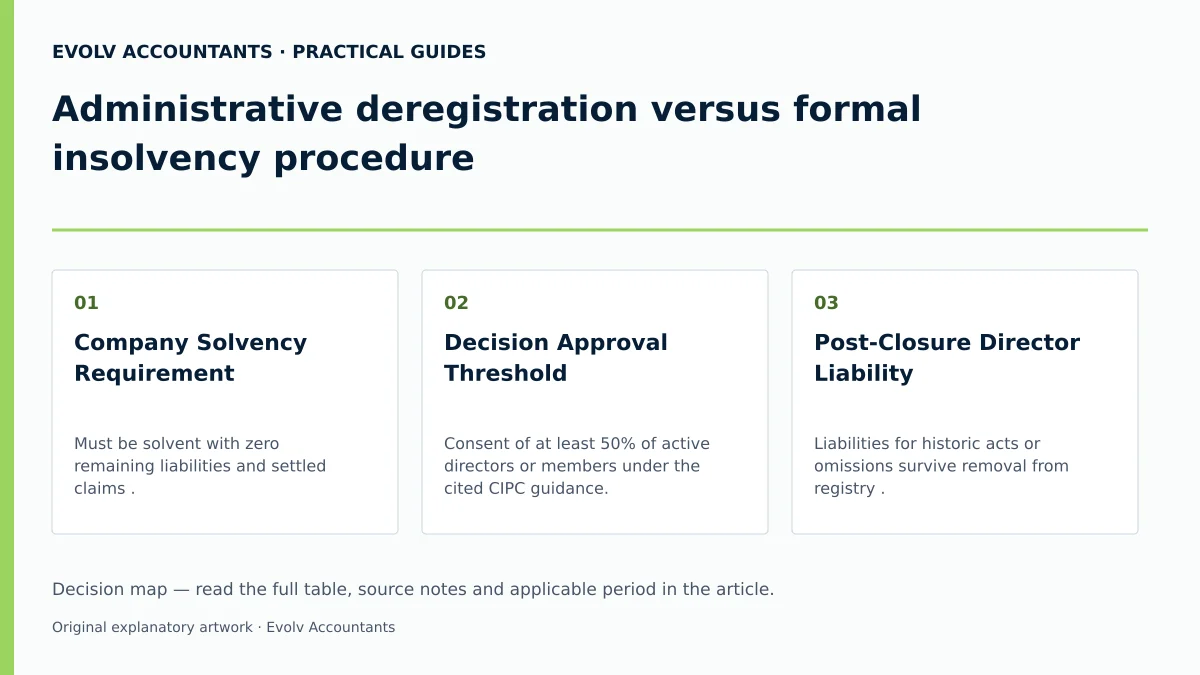
| Company Solvency Requirement | Must be solvent with zero remaining liabilities and settled claims 1 10 11 31. | Available under the applicable winding-up law; solvent and insolvent routes differ. Obtain advice on rescue and other lawful alternatives. | Companies Act 71 of 2008 s80, s81 and s82(3)(b) 1 3 18. | Directors must assess the lawful response to financial distress; continuing recklessly is prohibited. |
| Decision Approval Threshold | Consent of at least 50% of active directors or members under the cited CIPC guidance. | Special resolution supported by the applicable special-resolution threshold, ordinarily 75% of voting rights exercised subject to the MOI 17 18 29 30. | CIPC guide requirements and Companies Act s80(1) 18 27 30. | Apply CIPC’s stated deregistration-request signature condition and the applicable special-resolution rule for solvent voluntary winding-up. |
| Post-Closure Director Liability | Liabilities for historic acts or omissions survive removal from registry 5 6 7 8 64. | Existing personal liabilities for prior acts or omissions survive removal under section 83. | Companies Act s82(1) and s83(2) 8 9. | Deregistration leaves directors exposed to personal creditor claims 5 7 8. |
| Statutory Asset Handling | Entity must possess zero assets or inadequate assets for liquidation 1 10 11 31. | Independent liquidator realizes assets for statutory creditor distribution 20 21 23. | Companies Act s82(3)(b) and s80(5) 1 21 23. | Assets left in deregistered entities risk state forfeiture unless reinstated 32 33. |
| CIPC & SARS Reporting Obligations | All outstanding annual returns, BO records and tax filings must be up to date 25 26 34 65. | Liquidator submits statutory accounts to Master and CIPC during process 9 21 23. | CIPC Practice Notes and Regulations 30 & 40 66 67 68. | Deregistration requires clearing past statutory defaults beforehand 65 66 69. |
How the obligations differ: formal insolvency procedure
Statutory Mechanics of Winding-Up and Liquidation
Formal insolvency procedures are governed strictly by statutory law, regulator administrative directives, and specialized accounting standards:
- Voluntary Solvent Winding-Up (Section 80): Initiated when a solvent company adopts a special resolution to wind up 2 18. Prior to filing Form CoR 40.1, the company must furnish security to the satisfaction of the Master of the High Court for debt payment within 12 months, or obtain Master's consent to dispense with security by submitting a director's sworn statement and an auditor's certificate confirming zero debts 17 18 70 71 72.
- Court-ordered winding-up: Section 81 expressly concerns a solvent company. Insolvent winding-up requires the applicable insolvency and surviving winding-up provisions, including the transitional arrangements in Schedule 5. An insolvency practitioner or lawyer should identify the correct procedure and applicant standing.
- Business Rescue Alternative (Chapter 6): If a financially distressed enterprise retains a reasonable prospect of recovery, directors may pass a resolution under Section 129 to initiate business rescue, placing a temporary moratorium on creditor legal proceedings under Section 133 74 75 76 77 78.
Statutory Law versus Regulator Guidance and Professional Advice
To ensure clear regulatory boundaries:
- Statutory Law (Act of Parliament): Enforceable legislation enacted under the Companies Act 71 of 2008 and General Laws Amendment Act 22 of 2022 establishing legal rights, director duties, and insolvency processes 35 39 40 79.
- Regulator Guidance (CIPC Directives & Practice Notes): Official administrative procedure manuals, step-by-step guides, and practice notes issued by CIPC detailing portal submission protocols, OTP verifications, and document formatting 66 80 81 82.
- Evolv Recommendations: Independent professional accounting, statutory compliance, tax advisory, and payroll recommendations provided by Evolv to guide SME leadership through compliance risk assessments and formal filings.
Two business situations with different outcomes: administrative deregistration
Reproducible Hypothetical Scenarios
To illustrate how identical financial metrics yield contrasting legal outcomes based on debt liabilities, consider two hypothetical small private enterprises operating in South Africa:
- Scenario A (Dormant Clean Entity — Evolv Client Example A):
- Financial Profile: Annual turnover of R0 (illustrative value), third-party liabilities of R0 (illustrative value), average workforce of 0 employees (illustrative value), and 2 natural person shareholders acting as directors.
- Public Interest Score: Calculated under Regulation 26(2) as 0 (employees) + 0 (liabilities) + 0 (turnover) + 2 (shareholders) = 2 points (illustrative value) 43 44 46.
- Compliance Status: Tax filings fully cleared with SARS; all prior CIPC annual returns and 5% beneficial ownership declarations submitted 25 26 34 65 83.
- Applicable Outcome: Voluntary administrative deregistration under Section 82(3)(b) 1 10 11. The board passes a resolution with 100% consent, submits a deregistration request letter confirming dormancy and zero assets, and CIPC processes removal without creditor objection 25 26 34.
- Scenario B (Distressed Over-Indebted Entity — Evolv Client Example B):
- Financial Profile: Annual turnover of R800,000 (illustrative value), third-party trade creditor liabilities of R450,000 (illustrative value), remaining inventory/assets valued at R50,000 (illustrative value), average workforce of 3 employees (illustrative value), and 2 natural person shareholders.
- Public Interest Score: Calculated under Regulation 26(2) as 3 (employees) + 1 (liability portion) + 1 (turnover portion) + 2 (shareholders) = 7 points (illustrative value) 43 44 46.
- Compliance Status: Inability to pay trade debts as they fall due in the ordinary course of business; factual liabilities exceed assets 61 62 84 85.
- Applicable Outcome: Formal insolvent liquidation or business rescue 2 3 17 18 61 62 76 78. Attempting administrative deregistration is legally prohibited due to existing liabilities and assets 1 10 11 31. Continuing to trade while insolvent exposes directors to claims for reckless trading under Section 22 and personal liability under Section 77 61 62 63 86 87. The company must initiate formal court liquidation or negotiate creditor compromise 3 17 88 89.
When the comparison needs specialist input: formal insolvency procedure
Complex Triggers Requiring Professional Advice
Certain technical legal, tax, and accounting circumstances necessitate specialist advisory input from Evolv before initiating entity closure:
- Reportable Irregularities: If an independent reviewer identifies unlawful acts, fraud, or trading under insolvent circumstances, the reviewer must submit a first report to CIPC and notify the board, triggering statutory inquiry protocols under Regulation 29(6) 90 91 92 93 94 95.
- Complex Multi-Tier Beneficial Ownership: Enterprises featuring juristic corporate shareholders or trust structures must navigate complex tier declarations under CIPC e-services, requiring verified mandates signed by 50% plus one directors 27 82 96 97.
- Director Delinquency and Misconduct Risks: Directors facing potential delinquency applications under Section 162 for gross negligence or breach of fiduciary duty require formal legal and insolvency advice 98 99 100 101 102 103 104.
- Disputed Tax Liabilities and SARS Audits: Unresolved tax assessments or pending SARS compliance audits prevent voluntary deregistration, as CIPC receives objections from SARS if tax liabilities remain open 25 26 34.
Next steps for Company closure
Numbered Checklist for Action
- Determine Entity Solvency: Perform the Solvency and Liquidity Test under Section 4(1) based on accurate accounting records and financial statements 84 85 105 106.
- Audit Statutory Returns: Verify that all historic CIPC Annual Returns and 5% Beneficial Ownership declarations are fully updated on CIPC portals 35 36 65 66.
- Conduct Asset and Liability Audit: Confirm whether the entity holds zero assets and zero debts (qualifying for deregistration) or possesses remaining liabilities/assets (requiring formal liquidation) 1 10 11 31.
- Draft Internal Decision Record: Prepare formal board minutes reflecting director consensus (at least 50% under the cited CIPC guidance) or a special resolution using the applicable voting threshold for solvent winding-up 17 18 25 26 27 30.
- Engage Evolv Compliance Specialists: Share relevant company financial statements, securities registers, and tax clearance status to scope professional statutory compliance support.
Frequently Asked Questions
Does administrative deregistration clear director personal liability for past debts?
No. Removal of a company's name from the CIPC register does not affect or discharge the liability of any former director or shareholder for acts or omissions that took place prior to deregistration 5 6 7 8 64. Existing personal liabilities continue and may be enforced as if removal had not occurred; section 83 does not automatically impose every company debt on every former director.
How does CIPC beneficial ownership reporting differ from SARS tax declarations?
CIPC company filings and SARS tax returns are separate compliance duties administered under different legislation. Check each regulator’s requirements; filing with one does not complete the other. CIPC annual-return guidance.
When does a small private company require an independent review rather than an audit?
A private company requires an audit if it holds fiduciary assets exceeding R5 million, scores a Public Interest Score (PIS) of 350 or more, or scores a PIS of 100 or more with internally compiled financial statements 47 48 49 50. If a private company is not required to be audited and is not exempt under Section 30(2A) (owner-managed where all shareholders are directors), it must undergo an independent review under Regulation 29 51 52 53 54.
Can a deregistered company be reinstated?
Yes. Under Section 82(4) and Regulation 40(7), any interested person may apply to CIPC using Form CoR 40.5 to reinstate a deregistered entity 33 107 108 109 110. Reinstatement requires demonstrating that the entity was operational or held economic value at the time of deregistration, accompanied by settlement of outstanding annual returns and statutory filings 108 109 111 112 113.
What happens to company assets if an entity is administratively deregistered?
If a company is deregistered while still holding property or assets, those assets risk becoming bona vacantia (unowned property) and reverting to state custody 32 33. To deal with remaining assets legally, the company must either be reinstated via CIPC/court order or dissolved through formal liquidation where a liquidator distributes assets to creditors and shareholders 20 21 23 32 33 114.
Related guides
- Authorising an accountant to submit beneficial ownership
- Registering a private company with CIPC step by step
- Compliance and Regulations: Keeping Your Business on Track
Sources
- https://annualreturns.cipc.co.za/docs/FAQ_Annual_Returns.pdf
- https://www.justice.gov.za/legislation/acts/2008-071-reg.pdf
- https://www.cipc.co.za//wp-content/uploads/Legal/Regulations/CompaniesAct71_2008.pdf
- Beneficial Ownership (BO) Filing Compliance Inspections | CIPC
- Beneficial Ownership | CIPC
- https://www.cipc.co.za/wp-content/uploads/2024/09/Step-by-step-guide_E-Services-Beneficial-Ownership-Filing-Complex-Structure-Final.pdf
- https://www.cipc.co.za/wp-content/uploads/2024/09/Step-by-step-guide_E-Services-Beneficial-Ownership-Filing-Non-Affected-Company-With-Beneficial-Ownership.pdf
- https://www.sars.gov.za/wp-content/uploads/Docs/Webinarsuppdocs/SMME-Webinar-Deregistration_CIPC_06032025.pdf
- https://www.gov.za/sites/default/files/gcis_document/202212/47815anti-moneylaunderingact22of2022.pdf
- https://www.cipc.co.za/wp-content/uploads/Forms/Companies/CoR30_1.pdf
- IFRS - The IFRS for SMEs Accounting Standard
- https://www.cipc.co.za/wp-content/uploads/2025/01/PRACTICE-NOTE-DEREGISTRATIONS_v1.1-1.pdf