
Authorising an accountant to submit beneficial ownership
4 July 2025

Authorising an accountant to submit beneficial ownership requires a formal written mandate from company directors to ensure compliant filing without sharing online account credentials.
CIPC’s filing guides use a 5% reporting norm for percentage interests. That administrative guidance must be distinguished from the Act: the express 5% securities-register rule in section 56(7)(aA) applies to affected companies, while the definition of a beneficial owner also covers board appointment rights and material influence. Do not treat a holding below 5%, or the absence of shares, as a universal exemption from identifying effective control.
Assess the actual rights and the correct affected/non-affected category before filing. Read the statutory amendments.
South African small and medium-sized enterprises (SMEs) are required to maintain statutory transparency by declaring their ultimate natural person owners to the Companies and Intellectual Property Commission (CIPC) 1 2. Rather than sharing administrative login details or portal passwords, company directors can lawfully empower an independent accounting professional to act as an authorised filer using the practitioner's own CIPC customer code 1 3 4.
This formal delegation is established via a signed director resolution or mandate letter executed on the entity's letterhead 3 4 5. Evolv Accountants recommends implementing a structured governance mandate to enable seamless statutory compliance, payroll, tax advisory, and secretarial support while upholding strict credential security and statutory compliance under the Companies Act 71 of 2008 3 6.
— Practical point from this guide
Submission authority without password sharing
For South African SME directors and close corporation members, statutory compliance requires submitting accurate beneficial ownership declarations to CIPC across required annual filing windows or within statutory timeframes following any corporate ownership change 7. Under South African company law and regulatory guidelines, completing this task means acquiring official, verifiable CIPC filing evidence rather than merely completing portal data entry fields 8 9.
A critical legal and operational boundary exists between company regulatory filings and tax administration reporting. CIPC company beneficial ownership filing is a corporate transparency mandate governed by the Companies Act 71 of 2008 1 6. Directors must ensure that corporate secretarial authorisations for CIPC are handled under corporate law standards.
Corporate decisions regarding annual audits, independent reviews, or compilation engagements are determined by a company's Public Interest Score (PIS), statutory regulations, compilation methods, and specific accounting framework exemptions set out in the Companies Act 10 11. While public financial reporting frameworks such as IFRS for SMEs define accounting standards, CIPC beneficial ownership declarations focus strictly on identifying natural persons who ultimately own or control the enterprise 1 7 12.
Evolv Accountants advises SME leadership that statutory authorisation should never involve transferring personal portal passwords. Authorised filers transact using their own CIPC profiles, ensuring full traceability and governance integrity 1 3 4.
Prepare the information and authority: submission authority without password sharing
Before an accountant can lodge a beneficial ownership declaration on behalf of an enterprise, specific authority documents, registers, and identity verification inputs must be compiled.
Documented Mandate Requirements
CIPC regulations strictly govern the mandate that grants an accountant authority to file on behalf of an enterprise 13 14 15 16:
- Format and Letterhead: The mandate must be a written document (letter, director resolution, or power of attorney) drafted on the official letterhead of the declaring company or close corporation 3 4 5 14 16.
- Singular Natural Person Filer: Authority must be granted to a singular natural person (the specific accountant or compliance practitioner) who possesses an active CIPC customer code, rather than to a generic juristic firm name 3 4.
- Filer Details: The mandate must explicitly state the full name, surname, and identity (ID) or passport number of the mandated filer 3 4.
- Execution Threshold: CIPC guidance specifies that the mandate must be "signed by at least 50% +1 of the directors of the company" 3 (representing an ordinary resolution) or by all members of a close corporation 3 4.
- Filer Identification: A certified copy of the mandated filer's ID or passport (dated within 3 months) must accompany the mandate submission 3 4 17 18.
Required Supporting Documents
Depending on the corporate structure, the mandated accountant must be provided with the following supporting documentation 5 17 18 19 20:
- Beneficial Owner Identification: Certified copies of ID documents or passports for all natural person beneficial owners, certified by a Commissioner of Oaths or notary within the preceding 3 months 17 18 19 20.
- Securities or Members Register: A complete, updated securities register or beneficial interest register established under Section 56(7)(aA) of the Companies Act 5 18 19 20.
- Complex Structure Diagram: For entities with multi-tiered juristic shareholders or trust holdings, a signed disclosure form containing a diagrammatic structure map depicting the ownership chain up to the ultimate natural person beneficial owners 5 18.
Statutory Definitions and Ownership Thresholds
- Direct vs Indirect Beneficial Ownership: Direct beneficial ownership occurs when a natural person holds shares directly as a registered shareholder 21. Indirect beneficial ownership occurs when a natural person holds beneficial interest or effective control through bank/broker nominees, holding companies, or trust arrangements 21 22 23 24.
- The 5% Threshold Rule: Under CIPC regulations, any natural person who directly or indirectly holds 5% or more of beneficial interest in securities, voting rights, board appointment rights, or effective managerial control must be declared 1 2 7 12 25. Total declared ownership across the register must aggregate to 100%, Effective control must still be assessed independently of the percentage holding.
- Mandatory Entity Scope: Profit companies, non-profit companies (NPCs), external companies, and close corporations (CCs) are legally required to file beneficial ownership registers 26 27.
Complete the task step by step: documented completion and exceptions
Submitting beneficial ownership details without sharing credentials follows an online workflow on the CIPC e-Services platform 28 29 30. The mandated accountant executes the sequence using their professional customer credentials.
Sequenced Submission Workflow
- Portal Login: The mandated accountant logs into CIPC New E-Services (eservices.cipc.co.za) using their personal CIPC Customer Code and Password 28 29 30. Directors must never disclose their personal account details 1 31.
- Service Navigation: The filer selects Transact, clicks on Beneficial Ownership, and accepts the legal terms and non-compliance warnings under Section 214 of the Companies Act 6 28 29 30.
- Enterprise Selection & Contact Verification: The filer searches for the company using its enterprise registration number 32 33 34. The portal displays masked contact details (mobile number and email) registered to the customer profile to which One-Time Pins (OTPs) will be dispatched 34 35 36 37. *(Note: If contact details are outdated, they must be updated via the customer profile link prior to filing, which requires a 48-hour system propagation window before filing can proceed 37 38).*
- Mandate Upload: Under standard filing paths, the filer selects Choose File and uploads the signed director mandate on company letterhead 32 33 39 40.
- Category Classification: The filer selects the appropriate company category: Non-Affected Company WITH Beneficial Ownership to Declare (or Affected Company if subject to regulated takeover rules) 38 41 42.
- Ownership Details Capture:
- First-Tier Juristic Entities: For multi-tiered structures, the filer selects Juristic to log intermediate corporate entities or trusts 7 43 44.
- Natural Persons: The filer captures each natural person beneficial owner's SA ID number or foreign passport number, date of birth, contact details, residential address, and specific interest type (Shareholding %, Voting Rights %, Board Appointment rights, or Material Control) 45 46 47 48 49 50. SA ID numbers automatically verify against the Department of Home Affairs (DHA) database 26 27 46 49.
- Document Ingestion: The filer uploads mandatory supporting attachments: certified IDs/passports (dated within 3 months), original signed mandate, securities/beneficial interest register, and complex structure diagram (if applicable) 5 17 18 19 20.
- OTP Submission & Verification: The filer submits the transaction. The portal dispatches SMS and Email OTPs to the filer 35 36 51. The filer enters the SMS OTP (prefixed with capital 'S') and/or Email OTP (prefixed with capital 'E') in the verification modal to validate the submission 52 53 54.
- Finalisation: The filer clicks Finish to complete the filing transaction 8 9 53.
- [SME Board / CC Members]
- ▼ (Signs 50%+1 Mandate on Company Letterhead)
- [Authorised Accountant]
- ▼ (Logs into CIPC using Accountant's own Customer Code)
- [CIPC e-Services Portal] ► (Uploads Mandate + Certified IDs + Registers)
- ▼ (OTP Verification via SMS/Email)
- [CIPC Evidence Output] ► (Beneficial Ownership Certificate OR Email Notification)
Reproducible Hypothetical Example
(Illustrative Values Labelled)
- Entity: Apex Industrial Solutions (Pty) Ltd (Enterprise Registration No. 2022/987654/07).
- Capital Structure: 100 authorised and issued ordinary shares.
- Shareholders:
- Natural Person A holds 40 ordinary shares (40% direct beneficial ownership).
- Natural Person B holds 40 ordinary shares (40% direct beneficial ownership).
- Holding Co (Pty) Ltd holds 20 ordinary shares (20% corporate shareholder). Holding Co is 100% owned by Natural Person C.
- Analysis:
- Natural Person A (40% direct) and Natural Person B (40% direct) exceed the 5% threshold and must be declared 1 7 12.
- Natural Person C holds 20% indirect beneficial ownership through Holding Co (Pty) Ltd, exceeding the 5% threshold, and must be declared via a 1st-tier juristic person capture and structure disclosure diagram 5 7 21.
- Execution:
- The board of Apex Industrial Solutions adopts an ordinary resolution signed by 2 out of 2 directors (100%, satisfying the 50%+1 rule) authorising Compliance Practitioner Jane Doe (CIPC Customer Code: JD12345) 3 4.
- Jane Doe uploads the letterhead mandate, certified IDs of Persons A, B, C, and herself (all certified within 3 months), the securities register, and the group structure diagram to CIPC 5 17 18 19.
- Jane verifies the filing using her OTP, securing compliant submission without Apex directors ever revealing their login credentials 1 31 52 54.
Check the result against the evidence: submission authority without password sharing
Directors must verify submission completion by inspecting independent primary evidence rather than assuming portal data entry equals legal compliance.
Primary Evidence Types
- Standard Filing Certificate (Declared Beneficial Ownership):
- For Non-Affected Companies WITH declared beneficial ownership, CIPC issues an official Beneficial Ownership Certificate (PDF format) 8 55 56.
- The certificate displays the CIPC reference number, enterprise details, and confirmed beneficial owners 8 9 53.
- It is downloadable directly from the Completed Applications grid on the e-Services portal and is automatically emailed to the mandated filer from QA@cipc.co.za 8 9 53.
- Optimised System Email Confirmation (No Beneficial Ownership to Declare):
- For non-affected entities with no beneficial ownership outside direct registered directors/members (and with 10 or fewer directors/members using the CIPC Optimised BO system), CIPC does not issue a downloadable certificate 9 57 58.
- Compliance is evidenced solely by an official CIPC E-mail Filing Notification sent to the filer and enterprise, confirming receipt of the non-affected declaration 9 58.
Unprocessed Status Warnings
Filings listed in portal grids as In Progress, Draft, Pending OTP, or Nullified / Rejected do not constitute valid legal filings 59 60 61 62 63 64. Directors must ensure their accountant provides the final PDF certificate or official CIPC confirmation email.
Handle exceptions and unresolved cases: documented completion and exceptions
statutory compliance requires handling specific edge cases, portal system blocks, and statutory boundaries.
Enterprise Status Restrictions
CIPC rules dictate which enterprise statuses may or may not perform beneficial ownership filings 28 30 65 66:
- Allowed Statuses: Entities with statuses of In Business, Business Rescue, or AR Deregistration Process (entities undergoing deregistration due to annual return non-compliance) are legally active and permitted to file beneficial ownership 28 29 30 65 66 67 68.
- Disallowed Statuses: Entities in Final Deregistration, Voluntary Deregistration Process, Final Liquidation, Voluntary Liquidation, Provisional Liquidation, Suspended, Dissolved, or undergoing corporate conversion cannot file beneficial ownership declarations 65 66 69 70.
Missing System Information and Validation Failures
- Blank or Zero Authorised Securities: In the Optimised BO platform, if a company's authorised securities fields display blank or zero on CIPC records, the portal blocks filing 71. Filers cannot proceed online and must email certified proof of authorised shares to beneficialownershipenq@cipc.co.za for manual record updating prior to filing 71.
- Issued Securities Exceeding Authorised Limits: The portal enforces strict validation rules. If captured issued shares exceed total authorised shares recorded on CIPC systems, the portal generates a Validation Failure error 72. Share registers must be reconciled before refiling.
- Offline Home Affairs Verification: If the Department of Home Affairs (DHA) database is offline during filing, the ID verification indicator displays red; however, CIPC permits submission to proceed for queue processing 73 74.
- Foreign Beneficial Owners: Foreign citizens holding beneficial interest must provide notarised or Commissioner of Oaths certified passport copies (dated within 3 months) 17 18 26 27.
Legal Liabilities Under the Companies Act
Section 214 of the Companies Act provides for criminal prosecution and statutory penalties against individuals or juristic entities for reckless conduct, non-compliance, or deliberately providing false or misleading statements in CIPC declarations 6 75. Proper written mandates protect both directors and practitioners by establishing clear accountability.
Next steps for Beneficial ownership
SME management should follow this structured checklist to ensure compliant delegation and filing:
- Review Ownership Registers: Audit your current securities register to identify all natural persons holding 5% or more direct or indirect beneficial interest, voting rights, or control 1 7 12 25.
- Draft Company Mandate: Prepare a written mandate on company letterhead naming the specific accounting practitioner and their CIPC customer code 3 4 5 14 16.
- Execute Board Resolution: Secure signatures from at least 50% + 1 of company directors or all close corporation members 3 4.
- Compile Certified Documents: Obtain certified ID/passport copies for all beneficial owners and the mandated filer, ensuring certification dates are within 3 months 3 4 17 18 19.
- Lodge Online Submission: Instruct your authorised accountant to log into CIPC using their credentials, upload records, and complete OTP verification 28 29 30 39 52 53 54.
- Archival & Verification: Retrieve and archive the official CIPC Beneficial Ownership Certificate or CIPC confirmation email in your corporate records 8 9 58.
Task and Completion Checklist
| Step | Input or evidence | Responsible person | Completion check | Exception or next action |
|---|---|---|---|---|
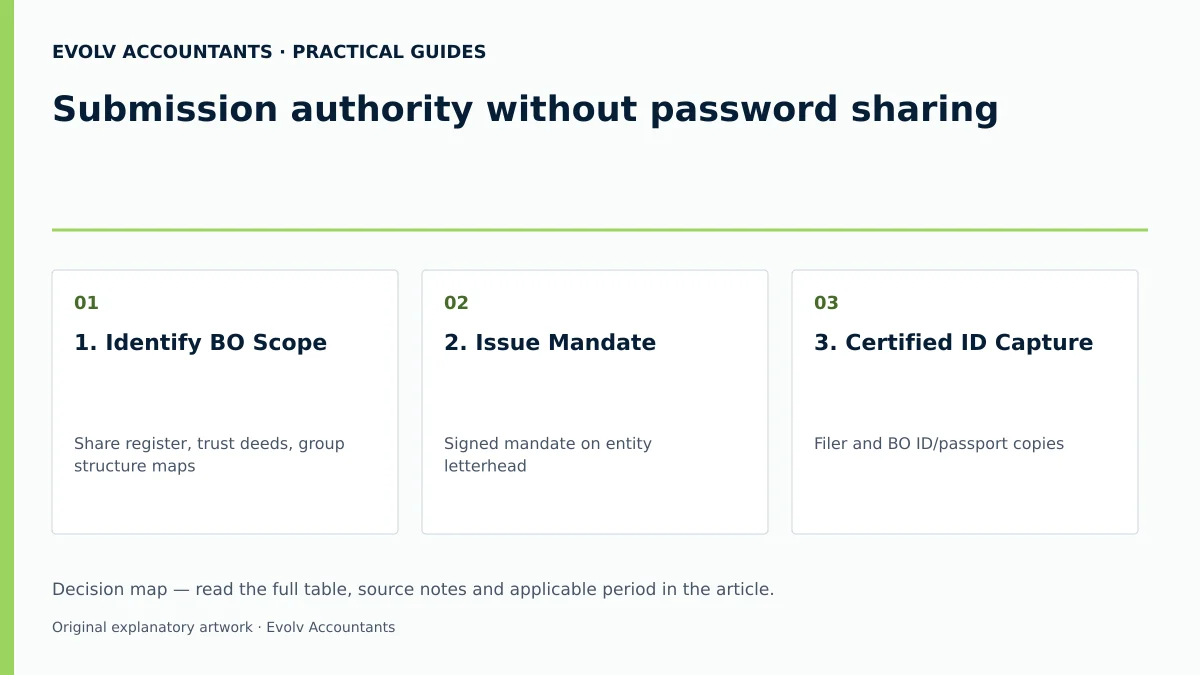
| 1. Identify BO Scope | Share register, trust deeds, group structure maps | Company Directors / CC Members | Reportable percentage interests and other ultimate natural-person control identified 1 7 12 | If complex tiers exist, draft visual disclosure diagram 5 18 |
| 2. Issue Mandate | Signed mandate on entity letterhead 3 4 5 16 | SME Board / CC Members | Signed by ≥ 50%+1 directors or all CC members 3 4 | Ensure filer's individual CIPC customer code is stated 3 4 |
| 3. Certified ID Capture | Filer and BO ID/passport copies 17 18 19 20 | Beneficial Owners / Filer | Certification stamp date ≤ 3 months old 17 18 19 20 | Use the certified or notarised passport evidence accepted by CIPC 17 18 26 27 |
| 4. Online Submission | CIPC e-Services login & data capture 28 29 30 | Mandated Accountant | Standard-route files uploaded, or optimised inline register completed 5 39 40 | If profile contact details change, wait 48 hrs for OTP reset 37 38 |
| 5. OTP Validation | SMS / Email OTP confirmation modal 35 36 51 | Mandated Accountant | OTP verification completed as required for the selected route; the optimised route accepts SMS or email 52 53 54 | Resend OTP if dispatches fail or expire 35 36 51 |
| 6. Verification Archive | CIPC BO Certificate or CIPC Confirmation Email 8 9 58 | SME Leadership / Accountant | Certificate / Email stored in statutory records 8 9 58 | If blocked by zero authorised shares, email CIPC support 71 |
Frequently Asked Questions
Q1: Can our company share our CIPC portal login credentials with our accountant?
No. Password sharing is unsafe and unnecessary 1 31. Under CIPC guidelines, authorised accountants submit beneficial ownership declarations using their own personal CIPC customer code and login details, backed by your signed letterhead mandate 1 3 4.
Q2: What threshold triggers a beneficial ownership declaration?
Any natural person who directly or indirectly owns, controls, or holds a beneficial interest of 5% or more in a company's securities, voting rights, or board appointment power must be declared to CIPC 1 7 12 25. Total declared interest must aggregate to 100% 7 12 25.
Q3: What happens if the Department of Home Affairs (DHA) verification is offline when filing?
If the DHA system is offline during filing, the ID verification status box displays red on the CIPC portal; however, CIPC allows the filing submission to proceed for queue processing 73 74.
Q4: Does CIPC issue a Beneficial Ownership Certificate for all filings?
No. CIPC issues a downloadable PDF Beneficial Ownership Certificate for Non-Affected Companies WITH declared beneficial ownership 8 55 56. For entities using the CIPC Optimised BO platform (non-affected entities without indirect BO and ≤ 10 directors/members), no certificate is generated; compliance is confirmed via an official CIPC confirmation email 9 57 58.
How do CIPC filings relate to SARS filings?
CIPC corporate filings and SARS tax filings are separate duties. Check each against the relevant regulator’s requirements; completing one does not complete the other. Primary guidance. Ask Evolv about submission authority without password sharing. Share the relevant records so the support required can be scoped.
Related guides
- Financial accountability supplements for small companies
- Who counts as a beneficial owner of a private company
- Compliance and Regulations: Keeping Your Business on Track
Sources
- https://www.gov.za/sites/default/files/gcis_document/202212/47815anti-moneylaunderingact22of2022.pdf
- https://www.cipc.co.za/wp-content/uploads/2024/09/Step-by-step-guide_E-Services-Beneficial-Ownership-Filing-Complex-Structure-Final.pdf
- https://www.cipc.co.za/wp-content/uploads/2024/09/Step-by-step-guide_E-Services-Beneficial-Ownership-Filing-Non-Affected-Company-With-Beneficial-Ownership.pdf
- https://www.cipc.co.za/wp-content/uploads/2025/10/Step-by-step-guide-OPTIMIZED-BO-FILING-Final.pdf
- https://www.cipc.co.za//wp-content/uploads/Legal/Regulations/CompaniesAct71_2008.pdf
- https://annualreturns.cipc.co.za/docs/FAQ_Annual_Returns.pdf