
Who counts as a beneficial owner of a private company
23 September 2026

A beneficial owner of a South African private company is an individual who directly or indirectly ultimately owns the company or exercises effective control over it 1 2.
Definition and filing scope. The 2022 amending Act introduced the beneficial-owner definition covering ultimate natural-person ownership or effective control. CIPC’s Notice 36 of 2026 states a 5% ownership and/or control threshold for reporting.
Assess the relevant control routes and the applicable filing category; the filing threshold is not a substitute for tracing the natural person behind the ownership structure.
Following corporate transparency mandates enacted to combat money laundering, every private company registered in South Africa must identify and disclose its ultimate natural-person owners 1 3 4. Under Section 1 of the Companies Act 71 of 2008, as amended by the General Laws (Anti-Money Laundering and Combating Terrorism Financing) Amendment Act 22 of 2022 (GLAA), a beneficial owner must always be a natural person 1 2 5 6.
While the statutory legal definition broadly encompasses any natural person who ultimately owns or exercises effective control through equity, voting rights, board appointments, holding structures, trusts, or material management influence CIPC’s beneficial-owner definition, operational guidance from the Companies and Intellectual Property Commission (CIPC) in Notice 36 of 2026 establishes a 5% threshold of ownership or control for filing beneficial ownership declarations 5 7 8 9.
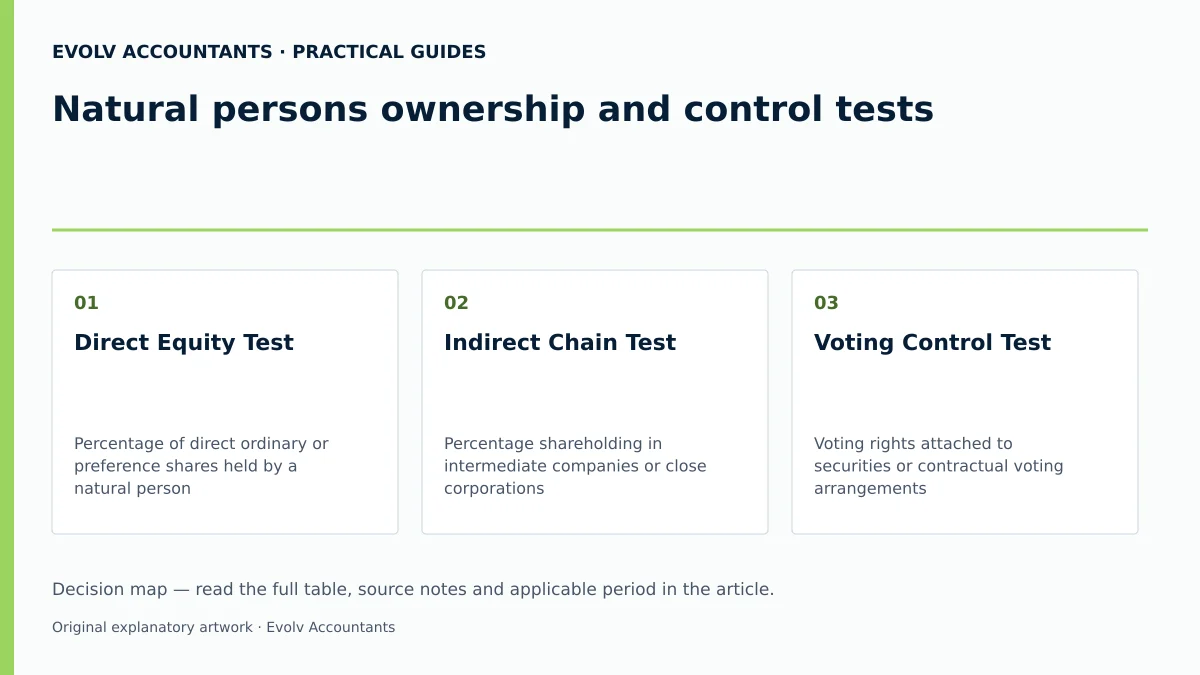
Natural persons ownership and control tests
Reader scope and entity applicability
This guide is structured for directors, public officers, and compliance leads of South African small and medium-sized enterprises (SMEs), including private companies and close corporations 7 8 10 11 12. It is vital to separate general company registration from beneficial ownership eligibility 1 2 5. A juristic person, such as a company or trust, can hold shares on a securities register, but it can never be declared as an ultimate beneficial owner 5 13 14.
Beneficial ownership declarations pertain strictly to natural persons 1 2 5 14.
Statutory effective period and regulatory timeline
The statutory legal mandate collecting beneficial ownership details was enacted under GLAA 22 of 2022 1 4 15. The CIPC officially launched the Beneficial Ownership Register on 1 April 2023, making beneficial ownership submissions mandatory for all corporate entities from 24 May 2023 4.
Distinguishing law, regulator guidance and Evolv recommendations
A critical compliance distinction exists between statutory law, regulator guidelines, and professional recommendations:
— Practical point from this guide
- Statutory legal definition: Section 1 of the Companies Act 71 of 2008 (as amended by GLAA 22 of 2022) broadly defines a beneficial owner as any individual who directly or indirectly ultimately owns a company or exercises effective control 1 2 6 16. The unamended 2008 Act did not contain a universal 5% threshold definition 6 15.
- CIPC reporting guidance: Under CIPC Notice 36 of 2026 and e-services user guides, the regulator enforces a 5% threshold of ownership or control for mandatory beneficial ownership reporting 5 7 8 9. Holdings or control below 5% need not be reported in the CIPC register 5 9.
- Evolv recommendation: SMEs should maintain an internal register recording all natural-person interest holders, while applying CIPC's 5% threshold to determine mandatory electronic declarations 5 7 17 18.
The qualification tests to check: natural persons ownership
Direct and indirect equity ownership tests
To determine who qualifies as a beneficial owner, private companies must apply six independent qualification tests CIPC’s beneficial-owner definition:
- Direct beneficial interest in securities: Holding beneficial interest in issued shares of the company directly in the individual's name 2 6 19 20.
- Indirect ownership through intermediate chains: Holding beneficial interests in shares through intermediate companies, close corporations, or holding structures 5 13 19 21 22 23.
Non-share control tests and governance routes
Control can also be established through non-share governance and contractual mechanisms CIPC’s control routes:
- Control over voting rights: Exercising, or controlling the exercise of, voting rights associated with company securities 6 20 21.
- Right to appoint or remove directors: Holding the right to appoint or remove members of the board of directors, or controlling that appointment power 6 20 21.
- Control through trust arrangements: Exercising effective control or holding ultimate interest through a trust instrument 21 22 24 25 26. For trusts holding shares, beneficial owners include trust settlors, trustees, named beneficiaries, protectors, or individuals exercising ultimate control over trust property 21 22 24 25 27 28 29 30.
- Material influence over management: Possessing the power to otherwise materially influence the executive management of the company, such as senior managing officials 24 26 27 31 32.
Exclusions and inactive status
Exclusions apply under specific statutory conditions:
- Juristic entities: Companies and trusts cannot be declared as UBOs, though they are declared as intermediate first-tier holdings in complex structures 5 13 14.
- Minority non-controlling holdings: Direct or indirect holdings under the CIPC 5% threshold that carry no non-share control rights are exempt from filing 5 9.
- Deregistered or liquidated entities: Companies in final deregistration, voluntary deregistration where business has ceased, or final liquidation are not required or able to file 33 34 35.
Evidence behind the eligibility decision: control tests
Primary evidence records
Every beneficial ownership determination must be substantiated by statutory company records 7 17 36 37 38 39:
- Securities and Beneficial Interest Registers: Maintained under Section 50 and Section 56(7)(aA) of the Companies Act, recording all registered shareholders and natural-person beneficial interest holders the 2022 amending Act.
- Identity verification documents: Certified green bar-coded ID or smart ID card copies for South African residents, or certified passport copies for foreign nationals, dated not older than 3 months 11 36 37 38 40 41 42. Foreign national filings are cross-verified against the CIPC Foreigner Assurance database 11 43 44.
- Authorisation mandate: Retain the written authority for an external filer. Under the optimised CIPC route, a mandate must still be held even when uploading it is not required 59.
- Structure disclosure form: For multi-tiered corporate or trust holdings, an organogram demonstrating the complete chain of ownership up to the ultimate natural persons 5 36 38.
Responsible governance personnel
Company directors and close corporation members bear primary fiduciary responsibility for ensuring accurate beneficial ownership filings 7 10 45 46 47. Providing false or misleading beneficial ownership declarations constitutes a criminal offence under Section 214 of the Companies Act 7 45.
A qualifying case and an excluded case: natural persons ownership
Hypothetical corporate ownership structure
To demonstrate how statutory tests and CIPC guidance apply, consider the following hypothetical SME structure (illustrative values):
Illustrative example: Apex Solutions (Pty) Ltd has 100 issued ordinary shares 5 48 49.
- Person A (Director): Holds 40 ordinary shares directly (40% direct equity and voting interest) 5 19.
- Beacon Holdings (Pty) Ltd: Holds 55 ordinary shares directly (55% direct shareholding) 5 13 19. Beacon Holdings (Pty) Ltd is 100% owned by Person B, who is its sole director 5 13 19.
- Person C: Holds 3 ordinary shares directly (3% direct equity and voting interest) with no board appointment rights or management influence 5 9.
- Crest Trust: Holds 2 ordinary shares (2% equity interest), where Person D is trustee and Person E is named beneficiary 21 24 25 27 28 29 30.
Inclusion and exclusion analysis
- Person A (Qualifying / Inclusion): Person A holds a 40% direct beneficial interest and voting right 5 19. Because 40% exceeds the CIPC 5% threshold, Person A qualifies as a natural person beneficial owner under Test 1 and Test 3 and must be declared CIPC’s current reporting guidance.
- Person B (Qualifying / Inclusion): Beacon Holdings (Pty) Ltd holds 55% of Apex Solutions (Pty) Ltd 5 13. Tracing up the corporate chain shows Person B holds 100% of Beacon Holdings (Pty) Ltd, giving Person B an indirect beneficial ownership interest of 55% 5 13 19 21 22. Because 55% exceeds the 5% threshold, Person B qualifies as an ultimate beneficial owner under Test 2 and Test 4 and must be declared CIPC’s current reporting guidance.
- Person C (Excluded / Non-filing): Person C holds a 3% direct interest 5 9. Because 3% is below the CIPC 5% reporting threshold and Person C exercises no non-share control or management influence, Person C is excluded from CIPC reporting 5 7 9.
- Person D and Person E (Trust Analysis): Crest Trust holds 2% equity 21 24. While trust beneficiaries and trustees are UBO categories, the trust's aggregate holding is 2%, which falls below the CIPC 5% threshold 5 7 9 21 24. Neither Person D nor Person E needs to be reported as a UBO for Apex Solutions (Pty) Ltd 5 9.
What changes the answer: control tests
Events requiring mandatory reassessment
Beneficial ownership compliance requires ongoing monitoring of corporate events 5 7 44 45:
- Share transfers and issuances: Any change in shareholding or voting rights that causes an individual to cross above or drop below the 5% threshold requires an updated filing 5 7 18 44 45.
- Governance shifts: Changes to board appointment rights, shareholder agreements, or executive management structures that alter effective control 21 24 26 27 28 32.
- Trust or juristic entity restructuring: Reconstitution of trust deeds, changes in trustees, addition of beneficiaries, or changes in holding company ownership 21 22 24 25 27 28 29 30.
Statutory CIPC filing timelines
The Companies Act and CIPC guidelines mandate strict submission windows:
- Newly incorporated entities: Companies incorporated on or after 24 May 2023 must file beneficial ownership details within 10 business days of incorporation 7 45.
- Changes to beneficial ownership: Any change to beneficial ownership records must be filed within 10 business days of the change 17 18 45 50.
- Annual compliance confirmation: All entities must re-confirm or update their beneficial ownership filings annually as part of Annual Returns within 30 business days after their anniversary date of incorporation 5 7 45 51.
Impact of entity status
Companies in Active, Business Rescue, or Annual Return Deregistration Process status remain obligated to maintain and file beneficial ownership information 33 34 35 52. Entities in Final Deregistration or Final Liquidation cannot file 33 34. Entities undergoing voluntary deregistration where trading has ceased are exempt 33 35.
Next steps for Beneficial ownership
Actionable decision checklist
SME directors and compliance officers should complete the following five-step checklist:
- Review internal registers: Inspect the company's Securities Register and Beneficial Interest Register to identify all direct shareholdings and voting rights 7 17 37 39.
- Trace ownership chains: Unpack all juristic entity and trust shareholders to identify ultimate natural persons holding an effective interest or control of 5% or more 5 13 21 22 53.
- Collect certified identification: Obtain certified ID copies for South African UBOs and certified passports for foreign UBOs, dated within 3 months 11 36 37 38 40 41 42.
- Authorisation mandate: Retain the written authority for an external filer. Under the optimised CIPC route, a mandate must still be held even when uploading it is not required 59.
- Complete the applicable filing route: Follow the current CIPC instructions for the company’s ownership structure and retain the filing confirmation. Document-upload requirements differ between routes CIPC optimised filing guide.
Eligibility decision table
| Test | Facts to obtain | Evidence | Applicable source | Result or unresolved question |
|---|---|---|---|---|
| Direct Equity Test | Percentage of direct ordinary or preference shares held by a natural person 5 9 19 49 | Securities Register under Section 50; share certificates 17 37 39 54 | Section 50 Companies Act; CIPC BO Guidance 5 7 9 17 | Qualifies as UBO if direct shares equal or exceed 5% 5 7 9 |
| Indirect Chain Test | Percentage shareholding in intermediate companies or close corporations 5 13 19 21 | Share registers of intermediate entities; structure organogram 5 13 36 38 | Section 1 GLAA 2022; CIPC Complex Structure Guide 5 21 23 53 | Qualifies as UBO if effective indirect interest equals or exceeds 5% 5 7 19 |
| Voting Control Test | Voting rights attached to securities or contractual voting arrangements 6 20 21 27 | Memorandum of Incorporation; shareholder agreements 20 21 27 55 | Section 1 GLAA 2022; CIPC Notice 36 of 2026 6 7 20 21 | Qualifies as UBO if voting control equals or exceeds 5% 5 7 9 |
| Board Appointment Test | Contractual or statutory right to appoint or remove board members 6 20 21 27 | Memorandum of Incorporation; governance contracts 20 21 27 55 | Section 1 GLAA 2022; CIPC BO Register Guidance 6 20 21 | Qualifies as UBO if individual holds effective board appointment power 6 20 21 |
| Trust Control Test | Roles as settlor, trustee, protector, named beneficiary, or trust controller 21 24 25 27 28 29 | Letters of Authority; Trust Deed; Master's BO Register 21 24 25 30 56 | Section 1 Trust Property Control Act; GLAA 2022 21 24 25 29 30 | Qualifies as UBO if trust holds 5%+ interest or controls entity 5 9 21 24 |
| Management Influence Test | Ability to materially influence executive decision-making or senior management 24 26 27 31 32 | Executive employment contracts; management delegation agreements 24 27 32 | Section 1 GLAA 2022; CIPC BO Filing Guidelines 24 26 32 | Qualifies as UBO if material management control is established 24 26 32 |
Frequently Asked Questions
Can a juristic person or trust be declared as a beneficial owner on CIPC?
No 5 13 14. A beneficial owner can only be a natural person 1 2 5 14. In complex holding structures involving private companies, close corporations, or trusts, juristic entities are listed as first-tier intermediate owners, but the filing must trace through to the ultimate natural persons who own or control those entities 5 13 14 22 53.
What is the difference between the legal definition and CIPC reporting guidance?
The statutory legal definition under Section 1 of the Companies Act (as amended by GLAA 22 of 2022) broadly encompasses any natural person who ultimately owns or exercises effective control over a company 1 2 6 16. CIPC operational guidance in Notice 36 of 2026 sets a practical 5% threshold of ownership or voting control for mandatory electronic declarations 5 7 8 9.
What are the strict CIPC filing deadlines for beneficial ownership?
Newly incorporated companies must file beneficial ownership details within 10 business days of incorporation 7 45. Any subsequent change to beneficial ownership information must be filed within 10 business days of the change 17 18 45 50. Additionally, all entities must confirm or update their BO filing annually within 30 business days after their anniversary date alongside Annual Returns 5 7 45 51.
What supporting documentation must be uploaded during CIPC BO filing?
Prepare the relevant identity documents, securities/beneficial-interest registers and any structure disclosure required by the company’s filing route. An external filer must retain the written authority. Under the optimised CIPC route, uploading the mandate is not required, although it must still be held for inspection; older workflows may prompt an upload 59. Follow the current route-specific guide and portal prompts rather than treating the older document list as universal 36 37 38 39 59.
What are the legal penalties for non-compliance with beneficial ownership filings?
Failure to maintain or file accurate beneficial ownership records constitutes an offence under Section 24 and Section 214 of the Companies Act 7 45. CIPC may issue compliance notices, impose administrative fines, late filing penalties, or initiate deregistration proceedings 7 57. Submitting false or misleading information can lead to criminal prosecution 7 45 57. In the words of CIPC Commissioner Adv. Rory Voller, "Promoting a culture of transparency and integrity can elevate South Africa as one of the sought after investor friendly destinations" 58. Tell Evolv about your company ownership question and the filing support you need.
Related guides
- Filing a first beneficial ownership declaration with CIPC
- Documents needed for beneficial ownership filing
- Compliance and Regulations: Keeping Your Business on Track
Sources
- Beneficial Ownership (BO) Filing Compliance Inspections | CIPC
- Beneficial Ownership | CIPC
- https://www.gov.za/sites/default/files/gcis_document/202212/47815anti-moneylaunderingact22of2022.pdf
- https://www.cipc.co.za/wp-content/uploads/2024/09/Step-by-step-guide_E-Services-Beneficial-Ownership-Filing-Complex-Structure-Final.pdf
- https://www.cipc.co.za/wp-content/uploads/2024/09/Step-by-step-guide_E-Services-Beneficial-Ownership-Filing-Non-Affected-Company-With-Beneficial-Ownership.pdf
- https://www.cipc.co.za/wp-content/uploads/2025/10/Step-by-step-guide-OPTIMIZED-BO-FILING-Final.pdf
- https://www.justice.gov.za/legislation/acts/2008-071-reg.pdf