
Filing a first beneficial ownership declaration with CIPC
28 February 2026

Filing a first beneficial ownership declaration with CIPC requires submitting verified natural-person control details and supporting records through the e-services portal.
Definition and filing scope. The 2022 amending Act introduced the beneficial-owner definition covering ultimate natural-person ownership or effective control. CIPC’s Notice 36 of 2026 states a 5% ownership and/or control threshold for reporting.
Assess the relevant control routes and the applicable filing category; the filing threshold is not a substitute for tracing the natural person behind the ownership structure.
South African small and medium enterprises (SMEs) must declare all natural persons who ultimately own or exercise effective control over the company to the Companies and Intellectual Property Commission (CIPC) 1 2. Under the Companies Act 71 of 2008, as amended by the General Laws (Anti-Money Laundering and Combating Terrorism Financing) Amendment Act 22 of 2022 (GLAA), companies are legally required to maintain an accurate beneficial ownership register and lodge it electronically 2 3 4 5.
While statutory law defines beneficial ownership through ultimate ownership or effective control regardless of percentage 6 7 8, CIPC regulatory guidance applies a 5% threshold of ownership and/or control for reporting purposes 6 9 10. Completion requires uploading mandate documentation and verified identity records, followed by dual OTP authentication to receive an official CIPC confirmation certificate or notification 11 12 13.
— Practical point from this guide
First filing preparation and submission evidence
Reader, Jurisdiction and Regulatory Framework
This guide is written for directors, accounting officers, and internal compliance teams operating private profit companies, non-profit companies, external companies, and close corporations within the Republic of South Africa 14 15. Corporate compliance is governed by CIPC under the statutory framework of the Companies Act 71 of 2008, the Companies Regulations, and the General Laws Amendment Act 22 of 2022 1 2 3.
Distinguishing Law, Regulator Guidance and Evolv Recommendations
To maintain compliance, SMEs must distinguish between statutory enactments, administrative regulator guidance, and professional practice standards:
- Statutory Law: Enacted by Parliament, the GLAA 22 of 2022 amended Section 1 of the Companies Act 71 of 2008 to insert the legal definition of a "beneficial owner" as an individual (natural person) who directly or indirectly ultimately owns a company or exercises effective control over it 2 3 7 8. The unamended 2008 Act contained no universal 5% definition of beneficial ownership. Under Section 50(3A) and Section 56(12), non-affected companies are statutorily mandated to record natural-person beneficial owners in their securities register and file these records with CIPC 4 5.
- Regulator Guidance: Issued by CIPC, administrative guidance (including Notice 36 of 2026 and portal step-by-step guides) prescribes operational mechanics, platform categories, and reporting thresholds 6 9 16 17. For filing purposes, CIPC guidance enforces a 5% threshold of ownership and/or control (aggregating to 100%), requiring declarations for any natural person holding 5% or more of beneficial interest or effective control 6 9 10.
- Evolv Recommendations: Evolv advises SME directors to establish formal statutory registers, verify indirect ownership chains to natural persons well ahead of annual deadlines, and retain signed director mandates on file to prevent statutory blocking during annual return submissions.
Statutory Filing Windows and Deadlines
Beneficial ownership reporting is tied to strict legal timelines:
- Newly Incorporated Entities: Companies incorporated on or after 24 May 2023 must submit their initial beneficial ownership declaration within 10 business days of incorporation 6 18.
- Existing Entities: Entities incorporated prior to 24 May 2023 must lodge beneficial ownership declarations annually alongside their Annual Returns within 30 business days after the anniversary date of incorporation 6 19 20.
- Material Changes: Any subsequent change to beneficial ownership details or corporate control structures must be updated on the CIPC register within 10 business days of the change occurring 4 18 21 22.
Prepare the information and authority: first filing preparation
Mandatory Documents and Authority Inputs
Before accessing the CIPC portal, the mandated filer must compile and verify the following supporting records:
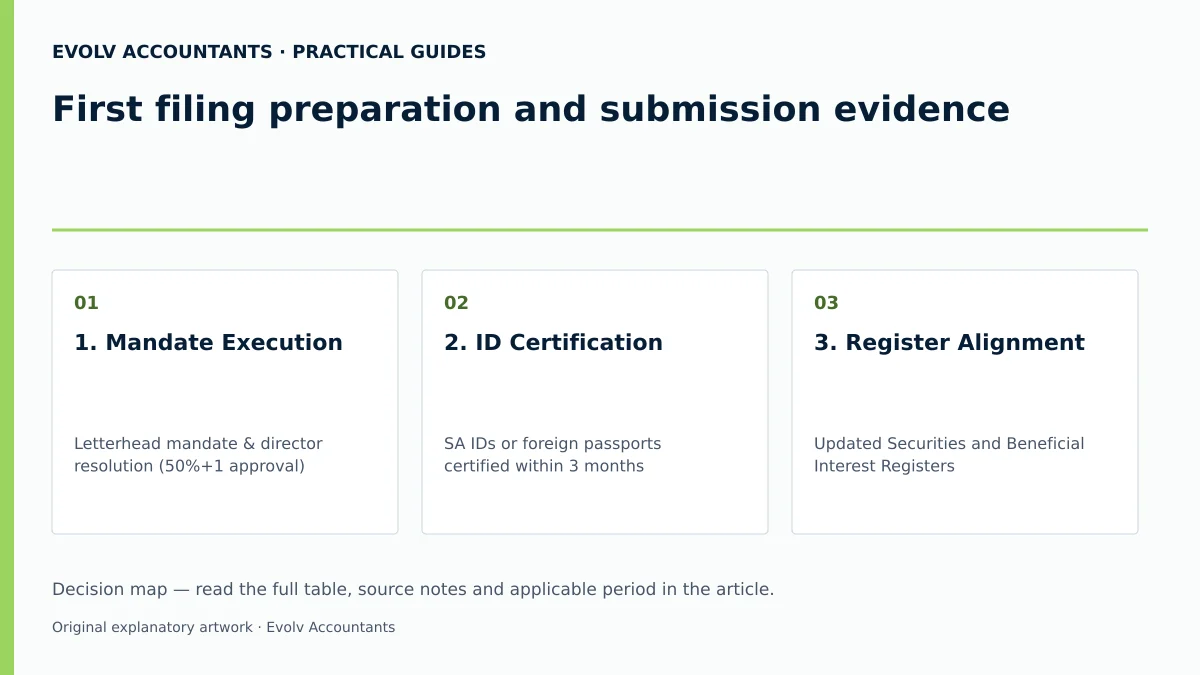
- Written Mandate: A formal written authorisation on the declaring entity's letterhead empowering a singular natural person (who holds a valid CIPC customer code) to submit beneficial ownership details 23 24 25 26 27 28. The mandate must state the filer's full name, surname, and ID number, and must be approved by an ordinary resolution signed by at least 50% + 1 of the directors (or 100% of close corporation members) 28 29 30 31.
- Certified Identity Records: High-resolution, certified copies of identity documents for the filer and all declared natural person beneficial owners, dated not older than 3 months 30 31 32 33. For South African residents, a green bar-coded ID book or smart ID card copy is compulsory 34 35 36. For foreign nationals, a notarized or Commissioner of Oaths certified passport copy is required 14 15 32 33 34.
- Securities and Beneficial Interest Register: An up-to-date securities register or beneficial interest register structured under Regulation 32, reflecting total issued share capital, member holdings, and natural-person beneficial interests 6 30 31 33 37 38.
- Complex Structure Disclosure Diagram: Where shares are held through juristic entities, intermediate holding companies, or trusts, a signed disclosure form containing a clear diagrammatic representation of the ownership hierarchy must be provided 9 33 37.
Non-Share Control Routes and Ownership Chains
Beneficial ownership extends beyond direct equity holdings. Under Section 1 of the Companies Act, ultimate control can be established through multiple legal channels 7 8:
- Holding beneficial interests in the issued securities of the company 7 8 10.
- Direct or indirect control over voting rights attached to securities 7 8 10.
- Holding the right, or controlling the exercise of the right, to appoint or remove members of the board of directors 8 39.
- Control exercised through holding companies, intermediate corporate tiers, or subsidiaries 40 41.
- Control exercised through trust arrangements, including founders, trustees, or named beneficiaries holding effective control or property rights 40 41 42 43 44.
- The capacity to otherwise materially influence the executive management or operational policy of the entity (effective control) 41 42 45 46.
Complete the task step by step: submission evidence
Executing a first beneficial ownership filing involves a multi-stage online procedure grounded in CIPC step-by-step instructions:
- Step 1: Authenticate Customer Account on CIPC e-Services Portal
- Step 2: Search Enterprise & Confirm Entity Filing Status
- Step 3: Select Company Classification (Non-Affected Entity)
- Step 4: Evaluate Ownership Structure & Capture Natural-Person Details
- Step 5: Upload Mandate & Supporting Evidence Documents
- Step 6: Execute Dual OTP Authentication & Receive Confirmation
Sequenced Procedural Execution
- Portal Authentication: Access the CIPC e-Services platform (eservices.cipc.co.za) using a valid natural-person Customer Code, password, and security code 16 47 48 49 50 51 52. Navigate to "Transact" and select "Beneficial Ownership" 23 48 50 52.
- Entity Status Validation: Accept the CIPC terms and statutory declaration under Section 214 of the Companies Act 48 50 52 53 54. Input the company registration number and verify entity status 23 26 52. Eligible statuses are "In Business", "Business Rescue", and "AR Deregistration Process" 23 52 55 56.
- Category Classification: Select company type as "Non-Affected Companies" (private companies not meeting public or regulated company criteria under Section 1) 46 57 58. Complete the portal ownership evaluation prompts to confirm whether beneficial owners above 5% exist 58 59 60.
- Capturing Ownership Details:
- For multi-tiered corporate structures, select "Juristic Person Listing" first to record intermediate juristic shareholders or trusts 9 61.
- Click "NEW" under Natural Person Owner Information to capture ultimate individual owners 62 63.
- Select citizenship status. For South African citizens, enter the ID number; the portal executes real-time validation against the Department of Home Affairs (DHA) database to auto-populate full names 14 15 62 64.
- Input mandatory details: date of birth, ID issue date, email address, mobile number, optional income tax number, gender, demographic category, and disability status 62 64.
- Select the relevant control type (securities interest, voting rights, director appointment rights, material influence) and enter the exact ownership or control percentage (must equal or exceed 5%) 7 9 10 64 65.
- Uploading Required Records: Attach PDF copies of the signed Mandate on letterhead, certified ID or passport copies for the filer and beneficial owners (dated <= 3 months), the Securities/Beneficial Interest Register, and the structural Disclosure Diagram 30 31 32 33 37.
- Dual OTP Verification: Initiate final verification. CIPC dispatches a dual One-Time Pin (OTP) to the filer's registered mobile number and email address 11 13 66. Enter the SMS OTP (prefixed with uppercase "S") and Email OTP (prefixed with uppercase "E") and select "Verify" 11 13 66. Upon successful verification, the red "X" system status turns to a green checkmark 11 13 66.
Check the result against the evidence: first filing preparation
Independent Completion Evidence
A submission is not complete upon mere document upload. Filers must verify independent electronic proof:
- Beneficial Ownership Confirmation Certificate: Non-affected entities declaring beneficial owners receive an official CIPC electronic certificate confirming lodgement upon completing dual OTP verification 12 60 67.
- Confirmation Email Notification: Entities with no beneficial owners above the reporting threshold (processed via the simplified portal) receive an official CIPC confirmation email 60.
- Completed Grid Status: The portal's "Completed Applications" dashboard displays the enterprise number, filing reference, and green confirmation status 24 61 68 69 70.
CIPC Compliance Inspections and Fiduciary Duties
CIPC actively conducts physical and virtual compliance inspections under Section 24 and Section 209 of the Companies Act to verify declared ownership records 1 6 71:
- Inspections are carried out by a minimum of two CIPC inspectors presenting official Section 209 Inspector Certificates 71.
- Personal Attendance Duty: Company directors or close corporation members are statutorily required to personally attend and participate during CIPC inspections 71. Attendance by corporate secretarial agents, accountants, or consultants does not fulfill statutory obligations, and third parties may not attend in lieu of directors 71.
Hard-Stop Annual Return Enforcement
CIPC enforces an automated "hard stop" mechanism: entities that fail to lodge beneficial ownership declarations are electronically blocked from completing Annual Returns, leading to late filing penalties and potential administrative deregistration 19 72.
Handle exceptions and unresolved cases: submission evidence
Ineligible Entity Statuses
Entities holding the following administrative statuses are legally barred from submitting beneficial ownership filings: Final Deregistration, Voluntary Deregistration, Final Liquidation, Voluntary Liquidation, Provisional Liquidation, Suspended, or Dissolved 55 56. Entities in voluntary deregistration have ceased trading under Section 82(3)(b)(ii) and are exempt from filing 73 74.
Authorised Securities Portal Errors
If the CIPC portal reflects blank or zero authorised share capital for a company, the online transaction will lock 75. Filers must email official proof of authorised securities to beneficialownershipenq@cipc.co.za for manual database correction before lodgement can proceed 75.
Correction and Resubmission Pathways
Where incorrect or incomplete information has been lodged, CIPC permits entities to immediately amend and resubmit beneficial ownership filings 18. CIPC reviewers analyse submissions and issue automated email alerts if structural adjustments or corrected records are required 18.
Next steps for Beneficial ownership
SME management should follow a structured compliance framework to execute and maintain beneficial ownership records.
Task and Completion Checklist
| Step | Input or evidence | Responsible person | Completion check | Exception or next action |
|---|---|---|---|---|
| 1. Mandate Execution | Letterhead mandate & director resolution (50%+1 approval) 28 29 | Company Directors / CC Members | Signed mandate on file with valid filer Customer Code 29 | Re-draft resolution if director voting quorum is incomplete 29. |
| 2. ID Certification | SA IDs or foreign passports certified within 3 months 32 33 | Mandated Filer & Beneficial Owners | Certification dates verified; SA IDs validated via DHA 32 62 | Obtain updated certified copies if older than 3 months 32. |
| 3. Register Alignment | Updated Securities and Beneficial Interest Registers 30 31 | Company Secretary / Accountant | Share capital and control percentages reconciled 9 75 | Update statutory register under Regulation 32 before filing 38. |
| 4. Portal Lodgement | PDF document uploads & dual OTP authentication 11 32 | Mandated Natural Person Filer | Red "X" box changes to Green checkmark in portal 11 13 | Resend OTPs or submit query to CIPC if portal locks 13 75. |
| 5. Evidence Retention | CIPC Beneficial Ownership Certificate / Email Notice 12 60 | Compliance Officer / Director | Certificate archived in corporate statutory records 12 | Confirm "hard stop" is cleared to allow Annual Return filing 19. |
Reproducible Hypothetical Example
To illustrate ownership calculation across intermediate corporate chains, consider the following scenario:
- Entity Structure: Apex Products (Pty) Ltd is a private non-affected company with 1,000 issued ordinary shares.
- Direct Holdings:
- Holdings Co (Pty) Ltd holds 600 ordinary shares (60% direct equity) 9 76.
- Mary Ndlovu (natural person) holds 400 ordinary shares (40% direct equity) 76.
- Indirect Chain Analysis:
- Holdings Co (Pty) Ltd is 100% owned and controlled by Sipho Ndlovu (natural person).
- Sipho Ndlovu indirectly controls 60% of Apex Products (Pty) Ltd through an intermediate juristic tier 9 41 76.
- CIPC Declaration Setup:
- CIPC Reporting Threshold: 5% or more beneficial interest or effective control 6 9 10.
- Tier 1 Juristic Listing: Holdings Co (Pty) Ltd recorded as 1st tier juristic owner (60% shareholding) 9.
- Natural Person 1: Sipho Ndlovu declared as Ultimate Beneficial Owner (60% indirect equity and voting control) 9 76.
- Natural Person 2: Mary Ndlovu declared as Ultimate Beneficial Owner (40% direct equity and voting control) 76.
- Aggregate Total: 100% declared beneficial ownership 9 10.
Frequently Asked Questions
What is the difference between the statutory definition of a beneficial owner and CIPC's reporting threshold?
The statutory legal definition under Section 1 of the Companies Act (as amended by GLAA 22 of 2022) defines a beneficial owner broadly as any natural person who directly or indirectly ultimately owns or exercises effective control over a company 2 3 7 8. CIPC administrative guidance in Notice 36 of 2026 establishes a 5% reporting threshold, requiring entities to lodge details for any natural person holding 5% or more of ownership or control 6 9 10.
When must a newly incorporated company file its first beneficial ownership declaration?
Companies incorporated on or after 24 May 2023 must lodge their initial beneficial ownership declaration within 10 business days of incorporation 6 18. Existing entities file annually alongside Annual Returns within 30 business days after their incorporation anniversary 6 19 20.
Who is authorised to submit the beneficial ownership declaration on behalf of a company?
Submissions must be lodged by a singular natural person holding a valid CIPC customer code who has been formally mandated in writing on company letterhead 24 25 27 28 29 47. The mandate requires approval by an ordinary resolution signed by at least 50% + 1 of company directors or all members of a close corporation 28 29 30 31.
Can an accounting agent or secretarial consultant represent directors during a CIPC compliance inspection?
No. Under CIPC inspection rules, company directors or close corporation members are statutorily required to personally attend and participate in physical or virtual compliance inspections 71. Consultants or agents may provide supporting records but cannot attend in lieu of directors or members 71.
How does a company prove compliance after completing its declaration?
Non-affected companies declaring beneficial owners receive an official electronic Beneficial Ownership Confirmation Certificate from CIPC upon completing dual OTP verification 12 60 67. Entities with no beneficial owners above the reporting threshold receive an official confirmation email notification 60. Ask Evolv about first filing preparation and submission evidence. Share the relevant records so the support required can be scoped. #article-enquiry
Related guides
- Who counts as a beneficial owner of a private company
- Documents needed for beneficial ownership filing
- Compliance and Regulations: Keeping Your Business on Track
Sources
- https://www.gov.za/sites/default/files/gcis_document/202212/47815anti-moneylaunderingact22of2022.pdf
- Beneficial Ownership (BO) Filing Compliance Inspections | CIPC
- Beneficial Ownership | CIPC
- https://www.cipc.co.za/wp-content/uploads/2024/09/Step-by-step-guide_E-Services-Beneficial-Ownership-Filing-Complex-Structure-Final.pdf
- https://www.cipc.co.za/wp-content/uploads/2024/09/Step-by-step-guide_E-Services-Beneficial-Ownership-Filing-Non-Affected-Company-With-Beneficial-Ownership.pdf
- https://www.cipc.co.za/wp-content/uploads/2025/10/Step-by-step-guide-OPTIMIZED-BO-FILING-Final.pdf
- https://www.justice.gov.za/legislation/acts/2008-071-reg.pdf