
Documents needed for beneficial ownership filing
30 March 2025

Beneficial ownership filing in South Africa requires entities to submit verified identity and authority records to prove natural-person ownership and control 1 2.
Definition and filing scope. The 2022 amending Act introduced the beneficial-owner definition covering ultimate natural-person ownership or effective control. CIPC’s Notice 36 of 2026 states a 5% ownership and/or control threshold for reporting.
Assess the relevant control routes and the applicable filing category; the filing threshold is not a substitute for tracing the natural person behind the ownership structure.
South African small and medium enterprises (SMEs) registered with the Companies and Intellectual Property Commission (CIPC) must compile, verify, and maintain a complete evidence pack when lodging beneficial ownership declarations 1 2. Under the Companies Act 71 of 2008, as amended by the General Laws (Anti-Money Laundering and Combating Terrorism Financing) Amendment Act 22 of 2022 (GLAA), corporate entities are legally required to identify all ultimate natural persons who hold beneficial interests or exercise effective control 1 3 4 5.
While statutory definitions encompass all routes of natural-person control, CIPC operational guidance applies a 5% reporting threshold for register declarations 6 7 8. Preparing a reviewer-ready document matrix ensures seamless compliance during annual return filings and routine CIPC inspections 6 9 10.
Identity ownership and authority document matrix
Statutory definition versus regulatory reporting threshold
Understanding the document requirements begins with distinguishing statutory law from regulatory filing guidance. The unamended Companies Act 71 of 2008 did not contain a universal 5% threshold for beneficial ownership disclosure 5. The legal concept was formally enacted through Section 55 of the GLAA 22 of 2022, which inserted the definition of "beneficial owner" into Section 1 of the Companies Act 3 5 11.
Legally, a beneficial owner is always an ultimate natural person who directly or indirectly owns a company or exercises effective control over it 4 6 11.
In contrast, CIPC operational guidance (including CIPC Notice 36 of 2026 and step-by-step reporting guides) establishes a 5% ownership or control reporting threshold for portal declarations 6 7 8. Natural persons holding less than 5% of beneficial ownership or voting control need not be declared on the CIPC beneficial ownership register unless specific affected-company disclosure rules apply 7 8 12.
Purpose and recipient identification
Before assembling records, entities must determine the exact verification purpose and recipient requesting the documentation:
— Practical point from this guide
- Statutory CIPC Filings: Required within 10 business days of incorporation for new entities 6 13, within 30 business days of the anniversary date alongside Annual Returns 6 10, or within 10 business days of any beneficial ownership change 13 14.
- CIPC Compliance Inspections: Official on-site or virtual inspections conducted under Section 209 of the Companies Act by appointed CIPC inspectors carrying Section 209 certificates 9.
- Institutional Verification: Requests from accountable institutions (such as commercial banks or financial advisers) conducting customer due diligence under anti-money laundering legislation 1 4 15.
Documents grouped by purpose: identity ownership
Supporting records for beneficial ownership declarations are classified into mandatory filings, conditional schedules, and internal accounting records 16 17 18.
Mandatory primary records
- Mandated Filer Identity Proof: Certified copy of the mandated filer’s South African smart ID card, green bar-coded ID book, or valid foreign passport, dated within 3 months of lodgement 16 17 19 20.
- Beneficial Owner Identity Proof: Certified copy of the South African ID card/book or foreign passport (notarised or certified by a Commissioner of Oaths) for every ultimate natural person declared, dated within 3 months 16 17 21 22.
- Signed Written Mandate: Original mandate on the company or close corporation letterhead authorising a singular natural person (holding a valid CIPC customer code) to lodge the declaration 16 20 23 24 25. The mandate must be signed by at least 50% + 1 of the directors or all members of a close corporation 20 24.
- Securities Register or Beneficial Interest Register: Written register detailing shareholding, member percentage, or beneficial interest disclosures kept under Section 50 or Section 56(7)(aA) of the Companies Act 6 17 26 27 28.
Conditional records and complex structure schedules
- Diagrammatic Disclosure Form: Required where corporate structures involve juristic entities (companies or close corporations) or trusts as intermediate ownership tiers 12 18 26. The diagram must depict the complete ownership chain leading to the ultimate natural person 12 26.
- Trust Documentation: Letters of Authority, trust deeds, and trustee resolutions where shares are held pursuant to a trust agreement 4 12 29.
| Record | Why it is needed | Required or conditional | Owner | Verification and reference |
|---|---|---|---|---|
| Filer Identity Document | Validates the identity of the individual lodging data on the CIPC portal 16 20 | Required 16 17 | Mandated Filer | Certified copy (less than 3 months old) matching CIPC customer account 16 19 24 |
| Beneficial Owner ID / Passport | Confirms the identity of the ultimate natural person owning or controlling the entity 6 16 22 | Required 16 17 | Natural-Person Beneficial Owner | SA ID verified via Home Affairs / Passport notarised (less than 3 months old) 16 22 30 |
| Written Board / Member Mandate | Grants legal authority from the entity to the filer on official letterhead 16 23 24 | Required (retained on file for optimised filings) 16 31 | Directors / CC Members | Signed by at least 50% + 1 of directors or 100% of CC members 20 24 |
| Securities or Beneficial Interest Register | Demonstrates internal corporate alignment with declared ownership percentages 6 26 28 | Required 17 26 | Company Secretary / Public Officer | Reflects share distribution under Section 50 or Section 56(7)(aA) 27 28 |
| Diagrammatic Disclosure Form | Maps multi-tiered ownership chains through intermediate companies or trusts 12 26 | Conditional (complex structures) 12 26 | Filer / Board | Illustrates full hierarchy down to natural persons 12 26 |
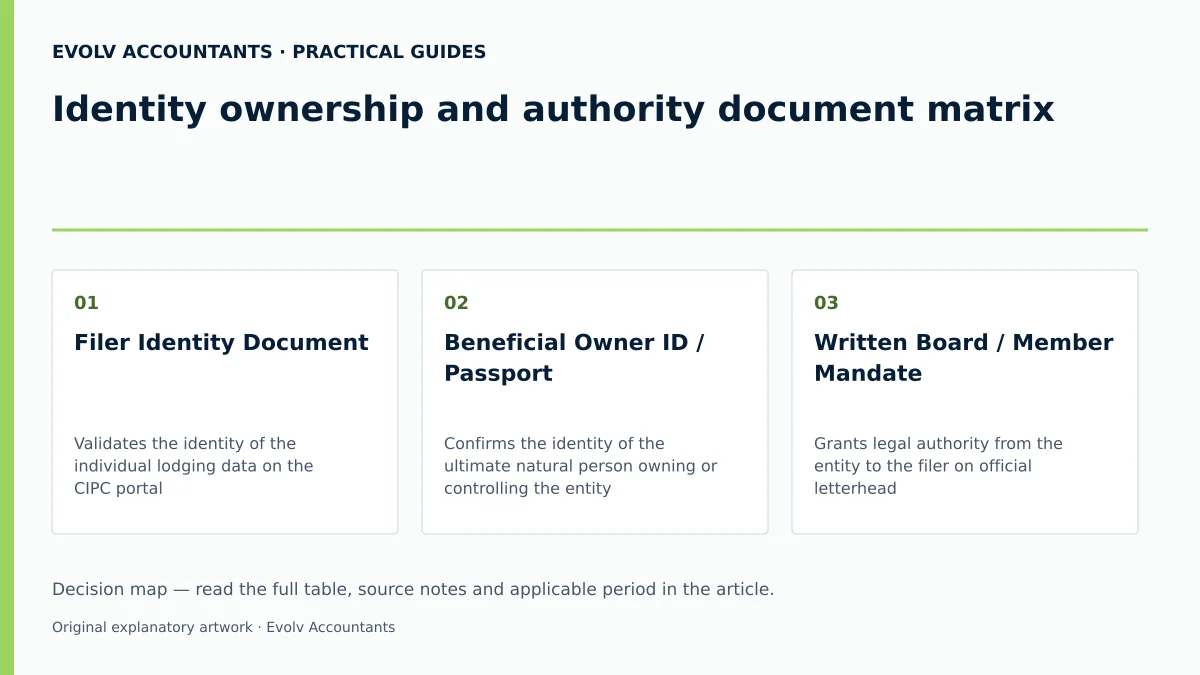
Check identity period and consistency: authority document matrix
To ensure an evidence pack passes CIPC automated validation and back-office review, filers must audit all records for strict consistency 13 30 32.
Consistency cross-checking protocol
- Filer Profile Matching: Verify that the mandated filer holds an active CIPC customer code and that the contact email and cell phone number match pre-filed CIPC records for One-Time Password (OTP) verification 7 33 34 35.
- Certification Recency: Confirm that all identity document stamps from a Commissioner of Oaths or notary are dated within 3 months of the filing date 16 17 18.
- Residency Document Rules: Ensure South African residents submit a green bar-coded ID or smart ID card; passport copies are strictly accepted as proof of identity for non-residents only 19 21 36.
- Ownership Summation: Reconcile direct and indirect ownership percentages to ensure total declared ownership reflects the aggregate holdings accurately across all tiers 8 11 37.
- Mandate Majority Signatures: Confirm that the signed mandate bears the signatures of at least 50% + 1 of current registered directors or 100% of close corporation members 20 24.
Build a reviewer ready evidence pack: identity ownership
Document indexing and naming conventions
CIPC portal uploads require specific classification tags during the submission process 38 39. Organizing electronic files prior to portal entry prevents document rejection 40:
- CERTIFIED_ID_FILER.pdf (Tag: CERTIFIED ID) 38 39
- CERTIFIED_ID_OWNER_[NAME].pdf (Tag: CERTIFIED ID) 38 39
- ORIGINAL_MANDATE_[ENTITY_NAME].pdf (Tag: ORIGINAL MANDATE) 38 39
- SECURITIES_REGISTER_[YEAR].pdf (Tag: SECURITIES REGISTER) 38 39
- DISCLOSURE_FORM_STRUCTURE.pdf (Tag: DISCLOSURE FORM) 38 39
Record retention and legal obligations
Under Regulation 5 of the Companies Regulations, CIPC and registered entities are required to maintain beneficial ownership records and supporting documentation for a minimum period of 5 years after an entity is dissolved 41. Furthermore, entries in securities and beneficial interest registers regarding individuals who have ceased to hold shares or beneficial interests must be retained for 7 years 42. Records must be stored securely in legible electronic or physical formats capable of immediate retrieval upon request 41 42.
While structured evidence packs streamline compliance, internal organisation systems represent private administrative practices and do not carry formal government endorsement.
Missing or contradictory records: authority document matrix
Authentic reconstruction procedures
Where historical share registers or founding documents contain gaps or contradictions, entities must conduct authentic reconstruction using verified primary records—such as registered Memoranda of Incorporation (MOI), CIPC CK founding statements, historical share certificates, and signed board minutes 6 13 43. Filers must never invent or fabricate replacement evidence, as submitting false or misleading information to CIPC constitutes a criminal offence under Section 214 of the Companies Act 6 13.
Resolving portal and data errors
In the CIPC portal system, if authorised securities fields reflect blank or zero values, the system will block the beneficial ownership transaction 44. Filers must resolve this by submitting official proof of authorised securities to CIPC via email (beneficialownershipenq@cipc.co.za) to update the master record before re-attempting filing 44 45.
Regulatory escalation pathways
For unresolved technical rejections or formal disputes regarding beneficial ownership filings, queries may be escalated directly to CIPC units via dedicated channels:
- Technical and filing enquiries: beneficialownershipenq@cipc.co.za 45
- Annual return administrative queries: annualreturns2@cipc.co.za 46
- Enforcement and surveillance escalation: KMaboya@cipc.co.za 46
Next steps for Beneficial ownership
Distinguishing upload from regulatory acceptance
Completing the online entry, uploading documents, and entering SMS and Email OTPs submits the application into CIPC processing queues 33 47. However, document upload or a status of "In Progress" or "Pending" does not constitute completed legal compliance 48. Official acceptance is achieved only when CIPC completes verification and issues an official Beneficial Ownership Confirmation Certificate 49 50.
Ongoing annual and event-driven compliance
- New Entities: Must lodge initial beneficial ownership records within 10 business days of incorporation 6 13.
- Existing Entities: Must submit updated beneficial ownership declarations annually within 30 business days following the anniversary date of incorporation 6 10.
- Event-Driven Changes: Any change to beneficial owners or their holdings requires an amended filing within 10 business days of the change occurring 13 14.
Practical hypothetical example
- Entity Structure: Zenith Solutions (Pty) Ltd (incorporation anniversary: 10 October) 10.
- Shareholding Chain: Natural Person A holds 60% direct ordinary shares 51. Juristic Person B (a private company) holds 40% ordinary shares 12 52. Natural Person B holds 100% shares of Juristic Person B, exercising an indirect 40% beneficial interest in Zenith Solutions 12 51.
- Labelled Holdings: Person A = 60% direct interest; Person B = 40% indirect interest; Total Declared Ownership = 100% 8 37 51.
- Compliance Process: On 20 October (within the 30-business-day window), Filer C obtains certified ID copies (dated 1 October), a signed board mandate from 2 of 3 directors (66.7% majority, satisfying the 50% + 1 rule) 24, the Securities Register, and a diagrammatic Disclosure Form mapping Juristic Person B 17 26. Filer C captures Juristic Person B as a 1st tier owner, attaches Natural Person B as the ultimate beneficial owner, uploads the document pack, completes OTP validation, and receives the official BO Confirmation Certificate 16 33 49 52.
Frequently Asked Questions
How does the statutory definition of a beneficial owner differ from the CIPC reporting threshold?
The statutory definition in the Companies Act (as amended by GLAA 22 of 2022) broadly covers any natural person who ultimately owns or exercises effective control over an entity through shares, voting rights, board appointments, or material influence 4 5 6 11. CIPC operational guidance (including Notice 36 of 2026) establishes a 5% reporting threshold for register declarations, meaning ownership or control below 5% does not require active portal declaration 6 7 8.
Who must sign the beneficial ownership mandate letter?
The written mandate must be signed by at least 50% + 1 of the company’s registered directors or by all members of a close corporation 20 24. It must be on official entity letterhead and authorise a singular natural person holding an active CIPC customer code 20 23 24.
Can secretarial consultants or accountants attend CIPC beneficial ownership inspections in place of directors?
No. Under CIPC S209 inspection rules, company directors or close corporation members are statutorily required to attend compliance inspections personally 9. Professional consultants or secretarial service providers may provide support, but they cannot attend in lieu of directors or members 9.
How long must a private company retain beneficial ownership records?
CIPC Regulations mandate that beneficial ownership records and supporting documentation be kept for at least 5 years after an entity is dissolved 41. Entries in securities and beneficial interest registers concerning persons who have ceased to hold securities must be kept for 7 years 42.
Does uploading documents to the CIPC portal complete beneficial ownership compliance?
No. Document upload and OTP entry place the filing into pending or submitted status 33 48. Legal compliance is finalised only when CIPC processes the submission and generates the official electronic Beneficial Ownership Confirmation Certificate 49 50. Ask Evolv about identity ownership and authority document matrix. Share the relevant records so the support required can be scoped.
Related guides
- Who counts as a beneficial owner of a private company
- Finding the natural person behind a corporate shareholder
- Compliance and Regulations: Keeping Your Business on Track
Sources
- Beneficial Ownership (BO) Filing Compliance Inspections | CIPC
- Beneficial Ownership | CIPC
- https://www.gov.za/sites/default/files/gcis_document/202212/47815anti-moneylaunderingact22of2022.pdf
- https://www.cipc.co.za/wp-content/uploads/2024/09/Step-by-step-guide_E-Services-Beneficial-Ownership-Filing-Complex-Structure-Final.pdf
- https://www.cipc.co.za/wp-content/uploads/2024/09/Step-by-step-guide_E-Services-Beneficial-Ownership-Filing-Non-Affected-Company-With-Beneficial-Ownership.pdf
- https://www.cipc.co.za/wp-content/uploads/2025/10/Step-by-step-guide-OPTIMIZED-BO-FILING-Final.pdf
- https://www.justice.gov.za/legislation/acts/2008-071-reg.pdf