
Finding the natural person behind a corporate shareholder
30 July 2025

Tracing the natural person behind a corporate shareholder requires unravelling legal ownership tiers to identify individuals holding ultimate effective control.
Under South African statutory compliance frameworks, corporate entities or trusts cannot be designated as ultimate beneficial owners on statutory registers 1 2. Where an SME's securities are held by a corporate shareholder, reporting entities must look through every intermediate juristic tier until each natural person exercising ultimate ownership or effective control is identified 2 3 4.
While the legal definition enacted under the Companies Act 71 of 2008, as amended by the General Laws (Anti-Money Laundering and Combating Terrorism Financing) Amendment Act 22 of 2022, broadly covers any individual holding ultimate ownership or control, the Companies and Intellectual Property Commission (CIPC) prescribes a 5% ownership or control threshold for statutory register filings 2 5 6 7.
Small and medium enterprises (SMEs) must maintain accurate beneficial ownership records, file annual declarations on the CIPC e-Services portal within prescribed windows, and upload verifying documentation including securities registers, identity copies, disclosure structure diagrams, and director mandates 5 8 9 10.
Definition and filing scope. The 2022 amending Act introduced the beneficial-owner definition covering ultimate natural-person ownership or effective control. CIPC’s Notice 36 of 2026 states a 5% ownership and/or control threshold for reporting.
Assess the relevant control routes and the applicable filing category; the filing threshold is not a substitute for tracing the natural person behind the ownership structure.
Tracing an ownership chain to natural persons
The primary output of an ownership chain tracing exercise is a verified beneficial ownership register alongside a diagrammatic disclosure chart that maps every juristic tier back to specific natural persons 2 5 11. The relevant unit of measurement is the percentage (%) of beneficial interest in issued securities, voting rights, or operational control held directly or indirectly by an individual 2 12 13.
Compliance operates on an annual filing period linked directly to the entity's incorporation anniversary (submitted within 30 business days following the anniversary date), alongside an ongoing obligation to file changes within 10 business days of any ownership shift 5 8 14 15.
It is vital to distinguish statutory compliance from accounting or taxation reporting:
- Statutory Compliance: Mandated by the CIPC under the Companies Act to enhance corporate transparency, align with international Anti-Money Laundering standards, and prevent financial crime 3 6 16.
- Accounting and Tax Standards: Focus on group consolidation rules (IFRS) or income tax liabilities, whereas CIPC beneficial ownership tracing strictly evaluates individual human control, regardless of tax residence or accounting treatment 2 3 16.
Inputs rates periods and exclusions: tracing an ownership chain to natural persons
Accurate ownership tracing depends on applying verified statutory definitions, regulatory reporting thresholds, and document requirements:
- CIPC Reporting Threshold: As established in CIPC implementation guidance and Notice 36 of 2026, a threshold of 5% direct or indirect beneficial ownership or control applies for declaration on the BO register 2 5 13 17. Any individual holding less than 5% interest or voting control need not be declared 2 13.
- Statutory Ultimate Ownership: The General Laws Amendment Act 22 of 2022 defines a beneficial owner as an individual who ultimately owns or exercises effective control over a company 3 4 5 7. This statutory definition is broader than share equity alone and includes non-share control mechanisms 7 18 19 20.
- Compliance Timelines:
- New Entities (incorporated on/after 24 May 2023): Initial filing required within 10 business days of incorporation 5.
- Existing Entities: Annual filing required within 30 business days after the incorporation anniversary date 5 8 15.
- Ownership Changes: Updates must be filed within 10 business days of any change in beneficial ownership 14 21.
- Mandatory Supporting Documents:
- Certified ID or passport copies for all filers and beneficial owners, certified within the preceding 3 months 9 10 22.
- Written mandate on company letterhead authorised by at least 50% + 1 of the board of directors or CC members 10 23 24.
- Approved Securities Register or Beneficial Interest Register 9 10 22.
- Complex structure Disclosure Form containing a diagrammatic representation of the ownership hierarchy 2 11 22.
- Exclusions and Ineligible Statuses: Entities with final liquidation, voluntary liquidation, provisional liquidation, final deregistration, voluntary deregistration (where operations have ceased), or dissolved statuses are prohibited or exempt from BO declarations 25 26 27 28.
The calculation in a worked example: documented completion and exceptions
To demonstrate how indirect shareholding translates into reportable beneficial interest, consider a hypothetical South African private company, SME (Pty) Ltd, which has 100 issued ordinary shares (100% equity).
Ownership Structure Setup (Hypothetical Illustrative Values)
- Shareholder Tier 1:
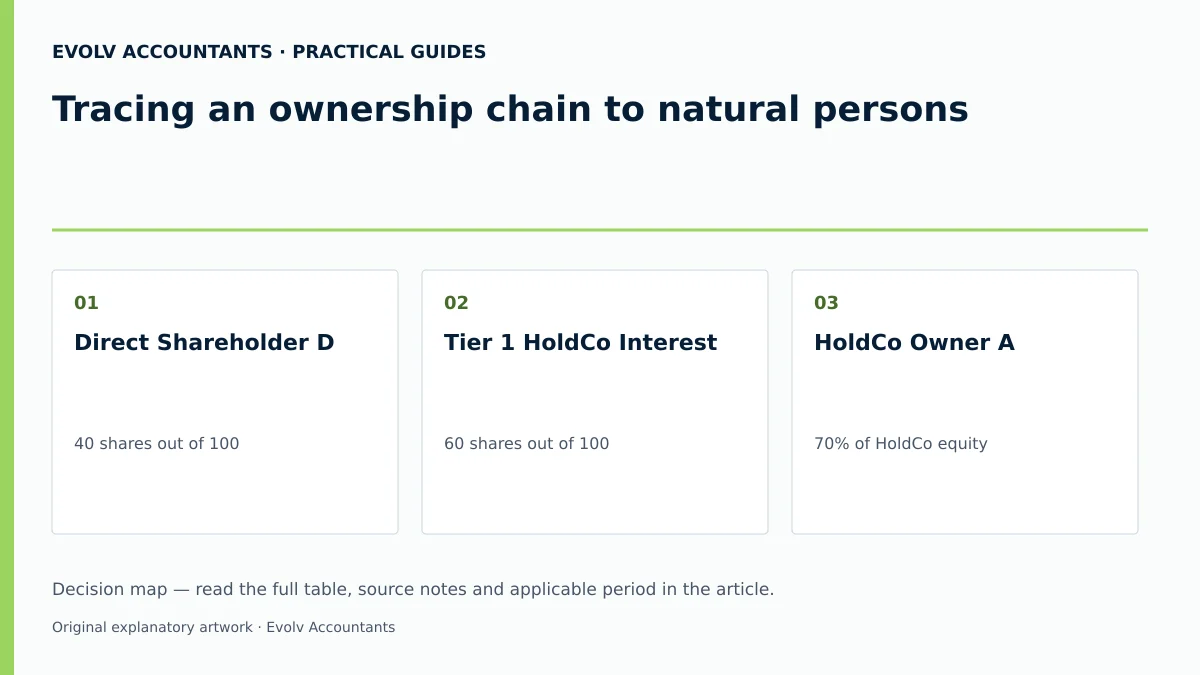
- HoldCo (Pty) Ltd (a juristic corporate shareholder) holds 60 shares (60% direct shareholding) in SME (Pty) Ltd.
- Individual D (a natural person) holds 40 shares (40% direct shareholding) in SME (Pty) Ltd.
- Shareholder Tier 2 (Inside HoldCo (Pty) Ltd):
- Individual A holds 70% of HoldCo (Pty) Ltd.
- Individual B holds 20% of HoldCo (Pty) Ltd.
- Individual C holds 6% of HoldCo (Pty) Ltd.
- Individual E holds 4% of HoldCo (Pty) Ltd.
Mathematical Tracing Calculation
- Individual D (Direct): 40.0% direct beneficial interest.
- Individual A (Indirect): 60% (HoldCo) × 70% (HoldCo Equity) = 42.0% indirect beneficial interest.
- Individual B (Indirect): 60% (HoldCo) × 20% (HoldCo Equity) = 12.0% indirect beneficial interest.
- Individual C (Indirect): 60% (HoldCo) × 6% (HoldCo Equity) = 3.6% indirect beneficial interest.
- Individual E (Indirect): 60% (HoldCo) × 4% (HoldCo Equity) = 2.4% indirect beneficial interest.
Threshold Evaluation against CIPC 5% Guideline
- Individual A (42.0%): Exceeds 5% \rightarrow Reportable as Indirect Beneficial Owner 2 5 29.
- Individual D (40.0%): Exceeds 5% \rightarrow Reportable as Direct Beneficial Owner 2 5 29.
- Individual B (12.0%): Exceeds 5% \rightarrow Reportable as Indirect Beneficial Owner 2 5 29.
- Individual C (3.6%): Below 5% threshold \rightarrow Excluded from declaration 2 13.
- Individual E (2.4%): Below 5% threshold \rightarrow Excluded from declaration 2 13.
| Input | Value or verified-source placeholder | Formula or step | Result | Independent check |
|---|---|---|---|---|
| Direct Shareholder D | 40 shares out of 100 | 40 / 100 × 100% | 40.0% Direct | Meets CIPC ≥ 5% threshold; declare direct UBO 2 5. |
| Tier 1 HoldCo Interest | 60 shares out of 100 | 60 / 100 × 100% | 60.0% Corporate Tier | Intermediate juristic entity recorded in 1st tier listing 2 30. |
| HoldCo Owner A | 70% of HoldCo equity | 60% × 70% | 42.0% Indirect | Exceeds 5% threshold; declare indirect UBO 2 5 29. |
| HoldCo Owner B | 20% of HoldCo equity | 60% × 20% | 12.0% Indirect | Exceeds 5% threshold; declare indirect UBO 2 5 29. |
| HoldCo Owner C | 6% of HoldCo equity | 60% × 6% | 3.6% Indirect | Below 5% threshold; exclude from filing 2 13. |
| HoldCo Owner E | 4% of HoldCo equity | 60% × 4% | 2.4% Indirect | Below 5% threshold; exclude from filing 2 13. |
| Total Declared BO % | Sum of reportable UBOs | 40.0% + 42.0% + 12.0% | 94.0% Total Declared | Sum of reportable UBOs; remaining 6.0% held below 5% threshold 2 13. |
Reconcile the answer to the underlying records: tracing an ownership chain to natural persons
Reconciling the beneficial ownership declaration against corporate records prevents compliance failures and portal rejections:
— Practical point from this guide
- Verify Securities Registers: Check the declaring company's securities register and all intermediate holding entities' share registers to ensure total share percentage calculations reflect issued share capital accurately 2 5 21.
- Validate First-Tier Juristic Captures: On the CIPC e-Services platform, capture intermediate corporate shareholders or trusts under the 1st tier juristic person listing before attaching ultimate natural persons 1 2 30 31.
- Confirm Identity Credentials: Ensure South African ID numbers match Department of Home Affairs (DHA) databases for automated green-tick verification 32 33 34. Foreign passports must be notarized or certified by a Commissioner of Oaths 9 22 33.
- Inspect Certification Dates: Confirm all certified identity documents are dated within 3 months of the submission date 9 10 22.
- Execute Dual OTP Verification: Complete final portal submission by entering both SMS and Email One-Time Passwords (OTPs) sent to the mandated filer's profile 35 36 37.
Edge cases that change the calculation: documented completion and exceptions
- Non-Share Control Routes: As CIPC guidance highlights, a beneficial owner is "an individual who directly or indirectly ultimately owns or exercises effective control over a company" 5. Even where an individual holds 0% equity, they must be declared if they possess voting rights exceeding 5%, hold the right to appoint or remove board members, or exercise material influence over company management 12 18 19 20 38.
- Trust Ownership Chains: Where shares are held by a family or business trust, tracing does not stop at the trust deed. Filers must declare all natural persons serving as trustees, founders/settlors, named beneficiaries, and individuals exercising effective operational control over trust arrangements 39 40 41 42 43 44.
- AR Deregistration Process: Entities undergoing deregistration due to Annual Return non-compliance remain legally active and trading; they are explicitly required to complete beneficial ownership declarations 25 26 27 28.
- Shareholding Dilution below 5%: When a previously registered beneficial owner’s interest falls below the 5% threshold due to share transfers or dilution, an amended filing must be lodged to update their portal status to inactive 45 46.
Next steps for Beneficial ownership
Action Checklist for SMEs
- Obtain Supporting Registers: Extract the company's current Securities Register and Beneficial Interest Register 9 10 22.
- Map Ownership Hierarchy: Draft a diagrammatic disclosure chart illustrating all intermediate juristic shareholders and final natural person UBOs 2 11 22.
- Calculate Indirect Shares: Multiply ownership percentages across each corporate tier to establish net individual beneficial interest 2 29.
- Compile Verified Documents: Collect certified ID copies (under 3 months old) for all UBOs and the filer 9 10 22.
- Issue Director Mandate: Prepare a written authorisation mandate on company letterhead signed by at least 50% + 1 of the directors 10 23 24 47.
- Log into CIPC e-Services: Navigate to the Beneficial Ownership portal, complete 1st tier juristic listings and natural person UBO captures, upload required files, and finalise via OTP verification 30 35 36 48 49.
Frequently Asked Questions
How does statutory ultimate ownership differ from CIPC's 5% reporting threshold?
Statutory law under the Companies Act (as amended by GLAA 22 of 2022) defines beneficial ownership broadly around ultimate ownership or effective control 3 4 5 7. However, CIPC regulatory guidance in Notice 36 of 2026 establishes a practical 5% reporting threshold, meaning individuals holding less than 5% interest or voting control are excluded from statutory register declarations 2 5 13 17.
Can an intermediate holding company be listed as the final beneficial owner?
No. CIPC e-Services system rules explicitly prohibit juristic entities or trusts from being declared as final beneficial owners 1 2. Juristic shareholders are entered strictly as 1st tier juristic listings to establish the ownership chain, but at least one natural person must be declared as the ultimate beneficial owner 1 2 30.
What documents are mandatory when filing for a complex entity structure?
Filers must upload certified ID/passport copies of the filer and UBOs (dated within 3 months) 9 10 22, a signed letterhead director mandate 10 23 24, the company’s Securities Register or Beneficial Interest Register 9 10 22, and a diagrammatic Disclosure Form charting the hierarchy 2 11 22.
What are the consequences of failing to submit a beneficial ownership filing?
From 1 July 2024, CIPC enforced a mandatory hard stop linking BO declarations to Annual Returns 8. Non-compliance prevents Annual Return completion, leading to late filing penalties, compliance notices, investigations, or eventual company deregistration 8 50.
How are non-share control rights reported on the CIPC portal?
When capturing a UBO, filers select specific interest types from a drop-down menu, including voting rights, board appointment powers, senior management control, or contractual rights 12 38 39 51. Percentage fields open specifically when shareholding or voting rights are selected 52 53. Tell Evolv about your company ownership question and the filing support you need. Ask Evolv about tracing an ownership chain to natural persons. Share the relevant records so the support required can be scoped.
Related guides
- Who counts as a beneficial owner of a private company
- Beneficial ownership when shares are held by a trust
- Compliance and Regulations: Keeping Your Business on Track
Sources
- https://www.cipc.co.za/wp-content/uploads/2024/09/Step-by-step-guide_E-Services-Beneficial-Ownership-Filing-Complex-Structure-Final.pdf
- Beneficial Ownership (BO) Filing Compliance Inspections | CIPC
- Beneficial Ownership | CIPC
- https://www.gov.za/sites/default/files/gcis_document/202212/47815anti-moneylaunderingact22of2022.pdf
- https://www.cipc.co.za/wp-content/uploads/2024/09/Step-by-step-guide_E-Services-Beneficial-Ownership-Filing-Non-Affected-Company-With-Beneficial-Ownership.pdf
- https://www.justice.gov.za/legislation/acts/2008-071-reg.pdf
- https://www.cipc.co.za/wp-content/uploads/2025/10/Step-by-step-guide-OPTIMIZED-BO-FILING-Final.pdf