
Beneficial ownership when shares are held by a trust
16 September 2025

Filing beneficial ownership for a South African company with trust shareholding requires identifying the natural persons exercising control and submitting declarations to the CIPC.
Definition and filing scope. The 2022 amending Act introduced the beneficial-owner definition covering ultimate natural-person ownership or effective control. CIPC’s Notice 36 of 2026 states a 5% ownership and/or control threshold for reporting.
Assess the relevant control routes and the applicable filing category; the filing threshold is not a substitute for tracing the natural person behind the ownership structure.
When a private company's shares are held by a trust, the corporate entity cannot declare the trust itself as the ultimate beneficial owner. Under South African corporate legislation and regulator procedures, beneficial ownership declarations must look through intermediate juristic structures to uncover the living individuals who ultimately exercise effective control or derive ultimate financial benefit from the shares.
Trust roles and control evidence
Regulatory Context and Jurisdictional Scope
For South African small and medium enterprises (SMEs) operating under current corporate reporting standards, filing beneficial ownership information with the Companies and Intellectual Property Commission (CIPC) is a statutory obligation under the Companies Act 71 of 2008 1 2. Completion means that the entity has successfully submitted verified natural person details for all trust roles meeting regulatory thresholds and obtained official regulator confirmation 3 4 5.
Distinguishing Company Declarations from SARS IT3(BO) Returns
It is critical to maintain a strict boundary between CIPC company beneficial ownership filings and South African Revenue Service (SARS) partnership or trust IT3(BO) reporting. CIPC beneficial ownership filings govern company compliance and register maintenance under the Companies Act 1, whereas SARS IT3(BO) filings relate to tax compliance and third-party financial reporting for trusts and partnerships.
Audit and independent review decisions require evaluating the Companies Act alongside statutory regulations, compilation standards, and statutory public interest score exemptions, rather than relying on CIPC portal submissions alone.
Legal Definition and Trust Control Mechanisms
Under the Companies Act 71 of 2008, a trust exercises control over a company if the trust holds securities or voting rights, or if an individual exercises control over the trust itself 6 7. Specifically, a person controls a trust if they have the ability to control the majority of trustee votes, appoint or remove the majority of trustees, or appoint or change the majority of trust beneficiaries 6.
In addition, voting rights exercisable in a fiduciary capacity are treated under the law as being held by the beneficiary of those voting rights 8. Regulator guidelines clarify that "Beneficial owner as per the definition (GLAA, 22 of 2022) can ONLY be a natural person." 9 Therefore, trust shareholding creates an indirect beneficial ownership chain where natural persons behind the trust must be declared 10.
Prepare the information and authority: trust roles
Identifying Mandatory Trust Roles
To prepare a compliant filing when shares are held by a trust, company officers must gather documentation for all natural persons holding defined trust roles. Regulator guidelines mandate evaluating five primary trust roles 11 12:
- Settlors / Founders: The natural person who established and settled property into the trust 11 12.
- Trustees: All natural person trustees who hold administrative and voting control over trust assets 6 11 12.
- Protectors: Any natural person appointed under the trust deed to oversee trustee decisions or veto specific actions 11 12.
- Beneficiaries: Named natural person beneficiaries entitled to trust income, distributions, or surplus assets 11 12.
- Other Controlling Individuals: Any individual who exercises effective material influence or ultimate control over trust administration or policy 6 11 12.
Document Inputs and Mandate Governance
Before initiating the digital portal process, company directors must compile a structured evidence pack:
— Practical point from this guide
- Trust Deed and Amendments: The registered trust deed and any deeds of adherence or trustee amendments establishing control rights and beneficiary entitlements 6 13.
- Letters of Authority: Official Master of the High Court Letters of Authority confirming current active trustees 6 13.
- Certified Identification: Clear copies of identity documents (or notarised passport copies for foreign nationals) for all identified natural persons and the mandated filer, dated not older than 3 months 13 14 15 16.
- Written Filer Mandate: An original written mandate on the declaring company's letterhead authorising a single natural person holding a valid CIPC customer code to submit the declaration 17 18. Under regulator rules, this mandate must be signed by at least 50% + 1 of the company's directors (ordinary resolution threshold) 17 18.
- Company Registers: The company's updated Securities Register and Beneficial Interest Register maintained under section 56(7) of the Companies Act 13 15 16.
- Ownership Hierarchy Diagram: A signed disclosure form displaying a diagrammatic representation of the corporate structure, illustrating the position of the trust and ultimate natural persons 9 13 16.
Complete the task step by step: control evidence
Sequenced Portal Filing Procedure
Evolv Accountants recommends following this exact, primary-source-grounded sequence when logging into the CIPC e-services portal:
- Access and Authentication: Log into the CIPC portal using a valid customer code and password, navigate to "Transact", select "Beneficial Ownership", and accept the declaration terms 19 20.
- Entity Selection and Mandate Upload: Search for the declaring enterprise, verify enterprise details, and attach the signed written mandate document 17 21 22.
- Select Company Category: Select "Non-Affected Company WITH Beneficial Ownership to Declare" from the drop-down menu 22 23.
- Capture First-Tier Juristic Owner (The Trust): Select "NEW", select "Juristic" beneficial ownership type, and choose "Trust" as the enterprise type 24 25 26 27. Manually enter the Trust Registration Date, Trust Number (note that automated search is unavailable for trusts), Trust Name, tax number (if applicable), country of registration, and address details 27 28 29. Select the applicable trust interest type (e.g., Shareholding/Beneficial Ownership or Voting Right) and enter the percentage interest held by the trust 12 28 29.
- Capture Ultimate Natural Person Beneficial Owners: Click "NEW" to add each natural person behind the trust 26 30. Enter South African ID or passport numbers, contact details, address details, date of interest acquisition, and specific trust interest types (e.g., Settlor, Trustee, Beneficiary, or Protector) 30 31 32. The system automatically verifies South African ID details against Department of Home Affairs (DHA) databases 30 33.
- Attach Supporting Records: Upload certified ID copies (under 3 months old), the signed mandate, securities register, beneficial interest register, and ownership structure disclosure form 13 14.
- OTP Verification and Final Submission: Click "Submit" to trigger dual One-Time Passwords (OTPs) sent via SMS (prefixed with 'S' in uppercase) and Email (prefixed with 'E' in uppercase) to the mandated filer 34 35 36. Enter both OTPs to complete verification 35 36.
Reproducible Hypothetical Example
Consider an illustrative scenario: Apex Manufacturing (Pty) Ltd has 100 issued ordinary shares. The Apex Family Trust holds 60 shares (60% shareholding, well above the statutory 5% declaration threshold) 1 2 9. The trust has one Settlor (John Doe), two Trustees (Mary Doe and Alan Smith), and two named Beneficiaries (Claire Doe and David Doe).
Under CIPC guidance, Apex Manufacturing first logs the Apex Family Trust as a 1st tier Juristic owner holding 60% shareholding 25 27 29. Next, Apex Manufacturing captures John Doe as Settlor (0% direct shares, indirect control), Mary Doe and Alan Smith as Trustees (0% direct shares, voting control), and Claire Doe and David Doe as Beneficiaries (allocated 30% indirect beneficial interest each to total the trust's 60% holding) 9 11 29 32.
All five individuals undergo DHA ID verification and submit 3-month certified ID copies, completing a fully traceable filing 13 14 30.
Check the result against the evidence: trust roles
Verifying Independent Completion Evidence
Submitting data through the CIPC portal does not automatically guarantee regulatory acceptance. Company officers and practitioners must verify independent evidence of completed registration 3 37. Valid completion requires checking the following:
- Completed Application Grid: Navigating to the CIPC portal landing page and confirming that the application reference appears under "Completed Applications" with the status "BO COMPLETE REGISTRATIONS" 3 4 37.
- Official BO Confirmation Certificate: Downloading the electronic Beneficial Ownership Confirmation Certificate issued directly by CIPC 3 4 5.
- System Notification Email: Verifying receipt of the formal confirmation email issued by CIPC containing the enterprise number and reference details 3 4.
- Internal Register Alignment: Ensuring the company's statutory Securities Register and Beneficial Interest Register match the exact figures recorded on the CIPC certificate 13 15.
Handle exceptions and unresolved cases: control evidence
Managing Discretionary Trusts and Minor Beneficiaries
In discretionary trusts where beneficiaries have no fixed vested rights until trustees exercise discretion, company officers must declare all current trustees, settlors, and protectors who exercise effective control 6 11 12. Where minor children are trust beneficiaries, their natural guardian details must be captured in accordance with fiduciary capacity rules 8.
System Disruptions and Compliance Notice Risks
When the DHA verification service is offline during portal entry, the system displays a red indicator; however, filings may still proceed to submission 34. If CIPC identifies incomplete disclosures, false statements, or reckless filings, section 214 of the Companies Act empowers the Commission to initiate criminal prosecution or issue compliance notices requiring trading to cease 38 39 40 41.
Next steps for Beneficial ownership
Task and Completion Checklist
| Step | Input or evidence | Responsible person | Completion check | Exception or next action |
|---|---|---|---|---|
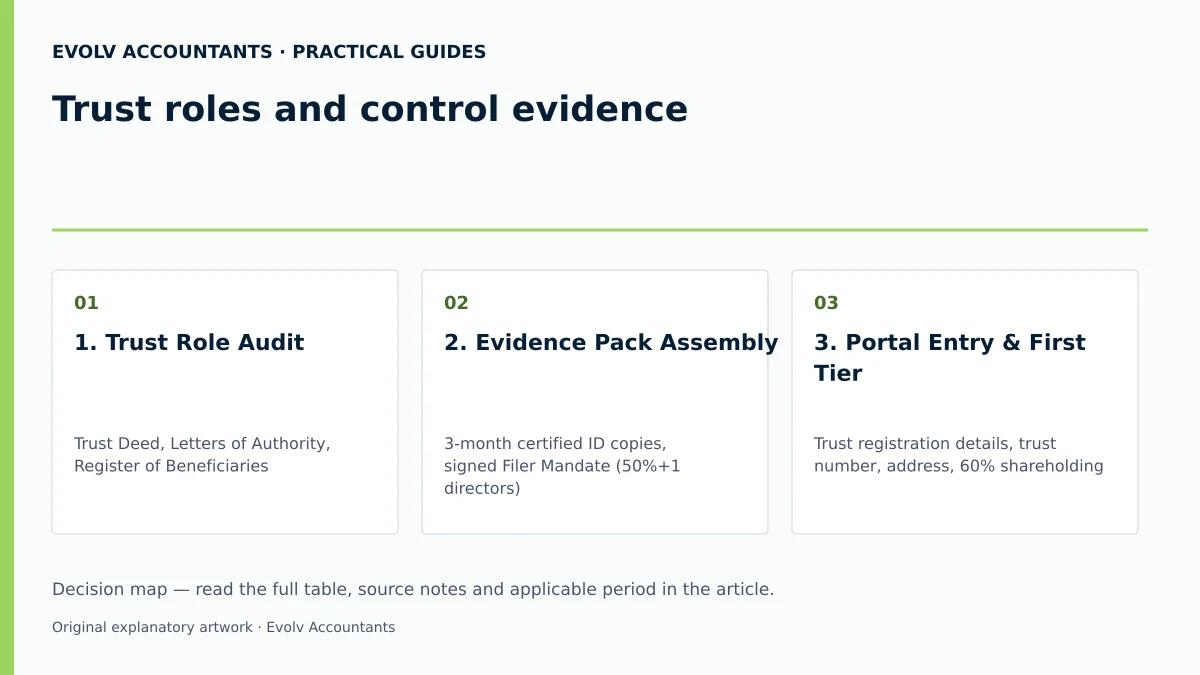
| 1. Trust Role Audit | Trust Deed, Letters of Authority, Register of Beneficiaries 6 13 | Company Director / Secretary | All settlors, trustees, protectors, and beneficiaries identified 11 12 | Escalate complex or discretionary trust terms to legal advisor 6 |
| 2. Evidence Pack Assembly | 3-month certified ID copies, signed Filer Mandate (50%+1 directors) 14 17 | Mandated Filer | All ID copies certified within 3 months; letterhead mandate signed 14 17 | Re-certify expired identification or re-obtain director signatures 14 17 |
| 3. Portal Entry & First Tier | Trust registration details, trust number, address, 60% shareholding 25 27 29 | Mandated Filer | Trust logged as 1st tier juristic owner on CIPC e-services 25 27 | Manually enter Trust number as automated search is unavailable 27 |
| 4. Natural Person Declaration | Individual ID numbers, email, mobile, trust interest types 30 32 | Mandated Filer | Green tick confirming DHA ID verification for natural persons 30 34 | Proceed if DHA offline; verify manually against ID copy 34 |
| 5. Supporting Doc Upload | Certified IDs, Mandate, Securities Register, Disclosure Form 13 15 | Mandated Filer | All required files successfully uploaded to portal 13 42 | Re-upload missing disclosure form or updated securities register 13 |
| 6. OTP Verification & Certificate | Filer SMS OTP ('S' caps) and Email OTP ('E' caps) 35 36 | Mandated Filer | Status reflects "BO COMPLETE REGISTRATIONS"; Certificate downloaded 3 4 | Resend OTPs if delayed; re-attempt before session timeout 35 36 |
Frequently Asked Questions
Can a trust be listed as the ultimate beneficial owner of a South African company?
No. Under CIPC regulations and the General Laws Amendment Act, a beneficial owner can ONLY be a natural person 9. While a trust is captured as a first-tier juristic owner, company filings must declare the ultimate natural persons behind the trust 9 25 26.
What proportion of company directors must sign the filing mandate?
The written mandate authorising a single natural person to file beneficial ownership details on the company's letterhead must be signed by at least 50% + 1 of the company's directors (ordinary resolution threshold) 17 18.
What certification age limit applies to uploaded identity documents?
Certified identity copies for both the mandated filer and all declared natural person beneficial owners must be dated not older than 3 months at the time of submission 13 14 15 16.
How does the CIPC system verify South African identity details?
When entering South African identity numbers on the portal, the system performs an automated real-time verification against the Department of Home Affairs (DHA) database 30 33. Successful verification displays a green indicator 34.
What constitutes legal proof that a beneficial ownership filing is complete?
Proof of completion requires a status of "BO COMPLETE REGISTRATIONS" in the CIPC portal's Completed Applications grid, receipt of an official CIPC confirmation email, and downloading the CIPC Beneficial Ownership Confirmation Certificate 3 4 5.
Related guides
- Who counts as a beneficial owner of a private company
- Filing a first beneficial ownership declaration with CIPC
- Compliance and Regulations: Keeping Your Business on Track
Sources
- https://www.gov.za/sites/default/files/gcis_document/202212/47815anti-moneylaunderingact22of2022.pdf
- Beneficial Ownership (BO) Filing Compliance Inspections | CIPC
- https://www.cipc.co.za/wp-content/uploads/2024/09/Step-by-step-guide_E-Services-Beneficial-Ownership-Filing-Complex-Structure-Final.pdf
- https://www.cipc.co.za//wp-content/uploads/Legal/Regulations/CompaniesAct71_2008.pdf
- https://www.cipc.co.za/wp-content/uploads/2024/09/Step-by-step-guide_E-Services-Beneficial-Ownership-Filing-Non-Affected-Company-With-Beneficial-Ownership.pdf