
Financial accountability supplements for small companies
4 October 2026

A financial accountability supplement is Form CoR 30.2, used for the applicable CIPC annual-return reporting route. It does not replace preparing annual financial statements.
A financial accountability supplement (FAS) is required with a CIPC annual return where audited AFS are not required and the company does not voluntarily file audited or reviewed AFS.
It does not remove a separate duty to prepare financial statements or obtain a required independent review. Primary guidance.
Decide the assurance obligation separately from the CIPC filing format. A private company needs a statutory audit at PIS 350 or more, or PIS 100 or more with internally compiled statements, and when another audit trigger applies. The owner-managed exemption does not cancel a mandatory statutory audit. Where no audit is required, test independent review and the section 30(2A) exemption using every securities holder and beneficial-interest holder, not only the registered shareholders.
Statements count as internally compiled unless the regulatory definition of “independently compiled and reported” is met. A company not required to file audited statements may file audited or reviewed AFS; if it does neither, it files FAS. FAS does not replace preparing AFS or obtaining a required review. CIPC annual-return FAQ; Companies Regulations.
Under Section 33 of the Companies Act 71 of 2008 and Regulation 30 of the Companies Regulations, every registered profit and non-profit company in South Africa must submit an annual return to the Companies and Intellectual Property Commission (CIPC) within 30 business days after the anniversary date of its incorporation 1 2 3. A core component of this annual return submission is demonstrating financial accountability 1 4.
While public companies, state-owned entities, and high-impact private companies are legally obligated to lodge full audited annual financial statements (AFS) via iXBRL, qualifying small private companies that are exempt from statutory audits or independent reviews—and choose not to file them voluntarily—must instead submit a Financial Accountability Supplement using Form CoR 30.2 5 6 7 8. This filing ensures statutory compliance, confirms active operational status, and prevents administrative deregistration 9 10.
Applicability and contents of financial accountability information
Target Reader, Jurisdiction, and Compliance Period
This legal and operational framework applies to directors, company secretaries, accounting officers, and registered advisors of small private profit companies and non-profit companies operating within the jurisdiction of South Africa 2 3 11. The compliance cycle is governed annually by the anniversary month of the company's incorporation 1 2 3. Entities have a prescribed period of 30 business days from the anniversary date to complete their filing without incurring late lodgement penalties 1 3 12.
Meaning of Task Completion
Completing the financial accountability supplement process does not merely involve logging into a portal or transferring money 13 14. Completion means accurately evaluating the company's financial reporting tier under Section 30 of the Act, determining its separate audit or review obligation and its CIPC filing route, preparing Form CoR 30.2 alongside Form CoR 30.1, updating beneficial ownership disclosures, capturing verified turnover figures, and securing an official CIPC annual return compliance certificate 1 4 6 7 15.
Prepare the information and authority: applicability
Statutory Authority and Legal Foundations
The obligation to maintain accurate financial records and present financial accountability information rests on key provisions of South African corporate law:
— Practical point from this guide
- Section 28 of the Companies Act 71 of 2008: Mandates that every company must keep accurate and complete accounting records in an official South African language to enable the preparation of financial statements 16.
- Section 29 of the Companies Act: Sets standards for financial statements, requiring that they present fairly the state of affairs of the company and bear a prominent notice on the first page specifying whether they are audited, independently reviewed, or unaudited, along with the compiler's identity and professional designation 17 18.
- Section 30 of the Companies Act: Establishes that annual financial statements must be prepared within 6 months after financial year end and details audit and independent review criteria 15 19.
- Section 33 of the Companies Act & Regulation 30: Mandates the annual return filing, designation of a compliance officer, and attachment of financial accountability documentation 2 3 20.
Core Documentation and Input Prerequisites
Before initiating a filing, the designated officer must gather specific inputs:
- Latest Approved Financial Statements: Turnover figures used for CIPC fee calculations and reporting tier decisions must be derived directly from the company's latest approved financial statements 6.
- Public Interest Score (PIS) Inputs: Calculated under Regulation 26(2) using average employee numbers, total liabilities (in R millions), total turnover (in R millions), and maximum individuals holding a beneficial interest in securities or members 26 27.
- Designated Compliance Person Details: Full name, identity/passport details, and contact information for the director or employee assigned under Section 33(3) to oversee statutory compliance 20 27.
- CIPC Account & Permissions: Valid customer code and profile credentials with authorisation to lodge statutory returns on behalf of the company 25 28.
- Beneficial Ownership Filing Status: Updated beneficial ownership register filed on CIPC prior to annual return lodgement 4 29.
Critical Evidence Boundaries
- **CIPC Beneficial Ownership vs. Compliance with CIPC does not fulfill SARS requirements, and vice versa 13. Audit and Review Decision Boundaries*: The necessity of an audit or independent review depends on a combined assessment of the Act, Companies Regulations 26 and 28, the company's Memorandum of Incorporation (MOI), the compilation method (internally vs independently compiled), and statutory exemptions 15 26 30 31. For instance, under Section 30(2A), a private company is exempt from independent review if every shareholder is also a director of the company 15 31. Accounting Standards Scope*: Public IFRS overview principles apply solely for identifying framework scope (such as IFRS for SMEs vs full IFRS) and edition facts, and do not replace the underlying statutory reporting thresholds established by South African law 32.
Complete the task step by step: contents of financial accountability information
Sequenced Compliance Process
Follow this structured, evidence-grounded workflow to prepare and lodge the financial accountability supplement:
- Calculate the Public Interest Score (PIS):
- Calculate 1 point for every employee (average over the financial year) 27.
- Calculate 1 point for every R1 million (or portion thereof) in third-party liabilities 27.
- Calculate 1 point for every R1 million (or portion thereof) in turnover 27.
- Calculate 1 point for every individual holding a beneficial interest in securities (or member of NPC) 27.
- Verify Financial Statement Filing Category:
- If PIS is 350 or more (or 100+ if internally compiled), or if holding fiduciary assets over R5 million, audited AFS via iXBRL is mandatory 26 30.
- A PIS below 100 and independent compilation do not remove the review requirement. Check the section 30(2A) exemption using all securities holders and beneficial-interest holders; mandatory statutory audit triggers still take precedence.
- Confirm that the company has not voluntarily audited or reviewed its AFS 6 33. Form CoR 30.2 (FAS) is applicable 6 7.
- Complete Beneficial Ownership Declaration First:
- Navigate to the CIPC electronic platform and ensure the latest Beneficial Ownership Declaration has been lodged 4 29. CIPC system rules block annual return lodgement if BO records are outstanding 29.
- Access CIPC Annual Return Portal and Enter Operational Data:
- Log into CIPC e-Services or BizPortal using an authorised customer profile 23 24 25.
- Search for the enterprise using its official registration number 34.
- Verify and confirm operational information on Form CoR 30.1: registered office address, location of accounting records, current directors, company secretary, and financial year-end date 35.
- Capture Turnover and Compliance Person Details:
- Capture the exact turnover figure from the latest approved financial statements 6 34.
- Enter details for the designated compliance officer or director mandated by Section 33(3) 20 27.
- Select Financial Accountability Supplement (Form CoR 30.2):
- Select the Financial Accountability Supplement option (FAS button) on the CIPC portal 6 7.
- Indicate whether statements were internally compiled or independently compiled 33.
- Complete the statutory financial disclosures required in Form CoR 30.2 6 7.
- Review Fee Calculation, Checkout, and Card Payment:
- Review the automatically calculated annual return fee structure based on declared turnover 12 36:
- Turnover less than R1 million: R100 standard fee (R150 if late) 12.
- Turnover R1 million to R10 million: R450 standard fee (R600 if late) 12.
- Turnover R10 million to R25 million: R2,000 standard fee (R2,500 if late) 12 36.
- Turnover R25 million or more: R3,000 standard fee (R4,000 if late) 36.
- Add the item to the online shopping cart and complete payment via credit or debit card 22 25.
Check the result against the evidence: applicability
Independent Completion Evidence
Directors must never assume that completing an electronic payment or receiving a browser confirmation screen equates to full regulatory acceptance 13 14. Independent completion evidence requires:
- CIPC Annual Return Certificate: Obtaining an official CIPC Annual Return Filing Certificate confirming that Form CoR 30.1 and Form CoR 30.2 have been successfully processed for the specified financial year 23.
- Registry Status Update: Checking the CIPC BizProfile or e-Services enterprise history to confirm the company's status reflects "In Business" and active, with no pending deregistration flags 10 37.
- Document Archiving: Under Section 24 of the Companies Act 71 of 2008, maintaining copies of the lodged CoR 30.1 return, CoR 30.2 FAS supplement, approved financial statements, and payment receipt in the company's minute book or electronic registry for a mandatory retention period of 7 years 21 38.
Handle exceptions and unresolved cases: contents of financial accountability information
Title-Specific Edge Cases and Rectifications
- Incorrect Turnover Captured During Submission: Once submitted, annual return data cannot be directly edited online 39. If an incorrect turnover figure was captured, a formal rectification request must be logged via the CIPC online enquiry system 40. The customer must request a credit note (if declared turnover was higher than actual) or debit note (if declared turnover was lower than actual) 39. Mandatory supporting documentation includes:
- Approved annual financial statements for the return year in question 40.
- Company name, registration number, and return year 40.
- Written explanation detailing the reason for the error 40.
- Certified ID copy of the customer code owner 40.
- Formal signed letter granting CIPC permission to adjust the customer account 40.
- Dormant or Inactive Entities: Neither the Companies Act 2008 nor Close Corporations Act 1984 exempts dormant or non-trading businesses from filing annual returns and paying prescribed fees 10 41. Dormant small entities must still submit Form CoR 30.1 and Form CoR 30.2 annually 8 10 41.
- Pending Deregistration for Non-Compliance: If a company fails to file annual returns for two or more consecutive years, CIPC automatically initiates administrative deregistration 9 10. To stop deregistration, all outstanding annual returns, FAS supplements, and late penalties must be submitted before final deregistration is published 10 42.
- Specialist Boundaries and External Audit Triggers: If a company's MOI requires an audit, if it holds fiduciary assets exceeding R5 million, or if its PIS exceeds statutory limits, the FAS route is legally unavailable 26 30 31. In such cases, full audited AFS must be prepared and submitted via iXBRL 5 26.
Next steps for CIPC annual returns
Reusable Compliance Task Checklist
- Determine the annual return anniversary date and 30-business-day filing window 1 3.
- Finalise and approve annual financial statements within 6 months of financial year end 6 19.
- Calculate Public Interest Score (PIS) under Regulation 26(2) 26 27.
- Confirm the separate assurance obligation and verify whether Form CoR 30.2 (FAS) is the applicable filing route.
- Update and lodge Beneficial Ownership Declaration on CIPC portal 4 29.
- Capture turnover and Section 33(3) compliance officer details on Form CoR 30.1 20 27 34.
- Submit Form CoR 30.2 Financial Accountability Supplement 6 7.
- Pay prescribed CIPC filing fee via electronic card payment 12 25 36.
- Download and archive CIPC filing certificate and proof of payment for 7 years 21 23.
Task and Completion Checklist
| Step | Input or evidence | Responsible person | Completion check | Exception or next action |
|---|---|---|---|---|
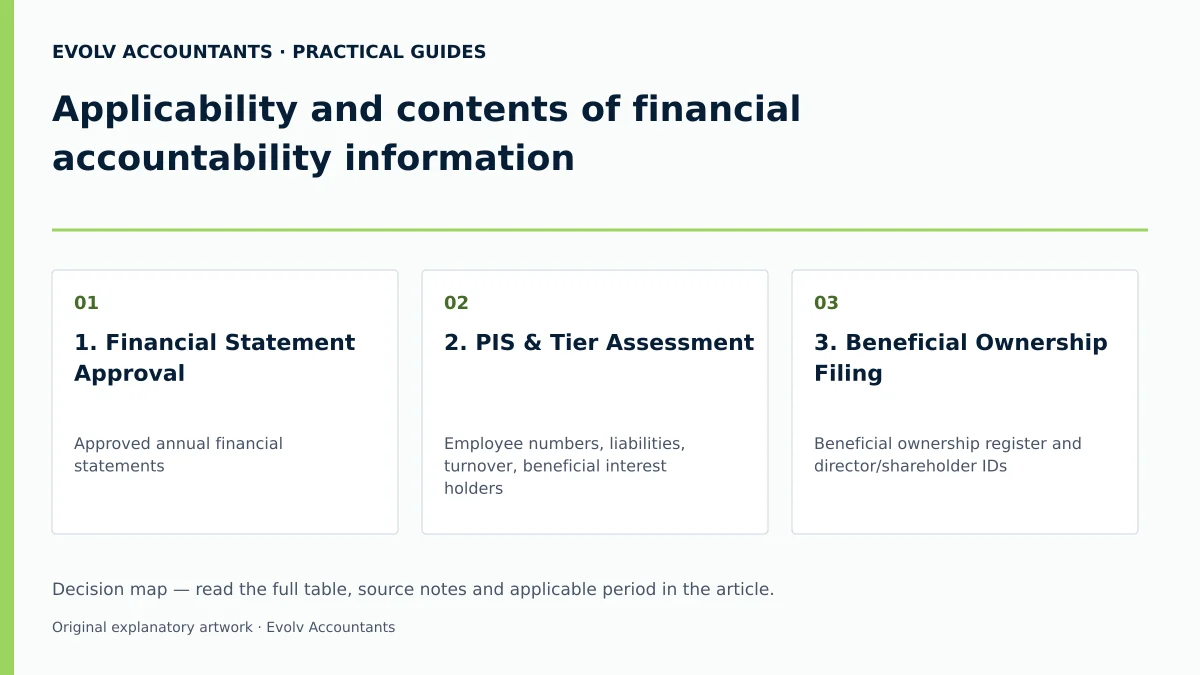
| 1. Financial Statement Approval | Approved annual financial statements 6 | Board of Directors / Accounting Officer | Statements signed by authorised director 43 | Resolve accounting queries before calculating turnover |
| 2. PIS & Tier Assessment | Employee numbers, liabilities, turnover, beneficial interest holders 27 | Compliance Officer / Evolv Accountant | Documented PIS score and tier decision 26 27 | If PIS >= 350 or audit triggered, lodge audited AFS via iXBRL 5 26 |
| 3. Beneficial Ownership Filing | Beneficial ownership register and director/shareholder IDs 4 29 | Designated Director / Company Secretary | CIPC BO acknowledgement reference 4 29 | Clear any CIPC BO filing blocks before annual return submission 29 |
| 4. Form CoR 30.1 & CoR 30.2 Submission | CIPC e-Services login, turnover figure, compliance person details 7 20 25 27 | Duly Authorised Representative 28 | Data captured and Form CoR 30.2 FAS selected 6 7 | If turnover incorrect, submit CIPC enquiry for credit/debit note 39 40 |
| 5. Fee Payment & Archiving | Debit/credit card, shopping cart checkout 12 25 | Customer Code Holder / Financial Manager | Official CIPC Filing Certificate issued 23 | Archive all records for 7 years under s24 21 |
Reproducible Hypothetical Example
Evolv Client Example: Apex Tech Solutions (Pty) Ltd (Note: Values below are illustrative values labelled for demonstration purposes.)
- Company Profile: Small private software company incorporated in South Africa.
- Financial Year End: 28 February 2025.
- Financial Statement Preparation: Statements completed on 30 May 2025 (within the 6-month statutory limit under s30(1)) 19.
- PIS Calculation Breakdown:
- Average employees: 6 (6 points) 27.
- Total third-party liabilities: R800,000 (1 point) 27.
- Annual turnover: R4.5 million (5 points) 27.
- Shareholders (all natural persons and active directors): 2 (2 points) 27.
- Total Public Interest Score: 14 points 27.
- Reporting Tier Decision: Assume no other statutory audit trigger or MOI audit clause, and that every securities holder and beneficial-interest holder is also a director. With those facts, the company has no statutory audit under the stated PIS test and qualifies for the review exemption. Low PIS and independent compilation alone would not remove review.
- Annual Return Lodgement: In June 2025 (anniversary month), the company logs into CIPC e-Services, files its Beneficial Ownership Declaration, completes Form CoR 30.1 with R4.5 million turnover, selects Form CoR 30.2 (FAS), pays the R450 statutory fee, and downloads its CIPC compliance certificate 1 3 6 7 12 25.
Frequently Asked Questions
What is a Financial Accountability Supplement (Form CoR 30.2)?
A Financial Accountability Supplement is an official statutory form submitted alongside a company's CIPC annual return (Form CoR 30.1) by small private entities that are not required by law or MOI to file audited or independently reviewed financial statements 6 7 8.
Does filing SARS corporate income tax returns replace CIPC annual returns?
No 13. CIPC annual returns under the Companies Act 71 of 2008 and SARS tax returns under tax legislation are entirely separate legal requirements administered by different government bodies 13. Compliance with SARS does not satisfy CIPC statutory obligations 13.
What happens if a small company fails to file its annual return and FAS?
Failing to file annual returns results in late payment penalties 1 12. Continuous non-compliance for two or more consecutive years triggers automatic administrative deregistration by CIPC, leading to the loss of legal personality and potential director liability 9 10.
Can a company apply for an exemption or fee waiver for CIPC annual returns?
No 41. The Companies Act and CIPC regulations do not allow exemptions from annual return filings or fee waivers, even for dormant or non-trading businesses 10 41. Payment cannot be made in instalments 41.
How can an error in declared turnover be corrected after submission?
Online editing is not permitted post-submission 39. The company must log an online enquiry with CIPC providing its financial statements, certified ID of the customer code owner, a formal explanation letter, and permission for CIPC to issue a credit or debit note adjusting the customer account 40. Ask Evolv about applicability and contents of financial accountability information. Share the relevant records so the support required can be scoped.
Related guides
- Beneficial interest versus registered share ownership
- Filing CIPC annual returns for a private company
- Compliance and Regulations: Keeping Your Business on Track
Sources
- https://annualreturns.cipc.co.za/docs/FAQ_Annual_Returns.pdf
- https://www.justice.gov.za/legislation/acts/2008-071-reg.pdf
- https://www.cipc.co.za//wp-content/uploads/Legal/Regulations/CompaniesAct71_2008.pdf
- https://www.cipc.co.za/wp-content/uploads/Forms/Companies/CoR30_1.pdf
- https://www.cipc.co.za/wp-content/uploads/2024/10/STEP-BY-STEP-ANNUAL-RETURNS-003.pdf