
Beneficial interest versus registered share ownership
20 November 2024

Registered share ownership is the holding recorded in a securities register; beneficial interest concerns rights or benefits that may belong to another person.
Registered share ownership denotes entry in a company securities register, whereas a beneficial interest concerns rights attached to securities, and beneficial ownership identifies the natural person who ultimately owns or controls the company.
CIPC’s filing guides use a 5% reporting norm for percentage interests. That administrative guidance must be distinguished from the Act: the express 5% securities-register rule in section 56(7)(aA) applies to affected companies, while the definition of a beneficial owner also covers board appointment rights and material influence. Do not treat a holding below 5%, or the absence of shares, as a universal exemption from identifying effective control.
Assess the actual rights and the correct affected/non-affected category before filing. Read the statutory amendments.
South African small and medium enterprises (SMEs) operating under the Companies Act 71 of 2008 must maintain a precise distinction between registered shareholders and beneficial interest holders. While registered shareholders hold formal legal title recorded on the company securities register, actual beneficial ownership attaches to the natural persons who ultimately enjoy the economic benefits or exercise effective control over the entity.
Regulatory compliance mandates that private companies identify, document, and submit beneficial ownership declarations to the Companies and Intellectual Property Commission (CIPC), ensuring complete corporate transparency.
Registered shares versus actual beneficial interest
Understanding registered shareholding under the Companies Act
Under South African statutory law, Section 1 of the Companies Act 71 of 2008 defines a shareholder as the person who is entered as the holder of a share in the certificated or uncertificated securities register of a company 1. Section 50 of the Act requires every company to establish and maintain a formal register of its issued securities (for a profit company; NPCs have the modified application in section 10) 2.
In terms of Section 50(4), this securities register serves as sufficient legal proof of the facts recorded in it, in the absence of evidence to the contrary 3.
— Practical point from this guide
Statutory law establishes that registered shareholding represents the formal administrative relationship between a company and an investor 1 2. Registered shareholders are entitled to receive notices, attend corporate meetings, and exercise general voting rights directly attached to their shares 4 5. Regulator guidance from the CIPC emphasizes that maintaining an accurate securities register is a fundamental statutory duty for all registered corporate entities in South Africa 2 6.
Evolv recommends that SME directors review their securities register quarterly to ensure every issued share corresponds exactly to valid corporate resolutions and physical share certificates or electronic ledger entries.
Defining actual beneficial interest and ultimate control
Statutory law under Section 1 of the Companies Act defines a "beneficial interest" in relation to a company's securities as the right or entitlement of a person—through ownership, agreement, relationship, or otherwise—alone or together with another person, to receive or participate in distributions, exercise or direct the exercise of voting rights, or dispose of the securities or distributions 7.
Section 56(1) explicitly recognizes that issued securities of a company may be registered in the name of one person while held for the beneficial interest of another 8.
Regulator guidance published by the CIPC incorporates amendments introduced by the General Laws Amendment Act 22 of 2022, expanding beneficial ownership to encompass the natural person who ultimately owns or exercises effective control over a company 9 10. CIPC guidance details that effective control includes holding beneficial interest in holding company securities through subsidiaries, controlling board appointments, or exercising material management influence through contracts, trusts, or corporate chains 11 12.
CIPC rules stipulate that a beneficial owner must always be an individual natural person; corporate entities or trusts holding shares represent intermediate ownership tiers rather than ultimate beneficial owners 13. Evolv recommends that company leadership trace all corporate shareholdings back to living natural persons to ensure compliance with CIPC declaration mandates.
Compare the criteria that matter: registered shares
Evaluating control, voting rights, and operational constraints
When comparing registered shareholding against actual beneficial interest, SME leadership must evaluate how voting power and operational management are structured:
- Voting Power: Statutory law specifies that registered shareholders hold the direct right to exercise general voting rights at company shareholder meetings 4 5. However, where shares are held via nominee agreements or intermediate entities, beneficial interest rules dictate that the individual holding ultimate voting control or directing the nominee exercises actual effective power 11 14.
- Board Appointments: Registered shareholding may confer contractual rights to nominate directors under a Memorandum of Incorporation 15. CIPC regulator guidance clarifies that beneficial control includes the unwritten or contractual ability to appoint or remove board members who control a majority of board votes 11 16.
- Operational Management: Being a shareholder does not itself confer the board’s management powers; a shareholder may separately hold an employment or management role. In contrast, CIPC guidance highlights that individuals who exercise material influence over company management constitute reportable beneficial owners regardless of formal share register entries 11 12.
- Legal liability: A company is a separate juristic person. Being a registered shareholder does not by itself make a person liable for company debts. Any personal liability requires its own legal basis. Section 56(5) concerns enquiries about securities held for another person’s beneficial interest; it does not transfer company debts to the registered holder. Companies Act, sections 19 and 56.
How the obligations differ: actual beneficial interest
Statutory filing requirements and the 5% threshold
Statutory law under Section 122(1) of the Companies Act requires any person who acquires or disposes of a beneficial interest in a regulated company resulting in a holding of 5%, or any further whole multiple of 5%, of issued securities of that class to formally notify the company within three business days 20 21.
CIPC’s operational guide describes a 5% percentage norm. The amended Act separately defines effective control and distinguishes affected-company beneficial-interest registers from non-affected-company BO records. Record the relevant securities and control facts without assuming that a percentage calculation alone resolves all control rights. Primary guidance.
Documentary evidence and mandated authorisation
CIPC regulator guidance outlines strict evidence requirements for submitting beneficial ownership declarations:
- Written Director Mandate: Filings submitted on the CIPC e-services platform by an authorised filer require a formal written mandate on the company letterhead, signed by at least 50% + 1 of the company directors 23 24.
- Certified Identification Copies: Filers must upload certified copies of South African identity documents or notarized foreign passports for all declared beneficial owners and the mandated filer, with certifications dated not older than three months 6 25 26.
- Mandatory Registers: Non-affected companies submitting beneficial ownership declarations must upload an updated Section 50 securities register and a Section 56 beneficial interest register 6 26 27.
- Complex Structure Disclosure Form: Where shareholding involves multi-tier juristic persons or trusts, filers must upload a disclosure form featuring a diagrammatic representation of the ownership structure demonstrating the position of natural person beneficial owners 13 26 27.
Evolv recommends establishing a permanent compliance file storing verified director mandates, certified ID copies, and structural disclosure charts to satisfy CIPC monitoring inspections.
Decision comparison matrix
| Criterion | Option A: Registered Shareholding | Option B: Actual Beneficial Interest | Evidence or assumption | Implication for this reader |
|---|---|---|---|---|
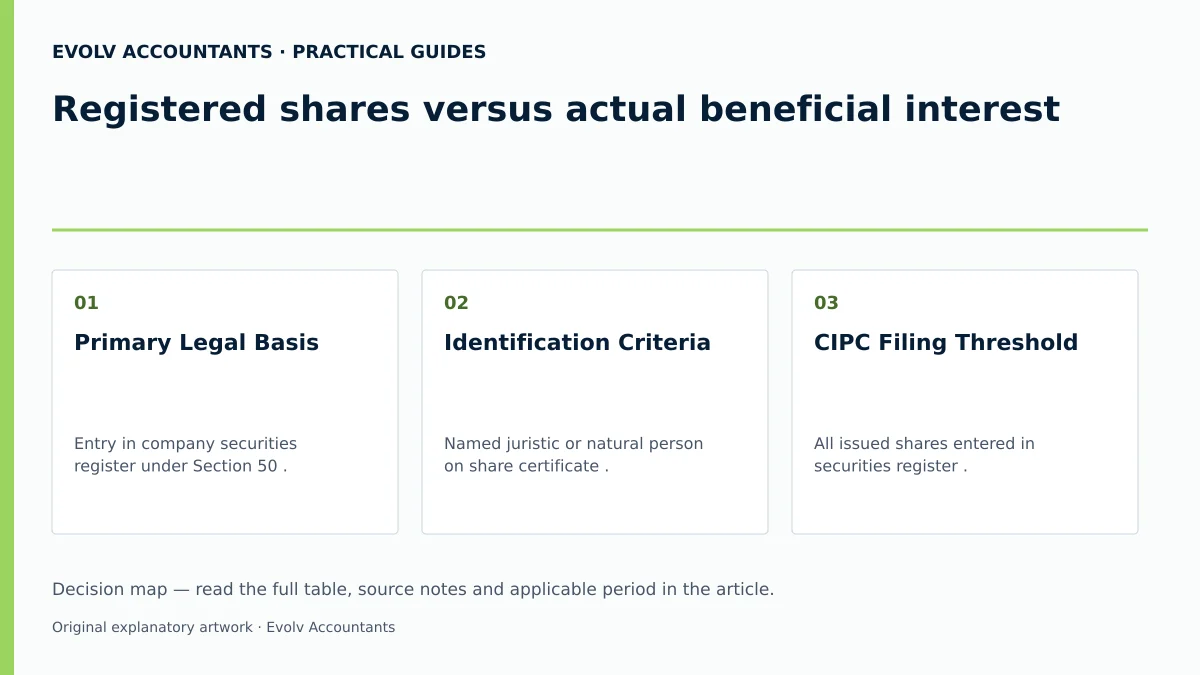
| Primary Legal Basis | Entry in company securities register under Section 50 2. | Economic entitlement or ultimate control under Section 1 7. | Companies Act 71 of 2008 statutory provisions 2 7. | Formal title differs from underlying economic control. |
| Identification Criteria | Named juristic or natural person on share certificate 28 29. | Beneficial interest: a person with securities rights, potentially natural or juristic. Ultimate beneficial owner: a natural person. | CIPC Beneficial Ownership Guidelines 9 13. | Corporate shareholding must be traced to natural persons. |
| CIPC Filing Threshold | All issued shares entered in securities register 2 30. | Reportable percentage interests and other ultimate natural-person control 9 19. | CIPC percentage guidance, read with the statutory effective-control definition 9 19. | Assess effective control separately; do not infer a universal sub-5% exemption. |
| Governance & Voting Power | Direct exercise of voting rights at shareholder meetings 4 5. | Directing nominee votes or controlling board appointments 11 14. | Section 57(1) read with CIPC control guidelines 4 11. | Voting control may reside outside registered holders. |
| Supporting Documentation | Certificated share certificates and securities register 28 29. | Director mandate (50% + 1), certified IDs, structural diagram 6 23. | CIPC mandatory supporting document guidelines 6 23. | Filings require verified identity and mandate evidence. |
Two business situations with different outcomes: registered shares
Scenario 1: Direct individual ownership in a simple private company
- Hypothetical Facts (illustrative values): Apex Logistics (Pty) Ltd is a South African private company with an authorised share capital of 1,000 ordinary shares (illustrative value) 30. The company has issued 1,000 ordinary shares (illustrative value) directly to Individual A (a natural person and South African citizen) 30 31, who serves as the sole director and manages daily operations. No intermediate holding companies, trusts, or nominee agreements exist 32 33.
- Application of Criteria: Individual A is both the sole registered shareholder on the Section 50 securities register 1 2 and the sole natural person holding 100% direct beneficial ownership and voting control 9 34.
- CIPC Filing Outcome: Apex Logistics (Pty) Ltd qualifies as a non-affected company without beneficial ownership to declare outside its registered directors/members 35 36. Under CIPC regulator guidance, because the company has 10 or fewer directors/members and no external beneficial control, it uses the CIPC Optimised BO filing platform 32 36. The filer completes the online securities register content directly on e-services without uploading document files, receiving an official e-mail confirmation upon successful verification 32 37 38.
Scenario 2: Nominee or corporate holding structure with indirect control
- Hypothetical Facts (illustrative values): Beacon Technology (Pty) Ltd has an authorised share capital of 10,000 ordinary shares (illustrative value), with 10,000 ordinary shares issued (illustrative value) 30. The Section 50 securities register reflects two registered shareholders: Corporate Holdings (Pty) Ltd holding 6,000 shares (60% registered shareholding) (illustrative value), and Nominee B holding 4,000 shares (40% registered shareholding) (illustrative value) 2 8. Natural Person C owns 100% of Corporate Holdings (Pty) Ltd 13. Nominee B holds shares under a written nominee agreement for the ultimate beneficial interest of Natural Person D 7 8.
- Application of Criteria: While Corporate Holdings (Pty) Ltd and Nominee B are the registered shareholders 1 2, they are not natural persons holding ultimate beneficial ownership 13. Tracing ownership reveals two ultimate natural person beneficial owners: Natural Person C holds 60% indirect beneficial ownership through Corporate Holdings (Pty) Ltd, and Natural Person D holds 40% indirect beneficial ownership through Nominee B 9 13 34. Both holdings exceed the 5% CIPC reporting norm 9 19.
- CIPC Filing Outcome: Beacon Technology (Pty) Ltd must submit a full CIPC beneficial ownership declaration under the "Non-Affected Company WITH Beneficial Ownership to Declare" category 39 40. The filer must upload a director mandate signed by at least 50% + 1 of Beacon Technology's directors 23 24, certified ID copies for Natural Persons C and D dated within three months 6 25, the Section 50 securities register 2 6, the Section 56 beneficial interest register 6, and a complex structure disclosure diagram mapping the intermediate corporate and nominee tiers 13 27. Upon verification via e-services OTP confirmation, CIPC issues an official Beneficial Ownership Confirmation Certificate 41 42.
When the comparison needs specialist input: actual beneficial interest
Complex ownership tiers, trusts, and overseas shareholders
SME corporate structures involving multi-tiered ownership require specialized professional review:
- Family Trusts and Trustees: Where shares are held by a trust, CIPC guidance mandates capturing the trust as a first-tier juristic listing, followed by declaring all natural person trustees, settlors, protectors, and beneficiaries who hold reportable control or economic interest 13 43 44 45.
- Foreign Juristic Shareholders: Where intermediate holding companies are registered overseas, filers must obtain certified or notarised copies of foreign passports for ultimate natural person beneficial owners, dated within three months 22 25 26.
- Complex Structure Disclosure Diagrams: Filers must construct an accurate hierarchical diagram detailing exact shareholding percentages across every intermediate corporate tier 13 27.
Unusual contractual rights and financial audit boundaries
Technical tax and legal judgments arise when contractual rights diverge from share equity:
- Contractual Control Rights: Agreements granting individuals rights to surplus assets upon dissolution, profit distribution rights, or veto power over board decisions trigger beneficial ownership reporting even if the individual holds zero registered shares 11 44 46.
- Audit and Independent Review Decisions: Under the Companies Act, determining whether a private company requires an independent financial review or an audit depends on calculating its Public Interest Score (PIS) under Section 30 and Companies Regulations 47. Evaluating whether beneficial interest disclosures affect group consolidated financial reporting or audit scope requires integrated technical guidance.
- Evolv Recommendation: Directors should engage Evolv Accountants to perform a preliminary beneficial ownership audit whenever company shares are encumbered, held in trust, or governed by complex shareholder agreements.
Next steps for Beneficial ownership
Practical compliance checklist for SME leadership
Follow this step-by-step checklist to ensure full compliance with CIPC beneficial ownership requirements:
- Examine the Current Securities Register: Review the company's Section 50 securities register to confirm all registered shareholdings, class descriptions, and share numbers 2 29.
- Issue Beneficial Interest Disclosure Notices: Send formal Section 56(5) written notices to any registered shareholders operating as nominees or juristic entities to verify underlying natural person details 18.
- Map Ultimate Natural Person Beneficial Owners: Identify every living individual who directly or indirectly holds 5% or more beneficial interest, voting control, or board appointment power 9 11 19.
- Draft and Execute Director Mandate: Prepare a written mandate on company letterhead authorising a designated natural person CIPC customer code holder to submit the filing, signed by at least 50% + 1 of current directors 23 24.
- Compile Certified Supporting Evidence: Obtain certified copies of South African ID cards or notarized foreign passports for all beneficial owners and the filer, dated within three months 6 25.
- Complete CIPC e-Services Submission: Log into the CIPC e-services portal, select the correct company category (optimised or non-affected with BO), upload mandatory registers and structural diagrams where applicable, complete OTP verification, and download the confirmation certificate 36 41 42 48 49.
Decision record and internal compliance documentation
Directors must record the compliance classification decision (such as confirming whether the entity is an affected or non-affected company) in board minutes. All securities registers, beneficial interest registers, director mandates, and CIPC confirmation certificates must be retained in company records for at least seven years in accordance with Section 24 of the Companies Act 50.
Frequently Asked Questions
What is the main legal difference between registered shares and beneficial interest?
Registered shareholding refers to the formal entry of a shareholder's name on a company's Section 50 securities register 1 2. Beneficial interest refers to the underlying right of a natural person to receive distributions, exercise voting rights, or direct the disposition of shares, regardless of whose name appears on the formal register 7 8.
What is the threshold for declaring beneficial ownership to CIPC?
CIPC regulator guidance establishes a 5% CIPC reporting norm for beneficial ownership declarations 9 19. Any natural person who directly or indirectly holds 5% or more of beneficial interest, voting rights, or effective control in a South African company must be declared on the CIPC register 9 11 19. Effective control must still be assessed independently of the percentage holding.
Who must sign the authorisation mandate for a CIPC beneficial ownership filing?
Under CIPC filing rules, the written authorisation mandate appointing a designated natural person to submit beneficial ownership information on behalf of the company must be printed on company letterhead and signed by at least 50% + 1 of the company's active directors 23 24.
How does the CIPC Optimised BO filing system differ from standard filing?
The CIPC Optimised BO filing system applies exclusively to non-affected companies that have no external beneficial ownership to declare outside their registered directors/members and have 10 or fewer directors/members 32 36. Eligible entities update their securities register content directly on the portal without uploading document files, receiving an e-mail notification rather than a confirmation certificate 32 37 38.
Does filing beneficial ownership with CIPC replace tax or securities registers?
No. Filing beneficial ownership with the CIPC does not replace a company's legal duty to maintain its Section 50 securities register and Section 56 beneficial interest register on site 2 6. Furthermore, CIPC corporate filings under the Companies Act are distinct from SARS revenue declarations, which operate under separate tax legislation.
Related guides
- What beneficial ownership information must stay current
- Who counts as a beneficial owner of a private company
- Compliance and Regulations: Keeping Your Business on Track
Sources
- https://www.gov.za/sites/default/files/gcis_document/202212/47815anti-moneylaunderingact22of2022.pdf
- https://www.cipc.co.za//wp-content/uploads/Legal/Regulations/CompaniesAct71_2008.pdf
- https://www.cipc.co.za/wp-content/uploads/2024/09/Step-by-step-guide_E-Services-Beneficial-Ownership-Filing-Complex-Structure-Final.pdf
- https://www.cipc.co.za/wp-content/uploads/2024/09/Step-by-step-guide_E-Services-Beneficial-Ownership-Filing-Non-Affected-Company-With-Beneficial-Ownership.pdf
- https://www.cipc.co.za/wp-content/uploads/2025/10/Step-by-step-guide-OPTIMIZED-BO-FILING-Final.pdf