
What beneficial ownership information must stay current
9 April 2025

Maintaining current beneficial ownership data requires South African companies to perform periodic verification and promptly submit updates to CIPC.
CIPC’s filing guides use a 5% reporting norm for percentage interests. That administrative guidance must be distinguished from the Act: the express 5% securities-register rule in section 56(7)(aA) applies to affected companies, while the definition of a beneficial owner also covers board appointment rights and material influence. Do not treat a holding below 5%, or the absence of shares, as a universal exemption from identifying effective control.
Assess the actual rights and the correct affected/non-affected category before filing. Read the statutory amendments.
South African private companies, close corporations, non-profit companies, and external companies must ensure that registered beneficial ownership records accurately reflect ultimate natural person control at all times 1 2. Periodic verification requires entities to review their beneficial ownership disclosures annually alongside annual return filings, or immediately when ownership structures change 3 4. Assess reportable percentage interests and any other ultimate natural-person effective-control rights.
Evolv Accountants recommends quarterly internal register audits to maintain statutory compliance prior to portal submission.
— Practical point from this guide
Periodic verification of still current declarations
This operational guidance applies to directors, company secretaries, compliance officers, and appointed accounting managers overseeing statutory compliance for commercial entities registered in South Africa under CIPC jurisdiction 1 5.
Periodic verification requires declaring entities to systematically review whether previously submitted beneficial ownership filings remain accurate 4 6. Under the statutory framework, companies must re-confirm or amend their beneficial ownership registers at least once annually, or whenever an administrative, legal, or equity transaction alters the ultimate natural person control structure 4 6.
Verification completion is not achieved by merely creating an online draft or saving enterprise information 7. Full completion requires obtaining independent primary evidence from CIPC confirming that the submission has been formally accepted and registered 8 9. For non-affected companies declaring beneficial owners, completion is proven by an official CIPC Beneficial Ownership Certificate 8 10.
For non-affected entities under the optimised filing pathway, completion is established upon receiving an official CIPC confirmation email 9 11.
Prepare the information and authority: periodic verification of still current declarations
Before launching an online filing on CIPC New E-Services, the mandated filer must assemble required documents, authority permissions, and entity data 1 12.
Mandatory Authorisation and Documentation
- Written Mandate: Filers submitting on behalf of a company or close corporation must hold a written mandate on the declaring entity's official letterhead 5 13. The mandate must explicitly name a single natural person holding a valid CIPC customer code and be signed by at least 50% plus one of the company’s directors, or by all members of a close corporation.
- Certified Identification: Filers must collect certified identity or passport copies for both the filer and all declared natural person beneficial owners 12 14. Certifications must be dated within three months of filing 12 14. Foreign beneficial owners require notarised passport copies or foreign assurance verification 2 12.
- Securities and Beneficial Interest Registers: The entity must maintain an updated securities register per Section 50 of the Companies Act 71 of 2008, alongside a beneficial interest register 3 12 14.
- Complex Structure Disclosures: Where shares are held via juristic entities or trusts, a disclosure form with a diagrammatic structure representation establishing the natural person at the control apex is required 4 15.
Regulatory Thresholds and Scope Boundaries
CIPC statutory reporting enforces a 5% threshold requirement 1 4. Any natural person directly or indirectly holding 5% or more of beneficial interest, voting rights, or board control must be declared 4 16. Effective control must still be assessed independently of the percentage holding.
CIPC beneficial ownership filing is a corporate compliance process. Check separate SARS obligations against SARS guidance. Primary guidance.
Complete the task step by step: documented completion and exceptions
Updating a beneficial ownership declaration follows a structured workflow on CIPC New E-Services 18 19 20.
Step-by-Step Filing Workflow
- Portal Authentication: Log into CIPC New E-Services (eservices.cipc.co.za) with customer credentials 18 19. Note: Updating profile contact details triggers a mandatory 48-hour system delay before filing can proceed 21 22.
- Navigate to Transact: Select Transact, click Beneficial Ownership, accept terms, and click New Application 18 19 23 24.
- Enterprise Selection: Search for the target entity using its registration number and verify enterprise details 25 26 27.
- Company Categorisation: Choose "Non-Affected Company WITH Beneficial Ownership To Declare" or "Non-Affected Company WITHOUT Beneficial Ownership To Declare" (Optimised System) 28 29 30 31.
- Capture Ownership Tiers:
- Juristic Tiers: For complex corporate shareholders, capture juristic details (registration date, interest type, ownership percentage) 4 16 32 33.
- Natural Persons: Capture natural person details (ID/passport number, full names, physical/postal addresses, interest type) 34 35 36 37 38 39.
- Upload Documents or Complete Online Register:
- Upload mandatory documents (certified IDs <3 months, signed mandate, securities register, disclosure form) 12 14.
- For optimised filings (entities with no indirect BO and ≤10 directors/members), complete the online register directly on screen 40 41 42 43.
- Submission and OTP Verification: Submit application and complete OTP verification sent via SMS and email 44 45 46. Standard filings require both OTPs 47 48; optimised filings accept either SMS or email OTP 49.
Reproducible Hypothetical Example
Evolv Precision Engineering (Pty) Ltd (Enterprise No. 2024/123456/07) has 1,000 ordinary shares issued. Director A holds 600 shares (60%), Director B holds 250 shares (25%), and an external trust holds 150 shares (15%) for Natural Person C. During annual verification, Evolv reviews the securities register 3. Director A (60%) and Director B (25%) exceed 5% directly 4. The trust (15%) is entered as a juristic tier tracing to Natural Person C (15%) 4 32.
The filer compiles certified IDs dated within 80 days (<3 months) and a mandate signed by both directors (100% > 50%+1) 5 12. After document upload and OTP verification, CIPC issues an official Beneficial Ownership Certificate 4 8.
Check the result against the evidence: periodic verification of still current declarations
Verifying compliance requires obtaining official secondary confirmation from CIPC rather than assuming portal submission equals acceptance 7 8.
As CIPC regulator guidance explicitly notes, "Applications in progress do not constitute a valid filing of beneficial ownership information" 7. Applications in "In Progress", "Draft/Pending", or "Nullified/Rejected" grids remain incomplete and non-compliant 7 50.
Definitive Evidence Criteria
- Standard Declared BO Filings: Upon clicking FINISH after OTP verification, the transaction moves to Completed Applications 8 51. The filer receives an official email with the attached CIPC Beneficial Ownership Certificate, also downloadable from the portal grid 8 51.
- Optimised BO Filings: Non-affected entities under the optimised pathway receive an official confirmation email from QA@cipc.co.za 9. CIPC guidance specifies that no downloadable certificate is issued for optimised filings; the confirmation email serves as official evidence 9 11.
Entities must archive certificates and confirmation emails alongside statutory minute books for a minimum seven-year retention period under Section 24 of the Companies Act 8 9 52.
Handle exceptions and unresolved cases: documented completion and exceptions
Managing compliance involves addressing technical platform errors, status restrictions, and accounting boundaries 53 54.
Ineligible Enterprise Statuses
Entities in final deregistration, voluntary deregistration, liquidation, or dissolution cannot file beneficial ownership data 53 55. However, entities in "AR Deregistration Process" (overdue annual returns) remain active and MUST comply 56 57.
Technical Platform Exceptions
- Home Affairs System Offline: Automated ID verification with Home Affairs may fail if DHA is offline, displaying a red verification box 34 44. The filing still submits and proceeds to back-office processing 44 58.
- Authorised Securities Zero or Blank: If authorised shares reflect zero or blank, submission is blocked 54. Filers must email valid share proof to beneficialownershipenq@cipc.co.za for manual system updating before filing 54.
- Validation Failure (Issued > Authorised): Capturing issued shares exceeding authorised shares triggers a system error 59. Filers must correct share numbers 43 59.
Governance and Accounting Boundaries
Evolv Accountants highlights that beneficial ownership compliance is distinct from statutory audit decisions. Determining whether a company requires an independent review or audit depends on calculating its Public Interest Score (PIS) under Companies Act Regulations and evaluating its reporting framework (e.g., IFRS for SMEs) 60 61 62. Statutory financial reporting framework scope requires separate professional accounting evaluation.
Next steps for Beneficial ownership
Execute the structured task checklist below and contact Evolv Accountants for professional compliance support.
Task and Completion Checklist
| Step | Input or evidence | Responsible person | Completion check | Exception or next action |
|---|---|---|---|---|
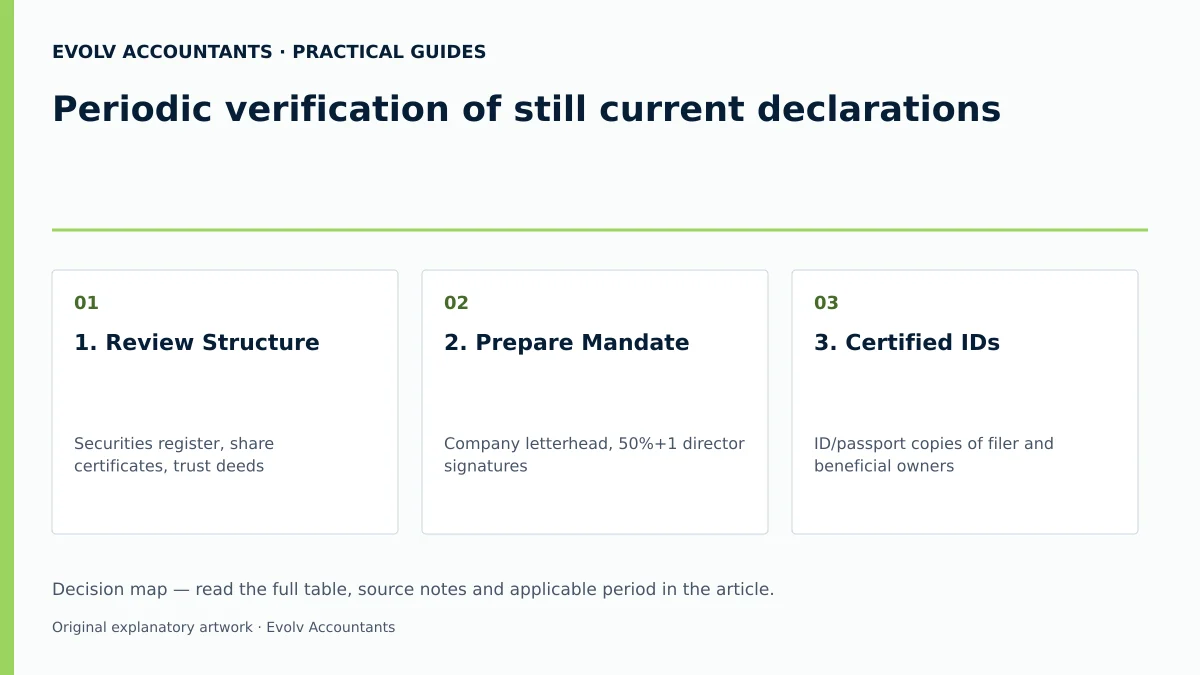
| 1. Review Structure | Securities register, share certificates, trust deeds 3 12 | Company Secretary / Director | Reportable percentage interests and other ultimate natural-person control identified 4 | If indirect tiers exist, prepare diagrammatic disclosure form 15 |
| 2. Prepare Mandate | Company letterhead, 50%+1 director signatures 5 | Mandated Filer | Signed written mandate naming natural person filer 5 | Re-issue mandate if director composition changes 5 |
| 3. Certified IDs | ID/passport copies of filer and beneficial owners 12 | Filer / Compliance Officer | Certification date within 3 months of filing 12 | Obtain notarised foreign passports for overseas owners 2 12 |
| 4. Portal Filing | CIPC New E-Services credentials, updated profile 18 21 | Mandated Filer | Required data captured, route-specific documents or inline register completed, and OTPs verified 12 47 | If contact details updated, wait 48 hours before filing 22 |
| 5. Retain Evidence | CIPC Certificate or official confirmation email 8 9 | Compliance Manager | Certificate archived in statutory company records 8 52 | If blocked by zero authorised shares, email CIPC support 54 |
Frequently Asked Questions
Q1: How often must a South African company verify and file beneficial ownership disclosures?
Companies must verify and file beneficial ownership information at least once annually alongside annual return filings, or immediately whenever ownership details change 4 6.
Q2: What is the statutory ownership threshold for declaring a beneficial owner?
The threshold is 5% 1 4. Any natural person directly or indirectly holding 5% or more of beneficial interest, voting rights, or board control must be declared 4 16. Effective control must still be assessed independently of the percentage holding.
Q3: Who must sign the mandate authorising a filer to submit beneficial ownership data?
The written mandate must be on company letterhead, name a single natural person holding a valid CIPC customer code, and be signed by at least 50% plus one of the company’s directors, or by all members of a close corporation.
Q4: Why did my company not receive a downloadable Beneficial Ownership Certificate?
Downloadable certificates are issued only for non-affected companies declaring actual beneficial owners 8 10. Entities filing under the Optimised BO System receive an official CIPC confirmation email from QA@cipc.co.za instead of a downloadable certificate 9 11.
Q5: Can a company currently in AR deregistration process file beneficial ownership updates?
Yes. Entities in "AR Deregistration Process" due to overdue annual returns remain legally active and MUST file beneficial ownership disclosures 56 57. Entities in final deregistration cannot file 53 55. *** Ask Evolv about periodic verification of still current declarations. Share the relevant records so the support required can be scoped.
Related guides
- When CIPC requires annual financial statements
- Who counts as a beneficial owner of a private company
- Compliance and Regulations: Keeping Your Business on Track
Sources
- https://www.gov.za/sites/default/files/gcis_document/202212/47815anti-moneylaunderingact22of2022.pdf
- https://www.cipc.co.za/wp-content/uploads/2024/09/Step-by-step-guide_E-Services-Beneficial-Ownership-Filing-Complex-Structure-Final.pdf
- https://www.cipc.co.za//wp-content/uploads/Legal/Regulations/CompaniesAct71_2008.pdf
- https://www.cipc.co.za/wp-content/uploads/2025/10/Step-by-step-guide-OPTIMIZED-BO-FILING-Final.pdf
- https://www.cipc.co.za/wp-content/uploads/2024/09/Step-by-step-guide_E-Services-Beneficial-Ownership-Filing-Non-Affected-Company-With-Beneficial-Ownership.pdf