
When CIPC requires annual financial statements
18 October 2026

CIPC requires audited annual financial statements where the applicable company-law reporting rules demand them. Audit exemptions, compilation and filing routes must be checked separately.
CIPC annual returns require audited AFS where mandatory, or the permitted audited/reviewed AFS or FAS route for other companies, within thirty business days after the incorporation anniversary.
Decide the assurance obligation separately from the CIPC filing format. A private company needs a statutory audit at PIS 350 or more, or PIS 100 or more with internally compiled statements, and when another audit trigger applies. The owner-managed exemption does not cancel a mandatory statutory audit. Where no audit is required, test independent review and the section 30(2A) exemption using every securities holder and beneficial-interest holder, not only the registered shareholders.
Statements count as internally compiled unless the regulatory definition of “independently compiled and reported” is met. A company not required to file audited statements may file audited or reviewed AFS; if it does neither, it files FAS. FAS does not replace preparing AFS or obtaining a required review. CIPC annual-return FAQ; Companies Regulations.
Every profit and non-profit company registered under the South African Companies Act 71 of 2008 must complete an annual statutory return filing with the Companies and Intellectual Property Commission (CIPC) within 30 business days following the anniversary date of its incorporation 1 2 3.
Submission compliance requires either uploading audited or reviewed Annual Financial Statements (AFS) in Inline eXtensible Business Reporting Language (iXBRL) format or completing a Financial Accountability Supplement (FAS) on Form CoR 30.2, depending on statutory audit thresholds, compilation method, and public interest criteria 4 5 6 7.
Submission format and financial statement applicability
Scope of obligation, jurisdiction, and period
For directors, financial managers, and owners of South African small and medium enterprises (SMEs), statutory compliance requires delivering accurate company records to the CIPC annually 1 2 8. The statutory submission period opens on the anniversary date of the enterprise's incorporation and remains open for 30 business days 1 3. Completion means not merely filling in enterprise details or paying the statutory fee, but fulfilling all concurrent statutory obligations 1 9 10.
— Practical point from this guide
Distinction between legal statutory requirements, regulator guidance, and Evolv recommendations
It is essential to distinguish statutory law, regulator administrative procedures, and practical advisory recommendations:
- Statutory Law (Companies Act 71 of 2008): As the CIPC FAQ notes, "An Annual Returns is a statutory form in terms of the Companies and Close Corporations Acts" 8. Section 30 mandates the preparation of annual financial statements within six months of financial year-end 11, while Section 33 mandates annual return filings accompanied by financial statements where an audit is required 2.
- Regulator Guidance (CIPC Administrative Protocols): CIPC guidance specifies that filings must be completed electronically via BizPortal or e-Services 9 12. CIPC mandates that companies required to be audited must upload AFS via the iXBRL portal 4, whereas companies exempt from audit that do not voluntarily file audited or reviewed AFS must file Form CoR 30.2 (FAS) 5 6 7. CIPC also requires that the latest Beneficial Ownership (BO) declaration be updated prior to annual return lodgement 1 10.
- Evolv Accountants Recommendations: Evolv recommends maintaining an ongoing compliance schedule to calculate Public Interest Scores (PIS) prior to year-end, ensuring AFS compilation methods are properly documented to prevent unexpected audit obligations 13 14.
Clarification on Beneficial Ownership filings
CIPC company beneficial ownership declarations are distinct statutory filings mandated under the Companies Act and must be up to date before filing annual returns 1 2 10. Compliance with CIPC company obligations does not constitute compliance with SARS tax obligations, as they are governed by different legislation and authorities 15.
Prepare the information and authority: submission format
Statutory inputs and required documents
To prepare an annual return submission format assessment, a company must compile specific documentation and authority inputs:
- Approved Annual Financial Statements or Trial Balance: The latest approved financial statements used to confirm annual turnover and financial position 5 16.
- Form CoR 30.1 Details: Verification of unchanged or updated company details including registered office, records location, directors, auditor/reviewer, and financial year-end 17.
- Public Interest Score (PIS) Metrics: Data on average employee count, third-party liabilities in Rand millions, annual turnover in Rand millions, and the maximum number of security holders or NPC members 18.
- Beneficial Ownership Confirmation: Evidence of a successfully lodged CIPC BO declaration for the current cycle 1 10.
- Designated Compliance Authority: Designation of a director, officer, or authorised person responsible for Companies Act compliance pursuant to Section 33(3) 18 19.
Turnover definition and calculation standard
Turnover for CIPC annual return fee calculations and financial reporting applicability must be calculated in accordance with Section 223 read with Regulation 164 of the Companies Act 20. Turnover is determined from the latest approved financial statements 5.
Complete the task step by step: financial statement applicability
Sequenced process for determining financial statement requirements
To determine whether a private company must submit audited AFS, reviewed AFS, or a Financial Accountability Supplement (FAS), follow these statutory steps:
- Calculate the Public Interest Score (PIS):
Under Regulation 26(2), calculate points as follows:
- 1 point for each average employee during the financial year 18.
- 1 point for every R1 million (or portion thereof) in third-party liabilities at year-end 18.
- 1 point for every R1 million (or portion thereof) in turnover during the financial year 18.
- 1 point for every individual holding a beneficial interest in issued securities (or NPC member) 18.
- Assess Mandatory Statutory Audit Criteria:
A private company must have its AFS audited if:
- It holds assets in a fiduciary capacity for non-related persons exceeding R5 million at any time during the year 13.
- Its PIS is 350 or more 14.
- Its PIS is 100 or more AND its AFS were compiled internally (e.g. by an internal accountant or director) 14.
- Its Memorandum of Incorporation (MoI) explicitly requires an audit 21.
- Assess Independent Review vs Exemption:
If the company is not required to be audited, it must undergo an independent review unless:
- It qualifies for the owner-managed exemption under Section 30(2A) / Section 30(2)(b)(ii), where every holder of securities is also a director of the company 21 22.
- It voluntarily chooses to audit its statements 7 21.
- Select Submission Format:
- Audited AFS Required / Voluntary Audit: Must file complete AFS electronically via iXBRL 4 7.
- No mandatory audited-AFS filing: The company may voluntarily file audited or reviewed AFS. If it does not, it must lodge FAS (Form CoR 30.2) with its annual return. Any required independent review must still be completed.
Reproducible hypothetical example
Scenario: "Cape Timber Crafts (Pty) Ltd" is a South African private company.
- Financial Metrics:
- Average employees: 12 (12 points) 18
- Third-party liabilities: R2.4 million (3 points) 18
- Annual Turnover: R14.5 million (15 points) 18
- Shareholders: 4 natural persons, of which 2 are non-director investors (4 points) 18
- Total PIS: 12 + 3 + 15 + 4 = 34 points 18.
- Compilation Method: AFS compiled externally by an independent accounting professional.
- Statutory Determination:
- Audit Requirement: PIS is below 100, fiduciary assets do not exceed R5 million, and MoI is silent. Statutory audit is not mandatory 13 14 21.
- Review Requirement: Because 2 shareholders are not directors, the Section 30(2A) owner-managed exemption does not apply 21 22. The company requires an independent review 21.
- Submission Format: The company chooses not to file audited AFS voluntarily; therefore, it submits Form CoR 30.2 (FAS) during its CIPC annual return submission 5 6 7.
Check the result against the evidence: submission format
Submission of annual return data does not automatically guarantee regulatory acceptance 23. Independent verification requires validating specific evidence outputs:
- Filing Certificate: Download the CIPC Annual Return Certificate containing the official transaction reference 24 25. Identity numbers on certificates are masked for privacy under POPIA 24.
- Transaction Status: Confirm on the CIPC e-Services or BizPortal shopping cart page that the item status reflects "Paid" and the transaction status is marked complete 25 26.
- Beneficial Ownership Verification: Verify that the CIPC register reflects an updated Beneficial Ownership filing date corresponding to the submission cycle 1 10.
- Fee Payment Match: Check that the statutory fee paid aligns with the CIPC fee schedule under the Companies Act 2008 based on turnover 27 28:
- Turnover less than R1 million: R100 filing fee (R150 total fee if filed late) 27.
- Turnover R1 million to R10 million: R450 filing fee (R600 total fee if filed late) 27.
- Turnover R10 million to R25 million: R2,000 filing fee (R2,500 total fee if filed late) 28.
- Turnover R25 million or more: R3,000 filing fee (R4,000 total fee if filed late) 28.
Handle exceptions and unresolved cases: financial statement applicability
Dormant companies
The Companies Act makes no distinction between active and dormant entities 29. Dormant or inactive companies remain fully obligated to lodge annual returns and pay prescribed fees annually 23 29.
Incorrect turnover submissions
If an incorrect turnover value was captured during submission, CIPC does not allow electronic self-correction 30. The customer code holder must log a ticket via the CIPC online enquiry system submitting:
- Approved AFS for the year in question 31.
- Entity name and registration number 31.
- Written explanation of the error 31.
- Certified ID copy of the customer code owner 31.
- Written authorisation requesting CIPC to credit or debit the customer code account for the fee difference 31.
Outstanding filings and deregistration
Failure to submit annual returns for two or more consecutive years causes CIPC to initiate automatic deregistration proceedings ("AR Deregistration") 29 32 33. Deregistration withdraws juristic personality and causes the entity to cease existing 34 35.
- Pending Deregistration: Outstanding returns must be lodged immediately before final deregistration 36. If deregistration was initiated voluntarily, a written objection letter must be emailed to deregistrations@cipc.co.za 36 37.
- Final Deregistration: If the company has been finally deregistered, an application for re-instatement must be lodged on Form CoR 40.5 (prescribed fee R200) to restore status to "in re-instatement process" before outstanding returns, BO declarations, and financial statements can be processed 27 38 39.
Next steps for CIPC annual returns
Task and completion checklist
| Step | Input or evidence | Responsible person | Completion check | Exception or next action |
|---|---|---|---|---|
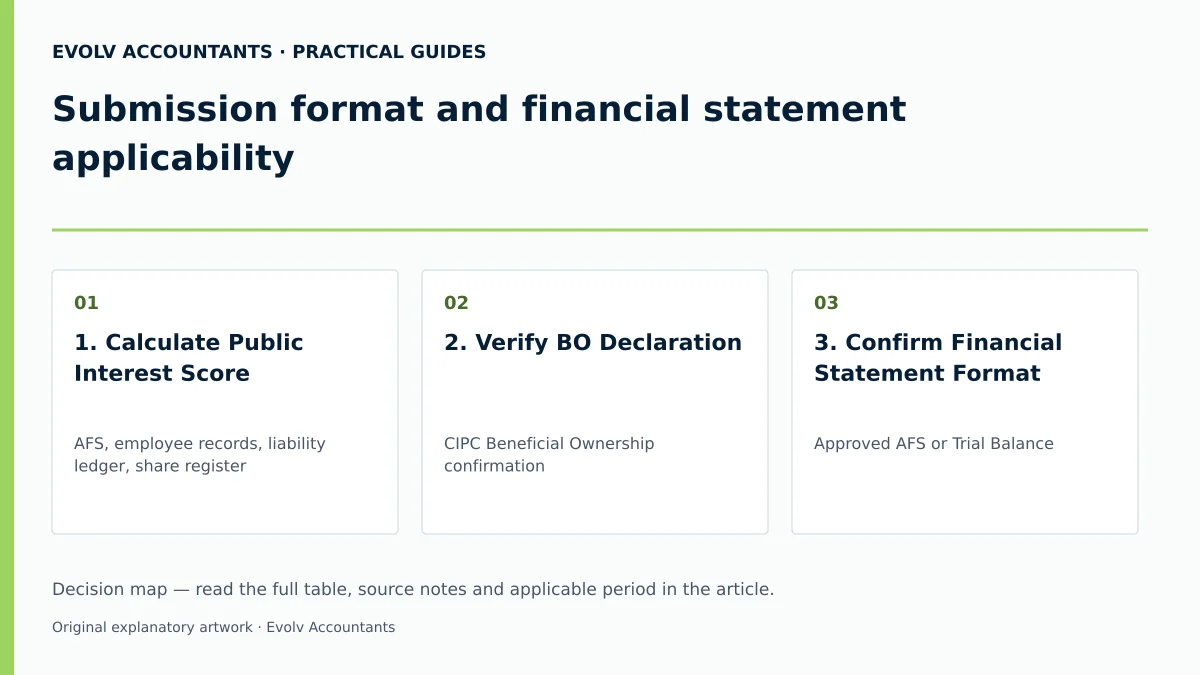
| 1. Calculate Public Interest Score | AFS, employee records, liability ledger, share register 18 | Financial Manager / Accountant | Documented PIS calculation sheet 18 | If PIS >= 350 or (PIS >= 100 & internal compilation), assign auditor 14 |
| 2. Verify BO Declaration | CIPC Beneficial Ownership confirmation 1 10 | Director / Designated Officer | Active BO filing on CIPC system 1 10 | Log into CIPC BO portal and submit updated declaration first 10 |
| 3. Confirm Financial Statement Format | Approved AFS or Trial Balance 5 16 | Director / Registered Auditor / Reviewer | Required audited AFS, permitted voluntary audited/reviewed AFS, or FAS as applicable 4 5 6 | If audited AFS are not required and audited/reviewed AFS are not voluntarily filed, complete FAS 7 21 |
| 4. Submit Annual Return & Pay Fee | Customer code, card payment details 26 40 | Authorised Representative | Transaction status "Paid" in CIPC shopping cart 25 26 | If payment fails, re-try via CIPC card portal; check customer code balance 23 26 |
| 5. Retain Filing Confirmation | CIPC Filing Certificate & Form CoR 30.1 copy 24 41 | Company Secretary / Director | Certificate archived in company records for 7 years 42 | If incorrect turnover was captured, log CIPC online enquiry with AFS 30 31 |
Frequently Asked Questions
When is a private company required to file audited AFS with CIPC?
A private company must file audited AFS via iXBRL if its Public Interest Score (PIS) is 350 or more, if its PIS is 100 or more and its statements were internally compiled, if it holds fiduciary assets exceeding R5 million, or if its MoI mandates an audit 4 13 14 21.
What happens if a company is exempt from audit and independent review?
If a company qualifies for the owner-managed exemption under Section 30(2A) and does not voluntarily audit or review its AFS, it is not required to submit full AFS via iXBRL 7 21 22. Instead, it must complete and attach a Financial Accountability Supplement (FAS / Form CoR 30.2) when filing its annual return 5 6 7.
Can annual returns be filed manually or in installments?
No. Annual returns can only be submitted electronically via CIPC platforms like e-Services or BizPortal 9 12. Prescribed fees are legislated and cannot be waived, reduced, or paid in installments 23.
Is a dormant company exempt from annual returns?
No. The Companies Act does not differentiate between active and inactive businesses 29. Dormant companies must file annual returns and pay required fees annually to maintain active status on the register 23 29.
How long does a company have to file its annual return after its anniversary?
Companies have 30 business days from the anniversary date of incorporation to file their annual returns before being considered non-compliant and incurring penalty fees 1 3 27 28. Describe your annual-return or company-record question and ask Evolv to scope the support required. Ask Evolv about submission format and financial statement applicability. Share the relevant records so the support required can be scoped.
Related guides
- Beneficial ownership when shareholders are overseas
- Filing CIPC annual returns for a private company
- Compliance and Regulations: Keeping Your Business on Track
Sources
- https://annualreturns.cipc.co.za/docs/FAQ_Annual_Returns.pdf
- https://www.justice.gov.za/legislation/acts/2008-071-reg.pdf
- https://www.cipc.co.za//wp-content/uploads/Legal/Regulations/CompaniesAct71_2008.pdf
- https://www.cipc.co.za/wp-content/uploads/Forms/Companies/CoR30_1.pdf
- https://www.cipc.co.za/wp-content/uploads/2024/10/STEP-BY-STEP-ANNUAL-RETURNS-003.pdf