
Beneficial ownership when shareholders are overseas
24 December 2024

Declaring CIPC beneficial ownership for South African companies with overseas corporate shareholders requires tracing multi-tiered ownership structures to ultimate natural persons.
CIPC’s filing guides use a 5% reporting norm for percentage interests. That administrative guidance must be distinguished from the Act: the express 5% securities-register rule in section 56(7)(aA) applies to affected companies, while the definition of a beneficial owner also covers board appointment rights and material influence. Do not treat a holding below 5%, or the absence of shares, as a universal exemption from identifying effective control.
Assess the actual rights and the correct affected/non-affected category before filing. Read the statutory amendments.
South African private companies and close corporations with overseas corporate shareholders must navigate specific statutory obligations to maintain compliance with the Companies and Intellectual Property Commission (CIPC). When an offshore company, foreign trust, or multi-tiered corporate group holds shares in a domestic enterprise, the reporting entity cannot simply declare the immediate foreign juristic person as the end owner.
Instead, statutory compliance demands establishing the full offshore ownership chain until the natural persons with reportable ownership interests or effective-control rights are identified and supported by the required evidence.
— Practical point from this guide
Overseas ownership chain and identity evidence
This guide is designed for South African small and medium enterprise (SME) directors, financial managers, and statutory compliance officers responsible for company secretarial filings. Within the jurisdiction of the Republic of South Africa, corporate compliance is governed by the Companies Act 71 of 2008 1 read alongside the General Laws Amendment Act 22 of 2022 and official CIPC beneficial ownership directives 2 3.
Under current statutory reporting requirements, completing a beneficial ownership filing does not merely mean submitting an online transaction or uploading partial corporate records 4. Prepare an accurate ownership and control record, the required recent identity evidence, and a reconciled portal filing. Distinguish intermediate juristic entries from ultimate natural persons; do not assume that every control right is entered as a percentage or duplicate intermediate and ultimate economic interests to force a particular total.
To manage these obligations effectively, SMEs must distinguish between three distinct layers of legal authority and guidance:
- Statutory Law: The Companies Act 71 of 2008 defines juristic persons 7, beneficial interest disclosures under Section 56 8 9, and statutory record-keeping mandates under Section 24 10. It establishes criminal liability under Section 214 for providing false statements or acting recklessly 11.
- Regulator Guidance: CIPC step-by-step guides specify operational portal procedures, including category selection for non-affected companies, first-tier juristic entries, document upload standards, and One-Time Password (OTP) validation protocols 5 6 12 13.
- Evolv Recommendations: Best-practice compliance governance advice from Evolv Accountants on conducting independent identity verification, pre-clearing foreign passport documentation, and structuring permanent secretarial audit files.
Prepare the information and authority: overseas ownership chain
Preparing a beneficial ownership filing for a company with an overseas ownership chain requires gathering specific authority documents, structural diagrams, and individual identity credentials before initiating portal transactions 5 14.
Ownership Thresholds and Key Definitions
Statutory regulations mandate that any individual who directly or indirectly holds 5% or more of beneficial ownership, voting rights, or effective control over a South African company must be declared to the CIPC 2 15 16. A juristic person—such as a foreign company, overseas close corporation, or foreign trust—can be included in the submission as an intermediate first-tier owner, but it can never serve as the final beneficial owner 6 7 17.
As official CIPC guidance explicitly mandates, "a juristic person cannot be a beneficial owner and at least one natural person MUST be declared" 17.
Types of beneficial ownership or effective control that must be evaluated across foreign holding structures include 16 18:
- Holding beneficial interests in company securities, directly or through intermediate entities 18 19.
- Holding or controlling voting rights exercisable at general meetings 16 18.
- Exercising the right to appoint or remove board members, or controlling such appointments 16 18.
- Holding beneficial interests or control over a holding company through a foreign subsidiary 18.
- Exercising control through foreign trusts, trustee arrangements, or beneficiary rights 20 21.
- Materially influencing management policies through contractual agreements or indirect control 21 22.
Mandatory Document Checklist
Before logging into the CIPC portal, the mandated filer must assemble the following evidentiary package 5 23:
- Written Authorisation Mandate: A formal mandate on the declaring entity's official letterhead, nominating a singular natural person holding a valid CIPC customer code to execute the filing 14 24. The mandate must be signed by at least 50% + 1 of the company's directors (ordinary resolution threshold) 14.
- Certified Filer Identity Document: A certified copy of the mandated filer’s South African ID or passport, dated not older than three months 5 14.
- Notarised Foreign Identity Documents: For non-South African beneficial owners, a notarised or Commissioner of Oaths certified copy of their valid foreign passport or foreign ID document, dated not older than three months 5 25.
- Securities and Beneficial Interest Registers: Updated internal securities register and beneficial interest register complying with Section 56 of the Companies Act 5 10 23.
- Complex Structure Disclosure Form: A detailed organogram or diagrammatic representation illustrating every intermediate tier, foreign entity registration, trust structure, and ultimate natural person in the hierarchy 5 6 26.
Complete the task step by step: identity evidence
Submitting identity evidence and offshore ownership chains through the CIPC e-services platform follows a structured, sequential workflow 27 28 29.
Sequenced CIPC Submission Process
- Portal Authentication: The mandated filer logs into the CIPC New E-Services portal (eservices.cipc.co.za) using their personal CIPC customer code and password 27 30.
- Enterprise Selection and Status Verification: Locate the target South African entity 31 32. The portal allows filings for entities with statuses listed as "In Business", "Business Rescue", or "AR Deregistration Process" 31 33. Entities in final deregistration or voluntary liquidation cannot file 33 34.
- Mandate Upload: Upload the signed board mandate on company letterhead to initiate the transaction 35 36 37.
- Company Category Selection: Select the option "Non-Affected Company WITH Beneficial Ownership to Declare" 12 22 38.
- Capture First-Tier Overseas Juristic Person: Select "Juristic" ownership type to record intermediate foreign companies or trusts 6 17 28. Capture the entity type (Enterprise or Trust), foreign registration number, official name, country of registration, contact details, effective date, and percentage interest held 39 40 41.
- Capture Ultimate Natural Persons: Add every natural person holding 5% or more ultimate indirect interest through the foreign entity 2 17 29. Input citizenship details, passport number, passport issue date, date of birth, contact details, physical address, and specific interest type (e.g., Shareholding or Voting Rights) 29 42 43.
- Upload Mandatory Supporting Documents: Upload certified identity copies of the filer and beneficial owners (dated within three months), the written mandate, the securities register, and the complex structure disclosure form 5 26 44.
- Submission and OTP verification: Click Submit to transmit the application and generate the SMS and email OTPs. Enter the OTPs on the confirmation screen, click Verify, and then click Finish to complete the transaction. CIPC complex-structure filing guide.
Step-by-Step Execution Checklist
- Verify target entity status on CIPC to ensure it is eligible for beneficial ownership filings 31 33.
- Draft and execute the board mandate letterhead resolution signed by >50% of directors 14.
- Obtain notarised passport copies dated within three months for all foreign beneficial owners 5 25.
- Prepare the complex structure organogram mapping intermediate foreign holding entities 5 6.
- Log into CIPC e-services, upload the initial mandate where requested, capture juristic and natural-person records, upload the remaining supporting files, and complete submission and OTP verification.
Check the result against the evidence: overseas ownership chain
Filing beneficial ownership details online does not automatically guarantee regulatory compliance; filers must independently verify submission acceptance and maintain persistent records 4 10 47.
Independent Completion Evidence
An application residing in "In Progress", "Draft", or "Pending" status does not constitute valid compliance under the Companies Act 4 48. Independent completion is proven only when the filing transitions to the "Completed Applications" grid on the CIPC portal and an official Beneficial Ownership Confirmation Certificate is issued 4 47 49.
Filers should verify success against three concrete markers:
- System Status Update: The application reference number reflects as complete within the portal's historical dashboard 4 47.
- Official Certificate Issuance: The CIPC generates and emails an official Beneficial Ownership Disclosure Certificate (BeneficiaryOwnershipDisclosure-Reference.pdf) 47 49.
- Email Notification: The primary filer receives formal email confirmation from CIPC Services verifying that disclosure processing is finalised 47 49.
Record-Keeping Mandates
Under Section 24 of the Companies Act, every profit company must maintain accurate, updated corporate records at its registered office 10. Keep the filing confirmation, ownership diagram, mandate and identity evidence securely in the company’s statutory records.
Section 24 provides a general seven-year retention requirement, subject to longer periods or continuing records required elsewhere in the Act; it does not make every uploaded document a permanently retained statutory record. Companies Act, section 24.
Handle exceptions and unresolved cases: identity evidence
Complex international ownership structures frequently present administrative bottlenecks that require proactive management 25 45 51.
Unverified Foreign Identity Documents
When entering South African identity numbers, the CIPC system automatically validates credentials against the Department of Home Affairs (DHA) database, turning the verification indicator green 25 29 45. Foreign passport numbers cannot be verified via the DHA interface; consequently, the portal indicator remains unverified (red box) 25 45. This is a standard system state for foreign nationals 45. Upload the certified or notarised passport evidence required by CIPC and complete the remaining filing steps.
A red DHA indicator for a foreign passport is not, by itself, proof that the filing has failed; confirm the completed application and retain the resulting filing evidence.
Outdated Customer Contact Information
OTP confirmations are transmitted directly to the mobile number and email address linked to the filer's CIPC customer profile 13 51 52. If contact details are outdated, the profile must be updated prior to transaction submission 51 53. CIPC’s optimised filing guide says updated customer contact details become effective after 48 hours, after which filing can proceed.
Unresponsive Offshore Stakeholders and Specialist Boundaries
In circumstances where foreign holding companies, offshore trustees, or corporate nominees delay providing ultimate identity evidence, companies face non-compliance risks under Section 214 of the Companies Act 11 20. While CIPC filings require natural person disclosures, local directors cannot unilaterally guess ownership tiers 11 14. If offshore parties do not provide the records, document the requests and seek advice on the company’s legal rights.
Section 56(5) allows written enquiries about beneficial interests in securities; it should not be presented as a general power to compel any offshore entity or trustee to disclose every ultimate controller. If offshore ownership remains unresolved, legal counsel or specialized statutory advisory services must be engaged to evaluate control exemptions or formal regulatory escalations 55 56.
Next steps for Beneficial ownership
To illustrate practical implementation, consider a representative South African SME ownership structure featuring overseas shareholders:
Illustrative Practical Example
- Declaring Entity: Cape Logistics (Pty) Ltd (South African Private Company).
- Shareholding Structure:
- 40% held directly by Director A (South African citizen, resident).
- 60% held by EuroCorp Holdings Ltd (Juristic person registered in the United Kingdom).
- Intermediate Tier Analysis: EuroCorp Holdings Ltd is 100% owned by a UK Family Trust, of which Trustee B (UK national) holds sole discretionary control.
- Filing Execution:
- First-Tier Entry: EuroCorp Holdings Ltd captured as a foreign juristic person holding 60% shareholding 28 39.
- Beneficial Owner Entries: Director A recorded directly for 40% interest 19 29. Trustee B captured as the ultimate natural person exercising effective control over the 60% foreign block through a trust 17 20 43.
- Documentation: Notarised passport copy of Trustee B (dated <3 months), certified ID of Director A, complex organogram diagram, signed director mandate, and updated securities register uploaded to CIPC 5 25 26.
Task and Completion Checklist
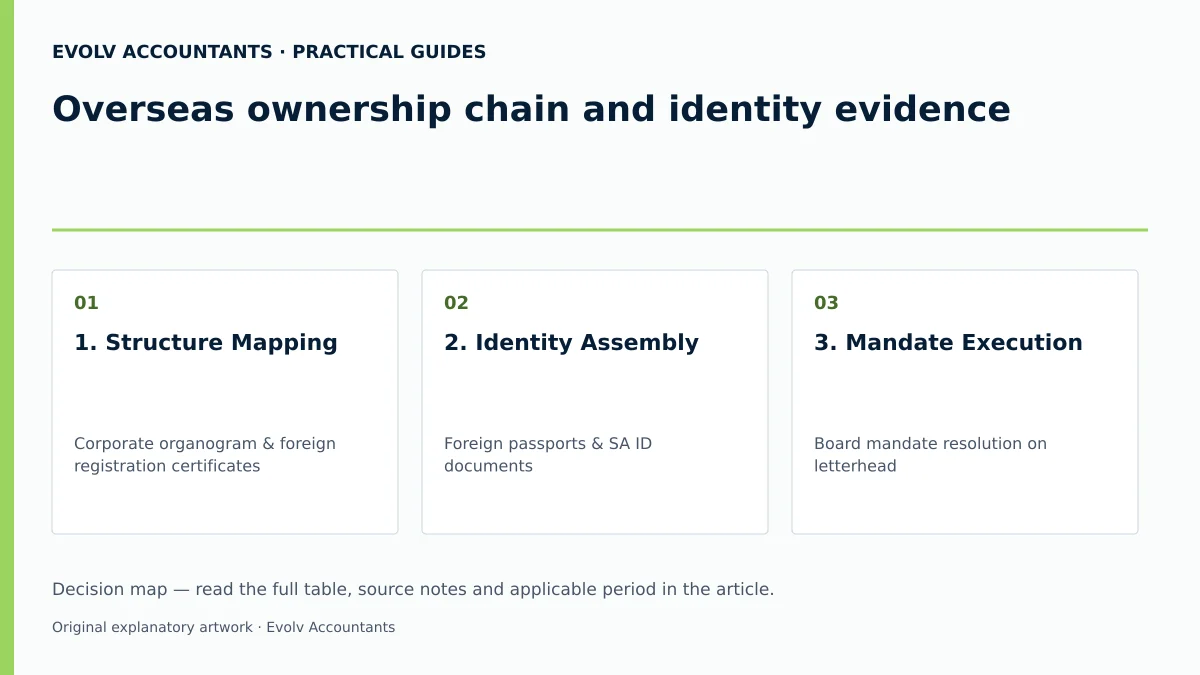
| Step | Input or evidence | Responsible person | Completion check | Exception or next action |
|---|---|---|---|---|
| 1. Structure Mapping | Corporate organogram & foreign registration certificates 5 6 | Financial Manager / Company Secretary | Intermediate entities, reportable percentage interests and ultimate natural-person controllers identified 2 17 | Request missing records and obtain advice on the available disclosure rights |
| 2. Identity Assembly | Foreign passports & SA ID documents 5 25 | Beneficial Owners / Compliance Officer | Copies certified or notarised within the last 3 months 5 | Re-certify expired documents if older than 3 months 5 |
| 3. Mandate Execution | Board mandate resolution on letterhead 14 24 | Board of Directors / Mandated Filer | Signed by at least 50% + 1 of active directors 14 | Re-convene board if signature threshold is unmet 14 |
| 4. Portal Data Entry | CIPC e-services customer credentials & draft registers 27 28 29 | Mandated CIPC Filer | Juristic first tiers and natural BOs captured to equal 100% aggregate 6 36 | Update CIPC customer profile if OTP contact details are outdated (48h delay) 51 |
| 5. Verification & Archive | Dual SMS/Email OTPs & CIPC confirmation certificate 13 47 | Mandated Filer / Public Officer | CIPC BO Certificate downloaded and archived in company register 10 47 | Investigate rejected or incomplete applications with CIPC support |
Frequently Asked Questions
Can an overseas holding company be listed as the final beneficial owner?
No. Under CIPC regulations, an overseas entity or foreign trust can be declared as an intermediate first-tier juristic owner, but it cannot be the final beneficial owner 6 17 28. The filing must continue through the ownership chain until ultimate natural persons holding 5% or more interest or control are identified 2 17.
What identity documents are required for non-South African beneficial owners?
Non-South African beneficial owners must provide a copy of their valid foreign passport or foreign identity document, certified by a notary public or Commissioner of Oaths, dated not older than three months from the date of submission 5 25.
Who must sign the authorisation mandate for an overseas ownership filing?
The mandate authorising a specific natural person to lodge the beneficial ownership filing must be printed on the declaring entity's company letterhead and signed by at least 50% + 1 of the company's directors 14 24.
How does CIPC verify foreign passport numbers during online submission?
Because foreign passports are not linked to the South African Department of Home Affairs database, the online verification status will display an unverified indicator 25 45. Upload the certified or notarised passport copy required by CIPC and check the application’s completion evidence; the DHA indicator does not verify a foreign passport.
What is the difference between a submission confirmation and a Beneficial Ownership Certificate?
An online submission or draft status merely indicates that data has been entered into the portal 4 48. For this article’s standard filing route with beneficial owners to declare, check the completed application and retain the CIPC confirmation certificate. The optimised route for eligible non-affected entities without external beneficial ownership issues an email confirmation instead, without a downloadable certificate. Portal completion evidence does not replace maintaining accurate underlying records. Ask Evolv about overseas ownership chain and identity evidence. Share the relevant records so the support required can be scoped.
Related guides
- Understanding CIPC annual return fees and penalties
- Who counts as a beneficial owner of a private company
- Compliance and Regulations: Keeping Your Business on Track
Sources
- https://www.gov.za/sites/default/files/gcis_document/202212/47815anti-moneylaunderingact22of2022.pdf
- https://www.cipc.co.za//wp-content/uploads/Legal/Regulations/CompaniesAct71_2008.pdf
- https://www.cipc.co.za/wp-content/uploads/2024/09/Step-by-step-guide_E-Services-Beneficial-Ownership-Filing-Complex-Structure-Final.pdf
- https://www.cipc.co.za/wp-content/uploads/2024/09/Step-by-step-guide_E-Services-Beneficial-Ownership-Filing-Non-Affected-Company-With-Beneficial-Ownership.pdf
- https://www.cipc.co.za/wp-content/uploads/2025/10/Step-by-step-guide-OPTIMIZED-BO-FILING-Final.pdf