
Understanding CIPC annual return fees and penalties
22 January 2026

Submitting a CIPC annual return is a statutory requirement under South African company law that requires paying official regulatory fees and maintaining corporate standing 1 2.
Decide the assurance obligation separately from the CIPC filing format. A private company needs a statutory audit at PIS 350 or more, or PIS 100 or more with internally compiled statements, and when another audit trigger applies. The owner-managed exemption does not cancel a mandatory statutory audit. Where no audit is required, test independent review and the section 30(2A) exemption using every securities holder and beneficial-interest holder, not only the registered shareholders.
Statements count as internally compiled unless the regulatory definition of “independently compiled and reported” is met. A company not required to file audited statements may file audited or reviewed AFS; if it does neither, it files FAS. FAS does not replace preparing AFS or obtaining a required review. CIPC annual-return FAQ; Companies Regulations.
Filing a CIPC annual return requires paying prescribed statutory fees determined by company turnover and submission timing, alongside separate professional service costs if an accounting practice assists with compliance, reporting, or statutory submissions 3 4.
Official fees penalties and separate service costs
Filing an annual return with the Companies and Intellectual Property Commission (CIPC) is a mandatory statutory transaction under Section 33 of the Companies Act 71 of 2008 2 5 and Section 15A of the Close Corporations Act 69 of 1984 5. The purpose of this transaction is to confirm that an entity remains active, update registered corporate details, and maintain legal personality on the national companies register 6 7.
A clear distinction must be maintained between regulator charges, supplier charges, and professional services 3 8:
- Regulator charges (Official CIPC fees and penalties): These are mandatory statutory levies prescribed by government regulations under Table CR 2B of the Companies Regulations 4 9. They are paid directly to the CIPC upon digital lodging of Form CoR 30.1 10 11.
- Optional third-party charges: If an intermediary charges for additional services, identify that charge separately. Do not assume a mandatory third-party portal surcharge on top of CIPC’s prescribed fee.
- Professional service costs (Accounting practice fees): These are separate professional fees charged by independent advisors, such as Evolv Accountants, to review company records, verify statutory compliance, prepare financial documentation, calculate public interest scores, and execute filings.
South African SMEs must distinguish CIPC annual returns from South African Revenue Service (SARS) tax filings 14. An annual return filed with the CIPC confirms corporate governance status and statutory standing under company law 1 14. In contrast, a SARS tax return calculates taxable income and income tax liability under tax legislation 14. Compliance with SARS tax obligations does not satisfy CIPC statutory annual return obligations 14.
CIPC company filings and SARS tax filings are separate obligations; check each against its regulator’s requirements. Primary guidance.
— Practical point from this guide
Official amounts and separate professional fees: official fees penalties
The statutory fees and late filing penalties levied by the CIPC are determined by primary legislation and regulations based on entity category, annual turnover, and filing timelines 3 4.
Prescribed CIPC fee tables
For profit and non-profit companies submitting annual returns under the Companies Act 2008, statutory fees are calculated on a tiered turnover scale depending on whether filing occurs within the standard 30 business days following the incorporation anniversary 4 15:
- Turnover less than R1 million: R100 if filed within 30 business days after the anniversary date; R150 if filed more than 30 business days after the anniversary date (includes a R50 late penalty) 4.
- Turnover between R1 million and R10 million: R450 if filed within 30 business days; R600 if filed more than 30 business days after the anniversary date (includes a R150 late penalty) 4.
- Turnover between R10 million and R25 million: R2,000 if filed within 30 business days; R2,500 if filed more than 30 business days after the anniversary date (includes a R500 late penalty) 17.
- Turnover of R25 million or more: R3,000 if filed within 30 business days; R4,000 if filed more than 30 business days after the anniversary date (includes a R1,000 late penalty) 17.
For close corporations filing under the Close Corporations Act 1984, the fee structure is divided into two turnover tiers 4:
- Turnover between R0 and R50 million: R100 if filed within two months from the beginning of the anniversary month; an additional R150 penalty applies for each late lodgment 4.
- Turnover of R50 million and above: R4,000 if filed within two months from the beginning of the anniversary month; an additional R150 penalty applies for each late lodgment 4.
For primary co-operatives filing co-operative annual returns, Category A1 and A2 entities (turnover under R10 million) incur an official fee of R50 if submitted on time, and R100 if submitted more than 30 days after the due date 18. Category B co-operatives (R10 million to R25 million) incur R450 on time and R600 late 18. Category C co-operatives (R25 million or more) incur R3,000 on time and R4,000 late 18.
Where a company or close corporation has been finally deregistered for non-compliance, the official statutory fee to lodge a re-instatement application on Form CoR 40.5 is R200 4 17.
CIPC statutory filing fees are legislated amounts; the CIPC has no legal discretion to waive prescribed fees, cancel accrued late penalties, or accept installment payment arrangements 19.
Distinguishing separate professional service fees
Professional fees charged by Evolv Accountants for statutory compliance management are completely separate from official CIPC charges. While CIPC charges cover the regulator’s administrative receipt of the return 4, Evolv’s professional service costs cover independent technical verification, compiling annual financial statements or financial accountability supplements, calculating public interest scores, verifying statutory registers, and preparing beneficial ownership submissions.
Inputs that change the total cost: separate service costs
Several operational and legal variables dictate the overall cost of maintaining CIPC annual compliance:
- Turnover calculation and financial statements: Official CIPC fee tiers depend directly on annual turnover 4 9. Turnover must be extracted from the entity's latest approved approved financial statements; the turnover calculation for the fee is governed by section 223 read with regulation 164.
- Public Interest Score (PIS) and reporting tier: On Form CoR 30.1, every company must calculate its PIS based on average employee numbers, total liabilities, annual turnover, and the number of individuals holding a beneficial interest in securities 21.
- Audit versus Independent Review requirements:
- Mandatory Audit: Public companies 22, entities holding fiduciary assets exceeding R5 million 23, state-owned companies and the specified categories of non-profit companies 23, or private companies with a PIS of 350 or more (or a PIS of 100 or more if statements are internally compiled) must submit audited AFS via iXBRL 24 25.
- Independent Review: Companies not requiring an audit must undergo an independent review under ISRE 2400 unless exempted under Section 30(2A) (subject to the section 30(2A) test for every securities holder and beneficial-interest holder also being a director) or mandated by their Memorandum of Incorporation (MOI) 25 26.
- Financial Accountability Supplement (FAS): Companies exempt from audit and review that do not voluntarily file AFS must complete and attach a Financial Accountability Supplement (Form CoR 30.2) 20 27.
- Beneficial Ownership (BO) declaration prerequisites: CIPC regulations mandate that an entity's latest Beneficial Ownership Declaration must be successfully lodged on the CIPC portal before the system will allow the submission of an annual return 15 16.
- Multi-year arrears and historical backlogs: Entities that have failed to lodge returns for multiple years accumulate consecutive statutory base fees and late penalties for each outstanding year 4 15.
A transparent cost worksheet: official fees penalties
The cost worksheet below outlines the statutory charges and separate professional inputs associated with CIPC annual return compliance.
| Component | Basis | Verified source or hypothetical input | Frequency | Included or excluded |
|---|---|---|---|---|
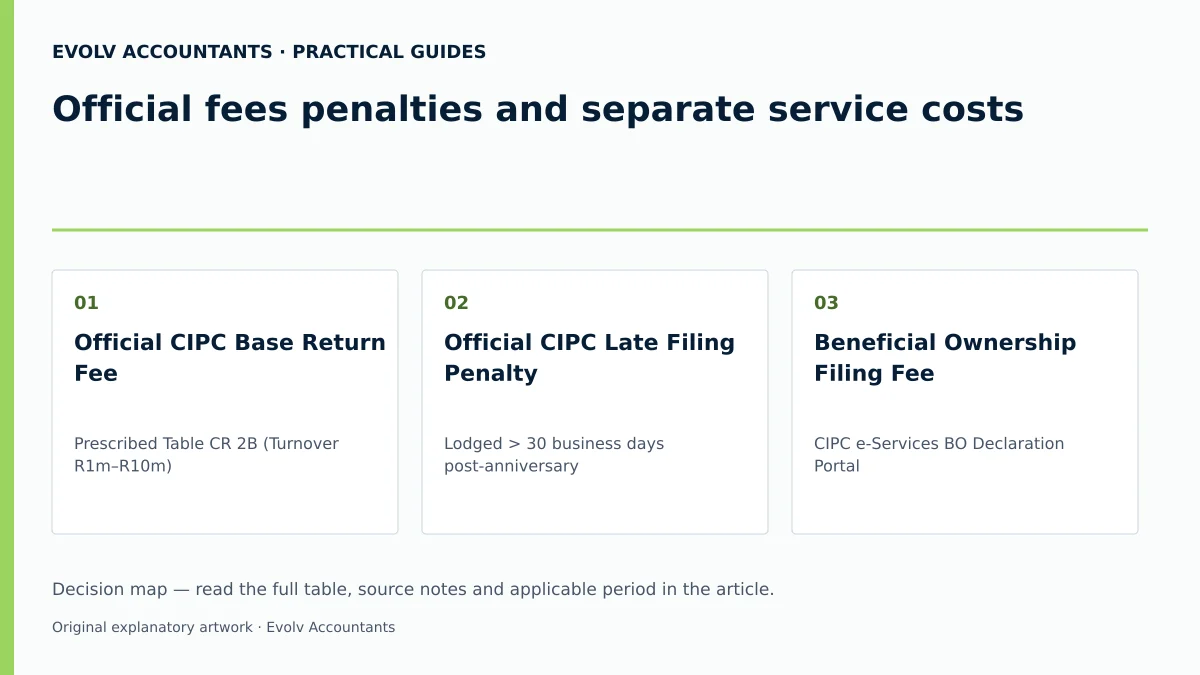
| Official CIPC Base Return Fee | Prescribed Table CR 2B (Turnover R1m–R10m) | R450 4 | Annual | Included in statutory fees |
| Official CIPC Late Filing Penalty | Lodged > 30 business days post-anniversary | R150 4 | Per late filing | Included in statutory fees |
| Beneficial Ownership Filing Fee | CIPC e-Services BO Declaration Portal | R0 (Statutory CIPC portal fee) 16 | Annual / On change | Included in statutory fees |
| Evolv Professional Compliance Fee | Professional statutory management & AFS review | R2,500 [Illustrative professional fee] | Annual | Excluded from CIPC fees |
| Value Added Tax (VAT) | Statutory tax on professional services | R375 [Hypothetical input: 15% on R2,500] | Per invoice | Excluded from CIPC fees |
| Form CoR 40.5 Re-instatement Fee | Required only if entity is finally deregistered | R200 17 | Ad hoc / Contingent | Excluded from standard return |
Reproducible hypothetical calculation
Consider a hypothetical South African private company, "Apex Engineering (Pty) Ltd":
- Assumptions: Apex Engineering has an annual turnover of R2.5 million (placing it in the R1 million to R10 million turnover tier) 4. The company submits its return 45 business days after its incorporation anniversary (exceeding the standard 30 business day window) 4 15.
- Official CIPC Statutory Charge:
- Base Filing Fee (Turnover R1m–R10m): R450 4
- Late Filing Penalty (> 30 business days late): R150 4
- Total Official CIPC Cost: R600 4
- Separate Professional Service Fee (Evolv Accountants):
- Statutory compliance verification, PIS calculation, FAS/AFS check, BO declaration confirmation, and filing submission: R2,500 [Illustrative professional fee]
- VAT at 15%: R375 [Hypothetical input]
- Total Professional Service Cost: R2,875
- Combined Total Cost: R600 (official CIPC) + R2,875 (professional service incl. VAT) = R3,475.
- Excluded Costs: Excludes statutory charges for corporate amendments (e.g. director or address changes on separate CoR forms) and Form CoR 40.5 re-instatement fees 7 17.
Costs that the headline price omits: separate service costs
Headline compliance quotes often overlook recurring duties, collateral administrative changes, and severe opportunity costs:
- Unfiled corporate amendments: An annual return form (CoR 30.1) is purely a verification document, not an amendment form 7. If an entity has changed its registered office, directors, auditors, or financial year-end, separate CoR amendment forms must be lodged and paid for independently 7 28.
- Turnover rectification procedures: Providing an incorrect turnover figure during submission cannot be edited online post-filing 29. Correcting an error requires logging a formal enquiry with CIPC to request a credit or debit note, supported by approved financial statements, entity records, a certified ID copy of the customer code holder, and a written permission letter 29 30.
- Consequences of final deregistration: Continuous failure to submit annual returns triggers automatic deregistration proceedings when two or more successive returns are outstanding 31 32. According to CIPC guidance, non-compliance leads to deregistration, which has the effect that "the juristic personality is withdrawn, and the company and close corporation cease to exist" 6.
- Operational freeze and director liability: When an entity is deregistered, third parties—including commercial banks, SARS, the Central Supplier Database (CSD), and vendors—freeze accounts and terminate services 31 33. Active directors at the time of deregistration remain personally liable for liabilities incurred during their tenure 6 33.
Next steps for CIPC annual returns
To maintain statutory compliance and avoid administrative penalties or deregistration, complete the following source-dated compliance checklist:
- Verify statutory anniversary dates: Identify the exact date of incorporation to determine the start of the 30 business day submission window for companies or the two-month window for close corporations 4 15.
- Extract approved annual turnover: Retrieve the latest approved annual financial statements to confirm the exact turnover figure required for CIPC fee tier classification 9 20.
- Calculate Public Interest Score (PIS): Calculate the entity's PIS on Form CoR 30.1 using employee counts, third-party liabilities, annual turnover, and beneficial interest holder tallies to determine whether an audit, independent review, or FAS filing applies 21 23 25.
- Submit Beneficial Ownership declaration: File or update the company's Beneficial Ownership Declaration on CIPC e-Services prior to initiating the annual return filing 15 16.
- Submit return and pay statutory fees: Complete the online Form CoR 30.1 submission, upload the required AFS or FAS documentation, and settle the calculated statutory fee via card payment on the CIPC portal 10 13 17.
Frequently Asked Questions
What is the legal difference between a CIPC annual return and a SARS tax return?
An annual return is a statutory confirmation of an entity's legal standing filed with the CIPC under the Companies Act or Close Corporations Act 1 14. A tax return is filed with SARS under tax legislation to calculate taxable income and state tax liability 14. Submitting tax returns to SARS does not fulfill the statutory obligation to lodge annual returns with the CIPC 14.
What happens if a company files the wrong turnover figure during its annual return submission?
Information submitted on an annual return cannot be updated directly on the portal once processed 29. To rectify an incorrect turnover entry, the customer code holder must lodge a formal request via the CIPC enquiry system for a debit or credit note 29 30. This request must be accompanied by the approved AFS for the year in question, certified ID documentation, written motivation, and formal consent 30.
Can CIPC waive late filing penalties or allow installment payment plans for annual returns?
No. Prescribed filing fees and late penalties are strictly legislated under the Companies Regulations 19. The CIPC possesses no statutory authority to waive fees, reduce late penalties, or enter into installment payment arrangements 19. Unpaid submissions are invalidated automatically 19.
When does a small private company require an audited AFS versus an independent review or FAS?
A private company requires an audited AFS if it holds fiduciary assets exceeding R5 million, has a Public Interest Score (PIS) of 350 or more (or 100 or more if internally compiled), or is required to audit by its MOI 23 25. Otherwise, it requires an independent review under ISRE 2400 unless exempt under Section 30(2A) 25 26. A company not required to file audited AFS must submit FAS if it does not voluntarily file audited or reviewed AFS.
What are the consequences if a company is deregistered by CIPC for failing to submit annual returns?
Deregistration deprives the entity of its legal personality, causing it to cease to exist legally 6 33. Corporate bank accounts are frozen, CSD supplier profiles are deactivated, and active directors may be held personally liable for debts incurred 6 33. Restoring legal standing requires lodging a formal re-instatement application (Form CoR 40.5) with a R200 statutory fee and submitting all outstanding annual returns, BO declarations, and financial statements 17 34 35.
Related guides
- Beneficial ownership obligations of a non profit company
- Filing CIPC annual returns for a private company
- Compliance and Regulations: Keeping Your Business on Track
Sources
- https://annualreturns.cipc.co.za/docs/FAQ_Annual_Returns.pdf
- https://www.cipc.co.za//wp-content/uploads/Legal/Regulations/CompaniesAct71_2008.pdf
- https://www.justice.gov.za/legislation/acts/2008-071-reg.pdf
- https://www.cipc.co.za/wp-content/uploads/Forms/Companies/CoR30_1.pdf
- https://www.cipc.co.za/wp-content/uploads/2024/10/STEP-BY-STEP-ANNUAL-RETURNS-003.pdf