
Beneficial ownership obligations of a non profit company
9 June 2025

Filing beneficial ownership for a South African non-profit company requires identifying natural persons who exercise effective control over the organisation.
CIPC’s filing guides use a 5% reporting norm for percentage interests. That administrative guidance must be distinguished from the Act: the express 5% securities-register rule in section 56(7)(aA) applies to affected companies, while the definition of a beneficial owner also covers board appointment rights and material influence. Do not treat a holding below 5%, or the absence of shares, as a universal exemption from identifying effective control.
Assess the actual rights and the correct affected/non-affected category before filing. Read the statutory amendments.
Control in a non profit organisation
Scope and completion parameters
This guidance applies to office bearers and directors of NPCs in South Africa under the Companies Act 71 of 2008 1 3 4 5. CIPC treats NPCs as part of its administrative disclosure workflow; its requirements must be read alongside section 10 and Schedule 1 rather than assuming the profit-company securities provisions apply unchanged. Completion requires identifying natural persons meeting the applicable ownership and effective-control tests, executing e-services workflows, and obtaining CIPC confirmation 17 18 19 20 21 22 23.
Statutory definition of control
Section 55 of the General Laws Amendment Act 22 of 2022 inserted the definition of “beneficial owner” into section 1 of the Companies Act. It describes "an individual who, directly or indirectly, ultimately owns that company or exercises effective control over that company" 9 13. Because NPCs issue no shares 1 2 3 6, effective control is established through specific statutory mechanisms 10 11 12 14 15 16:
- Voting rights: Controlling 5% or more of voting rights in an NPC with voting members 10 14 24.
- Board appointment: Holding statutory or contractual rights to appoint or remove board members 10 15.
- Chain of control: Exercising control through intermediate juristic entities, trusts, or bodies of persons 11 12 15 16.
- Material influence: Exercising capacity to materially influence management or executive policy 8 12 16.
Identifying these individuals requires examining Memorandum of Incorporation (MOI) rules, board charters, and founder agreements 25.
Prepare the information and authority: control in a non profit organisation
Document inputs and authorisation
Before initiating e-services filings, the NPC must assemble verified primary evidence and legal mandates 26 27 28 29 30 31 32 33 34:
— Practical point from this guide
- Certified Identity Documents: Copies of South African IDs or passports for beneficial owners and the mandated filer, certified within 3 months 4 5 26 30 31 34.
- Written Mandate: Letterhead authorisation granting a natural person with a CIPC customer code authority to file, signed by at least 50% + 1 of directors 28 29 30 32 33 34 35.
- Internal Registers: Updated Register of Members or Beneficial Interest Register under Section 24(4) and Schedule 1 Item 4(9) 24 27 30 31 34.
- Organogram Disclosure Form: Diagrammatic structure where control is exercised through trusts or corporate entities 27 31 36.
CIPC’s administrative guides include NPCs and ask about natural persons who control voting, board appointments or management. Section 10(2)(b) of the Companies Act excludes Part E of Chapter 2 (securities registration and transfer) from NPCs, so do not copy a profit company’s share-register or securities-percentage test mechanically into an NPC.
Examine the MOI, membership rights and contractual appointment powers, and obtain advice where the legal application is uncertain. Companies Act, section 10.
Complete the task step by step: documented completion and exceptions
Step-by-step CIPC submission process
Filers must execute portal submissions following regulator guides 42 43 44:
- Portal Access: Log into CIPC e-services, accept terms, select Transact then Beneficial Ownership 42 43 44.
- Enterprise Selection: Search for the NPC and confirm active, business rescue, or AR deregistration status 42 43 44 45 46 47 48 49 50. Final deregistered or liquidated entities cannot file 46 48 51 52.
- Category Selection: Select Non-Affected Company 12 53 54 55.
- Route Evaluation: Answer ownership prompts 56 57. Select CIPC Optimised BO system if no outside person holds control and directors/members are 10 or fewer 58 59; otherwise, select normal BO filing 57 59.
- Capturing Details: Upload mandate 28 29 32 33 45 47 50 60 61. Declare intermediate entities under Juristic Person 36 62 63 64 65. Add Natural Person beneficial owners with identity details, demographics, address, and control percentage (5% to 100%) 9 13 66 67 68 69 70 71 72.
- Document Upload: Attach certified IDs (<3 months), mandate, register, and organogram 26 27 30 31 34.
- OTP Verification: Submit to receive SMS and email OTPs 73 74 75 76 77 78 79 80. Enter both OTPs with capital letter prefixes ('S' for SMS, 'E' for email) 74 80 81.
Check the result against the evidence: control in a non profit organisation
Independent evidence of completion
Submitting data does not automatically confirm regulatory acceptance 82 83 84 85. Verify completion through official evidence 18 19 20 21 22 23:
- Normal BO Filing: Produces a downloadable CIPC Beneficial Ownership Confirmation Certificate and email notification 18 19 20 21.
- Optimised BO Filing: Produces an official confirmation email notification only 22 23. No downloadable certificate is issued 22 23.
- Status Check: Confirm e-services status reflects Completed rather than Pending, Draft, or Rejected 82 83 84 85 86 87 88.
Store confirmation certificates or emails in the minute book for seven years under Section 24 89 90.
Handle exceptions and unresolved cases: documented completion and exceptions
Managing edge cases
- Contact Detail Updates: Outdated profile details prevent receiving OTPs 49 91. Profile updates take 48 hours to become effective 55.
- Home Affairs Offline: DHA auto-verification showing a red box allows filings to proceed 73 77.
- Incomplete Records: Incorrect CIPC director details block filing 92. Submit a director amendment (Form CoR39) first 92.
- Intermediate Entities: Capture corporate entities under Juristic Person/Trust listings and attach an organogram identifying natural persons 27 31 36 62 63.
Reproducible hypothetical example: Hope Community NPC
Hope Community NPC (Enterprise No. 2018/123456/08) has no voting members and 4 directors 93 94. Under a donor agreement, Individual A holds rights to appoint 3 of 4 directors (75% appointment control) 10 15.
- Evaluation: Individual A has a contractual right to appoint a majority of the board, which must be considered as effective control.
- Classification: Non-Affected Company WITH Beneficial Ownership to Declare 12 53 54 57.
- Execution: Obtain a mandate signed by 3 directors (50% + 1 of 4) 29 30 33 34 35, certified IDs (<3 months) 26 30 31 34, capture Individual A under Appointment of Board, describing the right to appoint three of four directors 66 67 68 69 70 71 72, upload documents, complete OTPs, and download the CIPC Beneficial Ownership Confirmation Certificate 18 19 26 27 30 31 34 74 81.
Next steps for Beneficial ownership
Task and completion checklist
| Step | Input or evidence | Responsible person | Completion check | Exception or next action |
|---|---|---|---|---|
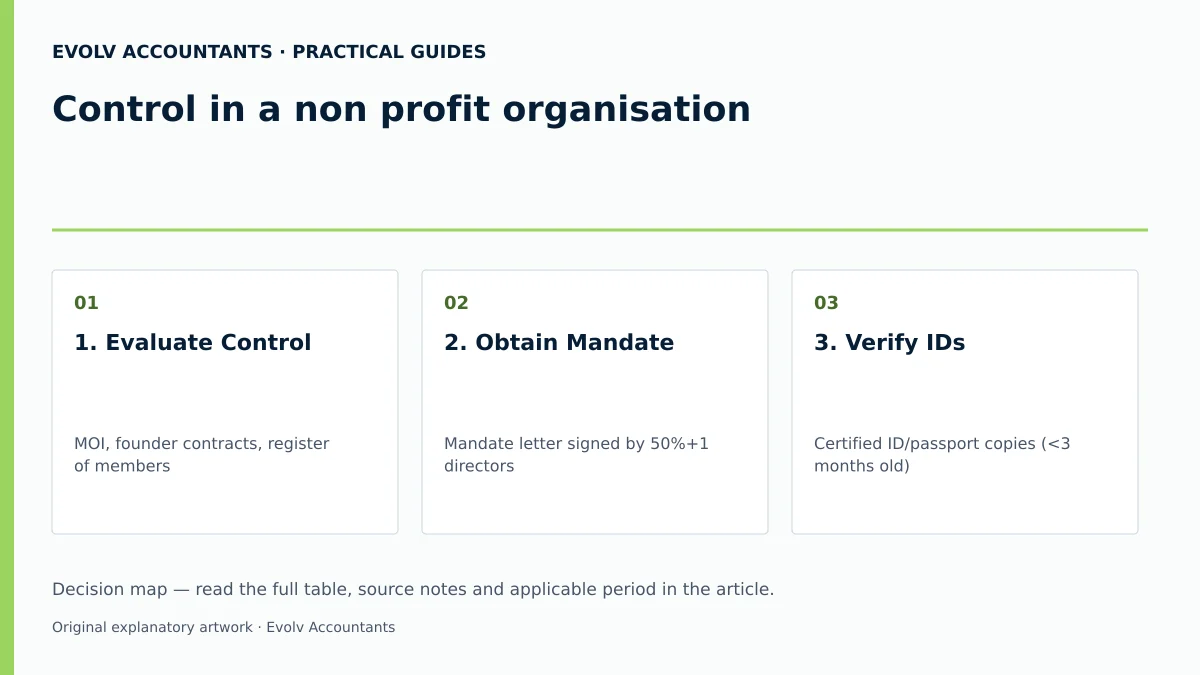
| 1. Evaluate Control | MOI, founder contracts, register of members 24 25 | Public Officer / Board Chair | Natural persons with relevant voting, appointment or other effective-control rights identified 9 13 17 | If no external control & <=10 directors, select Optimised system 58 59 |
| 2. Obtain Mandate | Mandate letter signed by 50%+1 directors 29 30 | Managing Director / Board | Mandate resolution signed & certified ID attached 29 30 | If board vacancies exist, submit CoR39 director amendment first 92 |
| 3. Verify IDs | Certified ID/passport copies (<3 months old) 26 30 | Compliance Officer / Filer | ID verification with DHA or notarised passport 4 66 | If DHA is offline, the guide permits submission despite the red indicator; check completion evidence 73 |
| 4. Submit e-Services | CIPC portal data entry & mandatory doc uploads 26 27 42 | Mandated Filer (Customer Code) | Standard-route documents uploaded, or optimised inline register completed 26 27 | If contact details invalid, update profile & wait 48 hours 55 |
| 5. Dual OTP Verification | SMS ('S' prefix) and Email ('E' prefix) OTPs 74 | Mandated Filer | OTP confirmed status turns green 74 | If OTP not received, click Resend OTPS on confirmation grid 77 |
| 6. Retain Certificate | CIPC BO Certificate or confirmation email 18 20 22 | Statutory Compliance Officer | File stored in NPC minute book for 7 years 89 90 | Verify e-services status reflects Completed, not Pending 82 83 |
Frequently Asked Questions
Are non-profit companies required to submit beneficial ownership filings to CIPC?
Yes, all registered non-profit companies, profit companies, external companies, and close corporations must submit beneficial ownership filings annually or upon control changes 4 5 36 44.
What is the threshold for declaring control in an NPC?
Assess voting rights, board appointment powers and other effective control. CIPC’s percentage guidance must not be used as a blanket exemption for a person who controls the NPC without shares.
Can a juristic entity or trust be declared as the ultimate beneficial owner of an NPC?
No, a beneficial owner must be a natural person 36 64. Juristic entities or trusts can only be captured as intermediate first-tier structures 36 62 63 64.
Who must sign the filing mandate for an NPC?
The mandate must be signed by at least 50% + 1 of the registered directors (ordinary resolution requirement) 29 30 33 34 35.
How do CIPC filings relate to SARS tax returns?
CIPC corporate filings and SARS tax returns are separate duties. Completing a CIPC filing does not replace a required SARS return. CIPC annual-return guidance.
Related guides
- Beneficial ownership versus the securities register
- Who counts as a beneficial owner of a private company
- Compliance and Regulations: Keeping Your Business on Track
Sources
- https://www.gov.za/sites/default/files/gcis_document/202212/47815anti-moneylaunderingact22of2022.pdf
- https://www.cipc.co.za//wp-content/uploads/Legal/Regulations/CompaniesAct71_2008.pdf
- https://www.cipc.co.za/wp-content/uploads/2024/09/Step-by-step-guide_E-Services-Beneficial-Ownership-Filing-Complex-Structure-Final.pdf
- https://www.cipc.co.za/wp-content/uploads/2024/09/Step-by-step-guide_E-Services-Beneficial-Ownership-Filing-Non-Affected-Company-With-Beneficial-Ownership.pdf
- https://www.cipc.co.za/wp-content/uploads/2025/10/Step-by-step-guide-OPTIMIZED-BO-FILING-Final.pdf
- https://annualreturns.cipc.co.za/docs/FAQ_Annual_Returns.pdf