
Beneficial ownership versus the securities register
12 May 2026

A securities register is the record of registered share ownership; a beneficial ownership filing identifies the natural persons who ultimately own or control the company.
Maintaining a securities register records legal title to shares, whereas filing a beneficial ownership declaration discloses the ultimate natural persons who hold effective control or interest.
CIPC’s filing guides use a 5% reporting norm for percentage interests. That administrative guidance must be distinguished from the Act: the express 5% securities-register rule in section 56(7)(aA) applies to affected companies, while the definition of a beneficial owner also covers board appointment rights and material influence. Do not treat a holding below 5%, or the absence of shares, as a universal exemption from identifying effective control.
Assess the actual rights and the correct affected/non-affected category before filing. Read the statutory amendments.
For South African small and medium enterprises (SMEs), statutory compliance requires a clear understanding of the distinct roles played by the internal securities register and the external CIPC beneficial ownership register. While a company's securities register records the legal holders of issued shares, a beneficial ownership declaration identifies the living individuals who ultimately own, influence, or exercise effective control over the business 1 2 3.
— Practical point from this guide
Misinterpreting these complementary statutory mechanisms can create severe compliance gaps, expose directors to criminal liability under section 214 of the Companies Act 71 of 2008, or delay annual compliance declarations required to maintain active enterprise status 4 5 6.
Different purposes of ownership declarations and securities records
Every profit company incorporated in South Africa must establish and maintain a register of its issued securities 7 8. The securities register serves as the formal legal record of share ownership, documenting the names, addresses, and shareholding quantities of certificated or uncertificated security holders 8 9 10. In the absence of evidence to the contrary, the entry of a person’s name in the securities register constitutes sufficient proof of legal title to those shares 11 12.
Its primary purpose is to govern internal corporate rights, including voting entitlement at shareholder meetings, right to receive financial statements, participation in dividends, and pre-emptive subscription rights 1 13 14 15 16.
By contrast, a beneficial ownership declaration is an external statutory submission made to the Companies and Intellectual Property Commission (CIPC) register 2 17. As defined by regulator guidance under the General Laws Amendment Act 22 of 2022, "beneficial ownership in respect of a company means an individual who, directly or indirectly, ultimately owns that company or exercises effective control" 3 18.
The statutory purpose of this declaration is transparency and anti-money laundering compliance, ensuring that law enforcement and regulatory authorities can trace the natural persons behind corporate structures 2 3 19.
Neither record replaces the other, and neither can be declared a universal winner for enterprise management. The securities register records who holds legal title to the issued equity, whereas the beneficial ownership declaration reveals who ultimately controls or benefits from that equity 1 3 20.
Compare the criteria that matter: different purposes of ownership declarations
When evaluating ownership disclosures against securities records, SME directors and management must analyse six key operational and statutory criteria:
Control and Influence
Legal ownership in the securities register reflects direct shareholding units 1 8. Beneficial ownership, however, encompasses direct or indirect control over voting rights, the right to appoint or remove board members, control exercised through intermediate holding companies or trusts, or the ability to materially influence management policy 23 24 25 26 27.
Statutory Liability
Failing to maintain an accurate securities register infringes internal corporate administration duties under section 24 and 50 of the Companies Act 7 8. Submitting false, misleading, or reckless beneficial ownership declarations to CIPC carries severe criminal penalties under section 214 of the Act, exposing both the declaring company and individual filers to prosecution 4 6.
Reporting Thresholds and Triggers
The securities register must record 100% of issued shares regardless of denomination or percentage held 8 28. Beneficial ownership declarations enforce a specific 5% threshold: any natural person holding a direct or indirect beneficial interest or effective control equal to or exceeding 5% must be declared, with all declared interests aggregating to the entity's ultimate control structure 3 19 29.
Personal Identification and Tax Data
Securities registers require standard contact details and holder names 9 12. Beneficial ownership filings demand extensive personal data for each natural person, including South African ID numbers verified against Department of Home Affairs (DHA) databases, an optional personal income tax number, physical and postal addresses, gender, demographic details, and nationality 21 30 31 32.
Documentation and Mandates
Updating a securities register requires a valid instrument of transfer or share issue board resolution 12 33 34. Submitting a beneficial ownership declaration requires a written, signed mandate on the company's letterhead, approved by at least 50% plus one of the directors (or all members of a close corporation), authorising a single natural person holding a valid CIPC customer code to file 35 36.
Cash and Dividend Entitlements
The securities register identifies the registered holders; the entitlement to receive or participate in distributions can belong to another person through a beneficial-interest arrangement. Beneficial owners who hold their interests indirectly through nominees, trusts, or juristic intermediaries receive economic rights through separate contractual or trust arrangements rather than directly from the issuing company 20 27 38 39.
How the obligations differ: securities records
To remain compliant, SME owners must distinguish between statutory legal requirements established by the Companies Act 71 of 2008, regulatory guidance issued by CIPC, professional recommendations, and software product features.
Sourced Legal Rules and Regulator Guidance
- Companies Act Requirement: Every profit company must maintain a formal securities register at its registered office or designated location, reflecting all certificated and uncertificated share transactions 7 8.
- CIPC BO Filing Rule: All active profit companies, non-profit companies, external companies, and close corporations must submit beneficial ownership filings annually or within periods when ownership details change 19 21 22.
- Filer Mandate Standard: The filing mandate must be executed on the enterprise's letterhead, identify a singular natural person filer with a valid CIPC customer code, and be signed by 50%+1 of directors or 100% of close corporation members 35 36.
- Supporting Document Quality: Certified copies of identity documents or passports for filers and beneficial owners must be dated within 3 months of submission 40 41 42.
Evolv Professional Recommendations
- Annual Reconciliation: Conduct a formal pre-filing audit reconciling the physical share certificates, board resolutions, and legal share register against CIPC records before submitting annual return disclosures.
- Structure Pre-Mapping: For entities with corporate shareholders or family trusts, map all intermediate ownership tiers down to natural persons before commencing portal entry to avoid filing rejections or nullifications 19 43 44.
- Integrated Compliance Review: Combine CIPC beneficial ownership updates with annual financial statement compilation and tax advisory planning to ensure consistency across statutory and SARS records.
Statutory Compliance Checklist
- Verify that the company's internal securities register accurately records all share issuances, transfers, and share classes 8 12 45.
- Identify all ultimate natural persons holding 5% or more beneficial interest or voting control, directly or through corporate chains or trusts 3 19 27.
- Draft the formal written mandate on company letterhead and obtain signatures from at least 50%+1 of directors 35 36.
- Obtain certified ID/passport copies (dated within 3 months) for the mandated filer and all declared natural person beneficial owners 40 41 42.
- Log into the CIPC e-services portal, select the correct company category (affected versus non-affected), and input natural person or first-tier juristic details 43 46 47 48.
- Upload mandatory supporting files (mandate, certified IDs, securities register, beneficial interest register, and complex structure disclosure diagram if applicable) 40 41 49.
- Complete One-Time Pin (OTP) verification via SMS and email to finalise submission and download the Beneficial Ownership Confirmation Certificate 50 51 52 53.
Two business situations with different outcomes: different purposes of ownership declarations
To illustrate how statutory criteria apply in practice, consider two hypothetical SME scenarios operating under South African company law.
Situation A: Direct SME Ownership (Optimised CIPC Filing Route)
Hypothetical Facts: "Kaya Logistics (Pty) Ltd" is a private company with two directors who each hold 50% of the issued ordinary shares directly in their personal names. No external shareholders, holding companies, family trusts, or third-party contractual rights exist.
Application & Criteria: Kaya Logistics is a non-affected private company 54 55. Because its directors are also its sole shareholders, there are 10 or fewer directors/members, and no external natural persons hold beneficial control, all ownership questions on the CIPC portal are answered "No" 56 57 58 59.
Outcome: The company qualifies for CIPC’s "Optimized BO Filing" system 57 60. Instead of uploading external mandates and certified ID copies, the filer completes the securities register content directly on the CIPC portal by confirming issued share numbers, share classes, and dates of interest 45 61 62. Upon OTP verification, CIPC issues an official email filing confirmation (no downloadable certificate is issued for optimised filings) 58 63.
Situation B: Multi-Tier Trust & Corporate SME (Standard CIPC BO Filing Route)
Hypothetical Facts: "Apex Engineering (Pty) Ltd" is a private company. Its securities register reflects two legal shareholders: 60% of shares are held by the "Mokoena Family Trust" and 40% are held by "Apex Holdings (Pty) Ltd".
Application & Criteria: Apex Engineering is a non-affected company with beneficial ownership to declare 47 54. Because juristic persons and trusts cannot be declared as ultimate beneficial owners, Apex Engineering cannot use the simplified optimised route 19 64. It must capture the Trust and Apex Holdings as first-tier juristic ownership entries, and then trace through to declare the underlying natural persons—such as trust beneficiaries, trustees, or holding company shareholders owning 5% or more 19 27 43 64 65.
Outcome: The filer must upload an original signed mandate (signed by 50%+1 of directors), certified ID copies for all beneficial owners dated within 3 months, the internal securities register, a beneficial interest register, and a diagrammatic disclosure form illustrating the hierarchy 35 40 41 49 66. Upon OTP confirmation, CIPC processes the submission and generates a formal Beneficial Ownership Confirmation Certificate 52 53.
When the comparison needs specialist input: securities records
Certain complex legal, contractual, and structural scenarios require formal legal or statutory compliance intervention before filing beneficial ownership declarations:
- Complex Trust Arrangements: Where discretionary trusts hold shares, determining whether settlors, trustees, named beneficiaries, or ultimate discretionary beneficiaries meet the 5% effective control threshold requires analysing trust deeds alongside Companies Act regulations 25 27 65 67.
- Deregistration and Business Rescue: Entities undergoing deregistration due to annual return non-compliance or in business rescue remain legally active and are required to file beneficial ownership declarations 5 68 69 70. CIPC’s portal excludes final deregistration, voluntary liquidation and other listed statuses from BO filing. A company in voluntary liquidation nevertheless retains its legal personality until dissolution; portal ineligibility does not itself mean the company has ceased to exist.
- Contractual Control and Nominees: Where shareholders hold securities under nominee agreements, pledge arrangements, or debt instruments conferring board appointment rights, legal analysis is necessary to identify the natural person holding material influence 24 27 38 39 65.
- Audit vs Review Thresholds: Determining whether a private company requires an independent review or a full audit under the Companies Act depends on its Public Interest Score (PIS) and compilation method 7 73. The amended section 56(7) register duties apply to affected companies; an audit requirement alone does not turn every private company into an affected company.
Next steps for Beneficial ownership
SME leaders should document their ownership comparison decision using a structured statutory decision matrix before executing online filings.
Decision Comparison Matrix
| Criterion | Option A: Securities Register Maintenance | Option B: Beneficial Ownership Declaration Filing | Evidence or Assumption | Implication for This Reader |
|---|---|---|---|---|
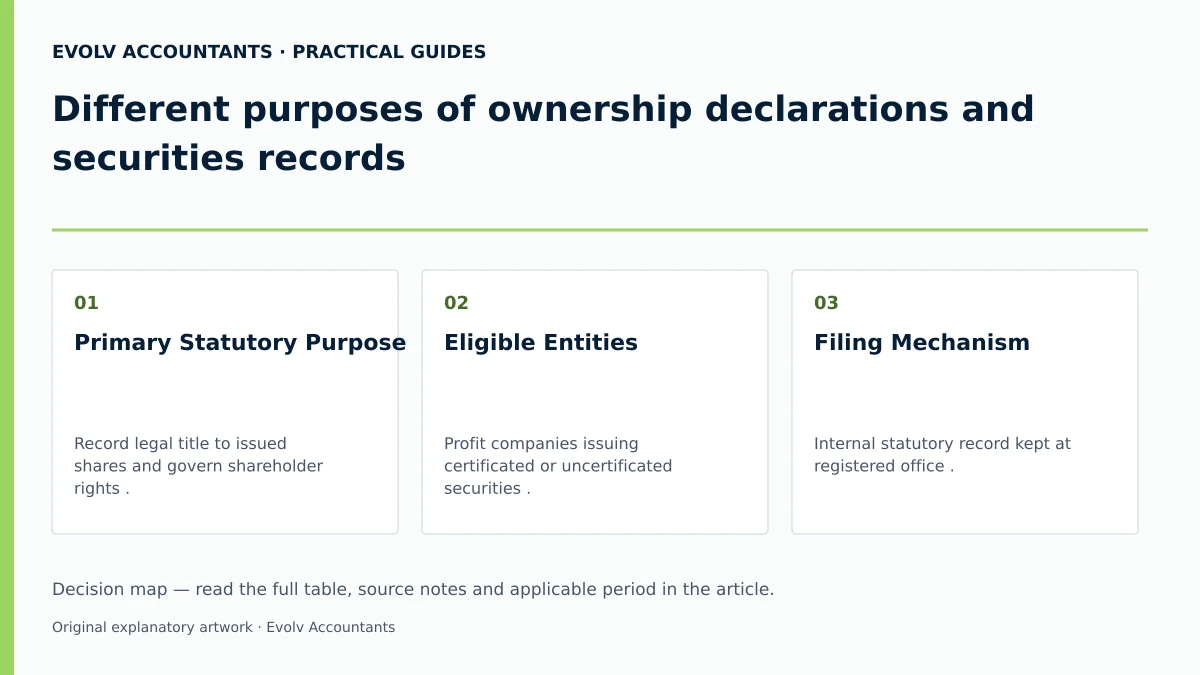
| Primary Statutory Purpose | Record legal title to issued shares and govern shareholder rights 1 8 16. | Disclose ultimate natural-person ownership and effective control 2 3 19. | Companies Act 71 of 2008 s50 vs CIPC BO Regulations 3 8. | Both registers must be maintained concurrently; one cannot replace the other 2 7. |
| Eligible Entities | Profit companies issuing certificated or uncertificated securities 7 8 76. | Profit companies, NPCs, external companies, and close corporations 21 22. | Statutory scope under CIPC filing guidelines 21 22. | Non-profit companies and CCs must comply with BO filings despite share structure differences 21 77. |
| Filing Mechanism | Internal statutory record kept at registered office 7 8. | External online filing via CIPC e-services portal 46 78 79. | CIPC step-by-step operational guides 46 78 79. | Requires valid CIPC customer profile and OTP mobile/email verification 2 51 80. |
| Mandatory Documentation | Share transfer forms, share certificates, board resolutions 12 33 34. | Signed mandate (50%+1 directors), certified IDs (<3 months), disclosure diagrams 35 40 41. | CIPC mandatory supporting document lists 35 40 41. | Standard filings require document uploads; optimised filings populate records online 40 61. |
| Non-Compliance Penalty | Internal corporate disputes, invalid voting, administrative notices 11 13 81. | Criminal prosecution for false statements/reckless conduct under s214 4 6. | Companies Act s214 criminal liability provisions 4 6. | Directors and filers face personal statutory liability for false BO disclosures 4 6. |
Frequently Asked Questions
Can a juristic person or trust be declared as an ultimate beneficial owner with CIPC?
No. An ultimate beneficial owner must always be a natural person (an individual) 19 64 82. Where shares are held by a company or trust, that entity is captured as a first-tier juristic owner, but the filing must trace through to the living individuals who ultimately own or control it 19 43 64.
What threshold triggers a beneficial ownership declaration?
A beneficial ownership declaration is required for any natural person who directly or indirectly holds 5% or more of the beneficial interest in securities or voting control in a company 2 3 19 29. Effective control must still be assessed independently of the percentage holding.
How does the CIPC optimised beneficial ownership filing differ from standard filing?
Optimised filing applies only to non-affected entities with 10 or fewer directors/members where all directors are direct shareholders with no external beneficial interest 56 57 59. It allows populating the securities register online without uploading document files or mandates, resulting in an email confirmation rather than a certificate 60 61 63.
Who must sign the mandate authorising a CIPC beneficial ownership filing?
The mandate must be on company or close corporation letterhead and signed by at least 50% plus one of the company's directors (an ordinary resolution threshold) or by all members of a close corporation 35 36. It must grant authority to a single natural person holding a valid CIPC customer code 35 36.
What supporting documents are required for a standard non-affected company BO filing?
Mandatory documents include a certified ID or passport copy for the filer and each beneficial owner (dated not older than 3 months), the signed company mandate, the internal securities register or beneficial interest register, and a diagrammatic disclosure form if complex ownership structures exist 40 41 49. Tell Evolv about your company ownership question and the filing support you need. Ask Evolv about different purposes of ownership declarations and securities records. Share the relevant records so the support required can be scoped.
Related guides
- Filing annual returns for a dormant company
- Who counts as a beneficial owner of a private company
- Compliance and Regulations: Keeping Your Business on Track
Sources
- https://www.gov.za/sites/default/files/gcis_document/202212/47815anti-moneylaunderingact22of2022.pdf
- https://www.cipc.co.za//wp-content/uploads/Legal/Regulations/CompaniesAct71_2008.pdf
- https://www.cipc.co.za/wp-content/uploads/2024/09/Step-by-step-guide_E-Services-Beneficial-Ownership-Filing-Complex-Structure-Final.pdf
- https://www.cipc.co.za/wp-content/uploads/2024/09/Step-by-step-guide_E-Services-Beneficial-Ownership-Filing-Non-Affected-Company-With-Beneficial-Ownership.pdf
- https://www.cipc.co.za/wp-content/uploads/2025/10/Step-by-step-guide-OPTIMIZED-BO-FILING-Final.pdf