
Filing annual returns for a dormant company
3 June 2025

Filing an annual return for a dormant company requires submitting statutory records and fees to CIPC within thirty business days of its incorporation anniversary.
Decide the assurance obligation separately from the CIPC filing format. A private company needs a statutory audit at PIS 350 or more, or PIS 100 or more with internally compiled statements, and when another audit trigger applies. The owner-managed exemption does not cancel a mandatory statutory audit. Where no audit is required, test independent review and the section 30(2A) exemption using every securities holder and beneficial-interest holder, not only the registered shareholders.
Statements count as internally compiled unless the regulatory definition of “independently compiled and reported” is met. A company not required to file audited statements may file audited or reviewed AFS; if it does neither, it files FAS. FAS does not replace preparing AFS or obtaining a required review. CIPC annual-return FAQ; Companies Regulations.
Under South African company law, dormant entities receive no exemption from statutory annual return obligations. Even when a private company registers zero turnover and conducts no trading activities during a financial year, it must file its annual return within thirty business days following its incorporation anniversary, keep BO filing current, and use the applicable AFS or FAS filing route to prevent administrative deregistration and legal dissolution.
Nil trading evidence without assuming exemption
In South Africa, company administration is strictly governed by the Companies Act 71 of 2008 and enforced by the Companies and Intellectual Property Commission (CIPC) 1 2 3. A common misconception among small and medium enterprise (SME) directors is that a company with no bank account, zero revenue, or zero commercial transactions is exempt from regulatory filings. However, the law does not distinguish between active commercial businesses and dormant or non-trading entities regarding statutory annual returns 4 5.
For the reader—whether a company director, shareholder, or appointed compliance officer—completion of this statutory task means successfully submitting the prescribed annual return form (Form CoR 30.1) electronically, clearing the prescribed fee, and maintaining the entity's active legal status on the CIPC registry 1 3 6 7.
To maintain compliance and avoid costly legal complications, business owners must clearly distinguish between three distinct sources of law and guidance:
- Statutory Law: Section 33(1) of the Companies Act 71 of 2008 mandates that every registered profit and non-profit company must file an annual return in the prescribed form with the prescribed fee within 30 business days after the anniversary date of its incorporation 2 3. Furthermore, Section 28 mandates the maintenance of accurate accounting records 8, while Section 82(3) empowers CIPC to deregister entities that fail to file annual returns for two or more consecutive years 9.
- Regulator Guidance: CIPC operational instructions specify that annual returns can only be submitted electronically via digital portals such as e-Services or BizPortal 10 11. CIPC guidance further dictates that a Beneficial Ownership (BO) declaration must be lodged prior to submitting the annual return 12 13 and that a company not required to file audited AFS must file FAS if it does not voluntarily file audited or reviewed AFS.
- Evolv Recommendations: Evolv Accountants advises SME leadership never to assume dormant status creates automatic statutory relief. Directors should establish an annual compliance tracking schedule tied to the incorporation anniversary date, assemble verified zero-trading documentation (such as bank statements or director affidavits confirming nil turnover), and conduct an annual Public Interest Score (PIS) evaluation prior to portal submission 17.
Failure to submit annual returns leads to CIPC placing the company into deregistration status ("AR Deregistration") 5 18. If non-compliance continues, CIPC finally deregisters the entity ("AR Final Deregistered"), which withdraws its juristic personality and causes the business to cease to exist legally 18 19 20. Furthermore, active directors at the time of deregistration may remain personally liable for liabilities incurred during their tenure 19 20.
Prepare the information and authority: nil trading evidence without assuming exemption
Before initiating the electronic submission, the responsible person must assemble all necessary statutory inputs, corporate evidence, and system permissions. Preparing these elements in advance ensures accurate data entry and prevents filing rejections or credit/debit adjustments 21 22.
— Practical point from this guide
Required Statutory Inputs and Documents
- CIPC Customer Code and Access Credentials: Filing can only be executed through an authenticated CIPC customer profile using registered login credentials 23 24 25.
- Company Registration Details: The exact registered name and enterprise registration number as reflected on CIPC records 25 26.
- Beneficial Ownership (BO) Declaration Confirmation: CIPC rules require that the entity's Beneficial Ownership declaration must be fully up to date on the CIPC portal before the system will allow an annual return submission 12 13.
- Financial Reporting Documents (FAS or AFS): Under Companies Regulation 28 and 30, a dormant private company that is not legally required to audit its financial statements—and has not voluntarily opted for an audit or independent review—must lodge a Financial Accountability Supplement (FAS / Form CoR 30.2) alongside Form CoR 30.1 14 15 16 27.
- Verified Turnover Evidence: Records confirming zero turnover (R0.00) for the relevant financial period 15 17 28.
- Public Interest Score (PIS) Inputs: Data required to calculate the PIS under Regulation 26(2), including average workforce size, third-party liabilities, annual turnover, and the total number of individuals holding a beneficial interest in the company's securities 17.
- Designated Compliance Officer Details: The full name, identity number or registration number, and contact details of the director or officer designated under Section 33(3) as responsible for statutory compliance 17 29.
Statutory Fee Structure
Annual return filing fees for private companies are legislated under the Companies Act 2008 fee table and depend on annual turnover and filing timeliness 6 30:
- Turnover Less than R1 million: The standard filing fee is R100 if submitted within 30 business days following the incorporation anniversary date 6.
- Late Filing Penalty: If submitted more than 30 business days after the anniversary date, the total fee is R150, consisting of the R100 on-time fee plus a R50 late increment.
- Higher Turnover Tiers: For entities with turnover between R1 million and R10 million, the standard fee is R450 (late fee R600); for turnover between R10 million and R25 million, the standard fee is R2,000 (late fee R2,500); and for turnover of R25 million or above, the standard fee is R3,000 (late fee R4,000) 6 31.
CIPC is legally prohibited from waiving legislated filing fees, granting exemptions, or accepting fee payment in instalments 4 31.
Complete the task step by step: documented completion and exceptions
Filing a dormant company annual return requires following CIPC's digital submission workflow. The process must be executed systematically to ensure that statutory declarations align with verifiable accounting evidence.
Sequenced Execution Workflow
- Verify Incorporation Anniversary and Submission Window: Check CIPC registry records to identify the exact anniversary month of incorporation. Calculate the 30-business-day compliance window from the anniversary date to determine whether standard or late penalty fees apply 6 12 32.
- Confirm Beneficial Ownership Filing: Access the CIPC Beneficial Ownership portal service. Ensure that the latest beneficial ownership register has been submitted and accepted 12 13. If outstanding, complete the BO filing before attempting the annual return 13.
- Log into CIPC Electronic Services: Navigate to the official CIPC electronic portal (e-Services at www.eservices.co.za or BizPortal at www.bizportal.gov.za) 10 11 24. Enter authenticated customer credentials 25.
- Access Financials and Annual Return Module: Select the "Financials" menu tab and click on the "Annual Returns" service 25. Search for the target entity using its CIPC registration number 25.
- Verify Corporate Governance Information: On the Form CoR 30.1 details screen, review and confirm whether key organizational records remain unchanged or require formal amendment, including registered office address, location of company records, director details, company secretary, auditor details, and financial year-end 26.
- Capture Financial Metrics and Calculate PIS: Input total annual turnover as R0.00 for the dormant period 15 17 28 33. Calculate PIS from actual average employees, year-end third-party liabilities, turnover and individual beneficial-interest holders. Zero trading does not prove that employees, liabilities or assets are zero.
- Attach Financial Accountability Supplement (FAS): For a non-trading private company exempt from audit and review requirements, select the FAS option (Form CoR 30.2) 15 16 27. Upload the required financial disclosure documents in PDF format 23 33.
- Validate Compliance and Review Cart: Click "Validate Filing Compliance" 25 33. The system automatically calculates the required statutory fee based on the captured R0.00 turnover and submission timing 6 31. Add the transaction to the electronic shopping cart 34.
- Execute Payment and Obtain Certificate: Complete card payment via the secure online portal 23 34. Upon payment confirmation, CIPC generates an official Annual Return Filing Certificate 35 36.
Step-by-Step Task Checklist
- Confirm company incorporation anniversary date and calculate 30-business-day deadline 12 32.
- Verify that CIPC Beneficial Ownership (BO) filings are up to date 12 13.
- Extract zero-trading financial evidence (bank statements or nil management accounts) 8 15.
- Compute Public Interest Score (PIS) according to Companies Regulation 26(2) 17.
- Log into CIPC e-Services and navigate to Financials > Annual Returns 25.
- Verify corporate details on Form CoR 30.1 and designate compliance officer 17 26 29.
- Declare annual turnover of R0.00 and attach Financial Accountability Supplement (FAS) 15 16 33.
- Review fee calculation in shopping cart and complete electronic card payment 6 34.
- Download and archive CIPC Annual Return Filing Certificate 35 36.
Check the result against the evidence: nil trading evidence without assuming exemption
Completing an annual return filing requires verifying independent confirmation evidence rather than assuming portal submission guarantees full regulatory compliance.
Verification and Audit Trail
- Annual Return Filing Certificate: CIPC issues an official filing certificate upon successful payment processing 35 36. To protect personal privacy under POPIA, director identity numbers, residential addresses, and personal contact details are masked on the certificate 35.
- CIPC Registry Status Check: Access BizProfile (www.bizprofile.gov.za) or run an enterprise search on CIPC e-Services to verify that the company's legal status reflects "In Business" rather than "AR Deregistration" 5 18 25.
- Financial Record Archiving: In accordance with Section 24 of the Companies Act, all filing records, Form CoR 30.1 summaries, FAS attachments, and proof of payment receipts must be retained in written or electronic format for a minimum of seven years at the company's registered office 37 38.
Reproducible Hypothetical Example
Consider Apex Logistics Dormant (Pty) Ltd, a private company incorporated in South Africa on 15 June 2022 that remained completely non-trading throughout its financial year ending 28 February 2025.
- Turnover & Workforce: Zero commercial transactions occurred; annual turnover is declared as R0.00, and the employee count is 0 15 17 28.
- Public Interest Score (PIS) Calculation:
- Average employees (0) = 0 points 17.
- Third-party liabilities (R0.00) = 0 points 17.
- Annual turnover (R0.00) = 0 points 17.
- Shareholders (1 natural person shareholder) = 1 point 17.
- Total Public Interest Score = 1 point 17.
- Audit/Review Requirement: Assume its sole shareholder is also its sole director, no other person holds a beneficial interest, no statutory audit trigger applies and the MOI does not require an audit. On those facts, it qualifies for the owner-managed review exemption; low PIS or dormancy alone would not establish the exemption. It selects the Financial Accountability Supplement (FAS / Form CoR 30.2) option 15 16 27.
- Fee Calculation: On 20 July 2025 (within 30 business days of its 15 June anniversary), the director logs into e-Services. For R0.00 turnover filed on time, the system assesses a fee of R100 6 31.
- Outcome: Payment is completed by card; CIPC issues an Annual Return Filing Certificate, and the company status remains confirmed as "In Business" 18 25 36.
Handle exceptions and unresolved cases: documented completion and exceptions
Complex compliance scenarios arise when filings are delayed, turnover figures are captured incorrectly, or statutory boundaries overlap.
Edge Cases and Remediation Protocols
- Multiple Outstanding Annual Returns: If a company misses filings for two or more consecutive years, CIPC automatically initiates deregistration proceedings ("AR Deregistration") 5 9. To halt deregistration before final dissolution, all outstanding annual returns and accumulated late fees must be submitted electronically 41 42.
- Final Deregistration and Re-instatement: If CIPC completes final deregistration ("AR Final Deregistered"), the legal persona is withdrawn 18 19 20. Any interested person must apply for statutory re-instatement using Form CoR 40.5 alongside a prescribed R200 application fee 6 43 44. Once placed "in re-instatement process", all outstanding annual returns, BO declarations, and financial statements must be lodged to restore full legal standing 43.
- Incorrect Turnover Captured: Information submitted on an annual return cannot be edited online once finalised 21. If an incorrect turnover figure was captured, the CIPC customer code holder must log a formal query via the online enquiry system submitting financial statements, a certified ID copy, a written explanation, and an authorisation letter requesting CIPC to issue a credit note (if turnover was over-stated) or debit note (if turnover was under-stated) 21 22.
Tax compliance with SARS does not satisfy CIPC statutory requirements, and vice versa 45. Audit and Independent Review Determinations:* Deciding whether a dormant company requires an audit or independent review requires evaluating Companies Act Section 30 alongside Regulations 26 to 28 2 39 40 46.
While most dormant private companies qualify for FAS filing, an audit is mandatory if the MOI requires it, if the entity holds assets in a fiduciary capacity exceeding R5 million, or if its PIS reaches 350 (or 100 if financial statements are compiled internally) 39 40.
Next steps for CIPC annual returns
Task and Completion Checklist
| Step | Input or evidence | Responsible person | Completion check | Exception or next action |
|---|---|---|---|---|
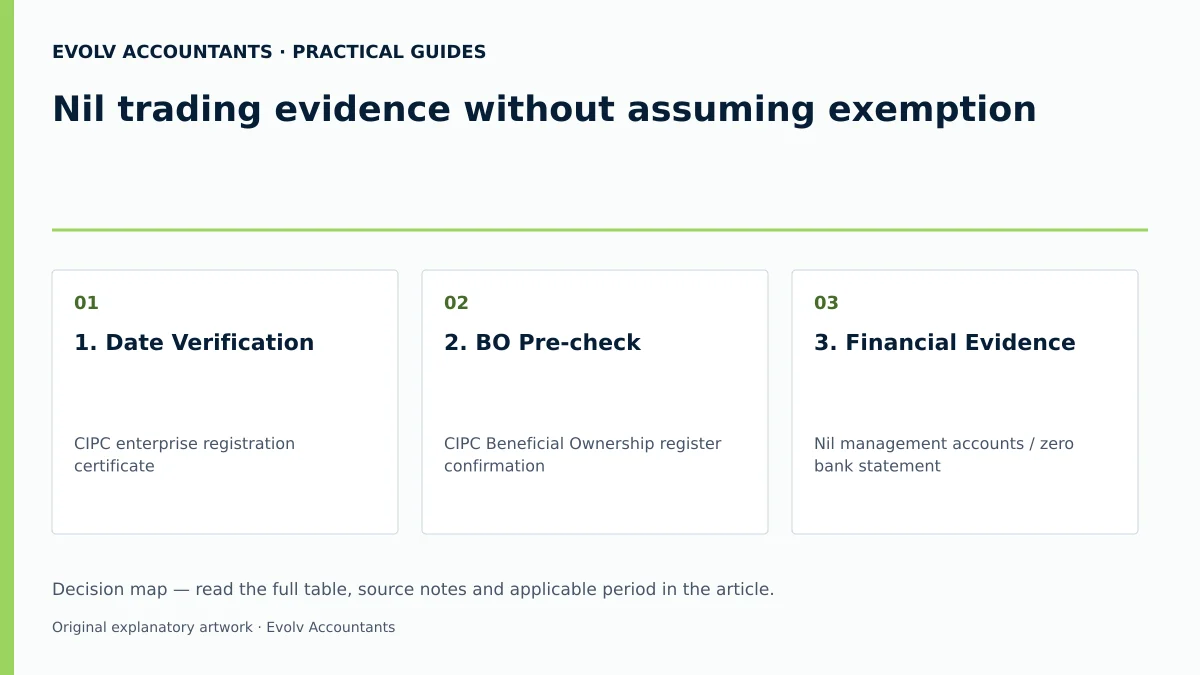
| 1. Date Verification | CIPC enterprise registration certificate | Compliance Officer / Director | Anniversary date and 30-business-day deadline logged | Calculate penalty fee if past 30 business days 6 32. |
| 2. BO Pre-check | CIPC Beneficial Ownership register confirmation | Company Director | BO declaration active on CIPC portal | Submit BO declaration prior to annual return 12 13. |
| 3. Financial Evidence | Nil management accounts / zero bank statement | Professional Accountant / Director | Zero turnover (R0.00) verified | Compile FAS (Form CoR 30.2) attachment 15 16. |
| 4. Portal Capture | CIPC e-Services credentials & Form CoR 30.1 inputs | Authorised Customer Code Holder | Turnover, PIS, and governance data entered | Log CIPC enquiry if portal error occurs 22 25. |
| 5. Fee Settlement | Credit / debit card details | Authorised Payee | Shopping cart payment successful | Re-try card authentication if transaction fails 23 34. |
| 6. Filing Verification | Annual Return Filing Certificate & CIPC BizProfile | Director / Company Secretary | Certificate stored; "In Business" status confirmed | File Form CoR 40.5 re-instatement if deregistered 6 43. |
Frequently Asked Questions
Does a dormant company with zero bank balance need to file CIPC annual returns?
Yes. Neither the Companies Act 71 of 2008 nor CIPC regulations distinguish between active trading entities and dormant or non-trading businesses 4 5. According to CIPC guidance, "even if the company or close corporation was inactive, it is still legally required to file and pay Annual Returns" 5.
What happens if a dormant company fails to file its annual return within 30 business days?
Failing to file within 30 business days following the incorporation anniversary date results in a total late filing fee of R150 for turnover below R1 million: R100 plus a R50 late increment. If non-filing continues for two or more consecutive years, CIPC automatically places the entity into deregistration proceedings, which ultimately leads to final deregistration and legal dissolution 5 9 19 20.
Is a full independent audit required for a dormant private company's annual return?
No, unless mandated by the company's Memorandum of Incorporation (MOI) or specific statutory thresholds 39 40 41. A low PIS and no qualifying fiduciary assets may remove the relevant statutory audit triggers, but do not automatically remove independent review. Test the section 30(2A) exemption and the MOI separately. FAS is the filing route where audited AFS are not required and audited or reviewed AFS are not voluntarily filed.
How does CIPC beneficial ownership filing relate to SARS tax filings for a non-trading entity?
CIPC beneficial ownership filings and SARS tax returns are separate regulatory processes. Completing one does not satisfy the other. CIPC annual-return guidance.
Can CIPC waive annual return fees or grant payment extensions for inactive companies?
No. Prescribed filing fees are established by legislation under the Companies Act regulations 6 30 31. CIPC has no legal authority to waive filing fees, grant fee exemptions, or allow payment of annual return fees in instalments 4 31.
Related guides
- Why an annual return submission can be blocked
- Filing CIPC annual returns for a private company
- Compliance and Regulations: Keeping Your Business on Track
Sources
- https://annualreturns.cipc.co.za/docs/FAQ_Annual_Returns.pdf
- https://www.justice.gov.za/legislation/acts/2008-071-reg.pdf
- https://www.cipc.co.za//wp-content/uploads/Legal/Regulations/CompaniesAct71_2008.pdf
- https://www.cipc.co.za/wp-content/uploads/Forms/Companies/CoR30_1.pdf
- https://www.cipc.co.za/wp-content/uploads/2024/10/STEP-BY-STEP-ANNUAL-RETURNS-003.pdf