
Filing CIPC annual returns for a private company
6 June 2025

Filing CIPC annual returns requires private companies in South Africa to submit statutory compliance records and financial declarations annually within thirty business days of incorporation.
Audit and assurance qualification. Regulation 28’s R5 million fiduciary-assets trigger concerns assets held in the ordinary course of the company’s primary activities for people unrelated to the company. The public-interest-score triggers also depend on whether statements are compiled internally or independently, and other statutory or MOI requirements can apply. Assess the complete tests rather than treating a low score as an automatic audit exemption.
See Companies Regulations, regulations 26–29.
An annual return filed with the Companies and Intellectual Property Commission (CIPC) verifies that a private company remains active and maintains up-to-date statutory details on the national corporate register 1 2.
Compliance requires submitting Form CoR 30.1 (or its digital equivalent) alongside an updated Beneficial Ownership Declaration, an audited or independently reviewed Annual Financial Statement (AFS) or Financial Accountability Supplement (FAS), and the prescribed compliance checklist within thirty business days following the anniversary date of incorporation 3 4 5 6.
— Practical point from this guide
Failing to file triggers statutory late payment penalties and automatically initiates administrative deregistration proceedings when two or more consecutive returns are outstanding 3 7 8 9. Involuntary deregistration terminates the entity's juristic personality, freezes commercial standing, and exposes active directors to personal liability for corporate obligations 8 10 11.
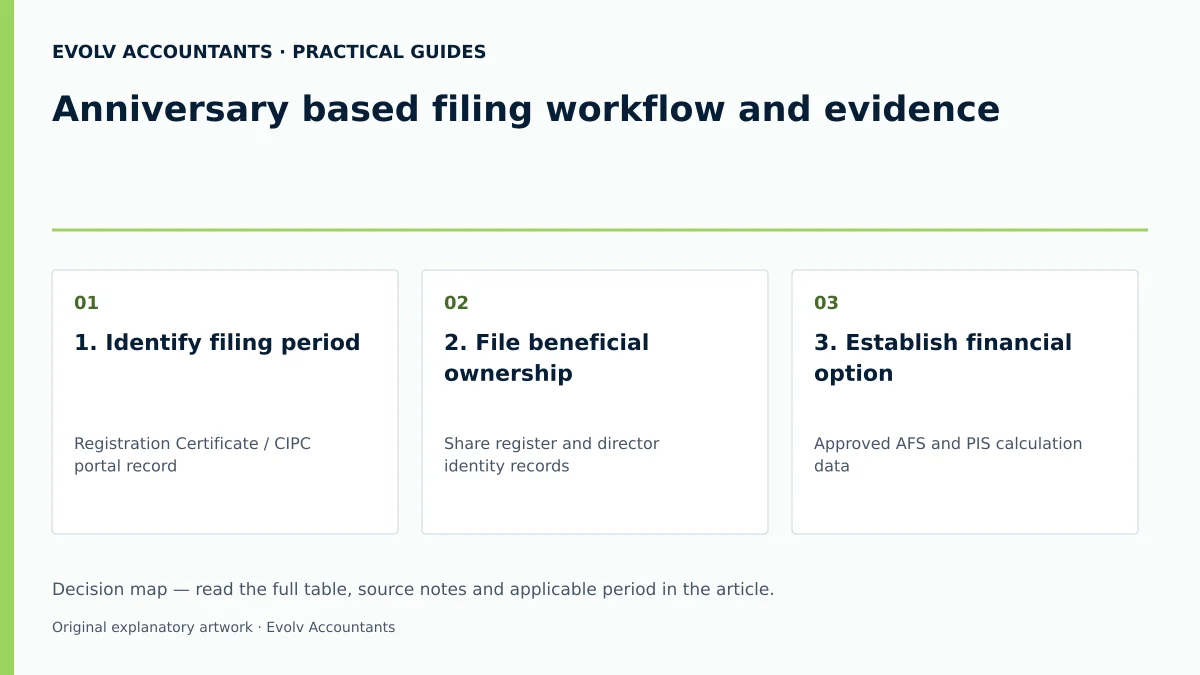
Anniversary based filing workflow and evidence
Reader, jurisdiction and legal period
This practical compliance draft addresses directors, business owners, and financial officers of South African private companies ((Pty) Ltd) operating under the Companies Act 71 of 2008 and Companies Regulations 12 13 14. Every private company registered in South Africa must file its CIPC annual return annually within thirty business days after the anniversary date of its original incorporation 3 5 6.
A fundamental distinction exists between a South African Revenue Service (SARS) income tax return and a CIPC annual return 15. A SARS tax submission determines corporate income tax liability payable to the State 15. Conversely, a CIPC annual return serves as a statutory administrative declaration under Section 33 of the Companies Act to confirm whether a company continues to conduct business and to verify its public registry records 1 2 5 15.
Complying with SARS tax obligations does not satisfy CIPC statutory annual return duties, as the two requirements stem from separate legislation enforced by distinct regulatory bodies 15.
Meaning of full statutory completion
Full statutory completion cannot be assumed merely because a user logs into an online portal or completes an electronic payment transaction 16. True legal completion occurs only when CIPC processes the complete filing submission—comprising the annual return form, updated Beneficial Ownership Declaration, compliance checklist, and applicable AFS or FAS—and issues an official CIPC Annual Return Filing Certificate 3 4 17 18.
Upon successful processing, the company's registry status remains formally recorded as "In Business" with zero outstanding filing years 19 20.
Prepare the information and authority: anniversary based filing workflow
Statutory documents and inputs required
To complete an anniversary-based filing workflow, a private company must compile and verify several mandatory legal inputs:
- Company Identifiers: Full registered name, registration number, registered office address, and verified details for all active directors and company officers 21.
- Designated Compliance Authority: Name and identity details of the specific director, employee, or designated individual responsible for corporate compliance under Chapter 2 Part C and Chapter 3 of the Companies Act 22 23.
- Public Interest Score (PIS) Metrics: Data required to calculate the company's PIS under Regulation 26(2), including average employee numbers, total liabilities in R millions, annual turnover in R millions, and the number of individuals holding beneficial interests in issued securities 23 24.
- Financial Reporting Records: The company's latest approved annual financial statements (audited or independently reviewed) or a completed Financial Accountability Supplement (Form CoR 30.2) where an audit or independent review is not statutorily required 25 26 27 28 29.
- Beneficial Ownership Records: An updated Beneficial Ownership Declaration submitted to CIPC prior to or alongside the annual return filing 3 4 30.
Distinction between Law, Regulator Guidance and Evolv Recommendations
- Statutory Law (Companies Act 71 of 2008 & Regulations): Mandates the legal duty to file annual returns within thirty business days of the incorporation anniversary (Section 33) 3 5, establishes mandatory audit and review thresholds based on PIS and fiduciary assets (Section 30 & Regulations 26/28) 24 31 32, and enforces deregistration for non-compliance (Section 82) 8 9.
- Regulator Guidance (CIPC Guides & FAQs): Specifies that annual returns must be filed electronically via CIPC digital channels (BizPortal, e-Services, or Self Service Centres) 17 33, masks personal identity numbers on public certificates to comply with POPIA 17, enforces credit/debit card payment mechanisms 34, and publishes scaled filing fee structures tied to turnover brackets 7.
- Evolv Recommendations: Evolv Accountants advises South African SMEs to maintain an internal compliance calendar aligned with incorporation anniversary dates, perform a pre-filing audit of statutory registers sixty days prior to due dates, reconcile turnover declarations directly against signed financial statements, and secure official filing certificates in a permanent compliance repository.
Evidence boundary: Beneficial ownership and accounting frameworks
CIPC beneficial ownership filings are established under the Companies Act to identify natural persons who ultimately own or control a legal entity 3 30. This legal requirement is distinct from SARS partnership or trust IT3(BO) tax data declarations. Furthermore, where private companies prepare financial statements, Section 29 requires adherence to prescribed financial reporting standards such as IFRS for SMEs 35 36.
Public summaries of the IFRS for SMEs accounting standard establish framework scope and edition facts, but do not replace statutory accounting obligations under South African law.
Complete the task step by step: evidence
Sequenced operational filing process
Executing the CIPC annual return filing requires a structured sequence grounded in official primary instructions:
- Step 1: Pre-Filing Beneficial Ownership Submission — Access the CIPC portal and verify that the company's latest Beneficial Ownership Declaration has been lodged 3 30. The annual return service automatically redirects users to complete beneficial ownership filing if records are outdated 30.
- Step 2: Financial Classification and PIS Determination — Examine the latest approved financial statements to establish annual turnover and calculate the Public Interest Score 23 27 37. Determine whether audited AFS (submitted via iXBRL), independently reviewed AFS, or a Financial Accountability Supplement (FAS) must be attached 25 26 27 28 29.
- Step 3: Portal Access and Enterprise Selection — Log into the CIPC digital platform using an active customer code, navigate to Financials / Annual Returns, and enter the company registration number to locate the enterprise 20 33 38.
- Step 4: Data Entry and Document Upload — Confirm company registry details, capture contact information for the designated compliance officer, enter the annual turnover figure, validate filing compliance, and attach required financial records in PDF or iXBRL format 20 23 28 39.
- Step 5: Fee Calculation and Card Payment — Review the automated fee assessment generated by the portal 40 41. Select unpaid return items in the digital shopping cart and finalise card payment authentication 18 41.
- Step 6: Confirmation and Certificate Retrieval — Confirm successful transaction processing and retrieve the CIPC Annual Return Filing Certificate sent to the customer code holder 17 18.
Reproducible hypothetical example
Consider an illustrative South African private company, Exemplar Solutions (Pty) Ltd (labelled as illustrative values):
- Incorporation Anniversary Month: June (Registered 26 June 2018) 42.
- Filing Window: 27 June to within 30 business days 3 6 7.
- Financial Inputs (Illustrative values): Annual Turnover = R8,5 million; Total Liabilities = R2,1 million; Average Employees = 14; Beneficial Security Holders = 3 natural persons.
- Public Interest Score (PIS) Calculation: 14 (average employees) + 3 (R2.1 million liabilities, rounded up to whole R1 million portions) + 9 (R8.5 million turnover, rounded up in the same way) + 3 (individual security holders) = 29 points 23.
- Audit / Review / FAS Decision: Because the PIS is below 100 points and the company holds no third-party fiduciary assets exceeding R5 million, a mandatory audit is not required by law 24 31. The company undergoes an independent review unless exempt under Section 30(2A); if unaudited and unreviewed, it lodges a Financial Accountability Supplement (FAS / Form CoR 30.2) 27 28 29 43.
- Prescribed Fee Assessment: Under the Companies Act 2008 fee table, a turnover of R8,5 million (between R1 million and R10 million) filed within 30 business days incurs a fee of R450 7. If filed more than 30 business days after the anniversary date, a penalty fee applies, bringing the total fee to R600 7.
Check the result against the evidence: anniversary based filing workflow
Independent completion verification
Submitting data online or receiving a bank notification does not confirm statutory compliance. Independent completion evidence requires verifying four primary records:
- Official CIPC Filing Certificate: Receipt of the CIPC Annual Return Filing Certificate displaying the filing year, company registration number, and masked director details 17 18.
- Registry Standing Confirmation: A CIPC registry check reflecting the enterprise status as active ("In Business") with no outstanding return years 19 20.
- Shopping Cart Payment Receipt: An official CIPC transaction outcome showing a "Paid" status and transaction reference number in the shopping cart history 18.
- Beneficial Ownership Confirmation: Written confirmation that CIPC has accepted the latest Beneficial Ownership Declaration 3 30.
Handle exceptions and unresolved cases: evidence
Incorrect turnover disclosure recovery
If an incorrect turnover figure is entered during annual return filing, the submitted information cannot be edited directly online 44. To rectify turnover and adjust fees, CIPC issues a credit note (if declared turnover exceeded actual turnover) or a debit note (if declared turnover was understated) 44. The customer code holder must log a formal query via the CIPC online portal providing:
- Approved financial statements for the relevant financial year 45.
- Entity name, registration number, and filing year in question 45.
- Written explanation detailing the reason for the error 45.
- Certified identity document copy of the customer code owner 45.
- Signed permission letter authorising CIPC to adjust the customer code balance 45.
Involuntary deregistration and reinstatement
Failing to submit annual returns for two or more consecutive years causes CIPC to place the company into deregistration process 8 9. Continued non-compliance results in final deregistration, which withdraws juristic personality, dissolves the entity, locks banking facilities, and leaves active directors vulnerable to personal liability for corporate debts 8 10 11 46.
If a company is finally deregistered for annual return non-compliance, any interested party may apply for reinstatement by lodging Form CoR 40.5 alongside the prescribed R200 fee 40 47 48 49. Processing Form CoR 40.5 alters the entity's status to "in reinstatement process", allowing the company to file all outstanding annual returns, Beneficial Ownership Declarations, and AFS/FAS documents to restore active status on the registry 48.
Next steps for CIPC annual returns
Reusable task checklist
- Determine the incorporation anniversary date and establish the thirty business days filing window 3 5 6.
- Compile beneficial ownership records and submit the updated Beneficial Ownership Declaration to CIPC 3 30.
- Calculate the Public Interest Score and determine whether audited AFS, reviewed AFS, or a Financial Accountability Supplement (FAS) is required 23 25 26 27.
- Access CIPC e-Services, capture turnover and designated compliance officer details, and attach required financial records 20 23 28 39.
- Complete card payment in the CIPC shopping cart for the prescribed fee and any late filing penalties 7 18 41.
- Download and archive the CIPC Annual Return Filing Certificate, verifying that enterprise status displays "In Business" 17 18.
Task and completion checklist
| Step | Input or evidence | Responsible person | Completion check | Exception or next action |
|---|---|---|---|---|
| 1. Identify filing period | Registration Certificate / CIPC portal record 5 | Director / Company Secretary | Anniversary date verified and 30 business days deadline calculated 3 6 | If past 30 business days, budget for late filing penalty fee 7 |
| 2. File beneficial ownership | Share register and director identity records 30 | Director / Compliance Officer | CIPC Beneficial Ownership submission confirmation 30 | Complete BO filing prior to initiating annual return filing 30 |
| 3. Establish financial option | Approved AFS and PIS calculation data 23 27 | Accountant / Financial Manager | Verified PIS and selected reporting pathway (AFS or FAS) 26 27 | Prepare iXBRL AFS file or FAS PDF based on PIS threshold 26 27 |
| 4. Submit annual return data | CIPC portal credentials and turnover figure 20 37 | Authorised Representative | Data captured and required documents attached 20 23 39 | If turnover error occurs, log CIPC query for debit/credit note 45 |
| 5. Settle filing fee | Credit or debit payment card 34 41 | Financial Manager / Director | Card payment authenticated and cart item marked paid 18 41 | If payment fails, retry transaction before cart item expires 16 |
| 6. Archive filing proof | Official CIPC certificate and registry status 17 18 | Compliance Officer | Filing certificate retrieved and status verified as "In Business" 17 18 | If status shows deregistration, lodge Form CoR 40.5 for reinstatement 40 48 |
Frequently Asked Questions
Does filing income tax returns with SARS fulfill CIPC annual return obligations?
No. CIPC annual returns and SARS tax returns are two distinct statutory requirements governed by different laws and administered by separate government departments 15. A SARS income tax return calculates income tax liability payable to the State, whereas a CIPC annual return confirms corporate existence and updates public registry records 15. Compliance with SARS does not satisfy CIPC statutory requirements 15.
What is the exact statutory deadline for filing a private company annual return?
Private companies must file their annual return electronically within thirty business days following the anniversary date of incorporation 3 5 6. Late submissions incur statutory penalty fees 3 7.
Must a dormant or inactive private company file CIPC annual returns?
Yes. The Companies Act makes no distinction between active and dormant or inactive entities 8 16. Inactive private companies remain legally obligated to file annual returns and pay prescribed fees annually to maintain active standing on the registry 8 16.
How is a private company's financial reporting option (AFS vs FAS) determined for annual returns?
Financial reporting requirements depend on Section 30 and Regulation 28 criteria 24 26 31. A private company must file audited AFS via iXBRL if its Public Interest Score is 350 or more (or 100 if internally compiled), or if it holds third-party fiduciary assets exceeding R5 million 24 26 31. Companies not required or voluntarily electing to file audited or reviewed AFS must lodge a Financial Accountability Supplement (FAS / Form CoR 30.2) 27 28 29.
What steps resolve an incorrect turnover declared during an annual return filing?
Annual return filings cannot be edited online after submission 44. The customer code holder must log an online query with CIPC, submitting approved financial statements, entity details, an explanation of the error, a certified ID copy, and a signed letter authorising CIPC to issue a debit or credit note against the customer code 45.
Related guides
- Finding the annual return anniversary and submission window
- Calculating turnover for a CIPC annual return
- Compliance and Regulations: Keeping Your Business on Track
Sources
- https://www.justice.gov.za/legislation/acts/2008-071-reg.pdf
- https://annualreturns.cipc.co.za/docs/FAQ_Annual_Returns.pdf
- https://www.cipc.co.za//wp-content/uploads/Legal/Regulations/CompaniesAct71_2008.pdf
- https://www.cipc.co.za/wp-content/uploads/Forms/Companies/CoR30_1.pdf
- https://www.cipc.co.za/wp-content/uploads/2024/10/STEP-BY-STEP-ANNUAL-RETURNS-003.pdf