
Calculating turnover for a CIPC annual return
27 February 2025

Calculating turnover for a CIPC annual return requires reconciling gross revenue from approved annual financial statements to statutory fee brackets.
Audit and assurance qualification. Regulation 28’s R5 million fiduciary-assets trigger concerns assets held in the ordinary course of the company’s primary activities for people unrelated to the company. The public-interest-score triggers also depend on whether statements are compiled internally or independently, and other statutory or MOI requirements can apply. Assess the complete tests rather than treating a low score as an automatic audit exemption.
See Companies Regulations, regulations 26–29.
Under Section 33 of the Companies Act 71 of 2008 and Companies Regulation 30, every South African company must file an annual return with the Companies and Intellectual Property Commission (CIPC) within 30 business days after the anniversary date of its incorporation 1 2 3 4. The annual return filing fee is calculated directly from the entity's gross annual turnover as declared in its latest approved annual financial statements 5 6 7 8.
Reconciling underlying accounting records to approved statements ensures that entities apply the correct statutory fee tier, satisfy corporate accountability requirements, and avoid administrative penalties or automatic deregistration 9 10 11.
— Practical point from this guide
Turnover definition and financial record reconciliation
The primary output of the turnover calculation is a verified monetary total in South African Rand (ZAR) representing gross revenue for a specified annual accounting period 5 6 8 12. This value determines the applicable statutory fee category under Table CR 2B of the Companies Regulations 2011 and dictates whether audited or reviewed annual financial statements (AFS) or a Financial Accountability Supplement (FAS) must accompany the submission 4 5 6 7 13.
A clear legal distinction exists between financial turnover calculated for CIPC statutory returns and revenue reported on SARS tax returns 14. CIPC annual returns serve as a regulatory summary of corporate status and compliance under the Companies Act 2008, using gross financial turnover to establish statutory fees and accountability thresholds 2 3 14. In contrast, SARS tax filings calculate taxable income under tax legislation to determine tax liability 14.
Compliance with SARS requirements does not satisfy CIPC statutory obligations, as the two processes are governed by separate legislation and administered by distinct government departments 14.
A similar regulatory boundary applies to corporate governance declarations. CIPC Beneficial Ownership declarations are mandatory corporate compliance filings required prior to submitting a CIPC annual return 1 15 16. This filing is distinct from SARS partnership IT3(BO) disclosures, which apply to unincorporated partnership structures under tax reporting rules.
Navigating turnover compliance requires distinguishing three tiers of legal authority:
- Statutory Law: The Companies Act 71 of 2008 mandates annual return filings under Section 33 3, financial record retention under Section 24 17, and financial statement preparation under Section 30 18.
- Regulator Guidance: Official CIPC FAQs and e-Services step-by-step guides set out procedural rules for electronic filing, fee schedules, document attachments, and customer code debit or credit adjustments 1 4 19 20 21.
- Evolv Recommendations: Practical accounting practices mandate reconciling general ledger gross turnover to trial balances before board approval, verifying financial year-end alignment, and archiving verification schedules for audit trails 7 21.
Inputs rates periods and exclusions: turnover definition
Calculating turnover for a CIPC annual return requires aggregating gross revenue entries from the general ledger for the relevant financial year 7 8 12. Primary inputs include invoiced sales of goods, rendered service fees, operating income, and trade adjustments 7 8. Exclusions comprise value-added tax (VAT) collected on behalf of the revenue authority, non-operating capital receipts, and recognised trade discounts, provided these adjustments align with the entity's financial reporting standards 7 8 22.
All turnover thresholds and filing fees are established by primary statutory fee schedules. Under Table CR 2B of the Companies Regulations 2011, filing fees for private, public, external, and non-profit companies are categorised into four turnover tiers 4 5 6:
- Less than R1 million turnover: R100 statutory fee if filed within 30 business days of the incorporation anniversary; R150 fee if filed more than 30 business days after the anniversary date 5.
- R1 million to less than R10 million turnover: R450 statutory fee if filed within 30 business days; R600 fee if filed more than 30 business days after the anniversary date 5.
- R10 million to less than R25 million turnover: R2,000 statutory fee if filed within 30 business days; R2,500 fee if filed more than 30 business days after the anniversary date 6.
- R25 million or more turnover: R3,000 statutory fee if filed within 30 business days; R4,000 fee if filed more than 30 business days after the anniversary date 6.
For Close Corporations, filing fees are governed by Schedule 1 of the Close Corporation Administrative Regulations 5 8:
- R0 to less than R50 million turnover: R100 statutory fee if filed within 2 months from the start of the anniversary month; R150 late lodgement penalty if filed after 2 months 5.
- R50 million or more turnover: R4,000 statutory fee if filed within 2 months; R150 late lodgement penalty if filed after 2 months 5.
Identifying missing inputs prior to filing is essential. If an entity has not finalised or approved its annual financial statements for the return year, exact turnover cannot be verified from an approved document, creating compliance risks under Section 215(2)(e) of the Companies Act 7 23.
The calculation in a worked example: financial record reconciliation
The following reproducible worked example illustrates how general ledger inputs are reconciled to approved financial statements to select the correct CIPC fee bracket. All monetary values represent illustrative hypothetical SME figures.
Reproducible Worked Example
| Input | Value or verified-source placeholder | Formula or step | Result | Independent check |
|---|---|---|---|---|
| Gross Invoiced Sales | R5,200,000 (Illustrative) | Sum of general ledger sales entries | R5,200,000 | Reconcile to sales daybook total 7 12 |
| Less: Sales Returns & Allowances | R150,000 (Illustrative) | Deduct verified credit notes issued | R5,050,000 | Match to credit note register 7 12 |
| Add: Operating Service Fees | R350,000 (Illustrative) | Add gross fee revenue earned | R5,400,000 | Cross-check bank deposits & fee ledger 7 12 |
| Net Approved Turnover | R5,400,000 (Approved AFS) | Final approved AFS income statement | R5,400,000 | Confirm board sign-off on AFS 7 24 |
| Fee Tier Determination | R1m to < R10m bracket | Map turnover to Table CR 2B fee tier | R450 fee (On-time) | Verify against CIPC Table CR 2B 4 5 |
| Filing Deadline Check | Within 30 business days | Apply Section 33 & Regulation 30 timeframe | R450 total fee due | Confirm anniversary date 1 3 5 |
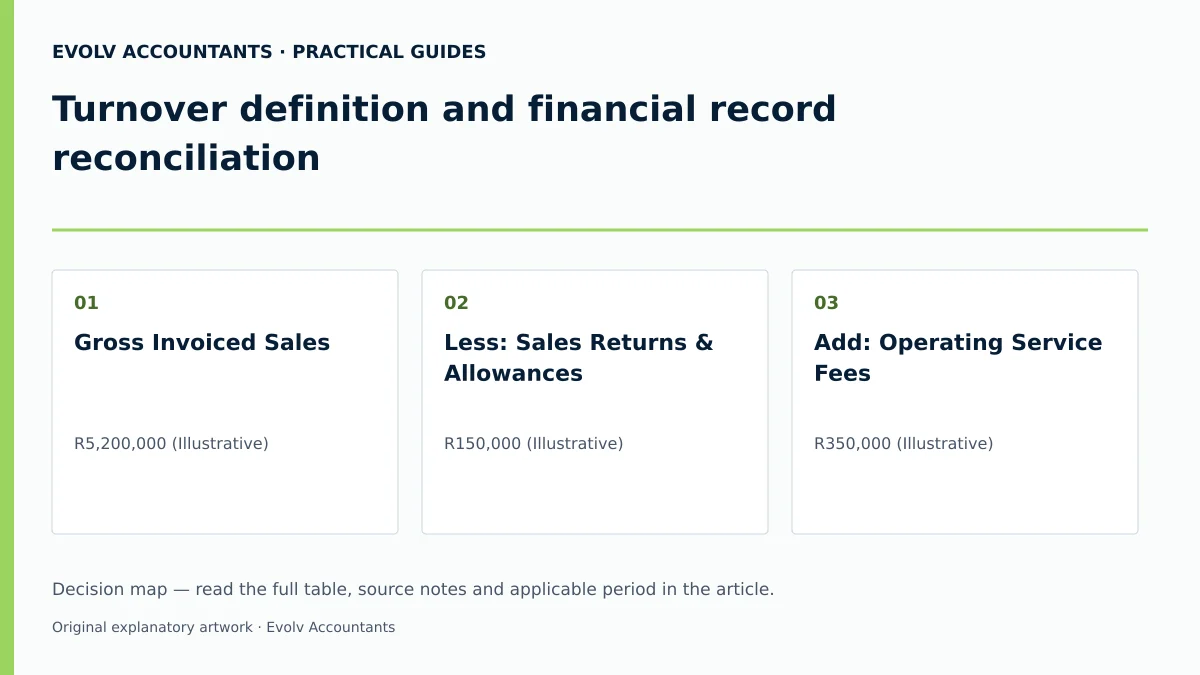
In this worked example, the entity's gross turnover of R5,400,000 places it in the R1 million to R10 million bracket 5. Submitting the return within 30 business days requires a statutory payment of R450 5. If submitted past 30 business days, the fee increases to R600 5.
Reconcile the answer to the underlying records: turnover definition
Reconciling the final turnover figure requires verifying ledger balances against primary source records, including trial balance totals, gross sales registers, credit notes, and year-end closing entries 7 12. The turnover declared to CIPC must match the revenue stated in the latest approved annual financial statements presented to shareholders or directors 7 24.
If a company accidentally submits an incorrect turnover figure during electronic filing, the system does not allow direct online edits once submitted 20. CIPC provides a specific administrative procedure to adjust the filing record 20 21:
- A credit note is issued to the filing customer code if the reported turnover was higher than actual turnover, or a debit note is issued if reported turnover was lower than actual turnover 20.
- The customer code owner must log an official enquiry via the online CIPC portal 21 25.
- The enquiry must be accompanied by five mandatory supporting documents 21:
- The approved annual financial statements for the return year in question 21.
- The full entity name, registration number, and return year concerned 21.
- A detailed written explanation stating the reason for the turnover error 21.
- A certified copy of the identity document of the customer code owner 21.
- A signed permission letter authorising CIPC to debit or credit the customer code account 21.
Section 215(2)(e) of the Companies Act states that knowingly providing false or misleading information to CIPC constitutes a statutory offence 23. Under Section 216(b), any person convicted of such an offence is liable to a fine, imprisonment for up to 12 months, or both 23.
Edge cases that change the calculation: financial record reconciliation
Specific organizational circumstances modify how turnover is determined and reconciled for CIPC filings:
Variable Accounting Periods
Under Section 27(2)(b) of the Companies Act, a company's first financial year begins on its registration date and ends on the financial year-end date set out in its Notice of Incorporation, which may not exceed 15 months 26. Under Section 27(4), a board may alter its financial year-end date, provided the change is filed before the year-end and does not result in a financial year exceeding 15 months 27.
Turnover for annual returns following a variable period must reflect the total approved turnover for that specific extended or shortened accounting period 7 12.
Dormant or Inactive Entities
Neither the Companies Act 2008 nor the Close Corporations Act 1984 exempts dormant or inactive entities from statutory filing obligations 11 28. Dormant entities with R0 turnover must still file an annual return within the prescribed timeframe, declaring R0 turnover and paying the baseline statutory fee of R100 5 11 28. Failure to file due to inactivity triggers automatic deregistration by CIPC when two or more successive returns are outstanding 9 11 29.
Entity Conversions
When a Close Corporation converts to a Private Company under Schedule 2 of the Companies Act 30 31, annual return requirements depend on conversion timing 32. If the conversion application (Form CoR 18.1) is received on or before the last day before the anniversary month begins, the Close Corporation return for that year is not required 32. For future filings, the conversion month becomes the entity's anniversary month 32.
If filed during or after the anniversary month, all outstanding returns including the current year must be brought up to date 32.
Next steps for CIPC annual returns
Before initiating an annual return submission, SME directors and finance officers should complete the following structured verification sequence:
Practical Submission Checklist
- Verify Anniversary Date: Confirm the company's incorporation date to calculate the 30 business day deadline 1 3.
- Approve Financial Statements: Ensure annual financial statements for the return period have been formally approved by the board 7 24.
- Reconcile Gross Turnover: Cross-check trial balance revenue accounts against the approved income statement figure 7 12.
- File Beneficial Ownership Declaration: Ensure the entity's latest Beneficial Ownership details are filed on the CIPC portal prior to launching the annual return 1 16.
- Calculate Public Interest Score (PIS): Compute the PIS under Regulation 26 to determine whether audited AFS, reviewed AFS, or a Financial Accountability Supplement (FAS) must be submitted via iXBRL or e-Services 13 33 34.
- Submit Return & Pay Tariff: Log into CIPC e-Services, select the verified turnover bracket, attach required financial documentation, and complete card payment via the shopping cart 5 6 19 35 36.
- Archive Compliance Records: Retain the CIPC filing certificate, payment receipt, and supporting reconciliation schedules for the mandatory 7-year retention period 17 36.
Ask Evolv about turnover definition and financial record reconciliation. Share the relevant records so the support required can be scoped.
Frequently Asked Questions
What financial document must be used to state turnover for a CIPC annual return?
A company or close corporation must use its latest approved financial statements to determine its turnover for CIPC annual return filings 7. Draft or unapproved financial records should not be used to declare statutory turnover 7.
Must a dormant SME file an annual return and pay CIPC fees?
Yes. The Companies Act 2008 and Close Corporations Act 1984 make no distinction between active and dormant entities 11 28. Dormant entities must file annual returns, declare R0 turnover, and pay the mandatory baseline statutory fee 5 11 28.
How can an SME rectify an incorrect turnover amount submitted to CIPC?
Turnover figures cannot be edited online once submitted 20. The customer code owner must log an enquiry via the CIPC online portal 21 25. CIPC will issue a credit note or debit note upon receiving the approved financial statements, written reason for the error, certified ID copy, and authorisation letter 20 21.
How does CIPC annual return turnover differ from SARS tax return revenue?
CIPC annual returns use gross turnover from approved financial statements to determine statutory regulatory fees and accountability categories under company law 2 3 7 14. SARS tax returns focus on calculating taxable income and allowable deductions under tax legislation 14.
Is a Beneficial Ownership declaration mandatory when submitting a CIPC annual return?
Yes. CIPC requires entities to ensure their latest Beneficial Ownership Declaration has been submitted before the annual return filing can be processed on e-Services 1 15 16.
Related guides
- Filing CIPC annual returns for a private company
- Documents to prepare before submitting annual returns
- Compliance and Regulations: Keeping Your Business on Track
Sources
- https://www.justice.gov.za/legislation/acts/2008-071-reg.pdf
- https://annualreturns.cipc.co.za/docs/FAQ_Annual_Returns.pdf
- https://www.cipc.co.za//wp-content/uploads/Legal/Regulations/CompaniesAct71_2008.pdf
- https://www.cipc.co.za/wp-content/uploads/Forms/Companies/CoR30_1.pdf
- https://www.cipc.co.za/wp-content/uploads/2024/10/STEP-BY-STEP-ANNUAL-RETURNS-003.pdf