
Documents to prepare before submitting annual returns
19 March 2026

Submitting CIPC annual returns requires verified beneficial ownership declarations, company records and statutory financial statements.
Audit and assurance qualification. Regulation 28’s R5 million fiduciary-assets trigger concerns assets held in the ordinary course of the company’s primary activities for people unrelated to the company. The public-interest-score triggers also depend on whether statements are compiled internally or independently, and other statutory or MOI requirements can apply. Assess the complete tests rather than treating a low score as an automatic audit exemption.
See Companies Regulations, regulations 26–29.
Filing an annual return with the Companies and Intellectual Property Commission (CIPC) is a mandatory statutory obligation for every registered company and close corporation in South Africa 1 2. The process verifies an enterprise's ongoing active status, updates legal entity registry records, and determines statutory oversight fees 3 4 5.
To complete this process without compliance delays or legal exposure, small and medium enterprises (SMEs) must construct a reviewer-ready evidence pack containing filing platform credentials, updated beneficial ownership filings, statutory corporate registers, and approved annual financial statements (AFS) or a financial accountability supplement (FAS) 6 7 8 9.
— Practical point from this guide
Distinguishing between statutory legal requirements, CIPC administrative portal guidance, and Evolv recommendations ensures structured execution and protects against administrative deregistration 10 11 12.
Filing access ownership and supporting financial records
Determining filing access ownership requires identifying the specific statutory purpose of the submission, the verification protocols of the portal, and the authorised individuals responsible for execution 13 14 15. Under Section 33 of the Companies Act 71 of 2008, every company must designate a director, employee, or authorised person responsible for ensuring compliance with statutory reporting and financial transparency provisions 2 16 17.
The statutory legal requirement mandates annual return submissions to confirm enterprise activity and present accurate financial metrics 2 3 17. Regulator portal guidance from CIPC specifies that filings must occur strictly through designated digital platforms, such as e-Services, BizPortal, or Self-Service Centres, using an authenticated customer profile code and registered user credentials 13 18 19.
Evolv recommends establishing formal internal governance protocols to manage these filing credentials, ensuring that access remains secured within the company's executive or accounting leadership rather than relying on unmonitored external intermediaries 15 20.
A critical evidence boundary exists between corporate compliance under the Companies Act and tax administration under the South African Revenue Service (SARS) 11. CIPC beneficial ownership declarations focus on natural persons holding direct or indirect ownership, control, or voting rights in a corporate entity 6 14. This is legally distinct from partnership IT3(BO) tax disclosures submitted to SARS 11.
Compliance with CIPC annual return filings does not fulfill SARS tax obligations, as they represent separate administrative processes governed by distinct legislation 11.
Documents grouped by purpose: filing access ownership
To ensure seamless electronic submission, supporting documents and corporate records must be systematically grouped into mandatory records, conditional records, and recommended supporting schedules 6 7 9.
Mandatory Records
- Beneficial Ownership Declaration: A verified CIPC Beneficial Ownership Declaration must be filed prior to or concurrently with the annual return submission 6 7 14.
- CIPC Filing Access Credentials & Authorisation: A registered CIPC customer profile code, user login credentials, and documented filing authorisation from the board of directors 14 15 19.
- Registry Verification Details (Form CoR 30.1 Data): Confirmation of the registered office location, location of company records, director details, company secretary, auditor appointments, and financial year-end 4 17.
- Statutory Accounting Records: Primary books of account, general ledgers, and transaction records required to be kept for seven years 20 21 22.
Conditional Records
- Audited Annual Financial Statements (AFS): Mandatory if required by the Companies Act or Regulations (such as public companies, companies holding fiduciary assets exceeding R5 million, or entities meeting statutory Public Interest Score thresholds) 9 23 24 25. Audited statements must be submitted digitally via the iXBRL module 9 26.
- Independently Reviewed AFS: Mandatory for non-exempt private companies that do not meet audit thresholds but are required to undergo an independent review under ISRE 2400 9 24 25.
- Financial Accountability Supplement (FAS / Form CoR 30.2): Mandatory for companies that are exempt from audit or independent review and choose not to file audited or reviewed statements voluntarily 6 9 27 28.
- Compliance Checklist: Required conditional application submitted alongside the annual return where mandated by CIPC portal workflows 7.
Recommended Supporting Schedules
- Public Interest Score (PIS) Working Papers: Detailed calculations documenting the average employee count, third-party liabilities, annual turnover, and total number of security holders or beneficial interest holders 17.
- Board Approval Minutes: Signed resolutions approving the annual financial statements, designating the compliance officer, and authorising the return filing 16 29.
Check identity period and consistency: supporting financial records
Before uploading documentation to the CIPC portal, finance teams must perform systematic consistency checks across entity names, registration numbers, dates, turnover figures, and signing authorities 4 17.
Identity and Information Consistency
All submission records must reflect the exact corporate identity registered with CIPC 4. Discrepancies between the Memorandum of Incorporation (MOI), financial statements, and CIPC registry entries regarding the registered office, director appointments, or financial year-end will delay processing 4. Under POPIA privacy provisions, public return certificates mask personal identifiers, displaying only the first 6 digits of director identity numbers 18.
Applicable Filing Windows and Periods
- Companies: Annual returns must be filed electronically within 30 business days following the anniversary date of the company's incorporation 5 6.
- Close Corporations: Returns are due from the first day of the anniversary month up until the end of the following month 6 7.
- Financial Statements: Annual financial statements must be prepared within six months following the conclusion of the company's financial year 30.
Reconciling Financial Metric Differences
Turnover calculations for statutory filing fee determinations must be derived directly from the latest approved annual financial statements 27 31. If an incorrect turnover figure is entered during filing, CIPC portal workflows do not permit direct digital editing 32. Correcting a recorded turnover figure requires logging a formal online enquiry with CIPC 33.
The application must include the approved AFS for the year in question, a written statement explaining the reason for the error, a certified identity document copy of the customer code owner, and a letter authorising CIPC to debit or credit the customer profile account 32 33.
Build a reviewer ready evidence pack: filing access ownership
A structured evidence pack allows company directors, accountants, and independent reviewers to verify filing accuracy prior to submission 15 29. Evolv recommends organizing the pack into a secure digital folder structure using standardized file formats and naming conventions 19.
Evidence Pack Indexing and Format
All uploaded documents must be clear, legible PDF files submitted individually per required item 19. Files should follow a consistent naming structure:
- [Registration_Number]_AFS_[Financial_Year].pdf
- [Registration_Number]_BO_Declaration_[Year].pdf
- [Registration_Number]_PIS_Working_Paper_[Year].pdf
Cross-Referencing Statutory Registers
The evidence pack must cross-reference underlying statutory registers, including the register of directors and the securities register 8 34 35. These registers confirm that shareholding structures, beneficial interest disclosures, and director details match the metrics entered into the Public Interest Score calculation on Form CoR 30.1 17 34 35.
Secure Access Control
Filing credentials, certified identity copies, and board resolutions must be stored in access-controlled environments to maintain confidentiality and record integrity 20 36. Best-practice evidence pack structures defined by Evolv provide practical compliance management for SMEs without asserting official CIPC endorsement.
Purpose mapped evidence checklist
The table below outlines the core evidence requirements, mapping each document to its legal purpose, statutory category, responsible owner, and verification method.
| Record | Why it is needed | Required or conditional | Owner | Verification and reference |
|---|---|---|---|---|
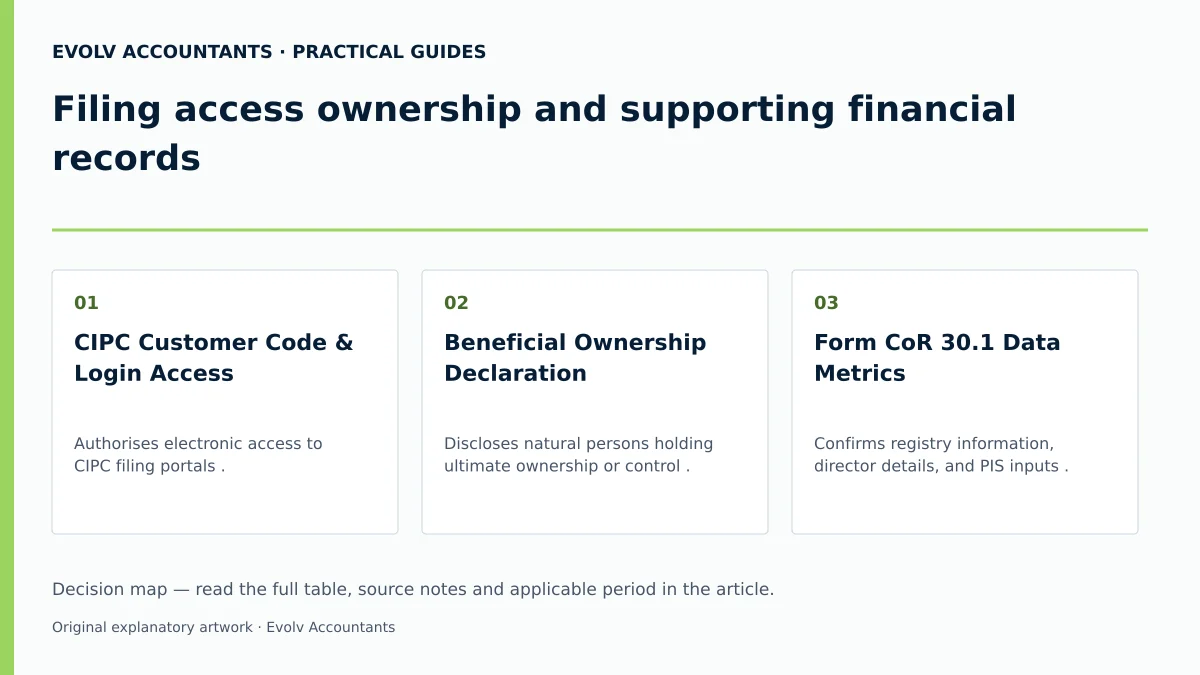
| CIPC Customer Code & Login Access | Authorises electronic access to CIPC filing portals 13 15 19. | Mandatory | Designated Compliance Person / Director 15 16 | Cross-check CIPC customer profile validation and user permission records 14 19. |
| Beneficial Ownership Declaration | Discloses natural persons holding ultimate ownership or control 6 14. | Mandatory | Company Secretary / Directors 14 16 | Verify against latest CIPC beneficial ownership submission acknowledgement 6 14. |
| Form CoR 30.1 Data Metrics | Confirms registry information, director details, and PIS inputs 4 17. | Mandatory | Director / Accountant 16 29 | Compare against CIPC registry lookup, MOI, and current board resolutions 4 8. |
| Approved Annual Financial Statements | Serves as the statutory financial reporting record 9 30 37. | Conditional (Mandatory if audited or reviewed) 9 23 24 | Board of Directors / Independent Auditor / Reviewer 29 | Check for board approval, director signatures, and preparer notices 29 38. |
| Financial Accountability Supplement (FAS) | Provides financial disclosure when AFS is not audited or reviewed 6 27 28. | Conditional (Mandatory if AFS is exempt from audit/review) 27 28 | Director / Accountant 16 | Verify completion of Form CoR 30.2 against accounting records 22 27 39. |
| Public Interest Score Calculation Sheet | Determines financial reporting framework and audit/review status 17 24. | Recommended | Finance Officer / Accountant 29 | Reconcile workforce, third-party debt, turnover, and shareholder counts 17. |
| Statutory Accounting Records | Maintains underlying evidence supporting financial statements 20 22. | Mandatory | Chief Financial Officer / Bookkeeper 22 | Confirm seven-year retention at registered office or filed alternate location 20 36. |
Missing or contradictory records: supporting financial records
When assembling an annual return evidence pack, SMEs may encounter missing accounting records, outdated director details, or conflicting turnover figures 32 40.
Authentic Reconstruction Protocols
If primary accounting records are missing or incomplete, the company must execute an authentic reconstruction using verifiable primary sources 22 37. Reconstructions should draw from bank statements, tax returns, supplier invoices, and executed contracts 22. Reconstructed records must be prepared in an official South African language and conform to financial reporting standards 22 37.
Escalation and Rectification
Where contradictory records or historical falsifications are identified, the matter must be escalated immediately to the board of directors 40. Under the Companies Act, knowingly keeping inaccurate accounting records, falsifying books, or submitting false regulatory statements constitutes a statutory offence 40 41 42.
Prohibition Against Invented Replacement Evidence
Companies must never invent replacement documents or adjust turnover entries arbitrarily on portal submission screens 32 40. If an error occurred in a previously filed return, the enterprise must follow formal CIPC enquiry procedures to debit or credit customer accounts based on certified AFS proof 32 33.
Next steps for CIPC annual returns
Executing CIPC annual returns requires following a structured sequential process to move from record preparation to final filing acceptance 6 19 43.
Sequential Action Checklist
- Confirm Filing Window: Check the company incorporation anniversary to establish the 30 business day submission deadline 5 6.
- File Beneficial Ownership Declaration: Ensure the latest beneficial ownership register is submitted on the CIPC portal before starting the annual return 6 14.
- Calculate Public Interest Score: Total the PIS metrics (employee average, liabilities, turnover, security holders) to confirm financial statement reporting requirements 17 24.
- Prepare Financial Documentation: Finalise board-approved AFS (in iXBRL format if audited) or complete the Financial Accountability Supplement 9 26 27 29.
- Verify Registry Information: Reconcile company address, director details, and financial year-end against Form CoR 30.1 fields 4 17.
- Capture Return Details & Validate: Log into e-Services or BizPortal, capture turnover figures, and validate compliance requirements 19 44.
- Process Payment via Shopping Cart: Add the return transaction to the digital shopping cart and complete payment via card 19 43.
- Archive Compliance Certificate: Download and store the official CIPC Annual Return Compliance Certificate in the evidence pack 18 45.
Reproducible Hypothetical Example
Consider a South African private company operating in manufacturing:
- Workforce & Operations: Employs an average of 15 staff members during the financial year (PIS = 15 points) 17.
- Liabilities: Holds third-party liabilities of R3 million at financial year-end (PIS = 3 points) 17.
- Turnover: Achieves annual turnover of R8 million (PIS = 8 points) 17.
- Shareholders: Has 4 natural person shareholders who also serve as the company's sole directors (PIS = 4 points) 17 46.
- PIS Calculation & Framework Determination: The total Public Interest Score is 30 points (15 + 3 + 8 + 4) 17. Because the score is below 100 and all shareholders are directors, the company qualifies for statutory exemption from audit and independent review under Section 30(2A) 24 46.
- Evidence Pack Assembly: The finance team compiles the customer code credentials, updated beneficial ownership filing acknowledgement, internally compiled AFS, Form CoR 30.2 (FAS), and board approval minutes 6 9 14 27 38.
- Filing Execution: Within 30 business days of its incorporation anniversary, the company logs into CIPC e-Services, submits its FAS data, captures its R8 million turnover, processes shopping cart card payment, and receives its Annual Return Compliance Certificate 6 43 44 45.
Distinguishing Upload from Acceptance
Uploading financial statements or entering turnover values on the CIPC portal creates an un-submitted shopping cart item 43. Filing is legally complete only when payment is successfully processed and CIPC issues the final Annual Return Compliance Certificate 18 43 45.
Statutory Retention and Consequences of Default
All annual return filings, compliance certificates, and underlying accounting records must be retained at the company's registered office for seven years 20 21 36. Failing to file annual returns for two or more consecutive years triggers automated deregistration by CIPC 47 48. Deregistration removes the entity's juristic personality, dissolves the company, causes bank accounts to be frozen, and exposes active directors to personal liability for company obligations incurred during default 10 49 50.
Frequently Asked Questions
Does submitting annual tax returns to SARS fulfill CIPC annual return requirements?
No. Compliance with SARS tax reporting does not constitute compliance with CIPC annual returns 11. CIPC annual returns update company register records under the Companies Act, whereas SARS returns assess taxable income under tax legislation 11. They are administered by different government bodies under separate statutory frameworks 11.
What happens if a company fails to submit its annual returns on time?
Failing to submit annual returns within 30 business days of the incorporation anniversary date results in statutory penalty surcharges 5 6. Continued non-compliance across two or more successive years triggers automated deregistration proceedings by CIPC, withdrawing the company's legal personality and exposing directors to personal liability 10 47 48 49.
How does an SME determine whether it must file audited financial statements, reviewed statements, or an FAS?
Financial reporting requirements depend on company category, Memorandum of Incorporation provisions, holding fiduciary assets above R5 million, and the Public Interest Score (PIS) 23 24 25. Companies requiring audits (or meeting PIS thresholds of 350+ or 100+ if internally compiled) must file audited AFS via iXBRL 9 24 26. Non-exempt companies below these thresholds file independently reviewed AFS 24 25. Exempt private companies file a Financial Accountability Supplement (FAS) via Form CoR 30.2 9 27 46.
Can incorrect turnover figures submitted during an annual return filing be edited online?
No. Once an annual return is submitted, turnover values cannot be altered directly on the portal 32. Correcting an incorrect turnover entry requires submitting an online enquiry to CIPC supported by approved AFS, a certified ID copy of the customer code owner, a written explanation, and formal account debit/credit authorisation 32 33.
Is a dormant or inactive company exempt from filing annual returns and paying fees?
No. The Companies Act does not distinguish between active and dormant companies regarding annual return compliance 47. Inactive and dormant entities are legally required to file annual returns and pay prescribed statutory fees for every year they remain on the CIPC register 47 51. Ask Evolv about filing access ownership and supporting financial records. Share the relevant records so the support required can be scoped. Contact Evolv Accountants
Related guides
- Filing CIPC annual returns for a private company
- Annual returns versus annual financial statements
- Compliance and Regulations: Keeping Your Business on Track
Sources
- https://www.justice.gov.za/legislation/acts/2008-071-reg.pdf
- https://annualreturns.cipc.co.za/docs/FAQ_Annual_Returns.pdf
- https://www.cipc.co.za//wp-content/uploads/Legal/Regulations/CompaniesAct71_2008.pdf
- https://www.cipc.co.za/wp-content/uploads/Forms/Companies/CoR30_1.pdf
- https://www.cipc.co.za/wp-content/uploads/2024/10/STEP-BY-STEP-ANNUAL-RETURNS-003.pdf