
Annual returns versus annual financial statements
16 November 2025

Filing a CIPC annual return is a statutory registry declaration, whereas preparing annual financial statements requires verifying complete accounting records.
Audit and assurance qualification. Regulation 28’s R5 million fiduciary-assets trigger concerns assets held in the ordinary course of the company’s primary activities for people unrelated to the company. The public-interest-score triggers also depend on whether statements are compiled internally or independently, and other statutory or MOI requirements can apply. Assess the complete tests rather than treating a low score as an automatic audit exemption.
See Companies Regulations, regulations 26–29.
South African private companies and close corporations must distinguish between CIPC registry disclosure and annual financial statement (AFS) preparation. While an annual return confirms a business's active legal standing and updates general company information on the CIPC register within 30 business days of its incorporation anniversary, financial statement preparation establishes full accounting compliance under the Companies Act within six months of the financial year-end 1 2 3 4 5.
Compliance with one obligation does not satisfy the other, and failure to fulfill registry duties risks administrative deregistration, loss of juristic personality, and director liability 2 6 7.
Registry disclosure versus financial statement preparation
Defining CIPC Annual Returns
A CIPC annual return is a statutory compliance summary submitted electronically to the Companies and Intellectual Property Commission (CIPC) to verify that an enterprise remains active and doing business 8 9 10 11. It requires confirming core corporate details—such as the registered office, location of accounting records, director identities, and financial year-end—or indicating changes via specific statutory forms 11 12.
— Practical point from this guide
Filing an annual return mandates submitting the latest Beneficial Ownership Declaration and providing financial accountability data via audited Annual Financial Statements (AFS), independently reviewed AFS, or a Financial Accountability Supplement (FAS) 1 9 13 14 15.
Defining Annual Financial Statements
Annual financial statements represent the comprehensive financial reporting framework mandated by Section 30 of the Companies Act 71 of 2008 4 16. Every company must cause accurate and complete accounting records to be kept for seven completed financial years 3 17 and prepare AFS within six months following its financial year-end 4.
The AFS must present fairly the financial position, assets, liabilities, equity, income, and expenses of the business, bearing a prominent notice on the first page disclosing the compiler's professional designation and whether the statements are audited, independently reviewed, or unaudited 18 19.
Core Legal Distinctions
Legally and conceptually, registry disclosure and financial statement preparation serve distinct regulatory purposes 2. Registry disclosure maintains corporate transparency, legal personality, and updated public information on the companies register 6 7 11. In contrast, financial statement preparation provides internal governance, shareholder accountability, and statutory verification of financial solvency and liquidity 18 20 21 22.
Distinguishing statutory law from regulator administrative guidance is essential: the Companies Act establishes the overarching duty to file returns and prepare statements 4 5 16, whereas CIPC step-by-step guides outline digital filing procedures and technical submission channels 9 10 23.
Compare the criteria that matter: registry disclosure
Statutory Constraints and Public Disclosure
Registry disclosure focuses on administrative information and control structures. When filing an annual return, companies disclose their Public Interest Score (PIS) components—including turnover, liabilities, employee headcount, and security holders 24—as well as beneficial ownership declarations 1 9. Under Protection of Personal Information Act (POPIA) considerations, personal identity numbers are masked on public certificates 25.
Liability and Deregistration Risks
Failing to submit an annual return within the prescribed 30 business days from the anniversary date places the entity into non-compliance 1 5. Continued default across two or more successive years triggers automatic AR deregistration by CIPC 7 26. Deregistration withdraws juristic personality, causes the entity to cease to exist, and leaves active directors personally liable for debts incurred during business operations 6 7.
Service providers, commercial banks, and state databases automatically refuse services to deregistered entities 7.
Operational and Financial Reporting Integration
While filing an annual return requires declaring turnover derived from the latest approved financial statements 14, an annual return does not alter corporate details directly; structural amendments require separate CoR filings 11 12. Incorrect turnover reporting requires a formal online application supported by approved financial statements, certified identity documents, and a letter authorising debit or credit adjustments to the customer account 27 28.
How the obligations differ: financial statement preparation
Statutory Assurance Thresholds
The level of assurance required for annual financial statements depends on legal category, fiduciary duties, and the Public Interest Score (PIS) calculated under Companies Regulation 26(2) 24 29 30.
- Mandatory Audit: Required for public and state-owned companies 4 31. Private companies require an audit if they hold assets in a fiduciary capacity exceeding R5 million [illustrative statutory threshold] for non-related persons, or if their PIS is 350 or more [illustrative statutory threshold] (or 100 or more if the statements are internally compiled) 30 31.
- Independent Review: Required for private companies with a PIS below 350 [illustrative statutory threshold] (or below 100 if internally compiled), unless exempted under Section 30(2A) 30 32 33.
- Exemptions: A private company is exempt from independent review under Section 30(2A) if every shareholder or beneficial interest holder is also a director of the company 32 33.
Accounting Records and Compilation Standards
Section 28 mandates that every company maintain accurate accounting records in an official language at its registered office for seven completed financial years 3 17 34. Financial statements must comply with prescribed financial reporting standards consistent with International Financial Reporting Standards (IFRS) 35.
Two business situations with different outcomes: registry disclosure
Decision Comparison Matrix
| Criterion | Option A: CIPC Annual Return | Option B: Annual Financial Statements | Evidence or assumption | Implication for this reader |
|---|---|---|---|---|
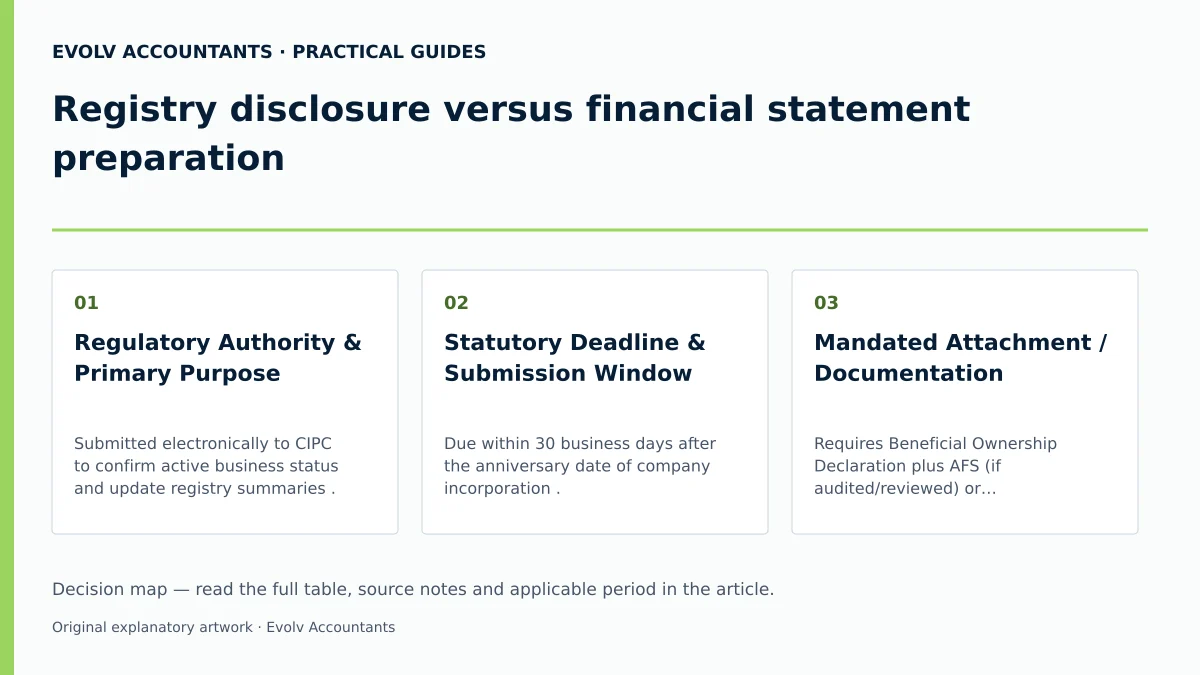
| Regulatory Authority & Primary Purpose | Submitted electronically to CIPC to confirm active business status and update registry summaries 2 8 9. | Prepared under Companies Act Section 30 to reflect financial position and explain transactions 4 18 36. | Statutory mandate under Act 71 of 2008 and CIPC administrative rules 2 16. | Compliance with one process does not satisfy the other; both must be completed independently 2. |
| Statutory Deadline & Submission Window | Due within 30 business days after the anniversary date of company incorporation 1 5 37. | Must be prepared within 6 months after the company's financial year-end 4. | Act Sections 30(1) and 33(1) 4 5. | CIPC filing deadlines depend on incorporation date, whereas AFS deadlines depend on financial year-end 4 5 38. |
| Mandated Attachment / Documentation | Requires Beneficial Ownership Declaration plus AFS (if audited/reviewed) or Financial Accountability Supplement (FAS) 1 9 14 15. | Full financial report including balance sheet, income statement, director's report, and compiler notice 18 22 39. | Form CoR 30.1 and Regulations 28–30 15 40 41. | Unaudited/unreviewed private entities must file form CoR 30.2 (FAS) with their annual return 14 15 41. |
| Non-Compliance Consequence | CIPC initiates AR deregistration; legal personality withdrawn; director liability for debts 6 7 26. | Statutory non-compliance under Act; compliance notices issued; potential director liability 42 43 44 45. | Act Sections 82(3) and 214; FAQ guidance 7 26 46 47. | Deregistration halts banking and commercial activities immediately 7. |
Reproducible Hypothetical Scenarios
Scenario 1: Owner-Managed Private Enterprise (Shareholders are Directors)
- Hypothetical Facts: Alpha Logistics (Pty) Ltd is a private company registered on 15 March. It has two directors who hold 100% of the shares. Annual turnover is R8 million [illustrative value], liabilities are R2 million [illustrative value], employee count is 5 [illustrative value], and fiduciary assets are zero [illustrative facts].
- Application of Criteria:
- PIS Calculation: 8 (turnover) + 2 (liabilities) + 5 (employees) + 2 (shareholders) = Public Interest Score of 17 Companies Regulations, regulation 26.
- AFS Level of Assurance: PIS is below 100. Because all shareholders are directors, Alpha Logistics qualifies for the Section 30(2A) exemption from independent review 32 33.
- Registry Disclosure: Alpha Logistics prepares internally compiled AFS within six months of its year-end 4. When filing its CIPC annual return within 30 business days of 15 March, it submits its latest Beneficial Ownership Declaration and attaches a Financial Accountability Supplement (Form CoR 30.2) 1 9 14 41.
Scenario 2: Growing Private Enterprise with Non-Director Shareholders
- Hypothetical Facts: Beta Trading (Pty) Ltd is a private company registered on 20 August. It has 12 non-director equity holders, 15 employees, turnover of R18 million [illustrative value], liabilities of R6 million [illustrative value], and holds no fiduciary assets [illustrative facts].
- Application of Criteria:
- PIS Calculation: 18 + 6 + 15 + 12 = Public Interest Score of 51 Companies Regulations, regulation 26.
- AFS Level of Assurance: PIS is under 100, but because there are non-director shareholders, the Section 30(2A) exemption does not apply 32 33. An independent review in accordance with ISRE 2400 is legally required 30.
- Registry Disclosure: Beta Trading must complete its independently reviewed AFS 30. When submitting its annual return within 30 business days of 20 August, it files its Beneficial Ownership Declaration and attaches its independently reviewed AFS 1 40 41.
- Outcome: Failure to attach reviewed financial statements or FAS invalidates the return, triggering late penalties and deregistration risk 1 26 48.
When the comparison needs specialist input: financial statement preparation
Excluded Complexities and High-Risk Scenarios
Specialist professional accounting and legal guidance is necessary when corporate structures exceed basic SME thresholds:
- Fiduciary Asset Holdings: Holding assets in a fiduciary capacity exceeding R5 million [illustrative statutory threshold] at any time during the financial year automatically triggers a mandatory audit regardless of PIS or shareholding structure 31.
- Public Interest Score Thresholds: PIS scores of 100 or more (internally compiled) or 350 or more (externally compiled) require mandatory audits 30.
- Complex Corporate Restructuring: Amalgamations, mergers, disposal of major assets, or business rescue proceedings under Chapters 5 and 6 of the Act require formal specialist involvement, independent valuation reports, and regulatory clearance notices 49 50 51 52.
- Tax versus Statutory Disconnect: Tax returns filed with the South African Revenue Service (SARS) report taxable income under tax legislation, which is legally separate from CIPC statutory reporting 2. SARS compliance does not satisfy CIPC duties 2.
Next steps for CIPC annual returns
Practical Compliance Checklist
- Determine Key Statutory Dates: Identify the company's registration anniversary date for CIPC annual returns (30-business-day window) and financial year-end date for AFS preparation (6-month window) 1 4 5 38.
- Calculate Public Interest Score: Tally turnover points, liability points, employee count, and security holder numbers to establish assurance category 24.
- Update Beneficial Ownership Register: Verify and file the latest Beneficial Ownership Declaration prior to launching the CIPC annual return submission 1 9 53.
- Prepare Financial Documentation: Complete audited AFS, independently reviewed AFS, or Financial Accountability Supplement (Form CoR 30.2) based on statutory PIS and shareholding criteria 13 14 15 41.
- File Electronically via Official Portals: Access CIPC e-Services, BizPortal, or Self Service Centre, capture required disclosure data, upload attachments, and complete card payment 9 10 23.
- Maintain Complete Records: Store all submitted returns, certificates, and underlying accounting records at the registered office for the mandatory seven-year retention period 3 34.
Frequently Asked Questions
Does filing corporate income tax returns with SARS satisfy CIPC annual return obligations?
No. A clear statutory distinction exists between CIPC annual returns and SARS tax returns 2. A CIPC annual return is a summary of company registry details and governance compliance filed under the Companies Act, whereas a SARS tax return calculates taxable income under tax legislation 2. Compliance with one authority does not constitute compliance with the other 2.
What happens if a dormant or inactive company fails to file its annual return?
Dormant or inactive companies are legally mandated to file annual returns and pay prescribed statutory fees 26 48. The Companies Act makes no distinction between active and dormant entities 26. Failure to file for two or more consecutive years triggers CIPC deregistration, removing juristic personality and leaving directors personally liable for outstanding obligations 6 7 26.
Can a company correct an incorrect turnover figure declared on a previously submitted return?
Information provided on a finalised annual return cannot be edited directly on the portal 27. To correct an incorrect turnover figure, the customer code owner must log an online enquiry submitting the approved annual financial statements, entity details, certified ID copy, reason for error, and a written letter authorising CIPC to debit or credit the difference 27 28.
How is the 30-business-day annual return filing window calculated?
Companies have 30 business days calculated from the anniversary date of incorporation to submit their annual return without incurring late penalties 1 5 37. Business days exclude Saturdays, Sundays, and public holidays 54.
When is a private company exempt from having its annual financial statements independently reviewed?
A private company is exempt from independent review under Section 30(2A) of the Companies Act if every holder of, or person with a beneficial interest in, its securities is also a director of the company, provided it is not otherwise required to be audited due to fiduciary assets or PIS thresholds 30 32 33.
Related guides
- Filing CIPC annual returns for a private company
- Finding the annual return anniversary and submission window
- Compliance and Regulations: Keeping Your Business on Track
Sources
- https://www.justice.gov.za/legislation/acts/2008-071-reg.pdf
- https://annualreturns.cipc.co.za/docs/FAQ_Annual_Returns.pdf
- https://www.cipc.co.za//wp-content/uploads/Legal/Regulations/CompaniesAct71_2008.pdf
- https://www.cipc.co.za/wp-content/uploads/Forms/Companies/CoR30_1.pdf
- https://www.cipc.co.za/wp-content/uploads/2024/10/STEP-BY-STEP-ANNUAL-RETURNS-003.pdf