
Finding the annual return anniversary and submission window
17 December 2024

Determining a company's annual return anniversary window requires tracking its original registration date rather than its financial tax year.
Audit and assurance qualification. Regulation 28’s R5 million fiduciary-assets trigger concerns assets held in the ordinary course of the company’s primary activities for people unrelated to the company. The public-interest-score triggers also depend on whether statements are compiled internally or independently, and other statutory or MOI requirements can apply. Assess the complete tests rather than treating a low score as an automatic audit exemption.
See Companies Regulations, regulations 26–29.
In South Africa, every registered private company and close corporation is legally mandated to file an annual return with the Companies and Intellectual Property Commission (CIPC) 1. Unlike corporate income tax submissions made to the South African Revenue Service (SARS), which align with the company's financial year-end or calendar tax deadlines, CIPC annual returns are strictly governed by the anniversary of the company's date of incorporation 2 3 4.
For private companies, the statutory submission window opens on the exact anniversary of incorporation and remains open for 30 business days before the filing is deemed late and subject to penalty fees 2 5. Close corporations operate on a distinct statutory calendar, where filing opens on the first day of their anniversary month and extends through the end of the following month 2 6.
Submitting this statutory return is a fundamental compliance obligation to confirm that an enterprise remains active, irrespective of whether it traded or generated income during the financial period 7 8.
Anniversary window versus a calendar tax deadline
Statutory foundation and jurisdictional distinction
Understanding corporate compliance in South Africa requires drawing a firm distinction between CIPC statutory returns and SARS tax filings. Under statutory law, company annual returns are governed by Section 33 of the Companies Act 71 of 2008 and Regulation 30 of the Companies Regulations 4 9, whereas close corporation returns are governed by Section 15A of the Close Corporations Act 69 of 1984 9. CIPC operates as the regulatory authority under the Department of Trade, Industry and Competition 10 11.
Conversely, tax returns are administered by SARS under separate national tax legislation to assess fiscal liabilities on taxable income 3.
As regulator guidance issued by CIPC explicitly emphasizes: "A clear distinction must be made between an Annual Return and a tax return." 3. Compliance with SARS tax obligations does not constitute compliance with CIPC requirements, nor does filing with CIPC fulfill tax obligations 3. They represent two distinct statutory processes managed by separate state departments 3.
Company directors must recognise that CIPC beneficial ownership declarations (which must be submitted prior to or alongside CIPC annual returns 6 12) are corporate transparency filings that are legally distinct from SARS partnership IT3(BO) income disclosures.
Defining the anniversary filing window
The deadline for a CIPC annual return is determined solely by the entity's incorporation date, not its financial year-end or tax submission calendar 2 3 4:
- Private Companies: The statutory return becomes due on the anniversary date of incorporation 2 4. The company has a prescribed window of 30 business days from that date to submit its return and pay the prescribed fee 2 5.
- Close Corporations: Filing opens on the first day of the entity's anniversary month and remains open until the last day of the following month (providing a two-month calendar window) 2 6 13.
Statutory consequences of missing the window
Failing to submit the annual return within the prescribed anniversary window places the entity in non-compliant status and incurs mandatory penalty fees calculated according to statutory turnover tiers 2 13 14.
Under Section 82(3)(a) of the Companies Act, if a company fails to file its annual return for two or more successive years, CIPC automatically initiates deregistration proceedings 8 15. Regulator guidance warns that final deregistration causes the juristic personality of the business to cease, rendering it unable to trade or hold assets, while exposing active directors to personal liability for outstanding business debts 7 16.
Prepare the information and authority: anniversary window
Required statutory documents and inputs
Before launching the online filing process, company officers must compile the following primary evidence and statutory inputs:
— Practical point from this guide
- Registration Certificate: Form CoR 14.3 or historical registration certificate establishing the exact date of incorporation 17 18.
- Form CoR 30.1 Data Fields: Prescribed statutory fields including registered office details, locations of company records, and director details 19 20.
- Financial Statements or Supplement: Latest approved Annual Financial Statements (AFS) or Financial Accountability Supplement (FAS) 6 21 22.
- Beneficial Ownership Declaration: Evidence of the latest Beneficial Ownership Declaration successfully lodged on the CIPC register 6 12.
- CIPC Compliance Checklist: Completed statutory compliance checklist where applicable 6.
Authority and portal credentials
Filing must be performed by the entity or its duly authorised representative who possesses full access to the required financial and statutory records 23. The representative must hold a registered CIPC customer code and valid portal credentials 10 24.
Statutory calculations and financial reporting thresholds
Evolv recommendations advise performing all threshold and metric calculations prior to accessing the portal:
- Annual Turnover Calculation: Turnover must be calculated in accordance with Section 223 and Regulation 164 of the Companies Act using the entity's latest approved financial statements 22 25. This figure determines the statutory fee tier 5 25.
- Public Interest Score (PIS): Computed under Regulation 26(2) and Form CoR 30.1 by summing: (a) average number of employees, (b) total third-party liabilities in millions, (c) annual turnover in millions, and (d) maximum number of individuals with a beneficial interest in securities 20.
- Audit vs Review vs FAS Thresholds:
- Mandatory Audit: Required for public companies, state-owned companies 26 27, and private companies that hold fiduciary assets exceeding R5 million or attain a PIS of 350 or more (or a PIS of 100 or more if financial statements were internally compiled) 26 28.
- Independent Review: Required for other private companies under ISRE 2400 unless exempted under Section 30(2A) (where every shareholder is also a director) 28 29 30.
- Financial Accountability Supplement (FAS): Companies not statutory required to file audited or reviewed AFS, and choosing not to do so voluntarily, must file an FAS (Form CoR 30.2) 21 22 31.
Complete the task step by step: a calendar tax deadline
Sequenced online submission process
Annual returns must be submitted electronically via CIPC digital platforms (such as e-Services or BizPortal); manual paper filings are not accepted 6 24 32.
- Step 1: Confirm Incorporation Anniversary: Inspect the company registration certificate to identify the exact date of incorporation 17 18. Calculate the 30-business-day window relative to current public calendar dates 2 5.
- Step 2: Complete Beneficial Ownership Filing: Log into the CIPC Beneficial Ownership portal and ensure the company's beneficial ownership register is fully updated 6 12. The annual return module will restrict progress if the BO declaration is outstanding 12.
- Step 3: Extract Financial Metrics: Review the latest approved AFS to extract the exact annual turnover figure and compute the Public Interest Score 20 22.
- Step 4: Access CIPC Portal: Navigate to the CIPC e-Services portal, log in with an authorised customer code, select "Financials", and launch the Annual Returns module 24 33.
- Step 5: Designate Statutory Compliance Officer: Input the name and identity details of the director, employee, or designated person responsible for company compliance under Section 33(3) of the Act 20 34.
- Step 6: Input Turnover and Validate Category: Enter the exact turnover amount and validate filing compliance 33 35. The system automatically categorises the required financial attachment based on turnover tiers 35 36:
- Turnover under R10 million: Attach Director's Report / FAS or reviewed AFS as applicable 21 35.
- Turnover R10 million to R25 million: Attach Independent Review report or audited AFS 21 35 37.
- Turnover R25 million or more: Upload audited AFS via iXBRL format 21 37.
- Step 7: Calculate Statutory Fee and Cart Checkout: The system automatically calculates the statutory filing fee based on turnover and timeliness 13 38. Add the item to the online shopping cart and complete payment via credit or debit card 10 37.
Check the result against the evidence: anniversary window
Independent completion verification
Company leadership must not assume that submitting data or initiating a card payment equates to official statutory acceptance 32 39. Evolv recommendations require verifying independent completion evidence:
- CIPC Annual Return Certificate: Download the official confirmation certificate 32. Verify that director identity numbers are correctly masked in compliance with POPIA standards (displaying only the first six digits) 32.
- BizProfile Registry Status: Search the enterprise on BizProfile or CIPC registry search to confirm that the company status reflects "In Business" and that the annual return status reflects full compliance for the reporting year 33 40.
- Zero Cart Balance: Confirm that the transaction status in the customer shopping cart reflects paid and processed with no remaining unpaid items 37.
- Audit Trail Retention: Retain the filing certificate, payment receipt, and uploaded financial supplement in company compliance records for a minimum of seven years as required by Section 24(1) of the Act 41.
Handle exceptions and unresolved cases: a calendar tax deadline
Correcting incorrect turnover submissions
If an incorrect turnover figure was entered during filing, the online system does not permit direct editing or re-submission 42. To rectify the record, the customer code owner must log a formal query via the CIPC online enquiry system 43. The application must attach: (1) approved financial statements for the year in question, (2) written permission to credit/debit the customer code, (3) explanation of the error, and (4) certified ID copy of the customer code owner 43.
CIPC will issue a credit note (if reported turnover was higher than actual) or debit note (if reported turnover was lower) 42.
Inactive or dormant businesses
Neither the Companies Act nor the Close Corporations Act exempts dormant or non-trading enterprises from submitting annual returns and paying prescribed fees 8 39. Under statutory law, CIPC cannot grant fee waivers, exemptions, or payment installment arrangements 39. Dormant private companies must submit their annual returns within 30 business days of their anniversary based on the lowest turnover tier (R100 fee within 30 business days; R150 late fee) 13 39.
Deregistration, objections, and reinstatement
When an entity defaults on two or more consecutive returns, CIPC places it into "AR Deregistration" status 8 40.
- Objection before Final Deregistration: If the company is in deregistration process but not yet finally deregistered, filing all outstanding annual returns immediately cancels the deregistration process 44.
- Reinstatement after Final Deregistration: If the entity is finally deregistered, its legal personality is withdrawn 7 16. To restore the entity, an interested party must lodge a reinstatement application on Form CoR 40.5 (fee R200) 13 14 45 46. Upon CIPC changing the status to "in reinstatement process", the applicant must file all outstanding annual returns, beneficial ownership declarations, and financial statements to complete restoration 45.
Specialist compliance boundaries apply; complex multi-year default reconciliations should be referred to Evolv Accountants for formal review.
Next steps for CIPC annual returns
Reusable task and completion checklist
| Step | Input or evidence | Responsible person | Completion check | Exception or next action |
|---|---|---|---|---|
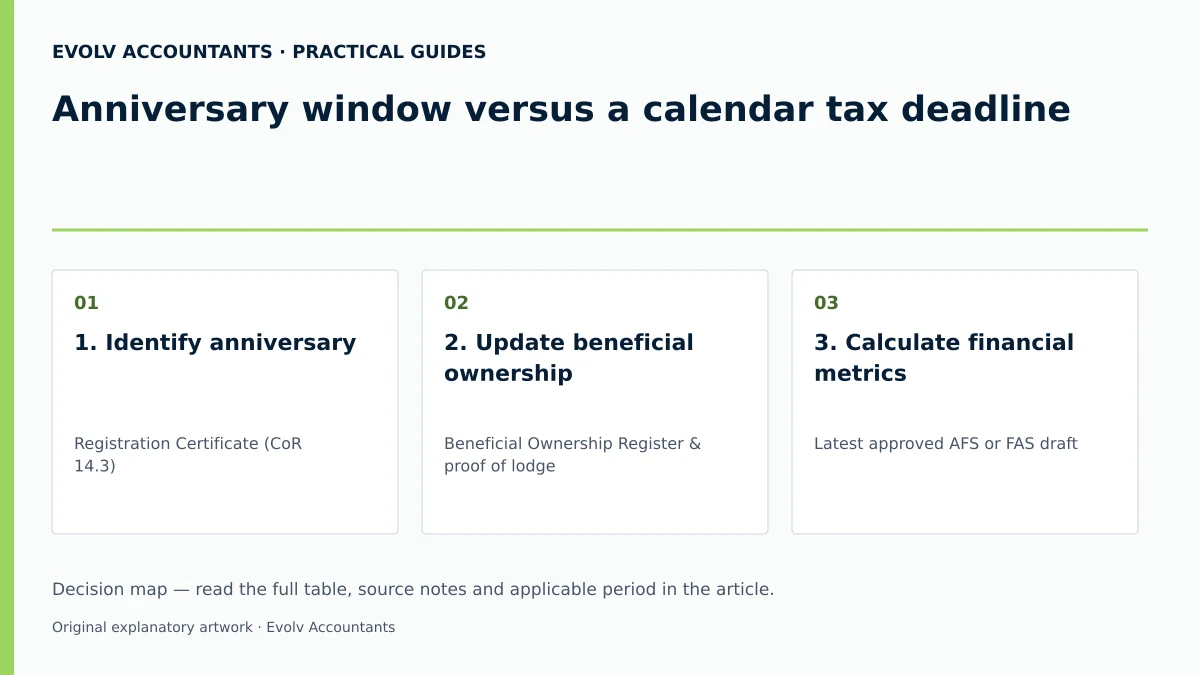
| 1. Identify anniversary | Registration Certificate (CoR 14.3) 17 18 | Company Secretary / Director | Exact incorporation anniversary and 30-business-day window logged 2 5 | Query CIPC registry if incorporation date is unconfirmed 17 |
| 2. Update beneficial ownership | Beneficial Ownership Register & proof of lodge 6 12 | Designated Compliance Officer | CIPC BO confirmation receipt obtained 6 12 | Access CIPC BO module and log missing disclosures first 12 |
| 3. Calculate financial metrics | Latest approved AFS or FAS draft 22 31 | Accountant / Director | Turnover extracted; Public Interest Score calculated 20 25 | Prepare FAS (Form CoR 30.2) if AFS audit/review not required 21 31 |
| 4. Execute portal submission | CIPC e-Services / BizPortal login 24 33 | Authorised Representative | Turnover captured; compliance officer designated; AFS/FAS uploaded 20 33 35 | Verify file format (PDF / iXBRL) if upload fails 10 21 |
| 5. Process fee payment | Credit / Debit card & shopping cart 10 37 | Finance Manager / Director | Payment processed; shopping cart reflects zero balance 37 | Re-attempt card authentication if transaction declines 10 |
| 6. Verify statutory status | CIPC Annual Return Certificate & BizProfile 32 40 | Compliance Officer | Certificate archived; status confirmed "In Business" 32 40 | Log CIPC online query if registry status fails to update 40 43 |
Reproducible hypothetical example
Illustrative Scenario (all values labelled as illustrative):
- Entity Details: Example Trading (Pty) Ltd, a private company incorporated on 15 March 2021 47.
- Anniversary Window: The annual return becomes due on 15 March annually 2 4. The statutory filing window spans 15 March through 30 business days thereafter (excluding weekends and public holidays) 2 5.
- Financial Inputs (Illustrative): The latest approved AFS reflect an annual turnover of R4,500,000 (R4.5 million) 22 25 and a Public Interest Score of 85 20.
- Statutory Fee Tier: Under the Companies Act 2008 fee schedule for private companies with turnover between R1 million and R10 million, the standard filing fee within 30 business days is R450 13. If filed after 30 business days, the fee increases to R600 13.
- Compliance Workflow: On 20 March, the compliance officer verifies that the Beneficial Ownership declaration is up to date 12, logs into CIPC e-Services 33, inputs the R4,500,000 turnover 35, attaches the FAS/AFS 35, pays R450 via debit card 13 37, and downloads the CIPC filing certificate 32.
Frequently Asked Questions
FAQ 1: Does submitting corporate income tax returns to SARS satisfy my CIPC annual return obligation?
No. CIPC annual returns and SARS tax returns are governed by separate legislation and regulatory bodies 3. Filing tax returns with SARS does not fulfill your statutory duty to file annual returns with CIPC 3.
FAQ 2: What happens if our company was dormant and generated zero turnover during the financial year?
Dormant or inactive businesses are legally required to file annual returns and pay the prescribed fee 8 39. For turnover under R1 million, the standard filing fee is R100 within 30 business days 13.
FAQ 3: How long is the company annual return submission window?
Private companies have 30 business days from the anniversary date of incorporation to submit their return before late filing penalty rates apply 2 5.
FAQ 4: Can CIPC grant an extension or payment arrangement for annual return fees?
No. The Companies Act does not empower CIPC to grant exemptions, fee waivers, or installment payment arrangements for annual returns 39.
FAQ 5: How can we restore a company that has been deregistered due to unpaid annual returns?
To restore a deregistered entity, an application for reinstatement must be lodged on Form CoR 40.5 (fee R200) 13 14 45. Once status changes to "in reinstatement process", all outstanding annual returns, beneficial ownership declarations, and financial statements must be filed 45 46. Ask Evolv about anniversary window versus a calendar tax deadline. Share the relevant records so the support required can be scoped.
Related guides
- Filing CIPC annual returns for a private company
- Calculating turnover for a CIPC annual return
- Compliance and Regulations: Keeping Your Business on Track
Sources
- https://www.justice.gov.za/legislation/acts/2008-071-reg.pdf
- https://annualreturns.cipc.co.za/docs/FAQ_Annual_Returns.pdf
- https://www.cipc.co.za//wp-content/uploads/Legal/Regulations/CompaniesAct71_2008.pdf
- https://www.cipc.co.za/wp-content/uploads/Forms/Companies/CoR30_1.pdf
- https://www.cipc.co.za/wp-content/uploads/2024/10/STEP-BY-STEP-ANNUAL-RETURNS-003.pdf