
Why an annual return submission can be blocked
15 July 2025

Submitting a Companies and Intellectual Property Commission annual return requires fulfilling mandatory statutory prerequisites before digital filing can be completed 1 2 3.
Decide the assurance obligation separately from the CIPC filing format. A private company needs a statutory audit at PIS 350 or more, or PIS 100 or more with internally compiled statements, and when another audit trigger applies. The owner-managed exemption does not cancel a mandatory statutory audit. Where no audit is required, test independent review and the section 30(2A) exemption using every securities holder and beneficial-interest holder, not only the registered shareholders.
Statements count as internally compiled unless the regulatory definition of “independently compiled and reported” is met. A company not required to file audited statements may file audited or reviewed AFS; if it does neither, it files FAS. FAS does not replace preparing AFS or obtaining a required review. CIPC annual-return FAQ; Companies Regulations.
In South African corporate governance, an annual return submission to the Companies and Intellectual Property Commission (CIPC) is blocked or rejected when prerequisite statutory filings—specifically the latest Beneficial Ownership Declaration, the Compliance Checklist, or required financial documentation (Audited Financial Statements or Financial Accountability Supplement)—are missing, or when prescribed payment is not rendered 1 2 4 5.
Under Section 33 of the Companies Act 71 of 2008 and Companies Regulations, CIPC electronic platforms enforce these administrative dependencies strictly, preventing processing and certificate generation until all prerequisite requirements and fee payments are satisfied 1 3 5 6.
Missing prerequisites and rejected submission states
This guidance is written for directors, company secretaries, and financial officers of South African private companies and close corporations operating under the Companies Act 71 of 2008 and the Close Corporations Act 69 of 1984 7 8.
The statutory filing period is strictly defined:
- Private Companies: Must submit their annual return electronically within thirty business days following the anniversary date of the company's incorporation 1 6 9.
- Close Corporations: Must submit their return starting from the first day of their anniversary month up until the end of the following month 1 2 6.
Achieving full regulatory completion means far more than capturing initial enterprise details or logging into an electronic portal 10 11. Statutory completion is only accomplished when all mandatory prerequisite disclosures have been validated by the CIPC system, the prescribed fee (and any applicable late penalty fee) has been successfully paid via card payment, and the official CIPC Annual Return filing certificate has been issued to the customer profile holder 5 12 13.
To maintain clarity across governance duties, three distinct operational tiers must be distinguished:
- Statutory Law: The Companies Act 71 of 2008 establishes the legal duty to file annual returns under Section 33, defines annual financial statement requirements under Section 30, and mandates deregistration procedures under Section 82(3) for non-compliance 3 8 14 15.
- Regulator Guidance: CIPC administrative guidelines and step-by-step procedures mandate electronic-only filing through BizPortal or e-Services, prescribe automated pre-filing validation checks for beneficial ownership disclosures, require iXBRL uploads for audited statements, and enforce immediate card payment protocols 2 4 10 12 16 17.
- Evolv Recommendations: Evolv Accountants advises establishing an internal compliance audit 60 days prior to the incorporation anniversary month to audit Public Interest Scores, confirm compilation standards, verify beneficial ownership registers, and secure director sign-off before initiating portal workflows.
Prepare the information and authority: missing prerequisites
Beneficial Ownership Declarations and Compliance Checklists
An annual return submission will be halted immediately if the entity's beneficial ownership disclosures are outdated or unfiled 4. Before the CIPC portal allows an annual return to proceed, the company or close corporation must have submitted its latest Beneficial Ownership Declaration 1 2 4. If missing, the portal presents a mandatory hyperlink redirecting the user to complete the Beneficial Ownership Declaration service first 4.
The annual return submission requires completing the mandatory CIPC Compliance Checklist 2.
Financial Statements, Public Interest Score, and Audit Triggers
Under Section 30 of the Companies Act 71 of 2008 and Companies Regulation 28, every company must prepare annual financial statements within six months after its financial year-end 14 16. Whether a private company must attach Audited Financial Statements (AFS), reviewed financial statements, or a Financial Accountability Supplement (FAS) depends on statutory criteria 16 19 20 21 22:
- It holds assets in a fiduciary capacity for non-related persons exceeding R5 million at any time during the financial year 23.
- Its Public Interest Score (PIS) in that financial year is 350 or more, or at least 100 if its annual financial statements were internally compiled 24 25.
- Its Memorandum of Incorporation (MoI) explicitly requires an audit 26.
- It has voluntarily opted to have its financial statements audited 21 26.
- Independent Review: A private company not subject to a mandatory audit must have its financial statements independently reviewed in accordance with ISRE 2400, unless exempt under Section 30(2A) (where every shareholder or beneficial interest holder is also a director) 24 25 26 27.
- Financial Accountability Supplement (FAS / Form CoR 30.2): A company that is neither required to file audited financial statements nor voluntarily files audited or reviewed statements must complete and submit a FAS alongside its annual return 20 21 22.
PIS adds average employees, one point for each R1 million or part thereof of year-end third-party liabilities, one point for each R1 million or part thereof of annual turnover, and the relevant count of individuals with direct or indirect beneficial interests (or the NPC membership count). Primary guidance.
For standard framework compliance, financial statements must satisfy prescribed financial reporting standards consistent with IFRS or IFRS for SMEs as applicable under Section 29 29 30.
Platform Credentials and Authorisation
An annual return must be filed by a director or a duly authorised representative who holds the required enterprise records 31. Access requires a validated CIPC customer code and login credentials on e-Services or BizPortal 10 11 12 17.
— Practical point from this guide
Complete the task step by step: rejected submission states
To resolve rejected submission states and complete the filing successfully, execute the following primary sequence 10 13 17 32 33:
- Authenticate Portal Customer Credentials: Access the official CIPC digital portal (e-Services or BizPortal) using a registered customer code and password 10 12 17 34. Verify that the customer profile record passes validation 11.
- Search Enterprise and Update Compliance Officer: Enter the company registration number, verify that enterprise status reflects active standing, and capture the full contact details (name, cell number, email) of the designated person responsible for compliance under Section 33(3) 28 32 35.
- Pass Beneficial Ownership Pre-Validation: The portal executes an automated check for the latest Beneficial Ownership Declaration. If the declaration is unfiled, progress is blocked; select the offered link to complete the beneficial ownership filing before returning to the annual return workflow 4.
- Capture Turnover and Select Financial Filing Option: Input the exact turnover figure derived from the latest approved annual financial statements 20 32. Click "Validate Filing Compliance" 32. Based on Section 30 audit and review thresholds, attach the required financial file: upload audited AFS via iXBRL for audited entities 16, attach the independent review report, or complete the FAS fields (Form CoR 30.2) 20 21 22.
- Complete Compliance Checklist: Answer the prescribed statutory compliance questions presented by the system 2.
- Review Shopping Cart Fee Breakdown: The system calculates the prescribed statutory fee based on annual turnover tiers under Table CR 2B of the Companies Regulations 6 9. If the filing occurs more than 30 business days after the anniversary date, late penalty fees are automatically added 1 6 9. Select the items in the Shopping Cart and proceed to payment 33.
- Render Card Payment: Execute full payment using a credit or debit card 13 17 33. Crucial rejected state rule: Prescribed fees cannot be paid in instalments or deferred; if full fee payment does not accompany the filing, the transaction is invalidated 5.
- Confirm Certificate Issuance: Ensure the card payment authentication succeeds 13. Upon payment confirmation, the portal generates the official CIPC Annual Return filing certificate, which is delivered electronically to the customer code holder 12 13.
Check the result against the evidence: missing prerequisites
Completion cannot be assumed merely because payment details were entered or portal screens were navigated. Independent verification must be established through documentary proof 5 12 13:
- CIPC Filing Certificate: The primary legal evidence of compliance is the official CIPC Annual Return certificate displaying the specific filing year, enterprise registration number, and filing date 12 13.
- Active Register Standing: Verify on CIPC BizProfile that the enterprise status reflects "In Business" rather than "Deregistration Process" or "Deregistered" 32 36 37.
- Shopping Cart Outcome: Retain the payment outcome summary displaying a "Paid" status alongside the CIPC transaction reference number 13 33.
- Prerequisite Confirmation Receipts: Maintain copies of the filed Beneficial Ownership Declaration confirmation and the iXBRL upload receipt or FAS submission record 1 4 16 20.
Rectifying Captured Turnover Errors
If an incorrect turnover figure was entered during filing, the online return cannot be edited or altered directly once submitted 38. To adjust the turnover record and receive a credit or debit note for customer code fees, the customer code owner must log a formal query via the CIPC online portal submitting 38 39:
- The approved annual financial statements for the return year in question 39.
- The entity name, registration number, and filing year 39.
- A written explanation detailing why the incorrect turnover was captured 39.
- A certified copy of the customer code owner's identity document 39.
- A signed letter authorising CIPC to credit or debit the customer code account for the fee difference 39.
Handle exceptions and unresolved cases: rejected submission states
Dormant or Inactive Entities
The Companies Act makes no distinction between active and dormant entities regarding statutory reporting 5 36. Dormant companies and close corporations remain legally obligated to file annual returns and pay prescribed statutory fees annually 5 36.
Pending Deregistration Status
When an entity fails to file two or more successive annual returns, the CIPC automatically initiates deregistration proceedings, updating the enterprise status to "Deregistration Process" 36. While in this pending state, juristic personality is not yet lost 40. The pending deregistration can be cancelled automatically by submitting all outstanding annual returns, missing beneficial ownership declarations, and required financial statements before final deregistration is executed 41.
Final Deregistration and Re-instatement
If an entity reaches "Final Deregistered" status, its juristic personality is withdrawn, its legal existence ceases, and third parties (including banks) may refuse service 36 42 43. Outstanding annual returns cannot be filed directly while finally deregistered 44 45. The entity or an interested third party must apply for re-instatement by submitting Form CoR 40.5 alongside the prescribed R200 fee 6 44 46.
Once CIPC updates the status to "in re-instatement process", all outstanding annual returns, Beneficial Ownership Declarations, and AFS/FAS submissions must be lodged to restore active registration 44.
SARS Income Tax vs CIPC Annual Returns
A clear distinction exists between SARS income tax filings and CIPC annual returns 18. SARS tax filings assess taxable income under tax legislation, whereas CIPC annual returns maintain corporate registry status under the Companies Act 18. Compliance with SARS does not satisfy CIPC duties 18.
Hypothetical Scenario: Evolv Client Manufacturing (Pty) Ltd
Evolv Client Manufacturing (Pty) Ltd is a private company with an annual turnover of R15 million, 25 full-time employees, liabilities of R8 million, and 4 shareholders. During its anniversary month, management attempted to submit its annual return online but the submission was blocked by the e-Services portal.
Step 1: Identifying the Blocked Submission State The portal displayed a blocking notice indicating that no Beneficial Ownership Declaration had been recorded for the current cycle 4. Furthermore, management was unsure whether the company required an audited AFS or an independent review.
Step 2: Calculating Public Interest Score (PIS) and Audit Thresholds Evolv Accountants performed the statutory PIS calculation under Regulation 26(2) 28:
- Average employees: 25 points
- Liabilities (R8 million): 8 points
- Turnover (R15 million): 15 points
- Shareholders: 4 points
- Total PIS: 52 points 28
Because the PIS is 52 (below 100/350), the company holds no fiduciary assets over R5 million, and its MoI contains no audit clause, an audit is not legally mandated under Section 30(2)(b) 23 24 25. Assume two of the four individual beneficial-interest holders are not directors and no other exemption applies. The company therefore requires an independent review under ISRE 2400; independent compilation alone does not decide review eligibility.
Step 3: Sequential Remediation and Completion
- Evolv lodged the company's Beneficial Ownership Declaration on the CIPC BO portal 4.
- The company obtained the required independent review and prepared its CIPC filing documents.
- Evolv accessed e-Services, captured the R15 million turnover, validated compliance, selected the appropriate reviewed-AFS filing or FAS route, and completed the Compliance Checklist.
- The system calculated the prescribed fee of R2,000 (filed within 30 business days for turnover between R10m and R25m) 6 9. Evolv rendered card payment in full 13 17.
- The portal issued the official CIPC Annual Return Certificate, successfully restoring full statutory compliance 12 13.
Next steps for CIPC annual returns
Task and Completion Checklist
| Step | Input or evidence | Responsible person | Completion check | Exception or next action |
|---|---|---|---|---|
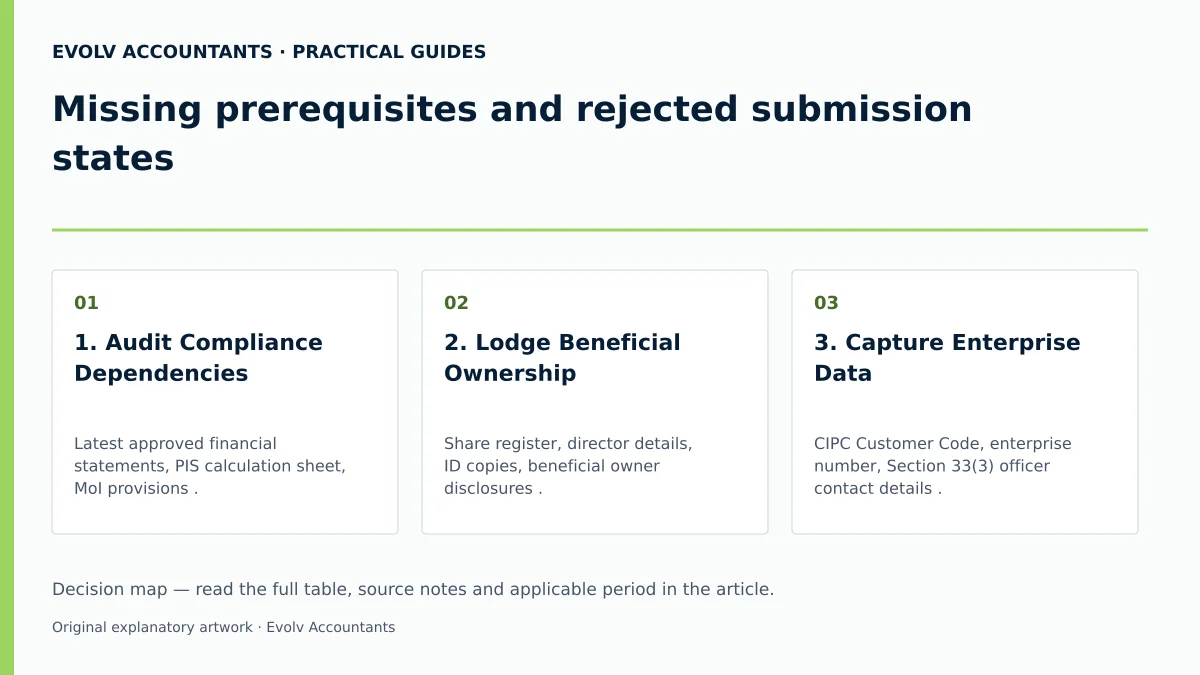
| 1. Audit Compliance Dependencies | Latest approved financial statements, PIS calculation sheet, MoI provisions 20 26 28. | Director / Financial Officer | Separate assurance obligation and AFS/FAS filing route confirmed 16 19 20. | If PIS ≥ 100 (internal compile) or ≥ 350, arrange iXBRL audit file 16 24. |
| 2. Lodge Beneficial Ownership | Share register, director details, ID copies, beneficial owner disclosures 1 4. | Company Secretary / Designated Officer | CIPC Beneficial Ownership confirmation receipt issued 1 4. | If portal blocks filing, follow hyperlink redirect to complete BO service first 4. |
| 3. Capture Enterprise Data | CIPC Customer Code, enterprise number, Section 33(3) officer contact details 17 32 35. | Customer Code Holder / Authorised Representative | Designated compliance officer details saved on e-Services 28 32. | Update outdated director or contact records prior to submission if needed 47. |
| 4. Submit Financial Disclosures | Approved AFS (iXBRL or PDF review) or completed Form CoR 30.2 FAS 16 20 21. | Financial Officer / Accountant | Financial file validated and attached on portal 21 32. | If audited AFS are not required and audited or reviewed AFS are not voluntarily filed, complete FAS; obtain any required review 20 22. |
| 5. Complete Compliance Checklist | Company secretarial records, board meeting minutes, statutory registers 2 37. | Company Secretary / Director | All statutory compliance questions answered on portal 2. | Verify statutory register accuracy before answering checklist items 2 37. |
| 6. Execute Card Payment | Credit/debit card, Shopping Cart invoice total 6 13 17 33. | Customer Code Holder | Shopping Cart status reflects "Paid" with transaction reference 13 33. | Full payment mandatory; partial or instalment payment invalidates filing 5. |
| 7. Secure Verification Certificate | CIPC Annual Return Filing Certificate 12 13. | Director / Compliance Lead | Official CIPC Certificate downloaded and archived 12 13. | Verify CIPC BizProfile status shows "In Business" 32 36 37. |
Frequently Asked Questions
Can a company be exempted from submitting CIPC annual returns or paying annual fees if it was dormant?
No. The Companies Act 71 of 2008 and Close Corporations Act 69 of 1984 make no distinction between active and dormant entities 5 36. Dormant entities are mandated by law to file annual returns and pay prescribed fees annually; CIPC cannot grant exemptions or waive legislated fees 5 36.
How does a company determine whether it must submit Audited Financial Statements or a Financial Accountability Supplement?
Under Section 30 and Regulation 28, a private company must file audited AFS via iXBRL if it holds fiduciary assets > R5 million, has a Public Interest Score (PIS) ≥ 350 (≥ 100 if internally compiled), or is required to audit by its MoI 16 23 24 25 26. A company not required to file audited statements must submit FAS if it does not voluntarily file audited or reviewed AFS.
What happens if an annual return submission is blocked due to a missing Beneficial Ownership Declaration?
The CIPC portal automatically enforces beneficial ownership compliance 4. If the declaration is missing, the portal halts the annual return process and presents a link redirecting the user to file the Beneficial Ownership Declaration first 4. Once lodged, the user can proceed with the annual return 4.
Does filing annual income tax returns with SARS satisfy CIPC annual return obligations?
No. CIPC annual returns and SARS income tax returns are two separate statutory requirements administered under different legislation by different government departments 18. Compliance with SARS tax obligations does not satisfy CIPC annual return duties under Section 33 18.
How can an incorrect turnover figure entered during an annual return submission be corrected?
Submitted annual return data cannot be edited online 38. To correct turnover, the customer code owner must log an online enquiry with CIPC providing the approved financial statements, entity details, reason for error, certified ID copy of the customer code owner, and a letter authorising CIPC to credit or debit the customer code account 38 39. Ask Evolv about missing prerequisites and rejected submission states. Share the relevant records so the support required can be scoped.
Related guides
- CIPC annual returns versus SARS tax returns
- Filing CIPC annual returns for a private company
- Compliance and Regulations: Keeping Your Business on Track
Sources
- https://annualreturns.cipc.co.za/docs/FAQ_Annual_Returns.pdf
- https://www.cipc.co.za//wp-content/uploads/Legal/Regulations/CompaniesAct71_2008.pdf
- https://www.justice.gov.za/legislation/acts/2008-071-reg.pdf
- https://www.cipc.co.za/wp-content/uploads/Forms/Companies/CoR30_1.pdf
- https://www.cipc.co.za/wp-content/uploads/2024/10/STEP-BY-STEP-ANNUAL-RETURNS-003.pdf