
CIPC annual returns versus SARS tax returns
15 August 2026

A CIPC annual return is a company-register filing; a SARS tax return reports income and calculates tax. Completing one does not satisfy the other obligation.
Submitting CIPC annual returns means maintaining corporate legal standing on the company register, whereas filing SARS tax returns requires assessing and settling tax liabilities with the revenue authority.
Decide the assurance obligation separately from the CIPC filing format. A private company needs a statutory audit at PIS 350 or more, or PIS 100 or more with internally compiled statements, and when another audit trigger applies. The owner-managed exemption does not cancel a mandatory statutory audit. Where no audit is required, test independent review and the section 30(2A) exemption using every securities holder and beneficial-interest holder, not only the registered shareholders.
Statements count as internally compiled unless the regulatory definition of “independently compiled and reported” is met. A company not required to file audited statements may file audited or reviewed AFS; if it does neither, it files FAS. FAS does not replace preparing AFS or obtaining a required review. CIPC annual-return FAQ; Companies Regulations.
A company operating in South Africa must distinguish between its statutory registry obligations under the Companies Act and its fiscal duties under tax legislation 1. Submitting an annual return to the Companies and Intellectual Property Commission (CIPC) confirms an entity's active status and statutory details 1 2 3, whereas filing a income tax return with the South African Revenue Service (SARS) calculates taxable income and tax liabilities 1.
Compliance with one regime does not fulfill the requirements of the other 1, and failure to submit CIPC annual returns triggers statutory deregistration, resulting in the withdrawal of juristic personality regardless of SARS tax compliance 4 5.
Company registry filing versus tax filing
Understanding the Legal Foundation
Company registry filings and tax filings are distinct regulatory requirements governed by separate statutory frameworks and administrative bodies 1. Under Section 33 of the Companies Act 71 of 2008 and Regulation 30 of the Companies Regulations, every registered company must file an annual return in the prescribed form with the CIPC 6 7 8. This filing must occur within 30 business days following the anniversary date of the company's incorporation 7 8 9.
Conversely, corporate tax returns are governed by tax administration legislation and submitted to SARS to account for direct and indirect tax liabilities 1. While SARS tax compliance focuses on revenue, deductions, and taxable income, CIPC registry filings focus on corporate transparency, governance metrics, and public record accuracy 1 3 10. Neither process substitutes for the other 1.
— Practical point from this guide
The Myth of Dual Compliance
A prevalent misconception among directors of small and medium enterprises (SMEs) is that filing annual tax returns with SARS automatically maintains a company's legal status with CIPC 1. As CIPC explicitly clarifies in its regulatory guidance: "Compliance with the one does not mean that there is compliance with the other" 1. The regulatory bodies operate independent digital databases; fulfilling tax liabilities does not update the company register, nor does paying CIPC fees satisfy tax obligations 1.
Compare the criteria that matter: company registry filing
Governing Legislation and Regulators
CIPC annual returns are administered by the Department of Trade, Industry and Competition through CIPC under the Companies Act 71 of 2008 1 7 11. Tax returns are administered separately by SARS under national revenue legislation 1.
Legal Standing and Director Liability
Failing to file CIPC annual returns leads to statutory deregistration 4 5 12. CIPC automatically initiates deregistration procedures when two or more successive annual returns remain outstanding 12. The legal effect of deregistration is severe: the juristic personality of the enterprise is withdrawn, and the entity ceases to exist in law 4 5. Consequently, third parties, banks, and service providers may refuse to conduct business with the entity 5 12.
Active directors at the time of deregistration may remain personally liable for liabilities and debts contracted during their tenure 4 5.
In contrast, non-compliance with SARS tax filings results in administrative penalties, interest, and enforcement actions under tax law, but does not directly extinguish the corporate entity's legal existence.
Submission Windows and Operational Constraints
A private company must file its CIPC annual return annually within 30 business days after its incorporation anniversary date 8 9. Submissions must be completed electronically via official CIPC online channels 13 14 15. Late submissions incur statutory penalty fees 8 9 16.
Along with the annual return, companies must submit their latest Beneficial Ownership (BO) Declaration 9 13 17 and either their Audited Financial Statements (AFS) or a Financial Accountability Supplement (FAS) 9 13 18 19 20 21.
Public Transparency versus Tax Privacy
Information submitted on CIPC Form CoR 30.1—such as registered office location, director details, public interest score, and employee numbers—forms part of the public registry 10 22. However, under privacy provisions, individual personal details (such as full identity numbers) are masked on public certificates 14. Tax filings with SARS remain strictly confidential between the taxpayer and the revenue authority.
How the obligations differ: tax filing
Beneficial Ownership Disclosures
CIPC requires companies to maintain and submit a Beneficial Ownership Declaration prior to or alongside the annual return submission 9 13 17. This filing identifies natural persons who ultimate own or control the legal entity.
Each reporting mechanism serves its respective statutory mandate independently. Primary guidance.
Financial Statement Reporting and Audit/Review Thresholds
Under Section 30 of the Companies Act, every company must prepare annual financial statements within six months after the end of its financial year 23. Whether these financial statements require a statutory audit or an independent review depends on specific statutory criteria and the Public Interest Score (PIS) 24 25 26:
- Mandatory Statutory Audit: Required for public companies, state-owned entities, companies holding assets in a fiduciary capacity exceeding R5 million for unrelated persons, or private companies whose PIS is 350 or more (or at least 100 if financial statements are compiled internally) 24 25 26.
- Independent Review: Required for other private companies in accordance with ISRE 2400 25, unless exempt under Section 30(2A) 26 27.
- Owner-Managed Exemption: Subject to mandatory statutory audit requirements, the owner-managed exemption is assessed by checking that every securities holder and beneficial-interest holder is also a director 26 27.
Companies not required to submit audited or reviewed financial statements must attach a Financial Accountability Supplement (Form CoR 30.2) to their CIPC annual return 19 20 21.
Framework Scope Note: The public overview of accounting standards (such as IFRS for SMEs versus Full IFRS) applies strictly to determine framework selection scope and financial reporting compliance under Section 29 28 29.
Two business situations with different outcomes: company registry filing
Scenario Analysis: Active Trading Entity vs. Dormant SME
The Companies Act makes no legal distinction between an active trading entity and a dormant or inactive company regarding registry filing obligations 12 30. Both active and dormant entities remain legally mandated to submit CIPC annual returns and pay prescribed statutory fees 12 30.
- Registered SME Entity
Reproducible Hypothetical Example
To illustrate how CIPC filing criteria and Public Interest Scores apply across different operational contexts, consider two private companies incorporated on 15 June:
- Entity A (Active Small Manufacturer):
- Operational Facts: Annual turnover of R850,000 (illustrative value); 5 full-time employees; third-party liabilities of R200,000 (illustrative value); 2 natural person shareholder-directors.
- Public Interest Score (PIS) Calculation: 5 points (employees) + 1 point (for R0.2m liabilities) + 1 point (for R0.85m turnover) + 2 points (shareholders) = 9 points 10.
- CIPC Fee Category: Turnover is less than R1 million, placing the entity in the base filing fee tier of R100 if filed within 30 business days of 15 June (or R150 if late) 16.
- Financial Reporting: PIS is below 100, and all shareholders are directors. Assuming no other statutory audit trigger or MOI audit clause, and that every securities holder and beneficial-interest holder is also a director, Entity A qualifies for the review exemption 26 27 and submits a Financial Accountability Supplement (FAS) 19 20 21.
- Entity B (Dormant Asset-Holding Vehicle):
- Operational Facts: Annual turnover of R0 (illustrative value); 0 employees; liabilities of R0; 1 shareholder-director.
- Public Interest Score (PIS) Calculation: 0 (employees) + 0 (liabilities) + 0 (turnover) + 1 (shareholder) = 1 point 10.
- CIPC Fee Category: Turnover is less than R1 million, requiring a base fee of R100 within 30 business days 16.
- Financial Reporting: Submits a Financial Accountability Supplement (FAS) 19 21.
Outcome Comparison: Entity B owes R0 to SARS due to zero taxable trading income. However, Entity B must still file its CIPC annual return and pay the R100 CIPC statutory fee 12 16. If Entity B assumes its SARS inactivity excuses CIPC non-filing, CIPC will initiate deregistration after two consecutive missing returns, extinguishing its legal status 5 12.
When the comparison needs specialist input: tax filing
Identifying Technical Judgements and High-Risk Trigger Points
SME directors should seek qualified professional advice from Evolv Accountants when navigating complex compliance scenarios, including:
- Public Interest Score (PIS) & Audit Triggers: Determining whether compilation methods, fiduciary assets, or liability thresholds trigger mandatory independent reviews or audits 10 24 25.
- Turnover Correction Procedures: Correcting incorrectly reported turnover figures on previously submitted CIPC returns requires logging an online application with supporting financial statements, certified ID copies, and written authorisation for debit or credit notes 31 32 33.
- Deregistration Objections & Reinstatements: Responding to CIPC deregistration notices 34 35 or executing formal company reinstatement via Form CoR 40.5 following final deregistration 16 36 37.
- Group Structures and Beneficial Ownership: Structuring complex shareholder registries and maintaining beneficial ownership alignment across corporate entities 9 13 17.
Next steps for CIPC annual returns
Compliance Checklist: CIPC Annual Return vs SARS Tax Return
- [ ] Identify Anniversary Date: Confirm the exact incorporation anniversary month and date from CIPC registration documents 7 8 9.
- [ ] Calculate Financial Metrics: Determine the latest approved turnover figure and calculate the Public Interest Score (PIS) 10 19 38.
- [ ] Determine Financial Reporting Level: Confirm whether the entity requires Audited Financial Statements, an Independent Review, or a Financial Accountability Supplement (FAS) 18 19 24 25 39.
- [ ] Update Beneficial Ownership: Ensure the latest Beneficial Ownership Declaration has been filed on CIPC e-Services 9 13 17.
- [ ] Submit CIPC Return Electronically: Complete Form CoR 30.1 online and settle the prescribed fee within 30 business days of the anniversary date 8 9 14 16.
- [ ] Separate SARS Tax Filings: Verify that corporate income tax returns (ITR14) and provisional tax obligations are independently submitted on SARS eFiling 1.
Artefact: Decision Comparison Matrix
| Criterion | Option A: CIPC Annual Return | Option B: SARS Tax Return | Evidence or assumption | Implication for this reader |
|---|---|---|---|---|
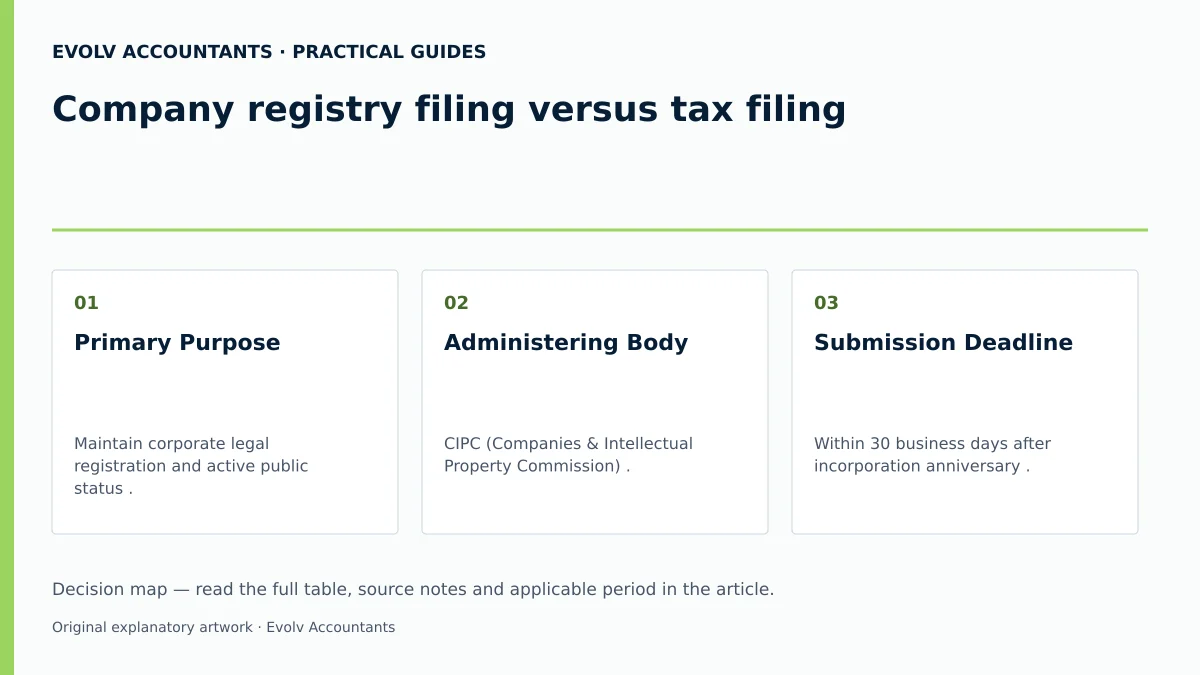
| Primary Purpose | Maintain corporate legal registration and active public status 1 2 3. | Declare income, calculate, and settle statutory tax liabilities 1. | Governed by Companies Act vs Income Tax Act 1 6. | Compliance with one regulator does not satisfy the other 1. |
| Administering Body | CIPC (Companies & Intellectual Property Commission) 1 7. | SARS (South African Revenue Service) 1. | Separate statutory state entities 1. | Filings must be executed on separate digital portals 1 14 15. |
| Submission Deadline | Within 30 business days after incorporation anniversary 8 9. | Defined financial year-end and provisional tax cycles. | Statutory filing windows 7 8 9. | CIPC deadline depends on incorporation date, not year-end 7 9. |
| Dormant Entity Impact | Mandatory filing and fee payment required 12 30. | Assess tax filing and liability from all relevant facts; no trading does not by itself prove zero taxable income. | Companies Act does not exempt inactive entities 12 30. | Dormant entities will be deregistered if CIPC returns are ignored 12. |
| Non-Compliance Risk | Final deregistration; loss of legal personality and bank account freezing 4 5 12. | Administrative penalties, interest, and tax enforcement. | Section 82(3) Companies Act 4 5 40. | CIPC non-compliance threatens the legal existence of the business 4 5. |
Frequently Asked Questions
Does paying SARS tax automatically keep my CIPC company registration active?
No. CIPC annual returns and SARS tax returns are administered under separate legislation by distinct authorities 1. Submitting tax returns to SARS does not update or maintain your company's active status on the CIPC register 1.
What happens if a company misses the 30 business day CIPC filing window?
Filing after the 30 business day window results in statutory late payment penalties 8 9 16. Continuous non-filing across two or more successive years causes CIPC to initiate automated deregistration, which ultimately strips the company of its legal personality 4 5 12.
Is a dormant company required to submit CIPC annual returns and pay filing fees?
Yes. The Companies Act does not differentiate between active and inactive or dormant companies 12 30. Every registered entity must submit annual returns and pay the prescribed fee based on its turnover tier 12 16 30.
What financial documents must accompany a private company's CIPC annual return?
Depending on its Public Interest Score and Memorandum of Incorporation, a company must submit Audited Financial Statements, Independently Reviewed Financial Statements, or a Financial Accountability Supplement (Form CoR 30.2) 18 19 20 21 24 25 39. A Beneficial Ownership Declaration must also be up to date 9 13 17.
How can an SME rectify an incorrect turnover figure previously submitted to CIPC?
Once submitted, turnover figures cannot be edited directly online 31. The company must log an official query with CIPC, submitting its approved financial statements, an explanatory letter, a certified ID copy of the owner of the customer code used for filing, and written authorisation for CIPC to process a credit or debit note adjustment 31 32 33. Ask Evolv about company registry filing versus tax filing. Share the relevant records so the support required can be scoped.
Related guides
- Beneficial ownership for a company with no trading activity
- Filing CIPC annual returns for a private company
- Compliance and Regulations: Keeping Your Business on Track