
Beneficial ownership for a company with no trading activity
22 December 2025

Maintaining statutory compliance for a non-trading South African company requires continuous beneficial ownership disclosure to CIPC despite the lack of active business operations.
CIPC’s filing guides use a 5% reporting norm for percentage interests. That administrative guidance must be distinguished from the Act: the express 5% securities-register rule in section 56(7)(aA) applies to affected companies, while the definition of a beneficial owner also covers board appointment rights and material influence. Do not treat a holding below 5%, or the absence of shares, as a universal exemption from identifying effective control.
Assess the actual rights and the correct affected/non-affected category before filing. Read the statutory amendments.
In South Africa, a private company that generates no turnover and conducts no commercial trading remains a fully recognised juristic person subject to statutory disclosure obligations under the Companies Act 71 of 2008 1 2 3. Dormant status or non-trading operational standing does not extinguish the legal duty to file beneficial ownership declarations with the Companies and Intellectual Property Commission (CIPC) annually or when ownership changes occur 2 4 5 6.
Compliance requires identifying reportable percentage interests and separately assessing ultimate natural-person effective control, securing a compliant board mandate, completing the e-services portal workflow, and obtaining independent verification evidence 7 8 9 10 11.
— Practical point from this guide
Non trading status versus continuing disclosure duties
For small and medium enterprises (SMEs), company directors, and corporate officers operating within South African jurisdiction, completing a beneficial ownership filing means securing official, audit-ready confirmation from CIPC that statutory disclosure duties are fulfilled for the current reporting period 7 11 12. A common misconception among business owners is that non-trading status, zero bank transactions, or nominal shareholding exempts an entity from regulatory filing requirements 2 3.
Under South African company law and regulator guidelines, corporate obligations are governed by entity status rather than trading volume 2 3 4 6:
- Law (Companies Act 71 of 2008): Every registered company must maintain an accurate securities register and file annual compliance disclosures 13 14 15 16. The Act establishes that juristic personality and statutory duties persist from incorporation until formal dissolution or final deregistration 1 17 18.
- Regulator Guidance (CIPC Guidelines): CIPC explicitly dictates that companies in active status, business rescue, or annual return (AR) deregistration process must submit beneficial ownership details 2 3 4 6. While an entity undergoing AR deregistration process remains active and legally obligated to file, entities that have lodged a formal application for voluntary deregistration (status: voluntary deregistration process) are recognised as having ceased business and are exempt from beneficial ownership submissions under section 82(3)(b)(ii) of the Companies Act 4 6. Entities that are finally deregistered, liquidated, or dissolved no longer exist in law and have no filing duties 17 18 19 20.
- Evolv Recommendations: Evolv recommends conducting an annual beneficial ownership audit alongside annual return preparations. Non-trading companies should formally record whether any natural person holds ultimate control to determine whether to file under the standard or optimised CIPC pathway 5 21 22.
According to CIPC explanatory notes, beneficial ownership refers to "an individual who, directly or indirectly, ultimately owns that company or exercises effective control over that company" 23 24. The threshold for declaration is 5% or more of beneficial interest in securities, voting rights, board appointment control, or material management influence, with an aggregate of 100% across the entity 5 7 24 25 26 27. Effective control must still be assessed independently of the percentage holding.
Prepare the information and authority: non trading status
Before accessing the CIPC portal, the declaring entity must gather specific inputs, establish authorisation, and assemble required supporting documentation based on its shareholding structure 8 28 29 30.
Mandatory Mandate and Filer Requirements
Filing must be performed by a singular natural person who holds a valid CIPC customer code and password 7 9 31 32 33. The declaring entity must execute a written mandate authorising the filer 8 30 34 35:
- Format: The mandate must be on the official company or close corporation letterhead in the form of a letter, resolution, or power of attorney 8 9 30 32.
- Content: It must specify the full name, surname, and South African ID (or passport) number of the mandated natural person filer, matching their CIPC customer profile 9 32.
- Execution: The document must be signed by at least 50% + 1 of the company directors or all members of a close corporation 9 32 36 37.
Document Preparation by Filing Pathway
Supporting document requirements depend on whether the non-trading entity has external beneficial owners to declare 21 38 39:
- Non-Affected Company WITH Beneficial Ownership to Declare:
- Certified ID or passport copy of the mandated filer (dated within 3 months) 28 29 32 36 37.
- Certified ID or passport copies of all declared natural person beneficial owners (dated within 3 months; foreign passport copies must be notarised or certified by a Commissioner of Oaths) 28 29 36 37 40 41.
- Signed original mandate on company letterhead 9 29 32 36 37 42.
- Approved Securities Register or Beneficial Interest Register maintained under section 56(7)(aA) of the Companies Act 29 36 37 42.
- Complex Structure Disclosure Form showing a diagrammatic representation of ownership tiers if shares are held through juristic entities or trusts 5 29 42.
- Non-Affected Company WITHOUT Beneficial Ownership to Declare (Optimised System):
- Applies to non-affected entities with 10 or fewer directors or members where no external natural person exercises control outside registered shareholders 21 22 43.
- No supporting documents are uploaded onto the portal during filing 21 44 45. However, the written mandate and verified securities register must be kept on file at the registered office for CIPC inspection upon request 31 44 45.
Complete the task step by step: continuing disclosure duties
To submit a beneficial ownership disclosure for a non-trading company, follow this sequenced operational workflow on the CIPC e-services platform (https://eservices.cipc.co.za/) 46 47 48:
- Portal Authentication: Log into CIPC e-services using a valid customer code, password, and security code 46 47 48. Tick to accept CIPC Terms and Conditions and click Login 46 47 48.
- Navigate to Service: Click Transact, then select the Beneficial Ownership tile 46 47 48 49. Read the Beneficial Ownership Declaration Information, check I Agree, and click Continue 45 46 49.
- Select Enterprise: Locate the non-trading company from the Associated Enterprise Listing or use the Search option by entering the enterprise number 50 51 52. Confirm the displayed enterprise details 50 51 52.
- Category Evaluation: Select the company type from the drop-down menu 53 54 55. Select NON-AFFECTED COMPANIES (unless the private company has transferred more than 10% of its securities among non-related persons within the preceding 24 months, classifying it as an affected company) 55 56 57.
- Ownership Evaluation Questions: Answer the system guidance prompts regarding external control, board appointment rights, and management influence outside registered shareholders 57 58 59:
- If YES to any control question: The portal routes to Non-Affected Company WITH Beneficial Ownership to Declare 58 59.
- If NO to all control questions (and 10 or fewer directors/members): The portal routes to the Optimised BO System 21 43 59.
- Data Capture & Document Upload:
- Standard Path: Capture details for natural person owners (ID number, Home Affairs auto-verification, residential address, interest type, and ownership percentage >= 5%) 5 26 60 61 62 63 64 65. Upload certified ID copies, mandate, and securities register 28 29 42. Click Submit 66 67.
- Optimised Path: Edit the inline Securities/Members Register Content 21 68. Input the date interest was issued, exact number of issued securities, share class (e.g., Ordinary Shares), and total authorised shares 59 68 69. Click Save, then Continue 69 70.
- OTP Verification: The portal generates One-Time Pins (OTPs) sent via SMS and Email to the filer's registered contact details 71 72 73. Click the red X under the CONFIRMED column 71 72 73. Input the SMS OTP (prefixed with capital 'S') and/or Email OTP (prefixed with capital 'E') in the verification fields and click Verify 74 75 76.
- Finalise Filing: Upon successful OTP validation, the status box turns green 74 75 76. Click Finish to complete the transaction 11 12 75.
Check the result against the evidence: non trading status
Filing submission on the portal does not automatically guarantee compliance 77 78. Filers must verify completion against independent primary evidence 11 12:
- Invalid Application Statuses: Applications listed under portal grids as "In Progress", "Draft", or "Pending" (waiting for OTPs) do not constitute valid beneficial ownership filings 77 78 79. "Nullified" filings indicate non-compliance with statutory regulations, while "Rejected" filings signify back-office rejections due to incomplete or invalid documentation 78 79.
- Path A Evidence (With BO Declared): For non-affected companies declaring beneficial ownership, valid completion is proven ONLY by obtaining an official CIPC Beneficial Ownership Confirmation Certificate 10 12 75 80. This electronic certificate is emailed to the filer upon completion and remains available for download under the Completed Applications grid in the e-services portal 12 34 35 75.
- Path B Evidence (Optimised System): For non-affected companies with no beneficial ownership to declare using the optimised system, NO confirmation certificate is generated or downloadable 11 59. Verification of completion exists solely in the official CIPC Email Filing Notification sent to the filer and declaring company, confirming receipt of the non-affected declaration 11 59.
Evolv recommends archiving the confirmation certificate or email notification alongside the signed mandate and updated securities register in the company's permanent statutory compliance file 11 14 34 35.
Handle exceptions and unresolved cases: continuing disclosure duties
When completing beneficial ownership filings for non-trading entities, several technical and administrative edge cases may arise:
- Department of Home Affairs (DHA) Verification Offline: During natural person ID entry, the system automatically validates South African ID details against Home Affairs 60 64 66 67. If the DHA system is offline, the verification box turns red 66 67. The filing will still proceed upon clicking submit, provided all captured text data is accurate 66 67.
- Zero or Blank Authorised Securities Error: On the optimised system inline register, if authorised securities reflect as zero or blank, the portal prevents submission and triggers a validation error 69. The filer must email written proof of correct authorised share capital (such as the Memorandum of Incorporation) to beneficialownershipenq@cipc.co.za for CIPC manual adjustment before filing can resume 69.
- Issued Securities Exceed Authorised Securities: Entering an issued share quantity greater than the registered authorised share capital results in an immediate portal validation failure 70. The share figures must be reconciled against company records before re-attempting 70.
- Outdated Filer Profile Contact Details: If masked contact details displayed for OTP delivery are invalid, the filer must update their customer profile 81. Profile updates require a 48-hour processing delay before the new contact details become active for OTP receipt 55 81.
- Complex Corporate Shareholding: Where shares in a non-trading company are held by another juristic person or trust, the first-tier corporate shareholder must be captured as a Juristic Person owner 5 82 83. A diagrammatic disclosure form showing the ultimate natural person beneficial owner behind the entity must be attached 5 29 42.
Decisions regarding whether a non-trading company requires an independent review or financial audit depend on calculating its Public Interest Score (PIS) under Chapter 3 of the Companies Act Regulations, evaluating its compilation method, and verifying shareholder-director exemptions, rather than its beneficial ownership status 84 85. Public IFRS overview facts apply solely to financial reporting framework scope and edition facts.
Reproducible Hypothetical Example
Consider Silent Ventures (Pty) Ltd, a non-trading South African private company with 100 authorised ordinary shares and 100 issued ordinary shares 22 68 69. The company has two directors who are natural persons, each holding 50 issued ordinary shares (50% interest) directly in their own names 22 68. There are no indirect owners, external trusts, or third parties holding voting rights or board appointment powers 22 57.
- Classification: Silent Ventures (Pty) Ltd is a non-affected company with 10 or fewer directors 21 43. Because both shareholders are registered directors with no external control, all ownership questions on the portal are answered NO 22 57 59.
- Filing Route: The portal automatically directs the filing to the Optimised BO System (Non-Affected WITHOUT BO to declare) 21 43 59.
- Execution: The mandated accountant logs in, selects the enterprise, edits the inline Securities Register, checks the pre-populated 100 authorised shares, enters 50 issued ordinary shares for each director, and captures the issue date 68 69. No document uploads are submitted 21 44 45.
- Verification & Evidence: The filer verifies the SMS or Email OTP 76. Upon clicking Finish, CIPC issues an official email confirmation notification to Silent Ventures (Pty) Ltd 11 59. No downloadable certificate is issued 11 59.
Next steps for Beneficial ownership
Review the practical checklist below to assign responsibilities and verify completion evidence for non-trading company beneficial ownership compliance:
| Step | Input or evidence | Responsible person | Completion check | Exception or next action |
|---|---|---|---|---|
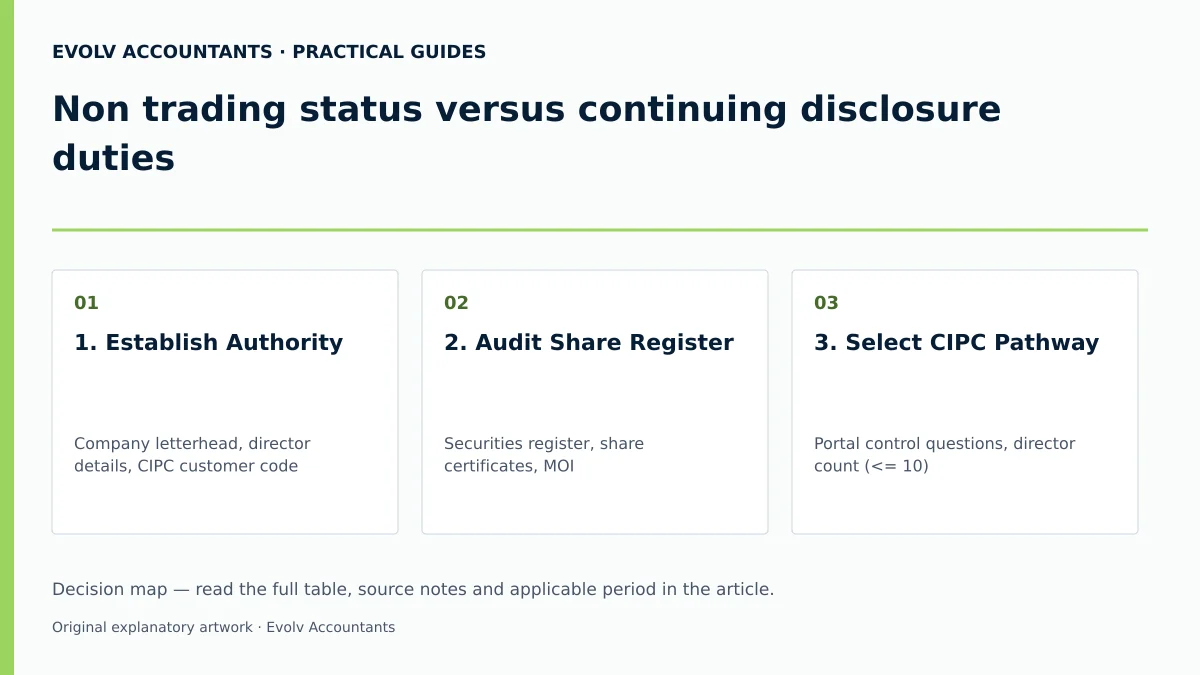
| 1. Establish Authority | Company letterhead, director details, CIPC customer code 9 32 | Board of Directors / Filer | Mandate signed by 50% + 1 directors 9 32 | Draft resolution if director signatures are pending 8 30 |
| 2. Audit Share Register | Securities register, share certificates, MOI 42 69 | Company Secretary / Accountant | Securities holdings reconciled and effective-control rights documented 5 26 | Identify natural persons behind juristic shareholders 5 82 |
| 3. Select CIPC Pathway | Portal control questions, director count (<= 10) 43 57 | Mandated Filer | Pathway determined (Standard vs Optimised) 21 58 | Prepare disclosure diagram if complex structure 29 42 |
| 4. Execute Portal Filing | Certified ID copies, inline securities data 28 68 | Mandated Filer | Required data captured; documents uploaded for the standard route, or inline register completed for the optimised route 42 69 | Contact CIPC if authorised shares reflect zero 69 |
| 5. Complete Verification | SMS OTP ('S' prefix) & Email OTP ('E' prefix) 74 75 76 | Mandated Filer | OTP confirmed & portal status reflects green 74 75 76 | Resend OTPs or update filer profile if details invalid 71 81 |
| 6. Archive Completion Proof | Confirmation Certificate OR CIPC Email Notification 11 12 | Public Officer / Statutory Clerk | Document saved in company compliance register 11 14 34 | Provide copy to bank or auditors upon request 86 87 |
Frequently Asked Questions
Does a non-trading or dormant company have to file beneficial ownership with CIPC?
Yes. Every active registered private company, close corporation, non-profit company, or external company must file beneficial ownership details with CIPC, regardless of whether it is actively trading or dormant 2 3 4 40 41. Check the full list of ineligible CIPC statuses, including voluntary deregistration and specified liquidation, suspension and dissolution statuses. Ordinary non-trading status is not one of those statuses.
How do CIPC filings relate to SARS filings?
CIPC corporate filings and SARS tax filings are separate duties. Check each against the relevant regulator’s requirements; completing one does not complete the other. Primary guidance.
What evidence proves that a beneficial ownership filing was successfully completed?
For companies declaring beneficial ownership (Path A), proof of completion is an official downloadable CIPC Beneficial Ownership Confirmation Certificate 10 12 75 80. For non-affected companies with no beneficial ownership to declare using the optimised system (Path B), no certificate is generated; completion is proven exclusively by the CIPC Email Filing Notification 11 59.
Who must sign the mandate authorising an accountant to submit beneficial ownership data?
The mandate must be on the company's official letterhead, nominate a single natural person holding a valid CIPC customer code, and be signed by at least 50% + 1 of the company's directors of the company or all members of a close corporation 8 9 30 32 37.
What happens if CIPC reflects zero authorised shares for a non-trading company during filing?
If the e-services portal reflects zero or blank authorised shares, the system blocks the filing 69. The filer must email proof of authorised share capital (such as the Memorandum of Incorporation) to beneficialownershipenq@cipc.co.za so CIPC can manually update the record before filing can proceed 69.
Related guides
- Updating beneficial ownership after a share transfer
- Who counts as a beneficial owner of a private company
- Compliance and Regulations: Keeping Your Business on Track
Sources
- https://www.gov.za/sites/default/files/gcis_document/202212/47815anti-moneylaunderingact22of2022.pdf
- https://www.cipc.co.za//wp-content/uploads/Legal/Regulations/CompaniesAct71_2008.pdf
- https://www.cipc.co.za/wp-content/uploads/2024/09/Step-by-step-guide_E-Services-Beneficial-Ownership-Filing-Complex-Structure-Final.pdf
- https://www.cipc.co.za/wp-content/uploads/2024/09/Step-by-step-guide_E-Services-Beneficial-Ownership-Filing-Non-Affected-Company-With-Beneficial-Ownership.pdf
- https://www.cipc.co.za/wp-content/uploads/2025/10/Step-by-step-guide-OPTIMIZED-BO-FILING-Final.pdf
- https://annualreturns.cipc.co.za/docs/FAQ_Annual_Returns.pdf