
Updating beneficial ownership after a share transfer
12 August 2026

Updating beneficial ownership after a share transfer requires amending internal registers and filing a revised CIPC declaration.
CIPC’s filing guides use a 5% reporting norm for percentage interests. That administrative guidance must be distinguished from the Act: the express 5% securities-register rule in section 56(7)(aA) applies to affected companies, while the definition of a beneficial owner also covers board appointment rights and material influence. Do not treat a holding below 5%, or the absence of shares, as a universal exemption from identifying effective control.
Assess the actual rights and the correct affected/non-affected category before filing. Read the statutory amendments.
When a South African small or medium-sized enterprise (SME) undergoes a share transfer, updating beneficial ownership is a multi-stage compliance requirement rather than a single administrative action 1 2.
Company leadership must first identify the exact trigger date when shareholding or effective control changes, update the internal securities register and beneficial interest register, obtain a duly executed board mandate, and complete the revised online declaration on the e-services platform of the Companies and Intellectual Property Commission (CIPC) 2 3 4 5. Navigating these obligations ensures that legal ownership, statutory compliance, and operational records remain synchronized across all enterprise systems 1 3.
— Practical point from this guide
Trigger date and revised ownership records
Distinguishing key corporate dates
A common pitfall for SMEs is confusing the various dates associated with a share purchase or transfer 2 6. Under South African corporate practice, four distinct timeline milestones must be recognised and recorded:
- Decision date: The date on which the company’s board of directors or shareholders approve the proposed transaction, pass the required resolutions, or sign the underlying share purchase agreement 6 7.
- Effective date: The legal date on which ownership of the shares or beneficial interest actually passes to the transferee under the terms of the agreement or by operation of law 6 8. This date serves as the true "trigger date" for updating internal ownership records 2 6.
- Filing date: The date on which the mandated filer submits the updated beneficial ownership declaration and mandatory supporting documentation through the CIPC e-services portal 4 9.
- Reflected system change date: The date on which CIPC processes the submission, completes electronic OTP verification, and issues an official Beneficial Ownership Certificate or confirmation notification 10 11 12.
Legal, regulator, and advisory boundaries
To maintain governance integrity, SMEs must distinguish between statutory law, regulator guidance, and professional advisory recommendations:
- Statutory law: The Companies Act 71 of 2008 sets the binding legislative mandate 3 13. Section 50 requires every profit company to establish and maintain a securities register 3 14, while Section 51(5) dictates that every share transfer must be entered in the securities register upon delivery of a proper instrument of transfer 6 8. Section 214 provides for criminal prosecution in cases of reckless conduct or false statements 15 16.
- Regulator guidance: Official CIPC step-by-step guides specify the operational mechanics of beneficial ownership disclosures 17 18 19. CIPC guidance establishes the 5% threshold for beneficial ownership declaration 17 20 21, prescribes the required supporting document types 9 22, and sets out the automated e-services filing workflow 23 24 25.
- Evolv recommendations: As an integrated advisory provider across bookkeeping/accounting, tax advisory, payroll, and company/statutory compliance, Evolv recommends establishing a formal change-management protocol whenever equity changes hands, ensuring that internal accounting ledgers, statutory registers, and CIPC filings are updated in a single coordinated effort.
Gather approvals and current records: trigger date
Mandatory corporate consents and resolutions
Before submitting an updated beneficial ownership declaration to CIPC, the company must prepare and verify specific foundational documents 4 5:
- Share transfer agreement and proper instrument of transfer: A executed transfer form or agreement proving that the transfer occurred legally 6 8.
- Board resolution or shareholder consent: Written resolutions reflecting approval of the share transfer and authorising the necessary changes to the company's registers 6 26.
- Filer mandate: CIPC requires that the individual submitting the beneficial ownership declaration be explicitly authorised 4 27. CIPC defines beneficial ownership as "an individual who, directly or indirectly, ultimately owns that company or exercises effective control over that company" 28 29. The mandate must be on the company’s official letterhead, nominate a single natural person possessing a valid CIPC customer code, and be signed by "at least 50% +1 of the directors of the company" 7 30.
Verifying identity evidence and customer permissions
The mandated filer must assemble valid supporting documentation prior to initiating the online transaction 9 22:
- Certified identity documentation: Unexpired certified copies of South African identity documents or foreign passports for both the mandated filer and all declared natural person beneficial owners 22 31. Certified copies must be dated within 3 months of submission 22 31.
- Securities register and beneficial interest register: An up-to-date copy of the company's internal securities register reflecting the new share distribution, alongside the beneficial interest register established under Section 56 5 9 22.
- Structure disclosure form: If the shareholding structure involves intermediate juristic persons, holding companies, or trusts (complex structure), a diagrammatic representation showing the ultimate natural person beneficial owners must be attached 9 20 22 32.
Update each affected system or register: revised ownership records
Updating internal securities and beneficial interest registers
Updating one statutory database does not automatically update another 3 20. A share transfer requires systematic updates across multiple independent registers:
- Internal securities register: Maintained under Section 50 and 51 of the Companies Act 3 6. The company secretary or director must record the transferee’s name, physical/postal address, number and class of shares transferred, date of transfer, and any remaining consideration due 3 6.
- Beneficial interest register: Kept pursuant to Section 56(7) of the Act 5 33. If shares are registered in the name of one person for the beneficial interest of another, or if voting control is held indirectly, the disclosures must be catalogued in this register 33 34 35.
- CIPC beneficial ownership platform: An external statutory register hosted on CIPC e-services 17 18. The filer logs into the portal, selects the target enterprise, captures the reportable natural-person ownership and effective-control details, applying the CIPC guidance and the statutory scope explained above, uploads the mandatory supporting files, and completes the transaction 9 20 23 36.
Aligning accounting, tax, and statutory systems
Following an internal equity adjustment, Evolv recommends conducting an immediate reconciliation across operational systems. Review the accounting, dividend, contact and statutory records affected by the transfer. A shareholder loan balance does not automatically change in proportion to a share transfer; follow the transaction documents and underlying accounting rights to prevent reporting discrepancies during annual returns or financial reviews.
Confirm the change took effect: trigger date
Electronic OTP verification and CIPC confirmation
Submitting information on the e-services platform does not conclude the process until official verification is achieved 10 11 37. The final operational steps include:
- Dual OTP confirmation: The CIPC system dispatches One-Time Pins (OTPs) to the mobile number and email address registered to the customer profile 10 38. Filers must enter both codes accurately, noting that the SMS OTP requires an uppercase 'S' prefix and the Email OTP requires an uppercase 'E' prefix 38.
- System status verification: Applications in draft or pending status do not constitute valid legal filings 37 39. The transaction is complete only when the status changes to completed 11 37.
- Filing outcome and certificate issuance: For standard non-affected companies declaring beneficial ownership, the system generates an official CIPC Beneficial Ownership Certificate and issues an electronic filing notification via email 4 11 40. For simplified non-affected companies with 10 or fewer directors/members and no external beneficial owners operating under the optimised system, an official email confirmation is issued in lieu of a downloadable certificate 12 41 42.
Reconciling public disclosures with opening records
Once confirmation is received, company management must compare the output certificate or notification against opening internal ledgers 3 11. Any variance between the issued CIPC records and the company's internal securities register must be identified and rectified immediately to maintain evidentiary consistency 3 43.
Responsibilities that continue after the change: revised ownership records
Statutory liabilities and non-compliance risks
Company leadership bears ongoing statutory accountability for maintaining accurate beneficial ownership data 15 16:
- Section 214 enforcement: Providing false, misleading, or incomplete beneficial ownership details, or failing to comply with statutory filing requirements, exposes both the declaring company and its individual officers to criminal prosecution and administrative penalties 15 16.
- Threshold monitoring: Companies must continuously monitor equity and voting structures 1 2. Where a percentage interest falls below CIPC’s reporting norm, review whether any other reportable voting, appointment or effective-control rights remain before changing the person’s status. File the supported change rather than automatically removing a continuing controller.
Record retention and privacy obligations
Under Section 24 of the Companies Act, profit companies are legally obligated to maintain copies of their securities register, director records, minutes of general meetings, annual financial statements, and accounting records for a minimum period of 7 years 14 26 44 45. Historical share transfer instruments, mandates, and CIPC beneficial ownership certificates must be archived securely and must not be destroyed when new filings are made 4 26 44.
Company officers must maintain proper data privacy protocols regarding the personal identity details, contact numbers, and home addresses of natural person beneficial owners captured during the compliance process 14 46.
Next steps for Beneficial ownership
Handover checklist for SME leadership
To execute a seamless beneficial ownership update following a share transfer, leadership should follow this numbered compliance sequence:
- Verify the trigger date: Establish the legal effective date of the share transfer from the executed agreement and transfer documentation 6 8.
- Execute statutory resolutions: Pass board resolutions approving the transfer and authorising a designated natural person filer 7 30.
- Draft and sign the formal mandate: Prepare the mandate on company letterhead signed by at least 50% + 1 of the directors 7 47.
- Collect certified identity evidence: Obtain fresh certified identity copies (dated within 3 months) for all declared natural persons and the filer 22 31.
- Update internal registers: Enter the transfer details into the company’s internal securities register and Section 56 beneficial interest register 3 6 33.
- Log into CIPC e-services: Access the portal using the mandated filer's customer code and password 23 24.
- Capture beneficial ownership details: Input all required natural person or intermediate juristic person details, interest types, and the correct interest type and any percentage field applicable to that type 20 36 48 49.
- Upload mandatory documents: Attach the signed mandate, certified identity copies, updated securities register, and structure disclosure form (if complex) 9 22.
- Complete OTP verification: Input the SMS ('S') and Email ('E') OTP codes to finalise the submission 10 38.
- Archive confirmation and audit trail: Download the CIPC Beneficial Ownership Certificate or filing email notification and archive it alongside the 7-year statutory company records 11 12 26.
Change and handover tracker
| Affected record | Authority or owner | Effective date | Action | Confirmation and continuing duty |
|---|---|---|---|---|
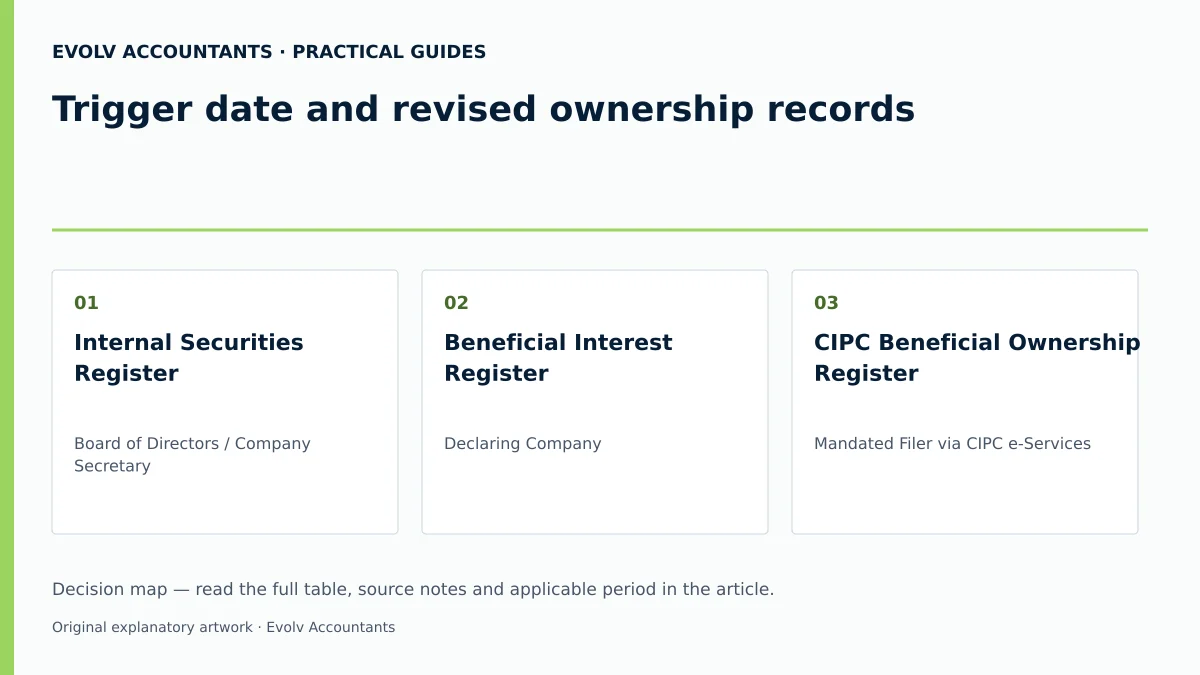
| Internal Securities Register 3 | Board of Directors / Company Secretary 3 50 | Trigger Date / Effective Date of Transfer 6 | Enter transferee details, share class, quantity, and transfer endorsement 6 | Maintain register at registered office; retain for 7 years 14 44 |
| Beneficial Interest Register 33 | Declaring Company 33 34 | Date of Disclosed Beneficial Interest Change 33 34 | Record the applicable beneficial-interest disclosures and changes 33 34 | Update upon notice; disclose in annual returns if required 33 51 |
| CIPC Beneficial Ownership Register 17 | Mandated Filer via CIPC e-Services 4 17 | Filing Submission Date 9 | Capture reportable natural-person ownership and control; upload documents where the selected route requires them 9 20 31 | Complete dual OTPs; obtain BO Certificate or email confirmation 11 12 38 |
| Accounting & Tax Ledgers 26 | Evolv Bookkeeping & Financial Reporting Team 26 | Financial Period of Transfer 26 | Reconcile shareholder loan balances, equity accounts, and distribution lists 26 | Preserve supporting trial balances and financial statements for 7 years 26 |
Reproducible hypothetical example
Consider a private South African profit company, Apex Solutions (Pty) Ltd, registered with 1,000 authorised and issued ordinary shares 14 52.
- Initial structure: Shareholder A (natural person) holds 600 shares (60%), and Shareholder B (natural person) holds 400 shares (40%). Both are registered in the CIPC beneficial ownership register 20 28.
- Transaction event: On 10 November, Shareholder A enters into a share purchase agreement to sell 200 ordinary shares (20% of total shares) to Shareholder C (a new natural person investor) 6 50.
- Timeline breakdown:
- Decision date: 10 November — Board passes an ordinary resolution approving the transfer and issuing a filing mandate signed by 2 of 3 directors (a majority of directors) 7 30.
- Effective date (Trigger date): 12 November — Payment settles and the executed transfer form is delivered to the company 6 8.
- Internal register update: 13 November — The company secretary updates the Section 50 securities register 3 6. Revised holdings: Shareholder A = 400 shares (40%), Shareholder B = 400 shares (40%), Shareholder C = 200 shares (20%) 3 6.
- Filing date: 14 November — The mandated filer logs into CIPC e-services, captures Shareholder C's details (20% interest), updates Shareholder A's interest to 40%, uploads the mandate, updated securities register, and certified ID copies dated within 3 months 9 22 23 49.
- Reflected system change: 14 November — Filer completes dual OTP verification using 'S' and 'E' prefixes 38. Status changes to completed, and CIPC issues a new Beneficial Ownership Certificate 11 40.
Frequently Asked Questions
What is the threshold for declaring beneficial ownership to CIPC after a share transfer?
Any natural person who directly or indirectly holds 5% or more of the beneficial interest or voting control in a company or close corporation must be declared on the CIPC beneficial ownership register 17 20 21. Effective control must still be assessed independently of the percentage holding.
Does updating our internal securities register automatically update CIPC records?
No. The internal securities register kept under Section 50 of the Companies Act and the CIPC beneficial ownership register are separate statutory records 3 17. Updating your internal records does not update CIPC; a separate online declaration must be completed on CIPC e-services 3 9 20.
Who is eligible to sign the CIPC filing mandate on behalf of a company?
The written mandate authorising a filer must be on company letterhead and signed by at least 50% + 1 of the company's directors (an ordinary resolution requirement) or all members of a close corporation 7 30 47. The mandate must explicitly name a single natural person holding a valid CIPC customer code 7 30.
How fresh must certified identity documents be for a beneficial ownership filing?
Certified identity copies for South African citizens (or certified/notarized passport copies for foreign nationals) for both the filer and all declared beneficial owners must be dated not older than 3 months at the time of submission 22 31.
What happens if a shareholder's interest drops below 5% following a share transfer?
When a share transfer reduces an existing beneficial owner’s interest below the 5% declaration threshold, the company must submit an updated filing to CIPC 1 2. Check whether other effective-control rights remain before marking that individual inactive. Ask Evolv about trigger date and revised ownership records. Share the relevant records so the support required can be scoped.
Related guides
- Catching up several years of outstanding annual returns
- Who counts as a beneficial owner of a private company
- Compliance and Regulations: Keeping Your Business on Track
Sources
- https://www.gov.za/sites/default/files/gcis_document/202212/47815anti-moneylaunderingact22of2022.pdf
- https://www.cipc.co.za/wp-content/uploads/2024/09/Step-by-step-guide_E-Services-Beneficial-Ownership-Filing-Complex-Structure-Final.pdf
- https://www.cipc.co.za/wp-content/uploads/2024/09/Step-by-step-guide_E-Services-Beneficial-Ownership-Filing-Non-Affected-Company-With-Beneficial-Ownership.pdf
- https://www.cipc.co.za//wp-content/uploads/Legal/Regulations/CompaniesAct71_2008.pdf
- https://www.cipc.co.za/wp-content/uploads/2025/10/Step-by-step-guide-OPTIMIZED-BO-FILING-Final.pdf