
Catching up several years of outstanding annual returns
13 October 2025

Catching up outstanding annual returns requires checking the company’s CIPC status, identifying each overdue year and reconciling the relevant turnover, documents and fees.
Catching up several years of outstanding CIPC annual returns requires systematic historical turnover calculations, mandatory compliance declarations, and prompt fee settlement to prevent final deregistration.
Decide the assurance obligation separately from the CIPC filing format. A private company needs a statutory audit at PIS 350 or more, or PIS 100 or more with internally compiled statements, and when another audit trigger applies. The owner-managed exemption does not cancel a mandatory statutory audit. Where no audit is required, test independent review and the section 30(2A) exemption using every securities holder and beneficial-interest holder, not only the registered shareholders.
Statements count as internally compiled unless the regulatory definition of “independently compiled and reported” is met. A company not required to file audited statements may file audited or reviewed AFS; if it does neither, it files FAS. FAS does not replace preparing AFS or obtaining a required review. CIPC annual-return FAQ; Companies Regulations.
When a South African private company or close corporation falls into arrears with its annual returns, the Companies and Intellectual Property Commission (CIPC) flags the entity as non-compliant and initiates administrative deregistration 1 2 3. Resolving multiple years of overdue filings is a structured statutory recovery exercise rather than a simple routine submission 4 5.
Every outstanding year must be submitted in strict chronological sequence, accompanied by the requisite financial disclosures and updated beneficial ownership declarations, to restore full corporate compliance and protect legal status 4 6 7.
A year by year arrears recovery schedule
Scope, Jurisdiction, and Statutory Meaning of Completion
This arrears recovery guidance applies to directors, members, and financial managers of South African private companies ((Pty) Ltd) and close corporations (CC) subject to the Companies Act 71 of 2008 and the Close Corporations Act 69 of 1984 1 8.
In South African company law, an annual return is a statutory compliance summary submitted electronically to CIPC within a prescribed window following the anniversary month of incorporation 1 4 9. Achieving full completion across a multi-year recovery schedule means successfully lodging every missing annual return from the earliest overdue year to the current cycle, paying all prescribed fees and late penalties, and filing the mandatory financial and beneficial ownership records 4 10 11.
— Practical point from this guide
Distinguishing Legal Obligations, Regulatory Rules, and Evolv Recommendations
To execute a successful recovery, entities must distinguish between primary legislation, administrative regulator guidance, and professional advisory practice:
- Primary Law (Companies Act 71 of 2008): Mandates that every registered company file an annual return in the prescribed form with the prescribed fee within 30 business days after its incorporation anniversary 9. Section 82(3) empowers CIPC to deregister companies that fail to lodge returns for two or more consecutive years 12. Section 30 dictates the preparation and financial reporting standards for annual financial statements (AFS) 13 14.
- Regulator Guidance (CIPC Directives & FAQs): Dictates electronic-only submission via CIPC digital platforms (such as e-Services or BizPortal) 15 16. CIPC rules specify that CIPC guidance notes that "an Annual Return is a summary of the most relevant information regarding the company" 17. CIPC mandates that a Beneficial Ownership (BO) declaration and an AFS or Financial Accountability Supplement (FAS) must be submitted prior to or alongside the annual return 4 6 15.
- Evolv Recommendations: Evolv Accountants advises conducting a complete historical audit of turnover, director records, and past customer code transactions before initiating online submission. Evolv recommends preparing all financial supplements in advance to prevent system timeouts or rejected filings.
Prepare the information and authority: a year by year arrears recovery schedule
Required Documents, Inputs, and System Authority
Before accessing CIPC digital platforms, the designated compliance officer or authorised representative must compile the following core inputs 5 6 18:
- Company Profile & Registration Details: Enterprise name, registration number, registered office address, and updated director or member particulars 19.
- CIPC Customer Code Authority: Filings must be submitted through an active CIPC customer code by a duly authorised representative who possesses authority to confirm corporate records 5 20.
- Approved Financial Records: Financial turnover figures derived from the latest approved annual financial statements or accounting records for each outstanding financial year 21 22.
- Beneficial Ownership Disclosures: Full disclosure of natural persons who directly or indirectly own or exercise control over the entity 4 6.
- Financial Reporting Documents: Either audited/reviewed AFS in Extensible Business Reporting Language (iXBRL) format or a completed Financial Accountability Supplement (Form CoR 30.2) 23 24 25 26.
Beneficial Ownership and Tax Distinction Evidence Boundaries
Entities must recognise crucial statutory evidence boundaries during preparation:
- CIPC Beneficial Ownership vs. CIPC Annual Returns vs. SARS Income Tax Returns: Compliance with SARS income tax obligations does not satisfy CIPC annual return obligations 17. SARS tax returns assess taxable income liabilities, whereas CIPC returns verify juristic activity and corporate record integrity 17. Audit vs. Review Reporting Boundaries:* Deciding whether a private company requires an independent audit, an independent review, or an FAS requires analysing the Companies Act together with Regulations 26 and 28 27 28. A private company requires an audit if it holds fiduciary assets exceeding R5 million, is a public-function NPC, or achieves a Public Interest Score (PIS) of 350 or more (or 100 or more if statements were internally compiled) 27. The section 30(2A) exemption must be checked using every securities holder and beneficial-interest holder who must also be a director; it does not override mandatory statutory audit requirements. Accounting Standards Scope:* While reporting frameworks (such as IFRS for SMEs) dictate financial statement presentation, CIPC annual return fees are determined specifically by turnover figures reported on Form CoR 30.1 or digital entry fields 10 18 22.
Complete the task step by step: documented completion and exceptions
Sequenced Recovery Process
Catching up overdue returns requires a chronological, step-by-step workflow:
- [Step 1: Audit Records] > [Step 2: File BO Declaration] > [Step 3: Submit AFS / FAS]
- [Step 6: Confirm Status] < [Step 5: Pay Fee & Penalty] < [Step 4: Lodge Annual Return]
- Determine Overdue Years & Anniversary Dates: Identify the exact anniversary month of incorporation and calculate all missing years 7 29.
- Update Beneficial Ownership Register: Navigate to the CIPC Beneficial Ownership portal and submit the latest beneficial ownership details for the entity 4 6. CIPC blocks annual return submission until BO filings are up to date 6.
- Select Financial Disclosure Path: Determine for each overdue year whether the entity must lodge audited AFS via iXBRL, reviewed AFS, or an FAS (Form CoR 30.2) 23 24 26.
- Calculate Public Interest Score & Turnover: Compute the PIS for each historical year on Form CoR 30.1 based on workforce size, liabilities, turnover, and beneficial interest holders 18.
- Capture Year-by-Year Annual Returns: Log into CIPC e-Services, enter the enterprise registration number, and capture turnover chronologically from the oldest overdue year to the most recent 7 30.
- Checkout and Settle Fees via Shopping Cart: Review the generated fee schedule, transfer unpaid items to the cart, and complete payment via card 10 31 32.
Numbered Compliance Checklist
- [ ] Verify current enterprise status on the CIPC register (Active vs. AR Deregistration) 33.
- [ ] Obtain board approval for historical financial statements or accounting summaries 21 34.
- [ ] Complete the CIPC Beneficial Ownership declaration online 4 6.
- [ ] Prepare iXBRL financial files or complete Form CoR 30.2 (FAS) 24 25.
- [ ] Confirm CIPC customer code login and card payment authorisation details 20 32.
- [ ] Submit annual returns starting from the earliest outstanding financial period 7 30.
- [ ] Download and archive the official CIPC Annual Return Compliance Certificate 32.
Reproducible Hypothetical Example
Consider Apex Engineering (Pty) Ltd, registered in June 2018, which failed to submit returns for three consecutive anniversary cycles (2022, 2023, and 2024).
- Financial Inputs:
- 2022 Turnover: R800,000 (Less than R1 million threshold) 10.
- 2023 Turnover: R4,500,000 (R1 million to R10 million threshold) 10.
- 2024 Turnover: R12,000,000 (R10 million to R25 million threshold) 10.
- Fee & Penalty Calculations (Companies Act 2008 Fee Schedule):
- 2022 Cycle (Late Filing): R150 (R100 base fee + R50 late penalty) 10.
- 2023 Cycle (Late Filing): R600 (R450 base fee + R150 late penalty) 10.
- 2024 Cycle (Late Filing): R2,500 (R2,000 base fee + R500 late penalty) 10.
- Total CIPC Fee Due: R3,250 10 11.
- Execution Pathway:
Apex Engineering's director logs into e-Services, files the BO declaration, uses the documented audit/review and filing assessment for each year, then submits the corresponding FAS or AFS, captures the three turnover values in chronological order, adds the items to the CIPC shopping cart, and completes card payment 6 24 30 31. Upon processing, CIPC issues the Annual Return Certificate and restores the entity to compliant active status 32 35.
Check the result against the evidence: a year by year arrears recovery schedule
Submitting data online does not inherently guarantee regulatory clearance. Directors must verify independent evidence of successful completion rather than assuming submission equals acceptance 4 32 33.
Verification Evidence Standards
- Annual Return Compliance Certificate: CIPC issues an official electronic certificate for each processed annual return year sent directly to the customer code holder 32. This certificate serves as primary legal proof of compliance.
- CIPC Registry Enterprise Status: Verify on BizProfile or CIPC search portals that the entity status reflects "In Business" or "Active" rather than "AR Deregistration" or "Final Deregistered" 30 33.
- CIPC Shopping Cart Payment Outcome: Ensure the transaction status in the CIPC customer profile displays "Paid" with a valid reference number, confirming funds were successfully processed 32.
- Updated Compliance History Tab: Review the entity's public record on CIPC systems to confirm all outstanding years display valid filing dates 33.
Handle exceptions and unresolved cases: documented completion and exceptions
Edge Cases and Remedial Pathways
Entity Placed in "AR Deregistration" Status
If CIPC has initiated deregistration due to two or more overdue returns, the company enters "AR Deregistration" status 33 36.
- Remedial Action: As long as final deregistration has not been finalised, the entity can cancel deregistration by filing all outstanding annual returns and paying accumulated fees immediately 35 37.
Entity Placed in "AR Final Deregistered" Status
If the entity fails to respond to deregistration notices, CIPC removes the juristic person from the register 2 3 33.
- Remedial Action: The company ceases to exist legally 2 3. To resume business or access frozen bank accounts, an interested party must submit a formal re-instatement application using Form CoR 40.5 (accompanied by the prescribed R200 application fee) 10 11 38 39. Once CIPC moves the enterprise to "In Re-instatement Process", all outstanding annual returns, BO declarations, and financial statements must be lodged 38.
Correcting Incorrectly Declared Turnover
If an annual return was previously submitted using incorrect turnover figures, CIPC systems do not allow direct online editing 40.
- Remedial Action: The owner of the CIPC customer code must log a formal enquiry requesting a credit or debit note 40 41. The request must include approved AFS for the year, written reasons for the error, a certified ID copy of the customer code owner, and a letter authorising CIPC to adjust the customer code balance 41.
Next steps for CIPC annual returns
Artefact: Task and Completion Checklist
| Step | Input or evidence | Responsible person | Completion check | Exception or next action |
|---|---|---|---|---|
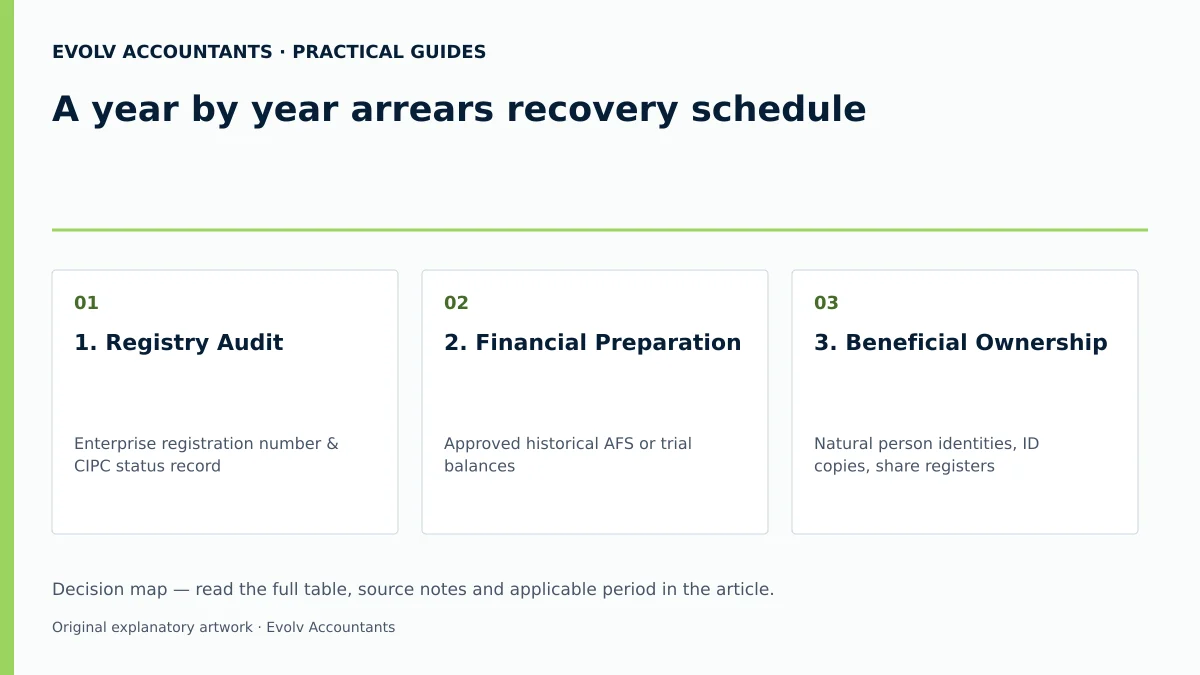
| 1. Registry Audit | Enterprise registration number & CIPC status record 30 33 | Director / Public Officer | Confirm total missing years and current enterprise status 33 | If status is "Final Deregistered", initiate Form CoR 40.5 re-instatement 11 38 |
| 2. Financial Preparation | Approved historical AFS or trial balances 21 22 | Financial Accountant | Verify annual turnover and compute PIS per year 18 22 | Test mandatory audit first, then review exemption and the appropriate AFS/FAS filing route 24 28 |
| 3. Beneficial Ownership | Natural person identities, ID copies, share registers 4 6 | Company Secretary / Director | Obtain CIPC Beneficial Ownership filing confirmation 6 | Resolve unverified BO details before attempting annual return entry 6 |
| 4. Electronic Capture | Active CIPC Customer Code & portal access 5 20 | Authorised Compliance Agent | Capture annual turnover chronologically across missing years 7 30 | If turnover was previously misstated, apply for customer code credit note 40 41 |
| 5. Fee Settlement | Valid credit or debit card 20 32 | Director / Agent | Complete Shopping Cart card payment and receive approval 32 | Re-try card authorisation if payment fails; unpaid items remain pending 31 |
| 6. Compliance Archiving | Official CIPC Certificate & updated registry status 32 33 | Compliance Officer | Archive Annual Return Certificate & confirm status is "In Business" 32 33 | Provide proof of compliance to banking institution and key stakeholders 3 |
Frequently Asked Questions
If a company has filed SARS tax returns, must it still submit outstanding CIPC annual returns?
Yes. A clear distinction exists between CIPC annual returns and SARS tax returns 17. Tax returns calculate taxable income liability to SARS, while CIPC annual returns maintain active corporate registration under the Companies Act 17. Compliance with SARS does not satisfy CIPC obligations 17.
What happens if a company was completely dormant during the overdue years?
Dormant or inactive entities are still legally mandated to file annual returns and pay prescribed fees 36. Neither the Companies Act 2008 nor the Close Corporations Act 1984 exempts inactive businesses from annual compliance 36.
Can CIPC waive late filing penalties or allow fee payment in installments?
No. Prescribed annual return fees and penalties are statutory requirements 42. CIPC lacks legal authority to waive prescribed fees or negotiate installment payment arrangements; invalid payments result in rejected filings 42.
How does a company determine whether to submit an AFS or an FAS with its arrears returns?
Companies required to file audited AFS must do so. A company not required to file audited AFS may voluntarily file audited or reviewed AFS; if it does not, it must file FAS. A required independent review remains necessary even where the company files FAS. Low PIS alone is not a review exemption.
Is beneficial ownership filing mandatory before arrears annual returns can be processed?
Yes. CIPC mandates that an entity's beneficial ownership register must be up to date before annual return submissions are unlocked on e-Services 4 6.
Related guides
- Registering a private company with CIPC step by step
- Filing CIPC annual returns for a private company
- Compliance and Regulations: Keeping Your Business on Track
Sources
- https://annualreturns.cipc.co.za/docs/FAQ_Annual_Returns.pdf
- https://www.justice.gov.za/legislation/acts/2008-071-reg.pdf
- https://www.cipc.co.za//wp-content/uploads/Legal/Regulations/CompaniesAct71_2008.pdf
- https://www.cipc.co.za/wp-content/uploads/Forms/Companies/CoR30_1.pdf
- https://www.cipc.co.za/wp-content/uploads/2024/10/STEP-BY-STEP-ANNUAL-RETURNS-003.pdf