
Applying SBC rates in a first short financial year
21 October 2025

SBC tax in a short first financial year requires a proportionate gross-income qualification test and the tax rates applicable to the assessment year.
Applying Small Business Corporation (SBC) tax rates in a first short financial year requires pro-rata reduction of the gross income threshold and exact application of published progressive tax brackets to taxable income.
When a newly incorporated South African enterprise trades for less than twelve months in its initial financial year, section 12E of the Income Tax Act 58 of 1962 mandates a proportional adjustment to the statutory gross income qualification limit 1 2. Qualifying entities benefit from a progressive corporate tax structure rather than a flat corporate tax rate 3 4.
Determining final tax liability involves verifying legal entity criteria, pro-rating the income ceiling based on months traded, calculating taxable income after allowable capital allowances, and filing the ITR14 company income tax return on eFiling 3 5 6.
Short reporting period and rate application
Under South African tax law, a company's year of assessment corresponds to its financial year 7. For a newly incorporated private company, close corporation, co-operative, or personal liability company, the first financial year begins on incorporation or registration and ends on the company’s applicable financial year-end date 8 9. When trading commences mid-year, the initial reporting period is frequently shorter than twelve months 10.
A clear distinction exists between accounting reporting and tax assessment:
- Accounting output: Financial statements (Income Statement and Balance Sheet) prepared under recognised accounting frameworks to report financial performance over the actual period of operation 11 12.
- Tax assessment output: The ITR14 company income tax return submitted to the South African Revenue Service (SARS) to compute taxable income and normal tax liability for the year of assessment 3 5.
- Monetary units: All primary entries and calculations are conducted in South African Rand (ZAR) 13.
- Appropriate use: SBC tax rates apply exclusively to juristic entities that satisfy all statutory requirements of section 12E throughout the relevant year of assessment 14 15.
Inputs rates periods and exclusions: short reporting period
Determining whether an SME qualifies for SBC tax rates in a short reporting period requires verifying specific statutory inputs against current SARS evidence 16.
— Practical point from this guide
Qualifying Criteria under Section 12E(4)
- Legal Entity Requirement: The taxpayer must be a private company, close corporation, co-operative, or personal liability company incorporated in South Africa 8 15.
- Shareholder Requirement: All holders of shares or member interests must at all times during the year of assessment be natural persons 15 17. Holding shares in another unlisted company (with limited statutory exceptions) disqualifies the entity 17 18.
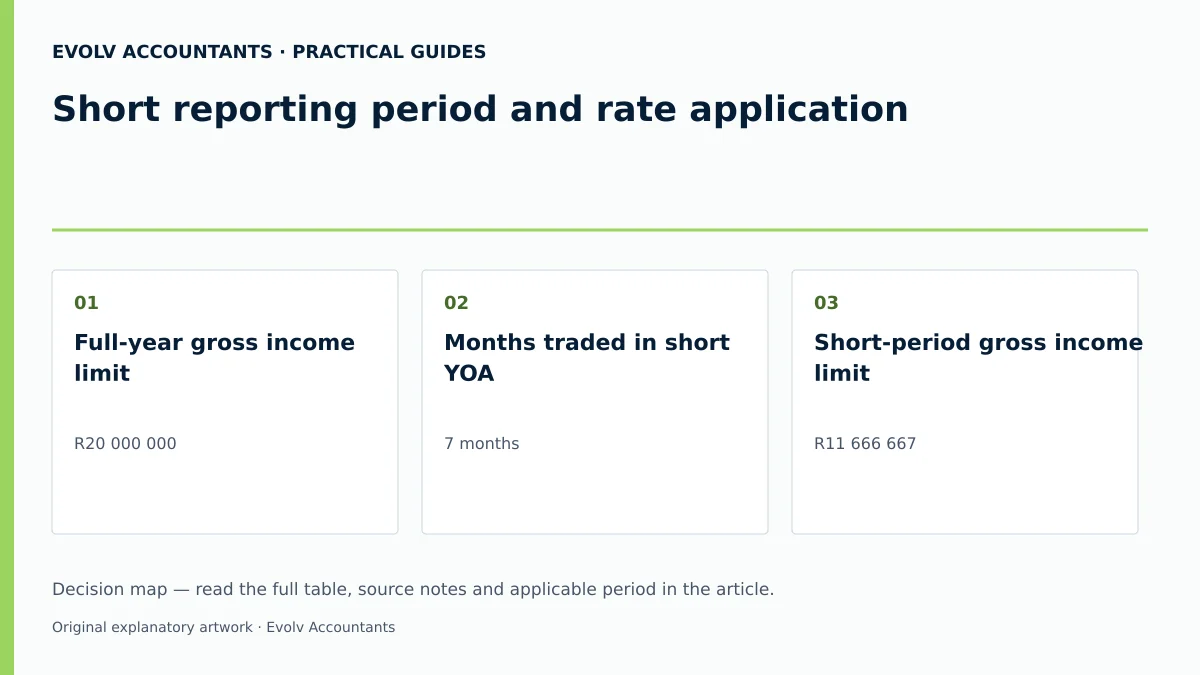
- Gross Income Limitation: Gross income for a full 12-month year of assessment must not exceed R20 million 2 19. Under the proviso to section 12E(4)(a)(i), if the entity carries on trade for less than 12 months, this limit is reduced in proportion to the number of months traded 1 2. A part of a month is reckoned as a full month 1 2.
- Business Activity Limit (20% Tainted Income Exclusion): Not more than 20% of the total of all non-capital receipts, accruals, and capital gains may consist collectively of investment income (such as dividends, interest, royalties, and property rental) and personal service income 15 20.
- Personal Service Provider Exclusion: The entity must not be a Personal Service Provider as defined in the Fourth Schedule 14 15.
Statutory SBC Progressive Tax Rates
The tax liability depends on the applicable year of assessment (YOA). SARS publishes progressive rates applicable to qualifying SBCs 21:
- 2026 Year of Assessment (Financial years ending between 1 April 2025 and 31 March 2026) 21:
- R1 – R95 750: 0% of taxable income 21.
- R95 751 – R365 000: 7% of taxable income above R95 750 21.
- R365 001 – R550 000: R18 848 + 21% of taxable income above R365 000 21.
- R550 001 and above: R57 698 + 27% of taxable income above R550 000 21.
- 2027 Year of Assessment (Financial years ending between 1 April 2026 and 31 March 2027) 21:
- R1 – R99 000: 0% of taxable income 21.
- R99 001 – R365 000: 7% of taxable income above R99 000 21.
- R365 001 – R550 000: R18 620 + 21% of taxable income above R365 000 21.
- R550 001 and above: R57 470 + 27% of taxable income above R550 000 21.
Turnover tax is a separate elective regime with its own qualification rules. Current SARS guidance gives a R2.3 million qualifying annual-turnover limit from 1 April 2026; a registered micro business may elect to remain in the VAT system. It does not replace the section 12E qualification tests. A company whose gross income exceeds R20 million cannot treat turnover tax as an automatic alternative.
Provisional tax comprises advance payments towards income tax, rather than a separate annual tax rate.
Older regulator guidance, such as Interpretation Note 9 (Issue 7), provides the legal interpretation framework for gross income pro-rating under section 12E(4)(a)(i) proviso 1 25, but historical numerical thresholds in legacy documents serve as background and do not overwrite current published SARS rates 21 22.
The calculation in a worked example: rate application
The following reproducible worked example illustrates the pro-rata gross income qualification test and the subsequent application of SBC tax rates in a first short financial year.
Scenario Parameters
- Entity: Private company incorporated in South Africa, owned 100% by natural persons 8 17.
- Year of Assessment: 2026 Year of Assessment (financial year ending 28 February 2026) 7 21.
- Trading Period: Commenced trading on 15 August 2025; year-end 28 February 2026 9 26.
- Trading Duration: 6.5 calendar months, which is reckoned as 7 full months under section 12E(4)(a)(i) 1 6.
- Actual Gross Income: R4 200 000 (illustrative value) 26.
- Investment / Personal Service Income: R100 000 20.
- Allowable Tax Deductions & Capital Allowances: R3 700 000 (including section 12E(1A) accelerated depreciation of 50% on office equipment costing R200 000) 27 28.
Step-by-Step Calculation Table
| Input | Value or verified-source placeholder | Formula or step | Result | Independent check |
|---|---|---|---|---|
| Full-year gross income limit | R20 000 000 19 | Statutory cap under section 12E(4)(a)(i) 2 | R20 000 000 | Confirmed statutory limit 2 |
| Months traded in short YOA | 7 months 6 | 15 Aug 2025 – 28 Feb 2026 (part month = full month) 1 | 7 months | 6.5 months rounded up to 7 6 |
| Short-period gross income limit | R11 666 667 6 | R20 000 000 x (7 / 12) 1 6 | R11 666 667 | 20 000 000 x (7/12) = 11 666 666.67, approximately R11 666 667 6 |
| Actual gross income test | R4 200 000 | Compare actual gross income to short-period limit 6 | Passes the gross-income test | R4 200 000 <= R11 666 667 (Pass) 6 |
| Business activity test | R100 000 / R4 200 000 (assuming this equals all non-capital receipts and accruals and there are no capital gains) | (Investment and personal service income / (non-capital receipts and accruals + capital gains)) x 100 20 29 | 2.38% | 2.38% <= 20% (Pass) 20 |
| Taxable income determination | R4 200 000 – R3 700 000 | Gross Income - Allowable Deductions 26 | R500 000 | Taxable income base 26 |
| Bracket 1 tax (R1 – R95 750) | R95 750 base 21 | R95 750 x 0% 21 | R0.00 | 0% band 21 |
| Bracket 2 tax (R95 751 – R365 000) | R269 250 taxable band 21 | (R365 000 - R95 750) x 7% 21 | R18 848.00 | 269 250 x 0.07 = 18 847.50; published table base rounds to R18 848 21 |
| Bracket 3 tax (R365 001 – R500 000) | R135 000 taxable band 21 | (R500 000 - R365 000) x 21% 21 | R28 350.00 | 135 000 x 0.21 = 28 350.00 21 |
| Total normal tax liability (2026 YOA) | Sum of brackets 21 | R0.00 + R18 848.00 + R28 350.00 21 | R47 198.00 | SBC progressive tax liability 21 |
| Standard CIT comparative test | R500 000 taxable income | R500 000 x 27% flat rate 22 | R135 000.00 | Standard company tax comparison 22 |
| Net SBC tax relief | Comparison 21 22 | R135 000.00 - R47 198.00 21 22 | R87 802.00 | Tax savings achieved under SBC 21 22 |
Reconcile the answer to the underlying records: short reporting period
To complete the tax return accurately, the calculated tax liability must be reconciled to the company's financial and statutory submission records 5 30:
- Gross Income Reconciliation: Match declared gross income on the ITR14 to total revenue plus other income recorded in the Annual Financial Statements 23 31.
- Tax Computation Adjustments: Reconcile accounting profit/loss to taxable income on the ITR14 return by reversing non-deductible accounting expenses and adding back accounting depreciation before claiming statutory section 12E capital allowances 32 33 34.
- Rounding Principles: Complete currency fields on the ITR14 return in Rands, rounding off cents as required by eFiling validation rules 13.
- Provisional Tax Credits: Deduct provisional tax payments previously remitted to SARS via IRP6 returns from the normal tax liability to establish the net amount payable or refundable 21.
- PAYE Credits: Ensure pre-populated IRP5 tax certificates for employee tax withheld are verified on eFiling 35 36.
- Statutory Disclosures: Maintain beneficial ownership records (mandatory for tax returns from the 2022 YOA onward) 37 and complete the Public Officer declaration 30.
Edge cases that change the calculation: rate application
Specific corporate changes or operational conditions can alter the tax calculation or trigger SBC disqualification 17 38:
- Variable Period Duration: As specified in Interpretation Note 9 (Issue 7), "the proviso does not increase the R20 million limitation when the year of assessment or the period of trading is longer than 12 months" 39. If a company has a 14-month financial year and traded for 13 months, the R20 million limit remains unadjusted 39.
- Cessation of Trade: When a company enters liquidation or permanently ceases trading mid-year, the gross income limitation must be pro-rated to the exact number of months traded prior to cessation 1 38.
- Manufacturing Assets (Section 12E(1)): Plant or machinery acquired and brought into use directly in a process of manufacture by an SBC qualifies for a 100% immediate write-off in the year first brought into use 40 41 42.
- General Depreciable Assets (Section 12E(1A)): Non-manufacturing tangible assets qualify for an accelerated 3-year write-off at rates of 50%, 30%, and 20% in respective years 27 43. Section 12E(1A)(b) does not require apportionment of the 50% allowance when the asset is brought into use during a short financial year 27 28.
- Loss of SBC Status in Subsequent Years: If a company qualifies as an SBC in Year 1 and claims the 50% allowance under section 12E(1A), but loses SBC status in Year 2 due to exceeding the gross income limit, it remains entitled to claim the remaining 30% (Year 2) and 20% (Year 3) deductions for assets brought into use while it qualified 44 45.
- Disqualifying Share Ownership: If a shareholder acquires shares in another unlisted private company for even a single day during the year of assessment, the entity is immediately disqualified from SBC tax rates for that entire tax year 17 18.
Next steps for Small business corporation tax
Numbered Compliance Checklist
- Verify Legal Status: Confirm entity registration and verify that all shareholders were natural persons throughout the financial period 8 17.
- Determine Trading Duration: Identify exact dates when trading commenced and calculate the trading period in months (counting partial months as full months) 1 6.
- Calculate Pro-Rata Ceiling: Multiply R20 million by the trading months divided by 12 to establish the short-period gross income limit 1 6.
- Test Gross Income & Business Activity: Check that total gross income is within the pro-rated threshold and that investment/personal service income does not exceed 20% 6 20.
- Prepare Financial Statements: Compile signed Annual Financial Statements supporting the ITR14 return 11.
- Compute Tax Allowances: Calculate section 12E accelerated depreciation allowances on qualifying capital assets 27 40.
- Complete ITR14 on eFiling: Select "Yes" to the SBC wizard question on the ITR14 return, complete the SBC section, and submit beneficial ownership disclosures 3 37 46.
Distinction Between Law, Guidance, and Professional Recommendations
- Statutory Law: Section 12E of the Income Tax Act 58 of 1962 establishes the mandatory legal framework, including the pro-rata gross income proviso 1 2 15.
- Regulator Guidance: SARS Guides and Interpretation Note 9 (Issue 7) provide administrative guidelines on trade commencement, asset write-off elections, and return completion 3 5 25.
- Evolv Recommendations: Evolv Accountants advises maintaining contemporaneous record-keeping of trading start dates, conducting pre-year-end qualification reviews, and performing dual-bracket tax checks prior to return submission.
Frequently Asked Questions
How is the SBC gross income limit calculated for a trading period of less than 12 months?
Under the proviso to section 12E(4)(a)(i), the statutory R20 million limit is reduced proportionately based on the ratio of months traded to 12 months 1 2. A part of a month is reckoned as a full month 1 2. For example, trading for 7 months results in a limit of R20 million x (7 / 12) = R11 666 667 6.
Do SBC tax rate brackets get pro-rated for a short financial year?
SARS publishes progressive tax rate brackets for the year of assessment 21. While the gross income qualification threshold is explicitly pro-rated under section 12E(4)(a)(i) proviso 1 2, normal tax is computed on the actual taxable income derived during that year of assessment using the published tax tables 3 21.
Does a short financial year affect the section 12E accelerated depreciation allowance?
No. Under section 12E(1A)(b), the accelerated depreciation allowance (50% in Year 1, 30% in Year 2, and 20% in Year 3) is calculated as a percentage of asset cost and does not require pro-rata reduction for assets brought into use during a short tax year 27 28.
What happens if an SBC shareholder acquires shares in another company during the year?
If any shareholder holds shares or an interest in another close corporation, private company, or co-operative during the year of assessment (outside limited statutory exceptions such as listed shares), the company is disqualified from SBC status for that entire tax year 17 18.
How does SBC tax compare to turnover tax for micro businesses?
Turnover tax is a separate elective regime with its own qualification rules. Current SARS guidance gives a R2.3 million qualifying annual-turnover limit from 1 April 2026; a registered micro business may elect to remain in the VAT system. It does not replace the section 12E qualification tests. A company whose gross income exceeds R20 million cannot treat turnover tax as an automatic alternative. Provisional tax comprises advance payments towards income tax, rather than a separate annual tax rate. Ask Evolv about short reporting period and rate application. Share the relevant records so the support required can be scoped.
Related guides
- SBC tax qualification and other shareholdings
- How South African Businesses Can Qualify for SBC Tax Rates & Save Thousands
- The Proactive SARS Audit Guide: Keeping Your Business Ledger Sanitised
Sources
- https://www.sars.gov.za/wp-content/uploads/Legal/Notes/LAPD-IntR-IN-2012-09-Small-Business-Corporations.pdf
- Small business relief | South African Revenue Service
- https://www.sars.gov.za/wp-content/uploads/IT-GEN-04-G01-How-to-complete-the-Income-Tax-Return-ITR14-for-Companies-External-Guide.pdf
- Companies, Trusts and Small Business Corporations (SBC) | South African Revenue Service
- Turnover Tax | South African Revenue Service