
SBC tax qualification and other shareholdings
2 November 2025

SBC tax qualification requires checking other shareholdings against the statutory restrictions and exceptions for the assessment year.
Small business corporation tax qualification requires that no shareholder holds an impermissible share or equity interest in any other company during the relevant year of assessment.
Under Section 12E of the Income Tax Act 58 of 1962, a South African private company, close corporation, personal liability company, or co-operative can access progressive Small Business Corporation (SBC) tax rates only if the natural-person ownership test and the restriction on impermissible interests in other companies are met throughout the assessment year, subject to the statutory exceptions 1 2 3.
While dual shareholding generally disqualifies an entity, statutory exceptions permit shareholders to hold interests in listed companies, collective investment schemes, sectional title bodies corporate, share block companies, and entities that have never traded in any assessment year and have never owned assets whose combined market value exceeded R5,000 in any assessment year 4 5 6.
Permitted interests versus disqualifying ownership
For South African business owners, corporate directors, and close corporation members, qualifying for Small Business Corporation relief provides substantial income tax savings 1 7. However, tax qualification must be clearly distinguished from company registration at the Companies and Intellectual Property Commission (CIPC). SBC status is not a static registration category; it is an annual tax classification evaluated by the South African Revenue Service (SARS) on the Income Tax Return for Companies (ITR14) 7 8.
Eligibility is re-evaluated for every year of assessment 8. For years of assessment ending between 1 April 2026 and 31 March 2027 and, for comparison, years ending between 1 April 2025 and 31 March 2026, qualifying SBCs benefit from a progressive tax table 9:
- R1 to R99,000 taxable income (R95,750 for years ending 1 April 2025 to 31 March 2026): Taxed at 0% 9.
- R99,001 to R365,000 (R95,751 to R365,000 for years ending 1 April 2025 to 31 March 2026): Taxed at 7% of taxable income above R99,000 (or R95,750 for years ending 1 April 2025 to 31 March 2026) 9.
- R365,001 to R550,000: Taxed at R18,620 + 21% of taxable income above R365,000 (R18,848 + 21% for years ending 1 April 2025 to 31 March 2026) 9.
- R550,001 and above: Taxed at R57,470 + 27% of taxable income above R550,000 (R57,698 + 27% for years ending 1 April 2025 to 31 March 2026) 9.
By contrast, companies that fail SBC qualification are taxed at the standard flat corporate income tax rate of 27% on all taxable income for financial years ending on or after 31 March 2023 10.
In navigating these provisions, businesses must distinguish statutory law, regulator guidance, and advisory practice:
- Statutory Law: Section 12E of the Income Tax Act 58 of 1962 establishes the legal requirements and exclusions 11 12.
- Regulator Guidance: SARS Interpretation Note 9 (Issue 7) and official ITR14 completion guides outline administrative rules, wizard triggers, and verification standards 7 11.
- Evolv Recommendations: Practical compliance procedures, shareholder portfolio audits, and evidence mapping to protect SBC eligibility against disqualification.
The qualification tests to check: permitted interests
To secure SBC tax treatment, a taxpayer must satisfy six cumulative statutory criteria under Section 12E(4)(a) throughout the entire year of assessment 2 13:
- Legal Entity Requirement: The business must be a private company, close corporation, personal liability company, or co-operative registered in South Africa 1 14.
- Natural Person Shareholder Requirement: All holders of shares or members must, at all times during the year of assessment, be natural persons 2 14. Shares held via a trust disqualify the company unless the beneficiaries are natural persons who hold a vested right in those shares throughout the year 15.
- Gross Income Limitation: Gross income for the year of assessment must not exceed R20 million 16. If trading carried on for less than 12 months, this threshold is reduced proportionately based on the ratio of trading months to 12 16 17.
- Business Activity / Tainted Income Test: Not more than 20% of the total non-capital receipts, accruals, and capital gains may consist collectively of investment income (dividends, royalties, immovable property rental, annuities) and personal service income 18 19.
- Personal Service Provider Exclusion: The entity must not be a "personal service provider" as defined in the Fourth Schedule, unless it employs three or more full-time employees who are neither shareholders nor connected persons in relation to shareholders engaged in rendering that service throughout the tax year 20 21 22.
- Permitted Interests Test: Under Section 12E(4)(a)(ii), no shareholder or member may hold any shares or equity interest in any other company at any time during the year of assessment 3 4.
The prohibition against dual shareholding prevents taxpayers from splitting turnover across multiple entities to exploit lower SBC tax brackets 3. However, Section 12E(4)(a)(ii) explicitly permits shareholders to hold interests in specific exempt categories 4 23:
- Listed Companies: Shares listed on a recognised exchange, such as the JSE 4 24.
- Collective Investment Schemes: Portfolios in collective investment schemes 4 24.
- Section 10(1)(e) Entities: Bodies corporate established under the Sectional Titles Act, share block companies, and non-profit homeowners associations formed to manage common collective interests 4 25.
- Co-operatives: Less than 5% interest in a social, consumer, or burial co-operative, or primary savings co-operative bank 5 26 27.
- Friendly Societies: Friendly societies registered under the Friendly Societies Act 5 27.
- Venture capital holdings: Check the actual wording of section 12E(4)(a)(ii) applicable to the assessment year before treating a holding as permitted. The older Interpretation Note is background and is not a substitute for that check.
- Inactive / Dormant Entities: A company, close corporation, or co-operative that has not carried on trade in any assessment year and has not owned assets whose combined market value exceeded R5,000 in any assessment year 6 29.
- Entities in Liquidation / Deregistration: Entities that have taken formal steps under Section 41(4) to liquidate, wind up, or deregister 6 29.
Holding shares in any entity outside these permitted categories—even for a single day during the year of assessment—disqualifies the company from SBC status for that entire financial year 2 3.
Evidence behind the eligibility decision: disqualifying ownership
SARS requires specific evidence to substantiate SBC eligibility disclosures on the ITR14 income tax return 7 30 31. Each requirement connects to concrete primary records and a responsible officer:
— Practical point from this guide
- Shareholder Identity and External Equity Holdings: The Public Officer and Directors must maintain the company share register, CIPC disclosures, beneficial ownership register, and signed shareholder declarations confirming that no shareholder holds equity in non-exempt third-party companies 2 30 31.
- Gross Income and Short Year Adjustments: Financial statements, trial balances, and trading start-date records prepared by the Accountant verify that gross income remains within the R20 million ceiling (or its prorated limit) 17 32.
- Tainted Income Ratios: General ledgers and revenue schedules verify that investment income and personal service earnings do not exceed the 20% limit 18 19.
- Dormant Entity Asset Verification: Where a shareholder holds equity in an inactive company, signed affidavits, CIPC deregistration filings, and asset valuations must establish that the entity has never traded in any assessment year and has never owned assets whose combined market value exceeded R5,000 in any assessment year 6 29.
A qualifying case and an excluded case: permitted interests
The following reproducible hypothetical scenario illustrates how shareholder equity holdings affect SBC eligibility in practice:
Scenario Parameters
Two independent South African private companies, Apex Engineering (Pty) Ltd and Beacon Freight (Pty) Ltd, evaluate their SBC status for the 2027 year of assessment (financial year ending 28 February 2027). Both companies generate R10,000,000 in gross income and realise R500,000 in taxable income. Assume that each meets every other section 12E test, including the combined investment/personal-service limit and the personal-service-provider exclusion; only the secondary shareholding facts differ.
Case A: Qualifying Entity (Permitted Interests)
Apex Engineering (Pty) Ltd is 100% owned by Director A 2. Director A also holds:
- Ordinary shares in a company listed on the JSE 4 24.
- A 2% shareholding in a residential share block company where Director A resides 4 25.
Result: Shares in JSE-listed companies and share block entities are statutory permitted holdings under Section 12E(4)(a)(ii)(aa) and (cc) 4. Apex Engineering satisfies all SBC requirements and qualifies for SBC tax rates in the 2027 year of assessment 9 13.
2027 SBC Tax Calculation for Apex Engineering:
- Taxable income: R500,000 9
- Tax on R0 – R99,000 @ 0%: R0 9
- Tax on R99,001 – R365,000 (R266,000 @ 7%): R18,620 9
- Tax on R365,001 – R500,000 (R135,000 @ 21%): R28,350 9
- Total Tax Payable: R46,970 9
Case B: Excluded Entity (Disqualifying Ownership)
Beacon Freight (Pty) Ltd is 100% owned by Director B 2. Director B also owns 50% of an unlisted property company, Delta Holdings (Pty) Ltd. Delta Holdings has never traded, but it owns an undeveloped plot of land with an asset market value of R30,000.
Result: Although Delta Holdings has never traded, its total assets (R30,000) exceed the statutory R5,000 threshold under Section 12E(4)(a)(ii)(hh) 6 29. Delta Holdings fails the dormant entity exemption, making Director B's shareholding impermissible 3 29. Consequently, Beacon Freight is disqualified from SBC treatment for the entire 2027 year of assessment 2 3.
2027 Standard Corporate Tax Calculation for Beacon Freight:
- Taxable income: R500,000 10
- Flat Corporate Tax Rate: 27% 10
- Total Tax Payable: R500,000 × 27% = R135,000 10
Financial Impact: Disqualification due to Director B's non-compliant secondary shareholding increases Beacon Freight's tax liability by R88,030 (R135,000 vs R46,970).
What changes the answer: disqualifying ownership
SBC eligibility can change rapidly during a tax year due to operational or structural changes:
- Mid-Year Share Acquisition: If a shareholder acquires shares in an unlisted trading company during the tax year, SBC status is lost for the entire year, even if the shares were held for only one day 2 3.
- Delisting of External Companies: If a listed company in which a shareholder owns shares delists from the stock exchange, the holding becomes an impermissible unlisted interest, disqualifying the SBC 33.
- Asset Growth in Inactive Entities: If an inactive company owned by a shareholder acquires assets pushing its total market value above R5,000, it loses its dormant exemption status under Section 12E(4)(a)(ii)(hh) 6 29.
- Trading Period and Income Changes: Exceeding the R20 million gross income limit (or its prorated equivalent in a short year) or exceeding the 20% limit on investment and personal service income immediately disqualifies the entity 17 18.
- Beneficial Ownership Changes: Introducing corporate shareholders or transferring beneficial ownership to non-natural persons invalidates SBC status 2 30.
Next steps for Small business corporation tax
To manage SBC compliance and prevent unintended disqualification, businesses should follow this decision checklist:
- Conduct an Annual Shareholder Audit: Review all direct and beneficial holdings for every shareholder 2 30 31.
- Verify Secondary Holdings Against Statutory Exemptions: Obtain share certificates, JSE listing confirmations, or s10(1)(e) registrations for external entities 4 23.
- Inspect Inactive Entities: Where shareholders own shares in dormant businesses, confirm that the entity has never traded and that the combined market value of its assets has never exceeded R5,000 in any assessment year 6 29.
- Test Gross Income and Short-Period Limits: Confirm gross income does not exceed R20 million, applying proportionate reduction if the trading period is under 12 months 16 17.
- Calculate Tainted Income Ratios: Ensure investment and personal service income combined do not exceed 20% of total non-capital receipts and capital gains 18 19.
- Verify Personal Service Provider Status: Confirm that the entity is not a personal service provider. If relying on the employee exception, verify three or more full-time employees throughout the assessment year who are neither shareholders nor connected persons in relation to shareholders and are engaged full time in the business of rendering the relevant service 20 21.
- Accurately Disclose on Return ITR14: Complete the SBC wizard questions correctly on SARS eFiling and retain supporting schedules for five years 7.
Eligibility Decision Table
| Test | Facts to obtain | Evidence | Applicable source | Result or unresolved question |
|---|---|---|---|---|
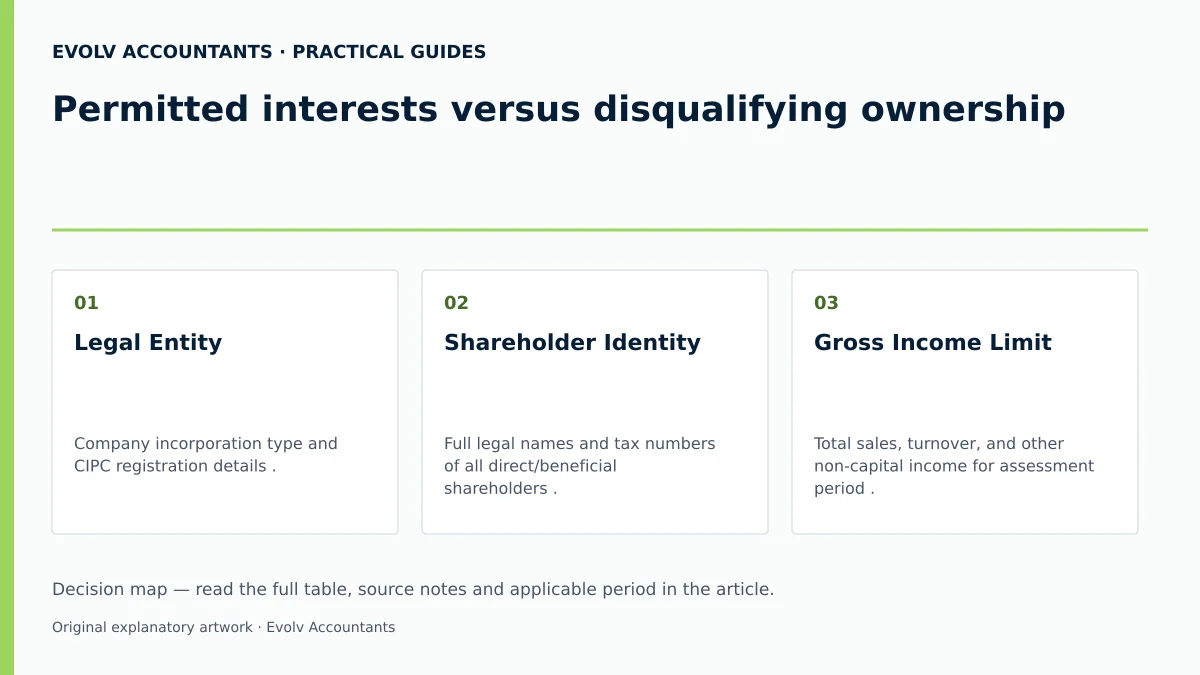
| Legal Entity | Company incorporation type and CIPC registration details 1. | CIPC MOI, founding statement, or registration certificate 1 34. | Section 12E(4)(a) 1 14. | Qualifies if private company, CC, personal liability company, or co-op 1. |
| Shareholder Identity | Full legal names and tax numbers of all direct/beneficial shareholders 2 30. | Share register, trust deeds, and ITR14 beneficial ownership disclosures 15 30 31. | Section 12E(4)(a) 2 14. | Natural-person beneficial ownership throughout the year; review any vested rights in trust-held shares 2. |
| Gross Income Limit | Total sales, turnover, and other non-capital income for assessment period 16 35. | Annual Financial Statements, trial balances, and trading start-date records 17 32. | Section 12E(4)(a)(i) 16 35. | Qualifies if <= R20m (or prorated limit for short trading period) 17. |
| Tainted Income Ratio | Investment income (dividends, interest, rent, royalties) and personal service revenue 18 19. | Income statement breakdown and general ledger analysis 18. | Section 12E(4)(a)(iii) 18 19. | This criterion passes if investment plus personal-service income is <= 20% of non-capital receipts and accruals plus capital gains 18. |
| Dual Shareholding | External shareholdings and equity interests held by all shareholders 3 4. | Signed shareholder affidavits and CIPC search reports across all shareholders 3. | Section 12E(4)(a)(ii) 3 4. | Qualifies only if external holdings fall within statutory exemptions (aa–ii) 4 23. |
| Dormant Entity Test | Trading history and asset-value history across every assessment year of external unlisted holdings 6 29. | Evidence confirming no trade in any assessment year and no ownership of assets whose combined market value exceeded R5,000 in any assessment year 6 29. | Section 12E(4)(a)(ii)(hh) 6 29. | The dormant exception fails if the external entity traded or owned assets with combined market value exceeding R5,000 in any assessment year 29. |
Frequently Asked Questions
Does holding shares in a JSE-listed company disqualify a business from SBC tax rates?
No. Section 12E(4)(a)(ii)(aa) specifically permits shareholders of an SBC to hold shares in a listed company 4 24. The holding must meet the actual listed-company exception applicable to the assessment year; verify the company’s listing status and the statutory definition.
What happens if a shareholder owns shares in an inactive or dormant company?
A shareholder may hold shares in an inactive entity only if that entity has never traded in any assessment year and has never owned assets whose combined market value exceeded R5,000 in any assessment year 6 29. If the entity owned assets whose combined market value exceeded R5,000 in any assessment year, or traded in any assessment year, the shareholding is impermissible and disqualifies the SBC 6 29.
Is SBC qualification a once-off status or reviewed annually?
SBC qualification is reviewed annually for every year of assessment 8. A company must satisfy all legal, shareholder, gross income, and activity criteria during each specific financial year to apply SBC tax rates on its ITR14 tax return 7 8 31.
Can a trust be a shareholder in a Small Business Corporation?
Direct shareholding by a trust generally disqualifies an SBC because all shareholders must be natural persons 2 15. However, a company may qualify if the trust's beneficiaries hold vested rights in those shares throughout the year of assessment and are all natural persons 15. If the trust itself holds the beneficial interest, the company is disqualified 15.
How is the SBC gross income limit calculated for a company trading for part of a year?
If an entity carries on trade for less than 12 months during a year of assessment, the R20 million gross income limit is reduced proportionately 16 17. The limit is calculated by multiplying R20 million by the number of trading months (reckoning a part of a month as a full month) and dividing by 12 16 17. Ask Evolv about permitted interests versus disqualifying ownership. Share the relevant records so the support required can be scoped.
Related guides
- SBC tax and ordinary company tax
- How South African Businesses Can Qualify for SBC Tax Rates & Save Thousands
- The Proactive SARS Audit Guide: Keeping Your Business Ledger Sanitised
Sources
- https://www.sars.gov.za/wp-content/uploads/Legal/Notes/LAPD-IntR-IN-2012-09-Small-Business-Corporations.pdf
- Companies, Trusts and Small Business Corporations (SBC) | South African Revenue Service
- https://www.sars.gov.za/wp-content/uploads/IT-GEN-04-G01-How-to-complete-the-Income-Tax-Return-ITR14-for-Companies-External-Guide.pdf