
SBC tax and ordinary company tax
18 November 2025

SBC tax is a qualifying company-tax regime with specific conditions and rates; ordinary company tax applies when a company does not qualify for small business corporation relief.
Comparing Small Business Corporation tax with ordinary company tax begins with statutory eligibility, then the applicable tax period, taxable income and asset allowances.
Small Business Corporation (SBC) tax under Section 12E of the Income Tax Act provides South African small and medium enterprises (SMEs) with progressive income tax rates starting at 0% alongside accelerated capital depreciation allowances 1 2 3. In contrast, ordinary corporate income tax imposes a flat rate of 27% across all taxable profits for assessment years ending between 1 April 2023 and 31 March 2027 4.
SBC status is not an elective choice or automatic benefit; a private company, close corporation, personal liability company, or co-operative must continuously satisfy four strict legal requirements regarding shareholding, gross income, investment income, and personal service activity to qualify 5 6 7. Where an entity exceeds the R20 million gross income cap or breaches ownership restrictions, it automatically defaults to ordinary company tax rules 8 9 10.
Like for like ordinary company tax comparison
Defining ordinary corporate income tax
Corporate income tax (CIT) is a direct tax levied by the South African Revenue Service (SARS) on all resident companies incorporated in or effectively managed within South Africa 11. For financial years of assessment ending on any date between 1 April 2023 and 31 March 2027, the standard corporate tax rate is a flat 27% 4.
Under ordinary company tax, all taxable profit—calculated after deducting allowable business expenses and standard wear-and-tear allowances—is taxed at this flat percentage regardless of whether the net profit is R10,000 or R100 million 4 11.
Defining Small Business Corporation (SBC) tax
SBC tax is a specialised tax relief regime governed by Section 12E of the Income Tax Act 58 of 1962, designed to foster growth and reduce administrative tax burdens for small enterprises 2 12 13. Rather than applying a single flat rate, SARS assesses qualifying SBCs using a progressive marginal tax bracket structure 1 2.
For the year of assessment ending between 1 April 2025 and 31 March 2026, the first R95,750 of taxable income is taxed at 0%, income between R95,751 and R365,000 is taxed at 7%, income between R365,001 and R550,000 is taxed at 21%, and taxable income above R550,000 is taxed at 27% 1. For the year of assessment ending between 1 April 2026 and 31 March 2027, the 0% exempt threshold increases to R99,000 1.
Key structural distinctions
Neither tax treatment is inherently a universal winner for every enterprise. While SBC tax offers substantial cash savings at lower and moderate profit levels, qualification is tightly bound by statute 5 6. Ordinary company tax imposes a higher initial tax burden on lower profits but places no restrictions on corporate shareholders, holding structures, secondary trading entities, or investment income ratios 8 14 15.
Compare the criteria that matter: like for like ordinary company tax comparison
Ownership and control parameters
Under Section 12E(4)(a), SBC qualification mandates that all holders of shares or members in the company, close corporation, or co-operative must at all times during the entire year of assessment be natural persons 5 7 14.
Those natural persons may not hold any shares or equity interest in any other company, close corporation, or co-operative, subject to narrow statutory exceptions such as listed shares, collective investment schemes, body corporates, or entities that have never traded in any assessment year and have never owned assets whose combined market value exceeded R5,000 in any assessment year 15 16 17 18 19 20 21 22 23. Ordinary corporate tax imposes no such shareholding limits 8.
Income, asset, and operational thresholds
An SBC's gross income for the year of assessment must not exceed R20 million 5 10 24. If the entity carries on trade for less than 12 months in a financial year, this threshold is reduced proportionally based on the number of months traded 25 26. Additionally, not more than 20% of total receipts, accruals (excluding capital receipts), and capital gains may consist collectively of investment income (such as dividends, interest, royalties, and rental from immovable property) and income from rendering a personal service 5 19 27.
Personal service income is excluded from this 20% restriction if the company throughout the year of assessment employs three or more full-time employees (who are not shareholders or connected persons) engaged in rendering that service 20 28 29 30 31 32 33 34.
Cash flow and depreciation impacts
SBC status unlocks enhanced accelerated depreciation allowances under Section 12E 35 36. Manufacturing plant and machinery brought into use for the first time by an SBC are eligible for a 100% immediate cost write-off in Year 1 under Section 12E(1) 37 38. Other qualifying tangible assets under Section 12E(1A) can be written off over three years at 50% in Year 1, 30% in Year 2, and 20% in Year 3, without pro-rata apportionment for assets used for part of a year 39 40 41.
Ordinary companies must rely on standard wear-and-tear under Section 11(e) or general manufacturing allowances under Section 12C 42 43 44.
Decision comparison matrix
| Criterion | Option A: Ordinary Company Tax | Option B: SBC Tax (Section 12E) | Evidence or assumption | Implication for this reader |
|---|---|---|---|---|
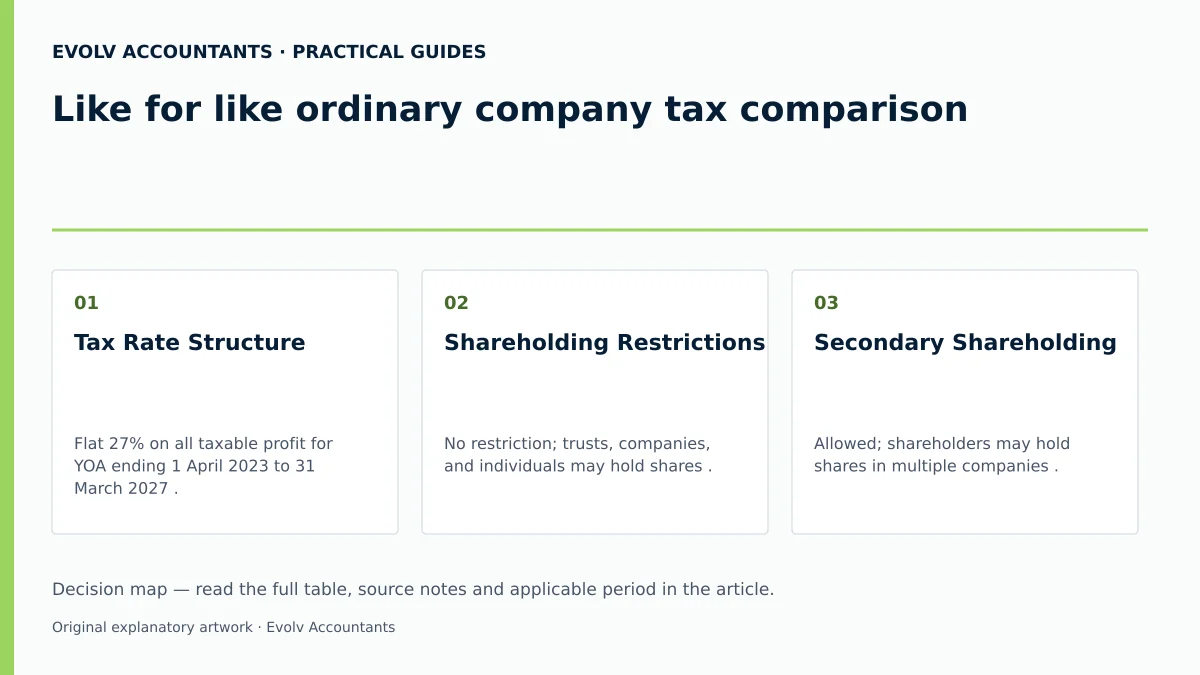
| Tax Rate Structure | Flat 27% on all taxable profit for YOA ending 1 April 2023 to 31 March 2027 4. | Progressive rates (0%, 7%, 21%, 27%) across statutory profit brackets 1. | SARS web rate tables for companies and SBCs 1 4. | SBC provides significant income tax savings on profits up to R550,000 1. |
| Shareholding Restrictions | No restriction; trusts, companies, and individuals may hold shares 8. | 100% natural person shareholders required at all times during YOA 5 14. | Section 12E(4)(a) statutory requirement 5 7. | Corporate ownership is disqualifying; trust arrangements require examination of whether natural-person beneficiaries hold vested rights in the shares throughout the year 14. |
| Secondary Shareholding | Allowed; shareholders may hold shares in multiple companies 8. | Prohibited; shareholders cannot hold equity in other companies (limited exceptions) 15 28. | Section 12E(4)(a)(ii) and Interpretation Note 9 15 16. | An impermissible external interest can disqualify the company even if the other entity is dormant 15. |
| Gross Income Limit | Unlimited turnover permitted 8. | Max R20 million per YOA (pro-rata for short trading periods) 5 24 25. | Section 12E(4)(a)(i) gross income cap 5 10. | Exceeding R20m automatically converts company to ordinary CIT 9 45. |
| Manufacturing Asset Allowance | Standard write-offs (e.g. Section 12C 40/20/20/20 or Section 11(e)) 42 43. | 100% immediate write-off in Year 1 under Section 12E(1) 37 38. | Section 12E(1) plant and machinery allowance 37 38. | Substantive cash flow relief in the year manufacturing machinery is brought into use 37. |
| General Asset Depreciation | Wear-and-tear under Section 11(e) spread over useful life 44 46. | 50% Year 1, 30% Year 2, 20% Year 3 under Section 12E(1A) 39 41. | Section 12E(1A) three-year accelerated write-off 39 41. | Faster tax write-off on office equipment and vehicles without monthly apportionment 39 40. |
| Personal Service Restrictions | Standard expenses allowed (subject to Fourth Schedule PSP rules) 47 48. | Combined investment and personal service income must not exceed 20% of the statutory denominator; the qualifying employee test can remove personal-service classification only 27 28 31. | Section 12E(4)(a)(iii) and Section 12E(4)(d) 27 29. | For service income performed by shareholders or connected persons, test the statutory employee exception and the combined 20% limit 31 34. |
How the obligations differ: documented completion and exceptions
Return filing and form wizard customisation
Both ordinary companies and SBCs complete and submit the Income Tax Return for Companies (ITR14) via SARS eFiling 49 50 51. During return preparation, the eFiling Form Wizard presents specific classification questions 52 53. If the taxpayer answers "Yes" to being an SBC under Section 12E, a dedicated SBC container is generated requiring explicit statutory declarations regarding gross income, shareholding, investment income ratios, and personal service provider status 5 28 54.
Misrepresentation on the eFiling declaration constitutes a legal breach subject to administrative penalties and prosecution 55 56.
Statutory disclosures and beneficial ownership
From the 2022 tax year onwards, SARS mandates complete disclosure of beneficial ownership for all companies submitting an ITR14, identifying individuals who ultimately own or exercise effective control 57. In addition, companies classified as "Small Business" on the eFiling Form Wizard (gross income up to R20 million and total assets up to R10 million) are distinguished from SBC statutory status under Section 12E; eFiling Form Wizard classification does not automatically grant Section 12E tax rates 8 24 58.
Distinction between law, regulator guidance, and Evolv recommendations
Law comprises the statutory provisions of the Income Tax Act 58 of 1962 (such as Section 12E and the Fourth Schedule) 13 38. Regulator guidance consists of official SARS external guides (like the ITR14 guide) and Interpretation Notes (such as Interpretation Note 9 Issue 7) 13 49. Evolv recommendations represent professional accounting advice tailored to optimise compliance, structure payroll, maintain statutory registers, and ensure client evidence stands up to SARS audit 59.
— Practical point from this guide
Actionable compliance checklist for testing SBC eligibility
- Verify legal entity incorporation status: Confirm incorporation as a private company, close corporation, co-operative, or personal liability company registered in South Africa 7 60.
- Confirm 100% natural person ownership: Ensure all shares or members' interests are held exclusively by natural persons at all times throughout the financial year 5 14.
- Audit secondary shareholdings: Confirm that no shareholder holds shares or equity in any other company or close corporation, whether active or dormant, at any time during the assessment year, subject to the specific statutory exceptions 15 28.
- Test gross income ceiling: Verify that gross income for the assessment year does not exceed R20 million (or the pro-rata limit for short financial years) 5 10 25.
- Evaluate personal service and investment income: Check that combined investment income and personal service income does not exceed 20% of total non-capital receipts plus capital gains, after classifying personal-service income correctly, including any qualifying employee exception 5 27 31.
- Exclude Personal Service Provider status: Ensure the company is not classified as a Personal Service Provider under the Fourth Schedule 5 61.
Two business situations with different outcomes: like for like ordinary company tax comparison
Scenario 1: A qualifying boutique engineering consultancy
Consider hypothetical Company Alpha (Pty) Ltd, a boutique structural engineering consultancy owned equally by two natural persons with no other directorships or shareholdings. For the year of assessment ending 31 March 2026, Alpha derives R4.5 million in gross consulting fees and incurs deductible operating expenses of R4.0 million, resulting in a net taxable profit of R500,000. Throughout the tax year, Alpha employs three full-time, non-shareholder, non-connected drafting technicians.
Because Alpha employs three full-time technical staff rendering the service, its engineering fees are excluded from being classified as a restricted personal service 28 31.
Scenario 2: A commercial trading company exceeding statutory limits
Consider hypothetical Company Beta (Pty) Ltd, an import trading firm owned by a discretionary family trust in which no natural-person beneficiary has vested rights in the shares throughout the year. For the year of assessment ending 31 March 2026, Beta generates R12 million in gross revenue and R500,000 in net taxable profit. Because a trust holds the shares, Beta breaches the natural person shareholding requirement of Section 12E(4)(a) and is disqualified from SBC rates 5 14.
Step-by-step arithmetic tax comparison
For the Year of Assessment ending 31 March 2026 (financial year ending between 1 April 2025 and 31 March 2026), comparing taxable profits of R500,000 1:
- Option A: Ordinary Company Tax (@ 27% flat rate) 4:
Tax Liability = R500,000 × 27% = R135,000 4
- Option B: SBC Progressive Rates (Section 12E) 1:
- Bracket 1 (R1 – R95,750 @ 0%): R0 1
- Bracket 2 (R95,751 – R365,000 @ 7% on R269,250): R18,848 1
- Bracket 3 (R365,001 – R500,000 @ 21% on R135,000): R28,350 1
- Total SBC Tax Liability = R18,848 + R28,350 = R47,198 1
- Comparative Result: Company Alpha saves R87,802 in income tax for the 2026 assessment year by qualifying for SBC status (R135,000 - R47,198) 1 4. Company Beta, due to trust ownership, must pay R135,000 under ordinary corporate tax 4 14.
When the comparison needs specialist input: documented completion and exceptions
Excluded entity structures and complex contracts
Specialist tax advice from Evolv is required whenever complex ownership structures exist, such as indirect shareholding, shares held by nominees, or cross-directorships 15. Entities with corporate shareholders or overseas parent companies are strictly excluded from SBC status and must be structured under ordinary company tax rules 14.
Personal service providers and employee thresholds
Where a company derives more than 80% of its income from a single client or operates under client supervision, SARS may classify it as a Personal Service Provider (PSP) under the Fourth Schedule 47 61. PSPs are explicitly disqualified from SBC tax relief under Section 12E(4)(a)(iv) 5 61. Evaluating whether contract terms imply an employer-employee relationship or whether technical employees meet the full-time non-connected criteria requires professional review 34 47 62.
Technical tax and legal judgements
Complex scenarios involving fluctuating turnover (where gross income borders R20 million), asset disposal roll-over relief under paragraph 66 of the Eighth Schedule, or capital grants require formal tax opinions and detailed accounting records 10 63 64.
Next steps for Small business corporation tax
Establishing a formal decision record
To substantiate SBC qualification during a SARS audit, management must establish an annual decision record containing verified share registers, CIPC disclosures, employee contracts, and income breakdowns 28 57 65.
Frequently Asked Questions
Can a company owned by a trust or another private company qualify for SBC tax rates?
Section 12E requires natural-person holders throughout the assessment year. Corporate shareholders do not qualify. A trust arrangement requires a separate review of the beneficial rights: SARS Interpretation Note 9 recognises cases in which natural-person beneficiaries hold vested rights in the shares throughout the year. Do not assume either that all trusts qualify or that every trust arrangement automatically disqualifies the company.
How is the R20 million gross income threshold applied if a company trades for only six months in its first financial year?
Under the proviso to Section 12E(4)(a)(i), if a company carries on trade for less than 12 months, the R20 million gross income limitation is reduced proportionately 25 26. For a 6-month trading period, the limit is R10 million (R20m × 6/12) 25 66. Exceeding R10 million in gross income during that 6-month period disqualifies the company from SBC status for that assessment year 66.
What is the key distinction between a Personal Service Provider and personal service income under SBC rules?
A Personal Service Provider (PSP) is excluded from SBC status 61. Its Fourth Schedule employee exception requires at least three full-time employees throughout the assessment year, engaged full time in the business of rendering the service, excluding shareholders and persons connected to shareholders (see SARS Interpretation Note 9). Section 12E separately tests listed services personally performed by shareholders or their connected persons, applying its own employee exception 29 31. Remaining personal-service income plus investment income must not exceed 20% of total receipts and accruals other than those of a capital nature, plus all capital gains 27. All other SBC conditions must also be met.
How do capital depreciation allowances differ between SBC tax and ordinary company tax?
Qualifying SBC manufacturing plant and machinery can receive the immediate 100% write-off under section 12E(1) 37 38. For other qualifying assets, an SBC may elect the section 12E(1A) 50/30/20 allowance without monthly apportionment for part-year use 39 40. For new assets, an ordinary company uses whichever capital-allowance provision applies, such as section 11(e) or section 12C when its conditions are met; the write-off period is not necessarily longer 42 43 44.
How do SBC tax, turnover tax, and provisional tax interact?
Turnover tax is a separate elective regime with its own qualification rules. Current SARS guidance gives a R2.3 million qualifying annual-turnover limit from 1 April 2026; a registered micro business may elect to remain in the VAT system. It does not replace the section 12E qualification tests. A company whose gross income exceeds R20 million cannot treat turnover tax as an automatic alternative. Provisional tax comprises advance payments towards income tax, rather than a separate annual tax rate.
Related guides
- Provisional tax after starting freelance work
- How South African Businesses Can Qualify for SBC Tax Rates & Save Thousands
- The Proactive SARS Audit Guide: Keeping Your Business Ledger Sanitised
Sources
- Companies, Trusts and Small Business Corporations (SBC) | South African Revenue Service
- Small business relief | South African Revenue Service
- https://www.sars.gov.za/wp-content/uploads/Legal/Notes/LAPD-IntR-IN-2012-09-Small-Business-Corporations.pdf
- https://www.sars.gov.za/wp-content/uploads/IT-GEN-04-G01-How-to-complete-the-Income-Tax-Return-ITR14-for-Companies-External-Guide.pdf
- Turnover Tax | South African Revenue Service