
Provisional tax after starting freelance work
26 October 2025

Starting freelance work alongside employment requires checking provisional taxpayer status and, where applicable, filing IRP6 estimates on combined annual taxable income.
SARS does not require a separate provisional-tax registration. Primary guidance.
Starting freelance or trade activities while remaining in salaried employment fundamentally alters a taxpayer's status under South African tax law. Under Paragraph 1 of the Fourth Schedule to the Income Tax Act No. 58 of 1962, any natural person who derives income from carrying on a trade or business—other than standard salary or remuneration—becomes a provisional taxpayer, subject to the statutory exclusions; the tax-threshold exclusion described by SARS applies to a natural person who does not earn income from carrying on a business 1 2 3 4.
Provisional tax is not a separate tax type; rather, it is a statutory payment mechanism designed to collect normal income tax in advance, spreading tax liabilities across two compulsory biannual instalments (and an optional third top-up) to prevent massive single debts upon final assessment 5 6.
Employment income plus new business income
In South Africa, taxpayers earning both salaried employment income and new freelance business income must understand the precise jurisdiction, period, and statutory criteria governing their tax position 1 4 5. Salaried employment income is subjected to Pay-As-You-Earn (PAYE) tax withheld monthly by an employer 7 8 9. However, when a worker initiates freelance trading, consulting, or sole proprietorship services, SARS classifies those secondary receipts as trade income 1 4.
For natural persons operating as sole proprietors, freelance trade income is aggregated directly with salary income on a single personal income tax profile 1 9. It is essential to distinguish sole proprietor freelancing from distinct corporate entities:
- Sole Proprietors (Individuals): Taxed at progressive personal income tax rates ranging from 18% to 45% based on total combined taxable income for the tax year (e.g., 2027 tax year running 1 March 2026 to 28 February 2027) 10 11.
- Companies (Corporate Income Tax): Standard private companies pay a flat corporate tax rate of 27% for years of assessment ending on or after 1 April 2023 through 31 March 2027 12.
- Small Business Corporations (SBC): Eligible private companies qualifying under Section 12E of the Income Tax Act benefit from progressive corporate tax brackets (e.g., 0% on taxable income up to R99 000, progressing to 27% above R550 000 for the 2027 year of assessment) 13 14.
- Turnover tax: This is a separate regime with its own eligibility rules. The calculations in this article use ordinary income-tax rules and do not establish turnover-tax eligibility.
For an individual employee adding freelance trade, completion of provisional tax obligations means accurately estimating total annual taxable income from both salary and freelance trade, submitting the required IRP6 return via SARS eFiling twice a year, and settling any net advance tax due after deducting PAYE withheld by the primary employer 7 9 18 19.
Prepare the information and authority: employment income plus new business income
To prepare accurate provisional tax calculations and establish proper filing authority, freelancers with employment income must organise specific financial inputs and statutory documentation prior to each submission window 18 20 21.
Required Documents and Inputs
- Employment Income Records: Monthly payslips or IRP5 certificates detailing gross salary, allowances, and total PAYE withheld during the first six months (for Period 1) or full twelve months (for Period 2) 7 9 19 21.
- Freelance Trade Records: Invoices, bank statements, fee summaries, and accounting records reflecting gross freelance receipts and allowable business expenditure directly incurred in the production of freelance income 20 22 23.
- Historical Assessment Data: The latest Notice of Assessment (ITA34) issued by SARS at least 14 calendar days prior to the provisional submission date, establishing the official "basic amount" 24 25.
- Rebate and Credit Proof: Medical scheme tax credit details under Section 6A, additional medical expenses under Section 6B, and primary tax rebates based on age 3 7 9 21.
Statutory Authority and Registration Definitions
Under Fourth Schedule rules, companies automatically enter the provisional tax system, whereas individual taxpayers must assess their own liability based on trade income receipts 4 7. There is no formal application process required to become a provisional taxpayer; the onus rests entirely on the individual to request and submit an IRP6 return on eFiling 7 18 26.
Complete the task step by step: documented completion and exceptions
Provisional tax compliance follows a strict biannual schedule governed by the Income Tax Act and detailed in SARS External Guides GEN-PT-01-G01 and GEN-PT-01-G02 7 27 28 29.
Step 1: Access SARS eFiling and Request the IRP6 Return
Log into the SARS eFiling profile using valid credentials 30. Navigate to Returns > Returns Issued > Provisional Tax (IRP6) on the side menu 31. Select the applicable tax period from the drop-down menu (e.g., 2027-01 for the first period of the 2027 tax year or 2026-02 for the second period) and click Request Return 31 32.
Step 2: Determine Estimated Total Taxable Income
Calculate total estimated gross income for the full 12-month year of assessment by combining expected employment salary and gross freelance revenue 7 9 21. Subtract allowable tax deductions (such as trade expenses incurred in producing freelance income) to arrive at estimated net taxable income 9 22 23. Ensure that capital gains or unusual infrequent lump sums are recorded in the designated fields 22 24 33 34.
Step 3: Verify the Basic Amount Rule
Check the pre-populated "basic amount" on the IRP6, which represents taxable income as assessed for the latest preceding tax year (excluding capital gains and lump sums) 24 34. Under Paragraph 19(1)(d), if the estimate is submitted more than 18 months after the end of the latest assessed year, the basic amount must be increased by 8% per year 35 36. Check the first-estimate basic-amount rules and any SARS agreement to a lower estimate.
— Practical point from this guide
For the second estimate, prepare an accurate full-year forecast and apply the separate underestimation tests; the basic amount is not a universal floor for every second estimate. Retain the records supporting a lower forecast.
Step 4: Calculate Advance Tax Due
- First Period (Due 31 August): Calculate normal income tax on total estimated annual taxable income using current individual tax brackets and subtract primary rebates 7 9 10. Divide the net annual tax by two (50%) 7 9. From this half-year tax figure, subtract the total PAYE deducted by your employer during the first six months 7 9 21.
- Second Period (Due 28/29 February): Calculate full-year normal tax on total updated annual taxable income, subtract annual rebates and medical scheme tax credits 7 19 33. From this total full-year liability, subtract full-year PAYE withheld by your employer AND the first provisional tax payment actually paid 7 19 33 38.
Step 5: File Return and Initiate Credit Push Payment
Review the completed IRP6 form, complete the online declaration, and click File Return 39. To settle any tax payable, navigate to Payments > Pay Now > Create Additional Payment, select Provisional Tax (PROV), enter the 19-digit Payment Reference Number (PRN), and authorise a Credit Push transfer through your commercial banking portal 40 41 42 43.
Check the result against the evidence: employment income plus new business income
Submitting an IRP6 return on eFiling does not automatically guarantee that SARS has accepted the estimate or that statutory obligations are fully satisfied 23 44 45 46. Taxpayers must obtain independent, documented completion evidence.
- eFiling Return Status Verification: Re-open the Provisional Tax Work Page to verify that the return status reflects "Filed through eFiling" alongside a valid submission date and version number 32 45 46.
- Statement of Account (SOA) Confirmation: Click Request Statement of Account on the IRP6 work page for the relevant tax year 46 47. Check that the provisional tax payment has processed, the account balance is reconciled, and no outstanding penalties or interest have accrued 8 46 47.
- Proof of Payment (Bank Notification): Retain the irrevocable Credit Push payment receipt from the commercial bank linked to the exact 19-digit SARS payment reference number 40 41 43.
Handle exceptions and unresolved cases: documented completion and exceptions
Provisional tax calculations for dual-income freelancers involve specific edge cases, missing data scenarios, and specialist compliance boundaries 23 44 48 49.
Missing Prior-Year Assessments and Basic Amount Adjustments
Where a taxpayer has unfiled or unassessed tax returns for preceding years, eFiling historical fields may remain blank 34 39. In such cases, if the latest assessment was issued more than 14 calendar days prior to return submission, use it to establish the basic amount. If the estimate is made more than 18 months after that assessed year ended, apply the 8% annual uplift for each year from that assessed year to the year being estimated, as illustrated in SARS’s guide.
SARS Justification Demands (Paragraph 19(3))
Under Paragraph 19(3) of the Fourth Schedule, SARS may issue a formal engagement letter requesting full particulars of income and expenditure to justify any estimate submitted 22 23 50. Taxpayers must upload supporting invoices, contracts, and financial schedules on eFiling within 10 business days 50. If SARS is dissatisfied with the evidence, the Commissioner holds statutory power to adjust the estimate upward, which is not subject to objection or appeal 22 23 50.
Statutory Penalty and Interest Framework
- Late Payment Penalty (Paragraph 27): A mandatory 10% penalty is levied under Chapter 15 of the Tax Administration Act on any provisional tax paid after the statutory deadline 49.
- Underestimation Penalty (Paragraph 20):
- Taxable income up to R1 million: If the second estimate is less than 90% of actual assessed taxable income AND less than the basic amount, a 20% penalty applies to the shortfall between tax paid and the lesser of tax on 90% of actual income or basic amount 48 51 52.
- Taxable income above R1 million: A 20% penalty is imposed on the difference between tax paid and normal tax calculated on 80% of actual taxable income 53 54.
- Interest Charges (Section 89bis & Section 89quat): Interest is charged on late payments and underpayments where individual taxable income exceeds R50 000 55 56.
Worked Hypothetical Example: Dual-Income Freelancer (2027 Tax Year)
To demonstrate how employment income and freelance trade income interact, consider a hypothetical individual under age 65 during the 2027 tax year (1 March 2026 – 28 February 2027) 3 10 11:
- Employment Income (Salary): R360 000 gross annual salary. Primary employer deducts R42 000 in annual PAYE (R21 000 in the first 6 months).
- Freelance Trade Income: R120 000 net freelance profit for the year (R50 000 earned in first 6 months).
- Total Estimated Taxable Income: R480 000 for the full tax year.
- Applicable 2027 Individual Tax Brackets: R480 000 falls into the bracket R383 101 – R530 200, taxed at R79 998 + 31% of income above R383 100 10.
- Step 1: Calculate Gross Normal Tax on R480 000
- Base tax = R79 998
- 31% of (R480 000 - R383 100 = R96 900) = R30 039
- Gross Normal Tax = R79 998 + R30 039 = R110 037
- Step 2: Less 2027 Primary Tax Rebate
- R110 037 - R17 820 (Primary Rebate) = R92 217 net annual tax liability
- Step 3: First Provisional Tax Payment (31 August 2026)
- Half of net annual tax (50% of R92 217) = R46 108,50
- Less PAYE deducted in Period 1 = R21 000,00
- First Provisional Payment Payable = R25 108,50
- Step 4: Second Provisional Tax Payment (28 February 2027)
- Total net annual tax liability = R92 217,00
- Less full-year PAYE deducted = R42 000,00
- Less First Provisional Payment paid = R25 108,50
- Second Provisional Payment Payable = R25 108,50
*(Note: All monetary figures in this example are illustrative values based on statutory 2027 individual tax tables 3 10.)*
Next steps for Provisional tax
To maintain complete compliance and manage dual-stream income effectively, taxpayers should follow a structured task workflow and consult professional tax advisors 18 20.
Reusable Task Checklist
- Determine whether the freelance activity is a business and whether any provisional-tax exclusion applies; a low tax liability alone does not establish an exclusion.
- Request the relevant IRP6 return on SARS eFiling prior to 31 August (Period 1) and 28 February (Period 2) 18 27 31.
- Reconcile monthly payslips to capture exact PAYE withheld by employers 7 9 21.
- Compile accurate bookkeeping records for all freelance income and allowable trade expenses 20 23.
- Verify the basic amount on eFiling against the latest SARS Notice of Assessment 24 34.
- Submit the IRP6 return, initiate Credit Push payment, and download the Statement of Account to confirm zero balance 39 43 47.
Task and Completion Checklist Table
Artefact: Task and completion checklist
| Step | Input or evidence | Responsible person | Completion check | Exception or next action |
|---|---|---|---|---|
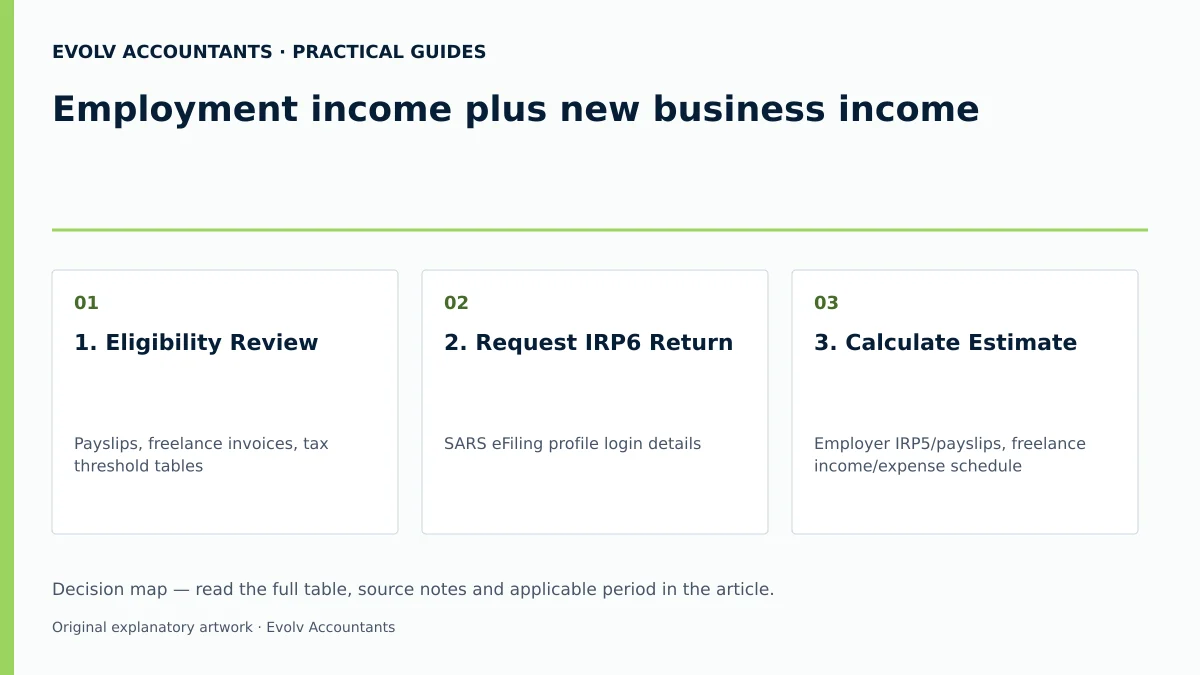
| 1. Eligibility Review | Payslips, freelance invoices, tax threshold tables 2 3 4 | Taxpayer / Evolv Advisor | Freelance business and applicable exclusions checked | Do not assume an exclusion merely because income is below the tax threshold. |
| 2. Request IRP6 Return | SARS eFiling profile login details 30 31 | Taxpayer / Tax Practitioner | IRP6 form generated on eFiling Work Page 32 58 | If return unavailable, check tax product activation under eFiling profile 18. |
| 3. Calculate Estimate | Employer IRP5/payslips, freelance income/expense schedule 7 9 21 | Taxpayer / Evolv Advisor | Total estimated taxable income and PAYE verified 7 9 21 | Apply the first-estimate basic-amount rules; use an accurate second forecast and its separate penalty tests. |
| 4. File IRP6 Return | Completed eFiling IRP6 form and declaration 21 39 | Taxpayer / Tax Practitioner | Status updated to "Filed through eFiling" 32 45 | Correct errors if eFiling validation fails before re-submitting 45. |
| 5. Settle Tax Payable | 19-digit Payment Reference Number, bank portal 40 43 | Taxpayer / Finance Team | Irrevocable Credit Push confirmation received 41 43 | Pay on last working day prior if deadline falls on weekend/holiday 40. |
| 6. Verify Account | Provisional Tax Statement of Account (SOA) 46 47 | Taxpayer / Evolv Advisor | Statement reflects processed payment and zero debt 46 47 | File Request for Correction (RFC) if incorrect period was submitted 46 47. |
Frequently Asked Questions
Does starting freelance work automatically make me a provisional taxpayer?
Yes. Under Paragraph 1 of the Fourth Schedule to the Income Tax Act, any individual who derives income from carrying on any trade or business—including freelance consulting, freelancing, or sole proprietorship services—is classified as a provisional taxpayer, subject to the statutory exclusions. SARS’s tax-threshold exclusion is expressly for a person who does not earn income from carrying on a business.
How does PAYE from my salary affect my provisional tax calculation?
PAYE deducted by your primary employer directly reduces your provisional tax liability 7 9 19. When completing the IRP6 return, you calculate total normal income tax on your combined employment and freelance income, and then subtract the PAYE already withheld by your employer during that period 7 9 19 21.
What is the "basic amount" on my provisional tax return?
The basic amount is your taxable income as assessed by SARS for the latest preceding year of assessment (issued at least 14 days before submitting your return), excluding capital gains and lump sums 24 25. The first-estimate rules and SARS’s ability to demand justification must be checked. The second estimate uses an accurate full-year forecast and the applicable 90%/basic-amount or 80% penalty test; it is not subject to an unconditional basic-amount floor.
What penalties apply if I under-estimate my freelance income?
Under Paragraph 20 of the Fourth Schedule, if your second provisional tax estimate is less than 90% of your actual assessed taxable income (for taxable incomes up to R1 million) and also less than your basic amount, SARS imposes a mandatory 20% underestimation penalty on the tax shortfall 48 51 52. Late payments also attract an automatic 10% penalty under Paragraph 27 plus interest 49 55.
Can I operate my freelance business through a company to pay Small Business Corporation (SBC) rates instead?
If you incorporate a private company for your freelance business, the company pays corporate income tax separately from your personal income tax 12 59. If the company meets all Section 12E criteria for a Small Business Corporation (SBC), it can access progressive corporate tax rates (e.g., 0% on taxable income up to R99 000 in the 2027 tax year) 13 14. However, personal salary or dividends drawn from the company remain subject to personal income tax or dividends tax on your individual profile 10 13 59. Ask Evolv about employment income plus new business income. Share the relevant records so the support required can be scoped.
Related guides
- Provisional tax underestimation penalties
- Who is a provisional taxpayer in South Africa
- The Proactive SARS Audit Guide: Keeping Your Business Ledger Sanitised
Sources
- Provisional Tax | South African Revenue Service
- Rates of Tax for Individuals | South African Revenue Service
- https://www.sars.gov.za/wp-content/uploads/Ops/Guides/GEN-PT-01-G01-Guide-for-Provisional-Tax-External-Guide.pdf
- Companies, Trusts and Small Business Corporations (SBC) | South African Revenue Service
- https://www.sars.gov.za/wp-content/uploads/Ops/Guides/GEN-PT-01-G02-How-to-eFile-your-Provisional-Tax-Return-External-Guide.pdf