
Provisional tax underestimation penalties
30 August 2025

A provisional tax underestimation penalty is linked to an insufficient second-period estimate under the applicable statutory test; it is distinct from late-payment penalties and interest.
Provisional tax underestimation penalties require South African taxpayers to submit accurate second-period income estimates to prevent statutory percentage-based penalties under the Income Tax Act.
Under Paragraph 20 of the Fourth Schedule to the Income Tax Act No. 58 of 1962, the South African Revenue Service (SARS) imposes a deemed 20% penalty when a provisional taxpayer's final estimate on the second IRP6 return falls below statutory accuracy thresholds relative to their actual assessed taxable income 1 2. For taxpayers with actual taxable income up to R1 million, the penalty applies if the estimate is under 90% of actual taxable income and also below the basic amount 2.
For taxpayers earning over R1 million, the penalty triggers if the second estimate is less than 80% of actual taxable income 3 4. Managing these underestimation tests protects provisional taxpayers from administrative penalties and non-deductible interest charges upon final assessment 1 5.
Underestimation tests and conditional penalty example
In South Africa, provisional tax is not a separate tax type, but "a method of paying the income tax liability in advance, to ensure that the taxpayer does not have a large tax debt on assessment" 6. For South African Small and Medium Enterprises (SMEs) and individual provisional taxpayers operating in the 2027 year of assessment (1 March 2026 to 28 February 2027) and earlier tax years, completing the provisional tax process requires verifying that second-period estimates satisfy statutory accuracy tests 1 7 8.
Legal and Tax Framework Distinctions
- Statutory Law: The Income Tax Act No. 58 of 1962 (Fourth Schedule) sets the underestimation penalty framework under Paragraph 20, alongside interest provisions under Sections 89bis and 89quat 1 9 10 11.
- Regulator Guidance: SARS operational guides (such as External Guides GEN-PT-01-G01 and GEN-PT-01-G02) define calculation mechanics, basic amount adjustments, and eFiling submission workflows 12 13.
- Evolv Recommendations: Strategic advisory practices focus on compiling mid-year management accounts, adjusting basic amounts, and filing voluntary top-up payments to prevent non-deductible interest 1 14.
Entity and System Boundaries
Selected primary evidence mandates strict separation across tax regimes:
- Ordinary Corporate Income Tax (CIT): Flat rate of 27% applies to standard companies for financial years ending between 1 April 2023 and 31 March 2027 15.
- Small Business Corporations (SBC): Qualifying SBCs benefit from progressive corporate tax tables (e.g., 0% up to R99,000, 7% between R99,001 and R365,000, R18,620 + 21% above R365,000, and R57,470 + 27% above R550,000 for financial years ending between 1 April 2026 and 31 March 2027) 16 17.
- Turnover Tax System: Excluded from selected primary evidence; micro-business turnover tax rates and thresholds cannot be asserted from available evidence.
- Provisional Tax System: Covers all companies, private company directors/CC members with external business income, and individuals earning non-remuneration income above statutory thresholds (e.g., interest exemptions of R23,800 for individuals under 65) 18 19 20.
Prepare the information and authority: underestimation tests
Completing the underestimation test requires gathering primary statutory authority, verifying historical assessment notices, and compiling exact financial inputs before filing the second IRP6 return 21 22.
Required Inputs and Documents
- Notice of Assessment (ITA34): Identifies the "basic amount", defined as the taxable income assessed by SARS for the latest preceding year of assessment, issued at least 14 calendar days prior to the IRP6 submission date, excluding taxable capital gains, retirement lump sum benefits, and severance benefits 21 23.
- Management Accounts & Year-End Forecasts: Quantifies current-period gross income, allowable business expenses, and aggregate capital gains 24 25.
- eFiling Access & Permissions: Active SARS eFiling profile with provisional tax activated 26 27.
- Tax Payment Records: Records of employees' tax (PAYE) withheld and first-period provisional tax payments actually made 28 29.
Basic Amount Uplift Rules
If the estimate is made more than 18 months after the end of the latest preceding assessed year, the basic amount must be automatically increased by 8% per year until the current year of assessment 23 30 31. Older SARS interpretation notes serve as legislative background but do not override current statutory rates or rules 32.
Complete the task step by step: conditional penalty example
Submitting an accurate IRP6 return and executing the conditional penalty test follows a structured operational sequence on SARS eFiling 22 33.
Sequenced Operational Process
- Request the IRP6 Return: Log into SARS eFiling, navigate to Returns > Returns Issued > Provisional Tax (IRP6), select the relevant tax year and period (e.g., 2027-01 or 2027-02), and select Request Return 22 34.
- Review Pre-Populated Data: Verify pre-populated basic amounts and historical tax figures on the Provisional Tax Work Page 35 36.
- Capture Estimated Taxable Income: Input expected taxable income (including taxable capital gains) for the full 12-month tax year into the Estimated Taxable Income field 25 37.
- Apply Tax Rates and Credits: Calculate normal tax using current corporate (27%), SBC, or individual tax tables, and subtract PAYE withheld, foreign tax credits under Section 6quat, and prior provisional tax paid 15 17 28 38.
- Submit Return and Settle Account: Access the declaration screen, select Confirm, click File Return, and initiate payment via Payments > Pay Now > Create Additional Payment using the 19-digit payment reference number 33 39 40 41.
Reproducible Conditional Penalty Example
Consider a hypothetical ordinary company with a February 2027 year-end. Assume it is not an SBC, the applicable normal tax rate is 27%, the valid basic amount is R300 000, the second estimate is R200 000, actual assessed taxable income is R280 000, and provisional tax paid by year-end is R54 000. Assume no PAYE, rebates or other credits.
- The estimate is below both 90% of actual income (R252 000) and the R300 000 basic amount, so the under-R1 million test is engaged.
- Tax on R252 000 at 27% is R68 040. Tax on the basic amount is R81 000. The lesser tax amount is R68 040.
- Deduct R54 000 paid by year-end: the penalty base is R14 040.
- Twenty per cent of R14 040 is R2 808.
- If an applicable paragraph 27 penalty of R1 000 has been imposed for the same second period, the paragraph 20 penalty is reduced to R1 808.
These are hypothetical company inputs, calculated at the published company rate. They are not SARS’s historical individual example or a calculation using individual rebates. SARS provisional-tax guide; company tax rates.
Check the result against the evidence: underestimation tests
Verifying compliance requires obtaining independent verification directly from SARS platforms rather than assuming submission guarantees final acceptance 47 48.
Verification Requirements
- Query SARS Status: On the eFiling Provisional Tax Work Page, click Query SARS Status to confirm return processing 48.
- Request Statement of Account (PROVSA): Click Request Statement of Account, select the tax year (e.g., 2027), and inspect the statement to verify that all provisional payments have posted correctly 48 49.
- Audit Assessment Notice (ITA34): Upon final income tax assessment, compare assessed taxable income against the second IRP6 estimate. Verify whether SARS levied Paragraph 20 penalties or Section 89quat interest 1 11.
Handle exceptions and unresolved cases: conditional penalty example
Certain statutory edge cases alter how underestimation tests apply or allow taxpayers to seek penalty relief 2 47 50.
Key Exceptions and Edge Cases
- Failure to Submit Second Return (Deemed Nil Rule): If a provisional taxpayer fails to submit the second IRP6 return within four months after the last day of the year of assessment, SARS deems the taxpayer to have submitted an estimate of NIL taxable income 47 50. SARS then applies the relevant paragraph 20 calculation; the amount depends on actual taxable income and qualifying payments, and is not automatically a maximum penalty.
- Taxable Income Above R1 Million: For taxpayers with actual taxable income exceeding R1 million, the basic amount defense does not apply. The second estimate must equal at least 80% of actual taxable income; otherwise, a 20% penalty is charged on the difference between tax on 80% of actual taxable income and taxes paid 3 4.
- Remission of Penalties: Under Paragraph 20(2), the Commissioner may remit the whole or part of the underestimation penalty if satisfied that the estimate was made with due care and was not intended to evade or postpone tax 2.
- Section 89quat Interest: Non-deductible interest is levied on underpayments from the effective date (seven months after a February year-end) if taxable income exceeds R20,000 for companies or R50,000 for individuals/trusts 1 11 51 52.
- Specialist Advisory Boundaries: Where evidence is incomplete or trading conditions fluctuate wildly, engage registered tax advisors to submit written justifications under Paragraph 19(3) prior to the filing deadline 31 32.
Next steps for Provisional tax
Actionable Compliance Checklist
Below is the task and completion checklist for managing provisional tax estimates and underestimation risks:
— Practical point from this guide
| Step | Input or evidence | Responsible person | Completion check | Exception or next action |
|---|---|---|---|---|
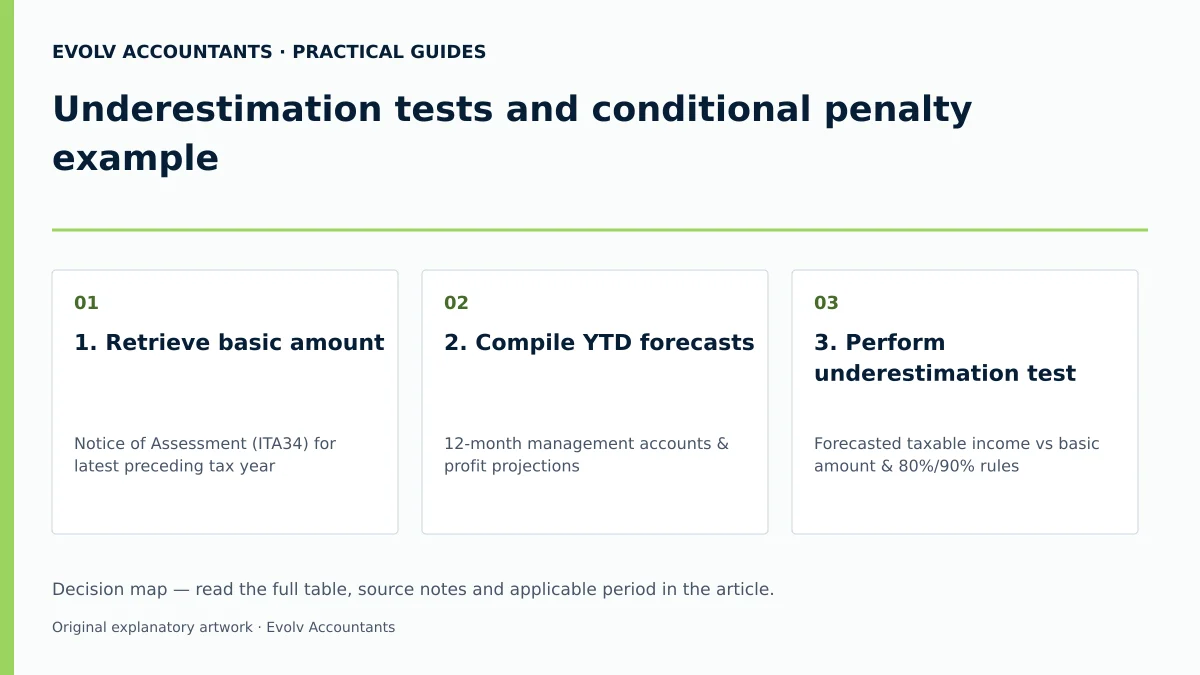
| 1. Retrieve basic amount | Notice of Assessment (ITA34) for latest preceding tax year 21 | Public Officer / Tax Practitioner | Preceding assessment issued ≥ 14 days prior to submission 21 | Apply 8% annual uplift if the estimate is made more than 18 months after the end of the latest preceding assessed year 23 |
| 2. Compile YTD forecasts | 12-month management accounts & profit projections 25 | Financial Manager / Accountant | Gross income and capital gains quantified 21 25 | Exclude once-off retirement/severance lump sums from estimate 46 53 |
| 3. Perform underestimation test | Forecasted taxable income vs basic amount & 80%/90% rules 2 4 | Tax Advisor / Evolv Specialist | For income up to R1m, test both 90% of actual income and the basic amount; above R1m, apply the 80% test 2 4 | Adjust second estimate upwards or prepare Paragraph 19(3) justification 31 |
| 4. Submit IRP6 return | Active eFiling profile & completed IRP6 fields 22 37 | Registered eFiler | Return status reads Filed through eFiling 34 54 | Correct period errors via Request for Correction 48 |
| 5. Settle tax liability | PRN & bank payment instruction 39 41 | Finance Department / Owner | Payment posted before deadline (31 Aug / 28 Feb) 7 41 | File voluntary 3rd top-up payment to limit Section 89quat interest 11 28 |
| 6. Verify SARS account | Provisional Tax Statement of Account (PROVSA) 48 49 | Public Officer | Zero unexpected penalty or interest debit on account 49 | File dispute/remission request if Paragraph 20 penalty is levied in error 2 |
Practical Task Checklist
To complete your provisional tax submission and prevent underestimation penalties, execute the following numbered sequence:
- Obtain your latest notice of assessment (ITA34) from SARS eFiling to establish your official basic amount 21 22.
- Calculate your revised 12-month taxable income projection, ensuring capital gains are included and lump sum benefits excluded 21 25 53.
- Compare your estimate against the 90% threshold (for income up to R1m) or 80% threshold (for income above R1m) and the basic amount 2 4.
- Complete and file the second IRP6 return on eFiling prior to the end of the year of assessment (e.g., 28 February) 7 33 37.
- Settle the resulting provisional tax liability using the correct 19-digit payment reference number 39 41.
- Request a Provisional Tax Statement of Account (PROVSA) on eFiling to confirm that payment has posted correctly 48 49.
Frequently Asked Questions
What is the main difference between the underestimation test for income below and above R1 million?
For taxpayers with actual taxable income up to R1 million, a Paragraph 20 penalty applies only if the second estimate is less than 90% of actual taxable income and less than the basic amount 2. For taxpayers with actual taxable income exceeding R1 million, the basic amount safe harbour is unavailable; the estimate must equal at least 80% of actual taxable income to avoid a 20% penalty on the tax shortfall 3 4.
What happens if a business fails to submit its second provisional tax return on time?
If a taxpayer fails to submit the second IRP6 return within four months after the close of the year of assessment, SARS deems the taxpayer to have submitted an estimate of nil taxable income 47 50. The nil estimate is tested under paragraph 20 using the applicable 90%/basic-amount or 80% rule and payments made by year-end. It is not simply 20% of tax on actual income.
How does a Paragraph 27 late payment penalty affect an underestimation penalty?
Where SARS levies a Paragraph 27 penalty (10%) for late payment of provisional tax on the second period, the subsequent Paragraph 20 underestimation penalty is reduced by the Paragraph 27 penalty amount already charged 3 46 51.
Can underestimation penalties be remitted by SARS?
Yes. Under Paragraph 20(2) of the Fourth Schedule, the Commissioner has the discretion to remit the whole or part of a Paragraph 20 penalty if the taxpayer demonstrates that the estimate was calculated in good faith with due regard to available financial records and was not intended to postpone tax payments 2.
What is the purpose of making a voluntary third provisional tax payment?
A voluntary third provisional payment (due 30 September for February year-end taxpayers) allows taxpayers to pay additional tax after year-end but prior to final assessment, preventing or reducing non-deductible Section 89quat interest on underpayments 7 11 28. Tell Evolv which estimate, payment period or income record you need help to review. Ask Evolv about underestimation tests and conditional penalty example. Share the relevant records so the support required can be scoped.
Related guides
- Provisional tax when income is irregular
- Who is a provisional taxpayer in South Africa
- The Proactive SARS Audit Guide: Keeping Your Business Ledger Sanitised
Sources
- https://www.sars.gov.za/wp-content/uploads/Ops/Guides/GEN-PT-01-G01-Guide-for-Provisional-Tax-External-Guide.pdf
- Provisional Tax | South African Revenue Service
- https://www.sars.gov.za/wp-content/uploads/Ops/Guides/GEN-PT-01-G02-How-to-eFile-your-Provisional-Tax-Return-External-Guide.pdf
- Companies, Trusts and Small Business Corporations (SBC) | South African Revenue Service