
Provisional tax when income is irregular
25 January 2026

Managing provisional tax when income is irregular requires accurate scenario modeling to satisfy SARS rules and prevent severe underestimation penalties.
South African businesses and individual taxpayers who experience fluctuating, seasonal, or project-based earnings face significant compliance challenges under the provisional tax regime. Rather than functioning as a separate tax, provisional tax is an advance payment mechanism designed to spread a taxpayer's normal income tax liability across the year of assessment 1 2.
When trading conditions cause mid-year revenue spikes or sudden drops, taxpayers must use statutory basic amounts or defensible forecast models when completing their IRP6 returns on eFiling 3 4 5. Proper compliance ensures advance tax payments align with final tax obligations while safeguarding the business against non-deductible interest and statutory underestimation penalties 6 7 8.
Scenario estimates for uneven income
This operational guide is written for South African small and medium enterprises (SMEs), sole proprietors, independent contractors, and corporate directors operating under the jurisdiction of the South African Revenue Service (SARS) 9 10 11. In tax environments characterized by irregular income, achieving full tax completion means accurately calculating, documenting, and submitting biannual provisional tax estimates (and optional top-up payments) on eFiling, accompanied by timely settlement of all calculated tax liabilities 2 3 12.
To estimate advance liabilities correctly, taxpayers must strictly distinguish between distinct South African tax schemes and corporate structures:
- Provisional Tax System: Governed by the Fourth Schedule to the Income Tax Act No. 58 of 1962, provisional tax applies to all corporate entities and any natural person earning non-remuneration income (subject to statutory thresholds) 9 10 13. It requires two mandatory payments: the first period payment due six months into the tax year (31 August for February year-end taxpayers) and the second period payment due on or before the final business day of the tax year (28/29 February) 3 14 15. A voluntary third top-up payment can be made after year-end to mitigate interest 2 3 16.
- Ordinary Corporate Income Tax: Standard private companies pay corporate income tax at a flat rate of 27% on taxable income for years of assessment ending on any date between 1 April 2023 and 31 March 2027 17.
- Small Business Corporation (SBC) Relief: Qualifying small business corporations under Section 12E benefit from progressive corporate tax brackets 18 19. For the 2026 year of assessment (financial years ending between 1 April 2025 and 31 March 2026), taxable income up to R95 750 is taxed at 0%, income from R95 751 to R365 000 at 7%, income from R365 001 to R550 000 at R18 848 plus 21% of the amount above R365 000, and taxable income above R550 000 at R57 698 plus 27% of the excess 19 20. For the 2027 year of assessment (financial years ending between 1 April 2026 and 31 March 2027), the 0% rate applies up to R99 000, 7% from R99 001 to R365 000, R18 620 plus 21% from R365 001 to R550 000, and R57 470 plus 27% above R550 000 19.
- Turnover tax: This is a separate regime with its own eligibility rules. The calculations in this article use ordinary income-tax rules and do not establish turnover-tax eligibility.
Historical interpretation notes provide background understanding but cannot override current numerical tax tables or statutory thresholds 23 24.
Prepare the information and authority: scenario estimates for uneven income
Preparing scenario estimates for irregular earnings requires gathering specific financial records, establishing legal parameters, and verifying taxpayer authorisation on SARS eFiling 4 5 12.
— Practical point from this guide
Taxpayers must assemble the following documentation and diagnostic inputs prior to preparing the IRP6 return:
- Notice of Assessment (ITA34): The most recent assessment issued by SARS, used to determine the statutory baseline 25 26.
- Management Accounts & Cash Flow Forecasts: Monthly year-to-date profit and loss statements, pipeline sales reports, and scenario projections 4 27.
- PAYE & Foreign Tax Records: Records of employees' tax withheld from remuneration and proof of qualifying foreign tax credits under Section 6quat 3 28 29.
- eFiling Access & Profiles: Active eFiling profile access linked to the taxpayer's income tax reference number 5 12.
Understanding key statutory rules and legal definitions is critical when managing uneven revenue stream forecasts:
- Basic Amount Definition: SARS defines the basic amount as "the taxpayer's taxable income assessed by the Commissioner for the latest preceding year of assessment" 25. This assessed figure must exclude taxable capital gains, retirement fund lump sums, and severance benefits, and must originate from an assessment issued at least 14 calendar days prior to submitting the provisional return 25 26.
- The 18-Month 8% Increment Rule: If the IRP6 estimate is submitted more than 18 months after the end of the latest preceding assessed tax year, the basic amount must be increased by 8% per annum for each intervening year 27 30 31.
- Paragraph 19(3) Justification: SARS holds the legal authority to request full particulars of income, expenditure, or operational records to justify any submitted estimate 27 32. Upon receiving a Paragraph 19(3) engagement letter via eFiling or email, the taxpayer must upload supporting evidence within 10 business days 23. An adjustment made by SARS under Paragraph 19(3) is not subject to objection and appeal 23 32.
Taxpayers must distinguish between statutory law (the Income Tax Act and Tax Administration Act) 13, regulator guidance (SARS external guides GEN-PT-01-G01 and GEN-PT-01-G02) 33 34, and Evolv professional recommendations.
While tax legislation establishes submission duties and penalty formulas 13 35, and SARS guidance details eFiling workflows 34, Evolv recommends establishing quarterly scenario forecast models (conservative, expected, and optimistic) to ensure advance tax reserves remain fully aligned with actual operational performance.
Complete the task step by step: documented completion and exceptions
To ensure compliant completion of provisional tax returns when income fluctuates, taxpayers should execute the following sequenced process grounded in official SARS primary instructions 5 34 36:
- Access the eFiling Profile: Log in to SARS eFiling, select the appropriate portfolio, navigate to the Returns top menu tab, click Returns Issued in the left panel, and select Provisional Tax (IRP6) 5.
- Request the Applicable Period: Select the specific provisional tax period from the drop-down menu (e.g., 2026-01 for the first period or 2026-02 for the second period of the 2026 tax year) and click Request Return to generate the Provisional Tax Work Page 5 37.
- Inspect Baseline & Pre-Populated Data: Click IRP6 to open the return 37. Review the pre-populated taxpayer particulars, date of birth, year last assessed, and auto-calculated basic amount displayed under historical information 38 39. Verify whether the 14-calendar-day rule or the 18-month 8% increment rule applies to the pre-populated basic amount 26 27 40.
- Perform Scenario Modeling: Review year-to-date accounting income and projected earnings for the remaining months of the year of assessment 4 28. When income is irregular, test the projected annual taxable income against the basic amount safe harbour 32 35.
- Capture Taxpayer Estimates: Enter the estimated annual figures into the mandatory fields on the IRP6 form: Gross Income (Sales/Turnover/Other Income), Estimated Taxable Income, Employees' Tax (PAYE withheld for the period, or 0.00 if non-applicable), Foreign Tax Credits, and qualifying medical scheme fees credits where applicable 41 42.
- Recalculate & Verify Tax Liability: Click Recalculate Tax 41 42. The eFiling system automatically calculates normal tax on the estimated taxable income, applies age-based individual rebates (Primary rebate of R17 235 for 2026 or R17 820 for 2027) 43 44, deducts prior period provisional payments paid 45, and displays the net tax payable for the current period 42 44 45.
- Submit the Return Declaration: Click File Return 36 46. When the online declaration prompt appears, review the statement certifying that the details are true and correct, and click Confirm to transmit the return to SARS 46. Save the submission confirmation 36.
- Execute Settlement Payment: If a balance is due, navigate to Payments on the top ribbon, select Pay Now, click Create Additional Payment, choose Provisional Tax (PROV), verify the 19-digit Payment Reference Number (PRN) and tax period, enter the amount, and click Make Payment to authorise the bank transaction prior to the statutory deadline 36 47 48.
Check the result against the evidence: scenario estimates for uneven income
Submitting an IRP6 return does not inherently guarantee regulatory acceptance or error-free processing 6 49. Taxpayers must obtain independent completion evidence to verify compliance:
- eFiling Return Status: Return to the Provisional Tax Work Page and confirm that the return status displays "Filed through eFiling" alongside a logged submission date and version number 36 37.
- Payment Confirmation Advice: Retain the eFiling transaction summary and internet banking EFT proof of payment displaying the correct 19-digit PRN reference and beneficiary details 48.
- Statement of Account (SA34): On the Provisional Tax Work Page, click Request Statement of Account, select the tax year or balance brought forward, and click Continue 49 50. Inspect the generated statement to confirm that all provisional tax payments have been credited against the income tax account, ensuring no unallocated credit balances, Paragraph 27 late payment penalties (10%), or Section 89bis interest charges remain outstanding 50 51 52.
Handle exceptions and unresolved cases: documented completion and exceptions
When dealing with irregular income streams, taxpayers frequently encounter edge cases, SARS queries, or underestimation risks that require structured remediation 27 32 35.
Underestimation Penalties Under Paragraph 20
If actual taxable income determined on final assessment exceeds the estimate submitted on the second IRP6 return, SARS imposes a statutory Paragraph 20 penalty under Chapter 15 of the Tax Administration Act 7 35:
- Taxable Income Up to R1 Million: Where actual taxable income is R1 million or less, a penalty is triggered if the second estimate is less than 90% of actual taxable income AND also less than the basic amount 35 53 54. The penalty equals 20% of the difference between:
- The lesser of normal tax on 90% of actual taxable income or normal tax on the basic amount; and
- The total sum of PAYE and provisional tax paid by the end of the year of assessment 8 35.
- Taxable Income Above R1 Million: Where actual taxable income exceeds R1 million, the basic amount safe harbour no longer applies 55. A penalty is triggered if the second estimate is less than 80% of actual taxable income 55 56. The penalty equals 20% of the difference between normal tax calculated on 80% of actual taxable income and the total employees' tax and provisional tax paid by year-end 55 56.
- Penalty Offsetting: Any Paragraph 20 underestimation penalty levied is automatically reduced by the amount of any Paragraph 27 penalty imposed for late payment of provisional tax for the same tax period 55 57.
Paragraph 19(3) Justification Reviews
If SARS issues a Paragraph 19(3) engagement letter questioning a low estimate, the taxpayer must compile and upload supporting evidence to eFiling within 10 business days 23 27. Supporting documentation must include detailed management accounts, signed customer contract cancellations, or industry audit reports proving that the income reduction was operational rather than an intentional tax deferral 4 27.
Voluntary Third Top-Up Payment
To avoid non-deductible Section 89quat interest on underpayment—which applies when normal tax exceeds provisional credits and taxable income exceeds R50 000 for individuals/trusts or R20 000 for companies 7 58—taxpayers with February financial year-ends should submit an optional third provisional payment by the final business day of September (or within six months of year-end for companies with non-February year-ends) 3 14 16 59.
Reproducible Hypothetical Example
To illustrate the mechanics of Paragraph 20 underestimation penalties during an uneven income year, consider the following scenario for a private company:
- Tax Year of Assessment: 2026 tax year (financial year ending 28 February 2026) 17 59.
- Applicable Corporate Tax Rate: 27% 17.
- Pre-populated Assessed Basic Amount: R600 000 (from 2025 assessment issued more than 14 days prior) 25 26.
- First Period (2026-01): The company pays R81 000 provisional tax (calculated as 50% of 27% on the R600 000 basic amount) 3 60.
- Second Period (2026-02): Due to severe mid-year project delays, the company submits a reduced second estimate of R450 000 estimated taxable income 4 61. Total annual tax on R450 000 at 27% equals R121 500 17. Less the R81 000 first payment, the company pays R40 500 for the second period 62. Total provisional tax paid for the year equals R121 500 (PAYE = R0) 35.
- Final Assessment (ITA34): Projects unexpectedly resume in Q4, and SARS assesses final actual taxable income at R580 000 7 53. Total actual normal tax at 27% equals R156 600 17.
Paragraph 20 Penalty Calculation (Taxable Income Up to R1 Million):
- Test Criteria:
- Is final estimate (R450 000) less than 90% of actual taxable income (90% of R580 000 = R522 000)? Yes (R450 000 < R522 000) 35 54.
- Is final estimate (R450 000) less than basic amount (R600 000)? Yes (R450 000 < R600 000) 35 54.
- Result: Penalty is triggered because both conditions are met 35 54.
- Determine Target Tax Amount:
- Normal tax on 90% of actual taxable income (27% of R522 000) = R140 940 8 17.
- Normal tax on basic amount (27% of R600 000) = R162 000 8 17.
- Lesser amount = R140 940 8 35.
- Calculate Penalty:
- Shortfall: R140 940 less total tax paid (R121 500) = R19 440 8 54.
- Paragraph 20 Penalty: 20% of R19 440 = R3 888 35 54.
This hypothetical example shows why the second estimate needs a current full-year forecast. A later September top-up can reduce underpayment interest, but it does not retrospectively improve the second estimate or the payments made by year-end for the paragraph 20 penalty test. Primary guidance.
Next steps for Provisional tax
The following task and completion checklist provides a structured operational workflow for managing irregular provisional tax estimates:
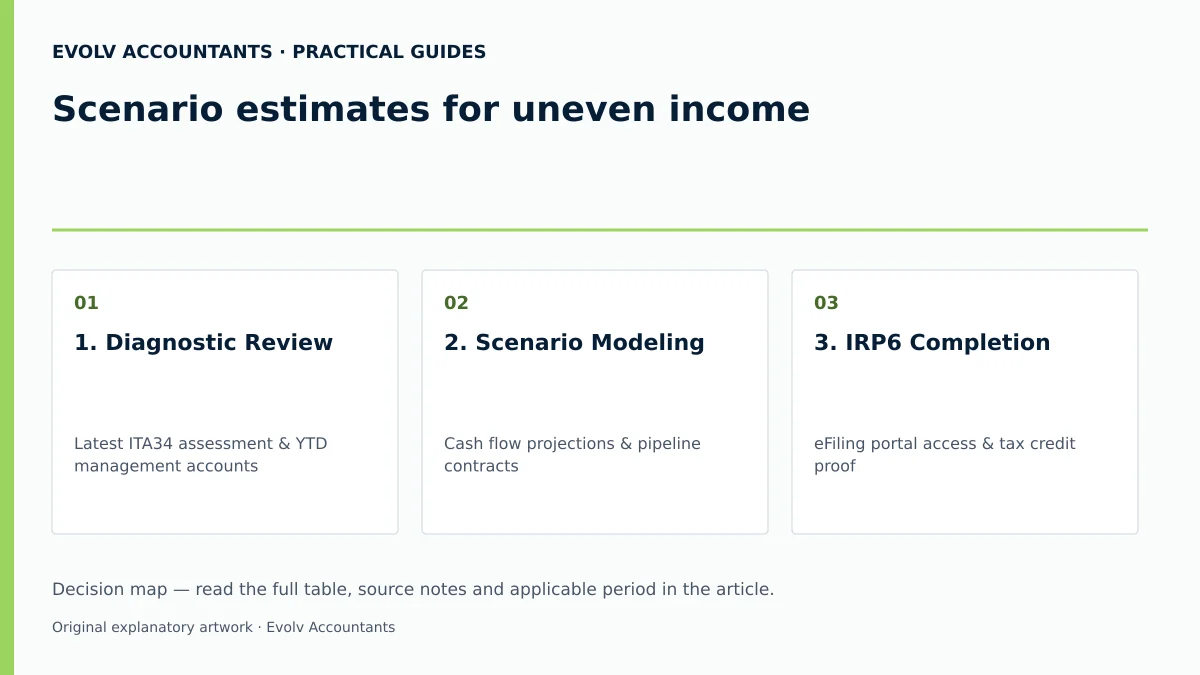
| Step | Input or evidence | Responsible person | Completion check | Exception or next action |
|---|---|---|---|---|
| 1. Diagnostic Review | Latest ITA34 assessment & YTD management accounts 4 25 | Financial Controller / Accountant | Baseline basic amount verified & 14-day rule checked 26 | Apply 8% annual increment if the estimate is made more than 18 months after the end of the latest preceding assessed year 27 30 |
| 2. Scenario Modeling | Cash flow projections & pipeline contracts 4 | Tax Advisory Lead | Conservative, expected & optimistic models documented 4 | Ensure estimate does not drop below basic amount without proof 32 35 |
| 3. IRP6 Completion | eFiling portal access & tax credit proof 3 5 | Tax Practitioner | IRP6 captured, recalculate checked & return filed 41 46 | Retain eFiling submission receipt & confirmation page 36 |
| 4. Tax Settlement | eFiling Payment wizard & 19-digit PRN 47 48 | Finance Manager | EFT authorised & funds cleared prior to statutory deadline 14 48 | Verify PRN reference to avoid misallocated payments 48 |
| 5. Post-Filing Audit | SARS Statement of Account (SA34) 49 50 | Tax Compliance Officer | Account balance verified & zero outstanding debt reflected 50 | Respond within 10 business days if Para 19(3) letter is issued 23 |
Frequently Asked Questions
How does SARS determine the basic amount when income is irregular?
The basic amount is based on the taxpayer's assessed taxable income from the latest preceding tax year, provided the assessment was issued at least 14 calendar days prior to submitting the IRP6 return 25 26. Capital gains, retirement lump sums, and severance benefits are subtracted from the assessed figure 25. If the estimate is made more than 18 months after the end of the latest preceding assessed tax year, the basic amount is automatically increased by 8% per year 27 30.
What happens if an SME underestimates its income due to an unexpected Q4 revenue spike?
If actual taxable income exceeds the second provisional estimate, SARS tests whether the estimate fell below statutory thresholds 35 61. For taxable incomes up to R1 million, if the estimate was below 90% of actual income and below the basic amount, a 20% underestimation penalty applies to the shortfall 8 35. For taxable incomes above R1 million, the penalty applies if the estimate was below 80% of actual taxable income 55 56.
Can SARS adjust a provisional tax estimate if it considers the forecast too low?
Yes. Under Paragraph 19(3) of the Fourth Schedule, SARS may call upon any provisional taxpayer to justify an estimate or provide full income and expenditure details 27 32. If dissatisfied with the response, SARS can increase the estimate to an amount it deems reasonable 27 32. This SARS adjustment is final and not subject to objection and appeal 23 32.
How does the Paragraph 20 penalty interact with Paragraph 27 late payment penalties?
If a taxpayer incurs both a Paragraph 27 penalty for late payment of provisional tax (10%) and a Paragraph 20 penalty for underestimation on the second period, statutory rules require the Paragraph 20 penalty to be reduced by the Paragraph 27 penalty amount, preventing double penalty exposure on the same underlying tax obligation 52 55 57.
What is the purpose of making a voluntary third provisional tax payment?
The optional third provisional tax payment allows taxpayers to pay additional advance tax after the tax year ends but before SARS issues the final ITA34 assessment 1 2 3. This top-up payment halts the accumulation of non-deductible Section 89quat interest on underpayment of tax 7 16 58. Ask Evolv about scenario estimates for uneven income. Share the relevant records so the support required can be scoped.
Related guides
- Investment income limits for SBC qualification
- Who is a provisional taxpayer in South Africa
- The Proactive SARS Audit Guide: Keeping Your Business Ledger Sanitised
Sources
- Provisional Tax | South African Revenue Service
- https://www.sars.gov.za/wp-content/uploads/Ops/Guides/GEN-PT-01-G01-Guide-for-Provisional-Tax-External-Guide.pdf
- https://www.sars.gov.za/wp-content/uploads/Ops/Guides/GEN-PT-01-G02-How-to-eFile-your-Provisional-Tax-Return-External-Guide.pdf
- Companies, Trusts and Small Business Corporations (SBC) | South African Revenue Service
- Rates of Tax for Individuals | South African Revenue Service