
Investment income limits for SBC qualification
30 November 2025
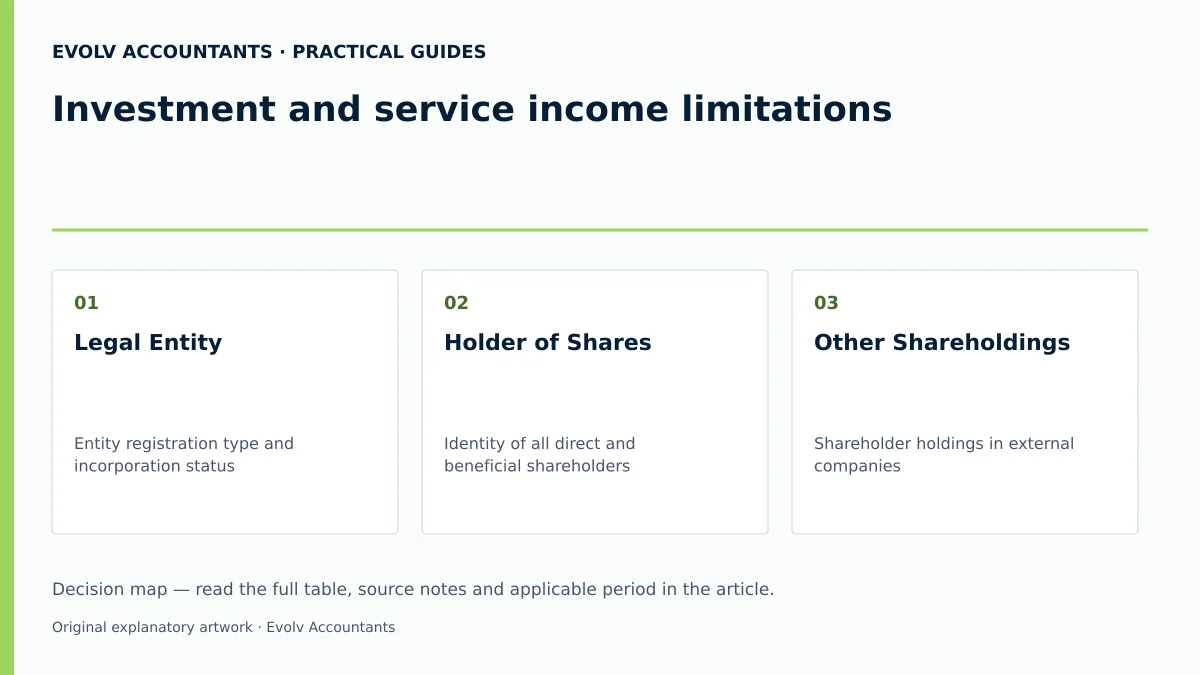
SBC qualification requires checking the investment income limits alongside personal service income and the statutory definitions, calculation base and exceptions.
Qualifying for Small Business Corporation tax status requires meeting strict statutory investment and service income limitations under South African tax law.
Small Business Corporation (SBC) tax status under section 12E of the Income Tax Act offers progressive tax relief to eligible private companies, close corporations, personal liability companies, and co-operatives 1 2. To maintain eligibility for any year of assessment, an entity must ensure that investment income and personal service income combined do not exceed 20% of its total non-capital receipts, accruals, and capital gains 3 4.
In addition, the business must satisfy statutory requirements regarding legal entity form, natural person shareholding, restrictions on holding shares in other companies, a gross income threshold of R20 million, and non-personal service provider status 5 6 7.
Investment and service income limitations
For South African private companies, close corporations, personal liability companies, and co-operatives, qualifying for SBC tax rates is an annual eligibility determination rather than a once-off registration 2 8. SBC status is evaluated self-assessingly on the annual Company Income Tax Return (ITR14) for each specific year of assessment 8.
The applicable corporate tax rates for qualifying Small Business Corporations follow a progressive marginal structure across specific assessment periods 8 9:
- Years of assessment ending 1 April 2025 – 31 March 2026 9:
- R1 to R95 750: 0% of taxable income 9.
- R95 751 to R365 000: 7% of taxable income above R95 750 9.
- R365 001 to R550 000: R18 848 + 21% of taxable income above R365 000 9.
- R550 001 and above: R57 698 + 27% of taxable income above R550 000 9.
- Years of assessment ending 1 April 2026 – 31 March 2027 9:
- R1 to R99 000: 0% of taxable income 9.
- R99 001 to R365 000: 7% of taxable income above R99 000 9.
- R365 001 to R550 000: R18 620 + 21% of taxable income above R365 000 9.
- R550 001 and above: R57 470 + 27% of taxable income above R550 000 9.
A primary operational barrier to accessing these concessionary tax rates is the business activity limit, which restricts investment income and personal service income to a maximum of 20% of the total non-capital receipts, accruals, and capital gains derived during the year of assessment 3 4.
The qualification tests to check: investment
To confirm whether a company qualifies as an SBC for a given year of assessment, six independent statutory tests must be verified 5 6 7:
- Legal Entity Test: The entity must be a close corporation, co-operative, private company, or personal liability company incorporated in South Africa 1 2 7. Foreign incorporated companies do not qualify unless they have formally transferred their registration to South Africa as domesticated companies 10.
- Holder of Shares Test: All holders of shares or members must, at all times during the year of assessment, be natural persons 7 11. Shares held by a trust disqualify the entity unless the beneficiaries hold vested rights in those shares throughout the year and are all natural persons 12.
- Other Shareholding Restriction Test: Shareholders or members must not hold an impermissible share or equity interest in another company at any time during the assessment year, subject to the statutory exceptions 13 14. Permitted exceptions include holdings in listed companies, collective investment schemes, sectional title body corporates, social/consumer co-operatives (less than 5%), primary co-operative banks (less than 5%), entities that have never traded in any assessment year and have never owned assets whose combined market value exceeded R5 000 in any assessment year, and companies in liquidation 13 14 15 16 17.
- Gross Income Limit Test: Gross income for the assessment year must not exceed R20 million 18 19. If the entity traded for less than 12 months in that assessment year, the R20 million threshold is reduced proportionately based on the ratio of full and partial months traded to 12 months 19 20.
- Business Activity (20% Income Limit) Test: Investment income and personal service income combined must not exceed 20% of total non-capital receipts, accruals, and capital gains 3 4.
- Investment Income includes dividends, foreign dividends, royalties, rental from immovable property, annuities, section 24J interest, section 24K amounts, and proceeds/capital gains from investment or trading in financial instruments, marketable securities, or immovable property 21 22. Short-term serviced accommodation (such as a guesthouse or hotel) is generally excluded from rental income, whereas long-term exclusive occupancy (more than one month) may be treated as rental 23.
- Personal Service includes services rendered in accounting, actuarial science, architecture, auctioneering, auditing, broadcasting, consulting, draftsmanship, education, engineering, financial service broking, health, information technology, journalism, law, management, real estate broking, research, sport, surveying, translation, valuation, or veterinary science 24 25. Service income is classified as personal service income if rendered personally by a shareholder/member or connected person, unless the entity employs three or more full-time, non-shareholder, non-connected employees engaged full-time in rendering that service throughout the assessment year 24 26 27.
- Personal Service Provider (PSP) Prohibition Test: The company must not be classified as a Personal Service Provider under paragraph 1 of the Fourth Schedule 6 28. A company is a PSP if services rendered personally by a connected person to a client render the individual an employee of the client, subject the individual to client control/supervision at client premises, or generate >80% of income from one client, unless three or more full-time employees who are neither shareholders nor connected persons in relation to shareholders are engaged in rendering the service 6 28 29 30 31.
Understanding the 20% business activity calculation formula
The 20% limitation is calculated using the following statutory formula 32 33:
Tainted Income Percentage = (Investment Income + Personal Service Income ÷ Total Non-Capital Receipts \& Accruals + Capital Gains) × 100
Amounts of a capital nature (such as gross proceeds from capital asset sales) are excluded from the denominator, but any resulting capital gain is included 33 34 35.
Evidence behind the eligibility decision: service income limitations
Determining SBC qualification requires gathering verifiable evidence across corporate, financial, and operational records. The table below outlines the factual audit trail required to substantiate each test.
— Practical point from this guide
Eligibility decision table
| Test | Facts to obtain | Evidence | Applicable source | Result or unresolved question |
|---|---|---|---|---|
| Legal Entity | Entity registration type and incorporation status | CIPC registration certificate, Memorandum of Incorporation | s12E(4)(a), IN 9 2 7 | Confirms a permitted entity type under section 12E |
| Holder of Shares | Identity of all direct and beneficial shareholders | Share register, beneficial ownership disclosures, trust deeds | s12E(4)(a), IN 9, ITR14 Guide 7 11 12 | Verifies natural person ownership throughout the year |
| Other Shareholdings | Shareholder holdings in external companies | Shareholder declarations, CIPC directorship disclosures | s12E(4)(a)(ii), IN 9 13 14 | Confirms no unpermitted shares held in other entities |
| Gross Income Limit | Total turnover and revenue for assessment year | Annual financial statements, audited or reviewed where applicable, and general ledger | s12E(4)(a)(i), IN 9 18 19 | Verifies gross income <= R20m (or pro-rata limit if short year) |
| Investment Income | Gross dividends, interest, royalties, and rental receipts | Trial balance, IT3(b) certificates, lease contracts | s12E(4)(c), IN 9 21 22 | Quantifies passive income for the 20% numerator |
| Personal Service | Field of service, personal performance, full-time staff count | Payroll reports, organograms, employment contracts | s12E(4)(d), IN 9 24 26 27 | Determines whether income is classified as personal-service income for this test |
| PSP Prohibition | Client dependence (>80%), supervision/control status | Client contracts, working location records, payroll | Fourth Schedule, IN 9 6 28 | Confirms non-PSP status under employment tax rules |
A qualifying case and an excluded case: investment
The following hypothetical cases illustrate how investment and service income rules apply for the year of assessment ending 28 February 2026 9.
Case A: Qualifying Small Business Corporation (Apex Software (Pty) Ltd)
Apex Software (Pty) Ltd is a software development firm owned equally by two natural persons who hold no shares in other companies 11 13. For its 12-month financial year ending 28 February 2026, the company recorded the following financial results 9 18:
- Custom software development revenue (IT field): R6 000 000 24.
- Computer hardware trading sales: R1 700 000.
- Local bank interest income: R300 000 21.
- Total gross income / non-capital receipts: R8 000 000 18 32.
Throughout the assessment year, Apex Software employed three full-time software engineers who are not shareholders or connected persons 26 36. Because the IT service was rendered with three qualifying full-time employees, the R6 000 000 development revenue is excluded from personal service income 26 27.
- Tainted Income: Interest income (R300 000) + Personal Service income (R0) = R300 000 21 26.
- Denominator: Total non-capital receipts = R8 000 000 32.
- Tainted Income Ratio: (R300 000 ÷ R8 000 000) × 100 = 3,75% 33.
Because 3,75% is well below the 20% limit and all other tests are met, Apex Software qualifies as an SBC for the 2026 year of assessment, paying progressive SBC tax rates on its taxable income 5 9.
Case B: Excluded Entity (Beacon Consulting (Pty) Ltd)
Beacon Consulting (Pty) Ltd provides management consulting services and is owned by a single natural person 11 24. For its 12-month financial year ending 28 February 2026, it recorded 9 18:
- Management consulting fees (rendered personally by the shareholder): R4 200 000 24.
- Commercial property rental income: R500 000 21.
- Sales of printed guides and stationery: R300 000.
- Total gross income / non-capital receipts: R5 000 000 18 32.
Beacon Consulting employs only one full-time receptionist (fewer than three full-time service employees) 26 37. Consequently, the full R4 200 000 consulting fee constitutes personal service income 24 37.
- Tainted Income: Rental income (R500 000) + Personal Service income (R4 200 000) = R4 700 000 21 24.
- Denominator: Total non-capital receipts = R5 000 000 32.
- Tainted Income Ratio: (R4 700 000 ÷ R5 000 000) × 100 = 94,00% 33.
Because 94% exceeds the 20% limitation, Beacon Consulting is disqualified from SBC status for the 2026 assessment year and is taxed at the standard corporate rate 8 38.
What changes the answer: service income limitations
SBC eligibility can change during a financial year due to operational or structural changes:
- Shareholding Alterations: If a natural person shareholder transfers a share to a juristic entity, or acquires shares in an unpermitted company mid-year, SBC status is lost for that entire assessment year 11 13.
- Fluctuations in Passive Revenue: A sudden rise in interest, dividend, or rental income—or a drop in trading receipts—can push tainted income above the 20% threshold 3.
- Employee Resignations: If staff turnover reduces the number of full-time non-shareholder service employees below three during the year, reassess the income attributable to services performed personally by shareholders or their connected persons; do not automatically classify unrelated employees’ service income as personal-service income 26 36.
- Short Assessment Periods: Commencing or terminating trade mid-year reduces the R20 million gross income limit pro-rata, increasing the risk of exceeding the adjusted ceiling 20 39.
Next steps for Small business corporation tax
To verify SBC qualification before submitting the annual ITR14 tax return, complete the following steps:
- Review ownership structures: Confirm that all shareholders are natural persons and verify that no shareholder holds shares in another unlisted company 11 13.
- Calculate adjusted gross income: Ensure gross income is within R20 million (or the pro-rata limit for short periods) 18 20.
- Extract passive and service income: Separate interest, dividends, rentals, royalties, and professional service fees from general trading revenue 21 24.
- Audit payroll and employee engagement: Verify whether at least three full-time non-shareholder employees were engaged in rendering personal services throughout the year 26 36.
- Perform the 20% limitation calculation: Confirm that investment income and personal service income together do not exceed 20% of total non-capital receipts plus capital gains 3 33.
Frequently Asked Questions
Can a company qualify as an SBC if a shareholder owns shares in another business?
An interest in another company is permitted only if it falls within a statutory exception; otherwise it can disqualify the entity from SBC status 13 14. Limited exceptions apply for listed companies, collective investment schemes, sectional title body corporates, social co-operatives (less than 5%), primary co-operative banks (less than 5%), entities that have never traded in any assessment year and have never owned assets whose combined market value exceeded R5 000 in any assessment year, or companies in liquidation 13 14 15 16 17.
How does hiring employees affect the personal service income test?
For a listed service personally performed by a shareholder or someone connected to a shareholder, the employee exception requires at least three full-time employees throughout the assessment year. They must work full time in the business of rendering that service and be neither shareholders nor persons connected to shareholders 24 26 27. The exception removes the relevant income from the personal-service category. Investment income plus remaining personal-service income must not exceed 20% of total receipts and accruals other than those of a capital nature, plus all capital gains 4.
Is short-term rental accommodation treated as investment income?
Income derived from short-term serviced accommodation (such as a guesthouse, lodge, or hotel) is generally treated as trading income rather than rental from immovable property 23. However, long-term exclusive occupancy (more than one month) may be classified as investment rental income 23.
What happens if a business trades for only part of a financial year?
If a company trades for less than 12 months in an assessment year, the R20 million gross income threshold is reduced proportionately based on the number of trading months divided by 12 (counting part of a month as a full month) 19 20.
Is an SBC required to register separately with SARS for SBC tax status?
No separate tax registration is required. SBC status is determined self-assessingly on the annual ITR14 tax return by answering the section 12E eligibility questions 8 40 41. Ask Evolv about investment and service income limitations. Share the relevant records so the support required can be scoped.
Related guides
- What happens when a company loses SBC status
- How South African Businesses Can Qualify for SBC Tax Rates & Save Thousands
- The Proactive SARS Audit Guide: Keeping Your Business Ledger Sanitised
Sources
- https://www.sars.gov.za/wp-content/uploads/Legal/Notes/LAPD-IntR-IN-2012-09-Small-Business-Corporations.pdf
- Companies, Trusts and Small Business Corporations (SBC) | South African Revenue Service
- https://www.sars.gov.za/wp-content/uploads/IT-GEN-04-G01-How-to-complete-the-Income-Tax-Return-ITR14-for-Companies-External-Guide.pdf