
What happens when a company loses SBC status
26 March 2026

Losing small business corporation status requires a company to recalculate its tax liability at the standard flat corporate tax rate.
When a South African private company, close corporation, co-operative, or personal liability company fails to satisfy all statutory qualifying criteria under Section 12E of the Income Tax Act 58 of 1962 during a year of assessment, it forfeits access to graduated small business corporation (SBC) income tax rates 1 2 3.
For that specific year of assessment, the entity transitions to the standard corporate income tax framework, where its entire taxable income is assessed at the flat statutory corporate rate (27% for years of assessment ending on or after 31 March 2023) 4 5 6. Furthermore, while new assets acquired during non-qualifying years cannot claim accelerated Section 12E capital allowances, existing assets brought into use in prior years under Section 12E(1A) continue to receive their remaining multi-year write-offs 7 8 9 10.
Tax computation after losing eligibility
This guide addresses South African small and medium enterprise directors, financial officers, and public officers navigating the loss of SBC tax status 1 11 12. Completion means successfully identifying the event triggering loss of SBC qualification, updating the SARS Income Tax Return for Companies (ITR14) wizard questions correctly, computing corporate income tax at standard company rates for the applicable year of assessment, and reviewing provisional tax estimates and any penalties or interest already due 5 10 13.
Turnover tax is a separate elective regime with its own qualification rules. Current SARS guidance gives a R2.3 million qualifying annual-turnover limit from 1 April 2026; a registered micro business may elect to remain in the VAT system. It does not replace the section 12E qualification tests. A company whose gross income exceeds R20 million cannot treat turnover tax as an automatic alternative.
Provisional tax comprises advance payments towards income tax, rather than a separate annual tax rate.
Legislation and regulator guidance establish that historical Interpretation Notes (such as SARS Interpretation Note 9 Issue 7) provide structural legal background, whereas current tax rates and monetary brackets are determined by the applicable SARS tax rates table for each specific year of assessment 4 20 21.
Applicable tax rates and brackets across assessment periods
For the 2026/2027 year of assessment (covering financial years ending between 1 April 2026 and 31 March 2027), qualifying SBCs benefit from progressive tax brackets 22:
- Taxable income up to R99 000 is taxed at 0% 22.
- Taxable income between R99 001 and R365 000 is taxed at 7% of the amount above R99 000 22.
- Taxable income between R365 001 and R550 000 is taxed at R18 620 plus 21% of the amount above R365 000 22.
- Taxable income above R550 000 is taxed at R57 470 plus 27% of the amount above R550 000 22.
For the 2025/2026 year of assessment (covering financial years ending between 1 April 2025 and 31 March 2026), qualifying SBCs are subject to the following progressive tax brackets 22:
- Taxable income up to R95 750 is taxed at 0% 22.
- Taxable income between R95 751 and R365 000 is taxed at 7% of the amount above R95 750 22.
- Taxable income between R365 001 and R550 000 is taxed at R18 848 plus 21% of the amount above R365 000 22.
- Taxable income above R550 000 is taxed at R57 698 plus 27% of the amount above R550 000 22.
When a company loses SBC eligibility in either the 2025/2026 or 2026/2027 year of assessment, the graduated brackets no longer apply, and all taxable income is calculated at the standard flat corporate rate of 27% 4 5 6.
Prepare the information and authority: tax computation after losing eligibility
To compute tax liability and submit an accurate return after losing SBC status, the public officer or tax practitioner must compile specific primary records, statutory definitions, and eFiling permissions 5 11 23.
— Practical point from this guide
Required inputs and statutory definitions
- Annual Financial Statements (AFS): Annual financial statements, audited or independently reviewed where applicable, reflecting total gross income, operating expenses, capital additions, and balance sheet items 5 17 24.
- Share Register and Beneficial Ownership Register: Complete records confirming the natural person status of shareholders and verifying whether any shareholder held shares in another company during the year of assessment 11 25 26.
- Gross Income Assessment: Total gross income (sales/turnover plus other income) calculated under Section 1 of the Income Tax Act 27 28.
- Income Stream Analysis: Breakdown of gross receipts into trading revenue, investment income (dividends, foreign dividends, royalties, rental from immovable property, annuities, interest), and personal service income 29 30 31.
- Asset Register: Detailed schedule of plant, machinery, implements, and office equipment showing acquisition dates, first brought-into-use dates, and historical Section 12E or Section 11(e) wear-and-tear claims 7 32 33.
- eFiling Access and Public Officer Authority: Verified credentials and public officer appointment compliant with Tax Administration Act requirements 34 35.
Statutory disqualification triggers
Under Section 12E(4)(a) of the Income Tax Act, a company loses SBC eligibility for a year of assessment if any one of the following five conditions occurs 1 21:
- Non-Natural Shareholding: A juristic entity (such as another company or a trust without fully vested natural person beneficiaries) holds even a single share at any point during the year of assessment 25 36.
- Multiple Shareholdings: A shareholder holds an equity interest in another active company, close corporation, or co-operative outside statutory exclusions 26 37.
- Gross Income Exceeding Limit: Gross income exceeds R20 million for a 12-month trading period, or exceeds the proportionately reduced threshold if trading for less than 12 months 28 38.
- Tainted Income Exceeding 20%: Investment income and personal service income collectively exceed 20% of total receipts and accruals (excluding capital receipts) plus capital gains 29 30.
- Personal Service Provider Status: The company meets the definition of a personal service provider under the Fourth Schedule without employing three or more full-time employees who are neither shareholders nor connected persons in relation to shareholders engaged in the rendering of that service throughout the year of assessment 30 39 40.
Complete the task step by step: documented completion and exceptions
Executing a compliant tax computation following the loss of SBC eligibility requires a systematic, documented four-step process aligned with official SARS primary instructions 5 13 34.
Step 1: Conduct the Section 12E eligibility test
Test the financial and operational records for the year of assessment against all four Section 12E(4)(a) criteria 21. Document the exact reason for disqualification (for example, gross income reaching R22 million or investment rental income exceeding 20% of gross receipts) 28 29.
Step 2: Configure the ITR14 Form Wizard on SARS eFiling
When generating the company income tax return (ITR14) on SARS eFiling:
- Complete the initial registered details and verify public officer declarations 34 35.
- In the "Information to create this income tax return" page (Form Wizard), locate the question: "Is the company a Small Business Corporation as defined in s12E?" 5 34 41.
- Select "No" 5 41. Selecting "No" instructs the SARS eFiling system to generate standard corporate return sections (Annexure D for Small Business or Annexure E for Medium to Large Business based on gross income and total assets) and disables the Section 12E progressive tax calculation 11 13 17 42 43.
Step 3: Recalculate corporate income tax liability
Calculate taxable income by making allowable debit and credit adjustments to accounting profit 44 45. Apply the standard corporate income tax rate of 27% to total taxable income for years of assessment ending on or after 31 March 2023 4.
Step 4: Apply correct capital allowance rules for capital assets
Distinguish between pre-existing capital assets and newly acquired capital assets 10 46 47:
- Existing Section 12E(1A) Assets: Assets acquired and brought into use in a prior year when the company qualified as an SBC, where the 50/30/20% write-off was elected, continue to receive their 30% (year 2) or 20% (year 3) depreciation deductions under Section 12E(1A)(b) during the non-qualifying year, provided trade usage continues 7 8 10 48.
- New Capital Assets: Assets brought into use during the current year of assessment (when SBC status is lost) cannot claim Section 12E(1) 100% write-off or Section 12E(1A) 50/30/20% write-off 10 46 49. They must be written off under standard wear-and-tear rules (Section 11(e) or other relevant provisions) based on SARS approved asset lifespans 10 47 49.
Check the result against the evidence: tax computation after losing eligibility
Verification requires independent evidence checks rather than relying on automatic eFiling submission receipts 34 50.
Independent verification checklist
- ITR14 Wizard Reconciliation: Verify that the wizard question for Section 12E is marked "No" and that the return header correctly reflects company classification (Small Business or Medium to Large Business) based on asset and gross income totals 11 13 17 41.
- Assessment Notice (ITA34) Review: Upon SARS assessment, inspect the ITA34 notice to confirm that normal tax was calculated at 27% on taxable income 4 5.
- Depreciation Schedule Reconciliation: Ensure that no 100% Section 12E(1) manufacturing write-offs were claimed for new assets in the current tax year, while verifying that ongoing Section 12E(1A) write-offs for qualifying legacy assets match the fixed 30% or 20% cost percentage without illegal wear-and-tear switching 8 46 47.
- Statement of Account (EMSA34): Review the SARS statement of account to confirm that provisional tax credits were correctly applied and that no underpayment penalties were assessed due to incorrect tax rate assumptions 34.
Reproducible hypothetical calculation example
Consider a South African private manufacturing company with a financial year ending on 28 February 2027 (2026/2027 year of assessment).
Scenario Data (Illustrative Values):
- Gross Trading Income: R22 000 000 (exceeds the R20 million limit; SBC status lost) 28.
- Allowable Deductions: R21 400 000.
- Net Taxable Income: R600 000.
Comparative Tax Computation (2026/2027 Year of Assessment):
- If Company Had Qualified as SBC:
- First R99 000 at 0% = R0 22.
- Next R266 000 (R99 001 to R365 000) at 7% = R18 620 22.
- Next R185 000 (R365 001 to R550 000) at 21% = R38 850 22.
- Remaining R50 000 (above R550 000) at 27% = R13 500 22.
- Total SBC Income Tax = R70 970 (matching statutory formula: R57 470 + 27% of amount above R550 000 = R57 470 + R13 500 = R70 970) 22.
- Actual Non-Qualifying Status (Standard CIT):
- Flat rate calculation: R600 000 x 27% = R162 000 4 5.
- Tax Difference: Loss of SBC status increases tax liability by R91 030 (R162 000 - R70 970) for the 2026/2027 year of assessment 4 22.
Handle exceptions and unresolved cases: documented completion and exceptions
Specific operational edge cases require specialist accounting procedures and clear administrative boundaries 5 11.
Short financial years and partial trading
If a company trades for less than 12 months in a financial year (for example, a new business incorporating mid-year or a company entering liquidation), the R20 million gross income threshold is reduced proportionately 38 51. For instance, if a company trades for 7 months in a year of assessment, its SBC gross income limit is R11 666 667 (R20 000 000 x 7 / 12) 52 53. Exceeding this reduced threshold immediately disqualifies the entity for that assessment period 53.
Multi-year capital allowance continuity
A common misconception is that losing SBC status invalidates all Section 12E capital allowances. Regulator guidance explicitly confirms that where an asset was brought into use during a qualifying SBC year under Section 12E(1A), the company remains entitled to claim the 30% second-year and 20% third-year write-offs in subsequent non-SBC years, provided the asset remains in trade use 7 8 10 48.
Specialist accounting boundaries
Evolv recommends immediate tax practitioner intervention when encountering complex disqualification triggers, such as beneficial ownership trusts, share transfers during the financial year, or potential Personal Service Provider disputes with SARS 11 36 54.
Next steps for Small business corporation tax
Task and completion checklist
| Step | Input or evidence | Responsible person | Completion check | Exception or next action |
|---|---|---|---|---|
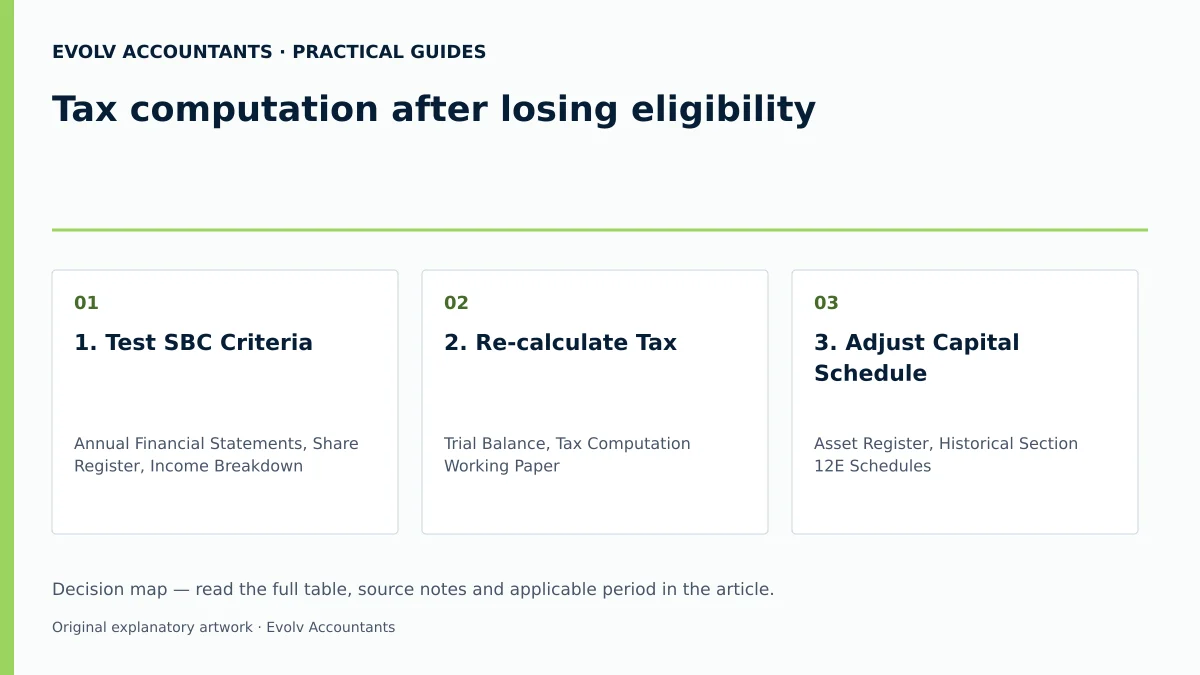
| 1. Test SBC Criteria | Annual Financial Statements, Share Register, Income Breakdown | Public Officer / Tax Practitioner | All applicable section 12E qualification tests evaluated | Document disqualification trigger if any test fails 1 21 |
| 2. Re-calculate Tax | Trial Balance, Tax Computation Working Paper | Accountant / Tax Specialist | Standard CIT flat rate (27%) applied to taxable income | Adjust provisional tax estimates for upcoming periods 4 5 |
| 3. Adjust Capital Schedule | Asset Register, Historical Section 12E Schedules | Fixed Asset Accountant | Legacy 12E(1A) deductions checked; new assets tested under applicable ordinary capital-allowance provisions | Separate legacy SBC assets from new general assets 8 10 46 |
| 4. Update ITR14 Wizard | SARS eFiling profile, ITR14 Form Wizard | Public Officer | Section 12E wizard question set to "No" | Confirm ITR14 expands to standard company sections 34 41 |
| 5. Review Assessment | SARS Assessment Notice (ITA34), EMSA34 Statement | Public Officer / Director | ITA34 tax calculation verified against working paper | File Request for Correction if eFiling wizard error occurred 50 |
Frequently Asked Questions
Q1: Does losing SBC status automatically cancel the company's income tax registration?
No. Losing SBC status does not alter a company's corporate tax registration or legal status. It simply alters the company's tax classification on the ITR14 return from a Small Business Corporation to a standard company, shifting the tax calculation from graduated rates to the standard flat corporate rate 5 6 13.
Q2: Can a company regain SBC status in a future year of assessment if it meets the rules again?
Yes. SBC eligibility is evaluated independently for every year of assessment 1 6. If a company exceeds the R20 million gross income limit or holds non-qualifying income in one year, but satisfies all Section 12E criteria in a subsequent year, it qualifies as an SBC again for that subsequent year 1 2 6.
Q3: What happens to existing assets being depreciated under Section 12E(1A) when SBC status is lost?
Where a qualifying section 12E(1A) 50/30/20 election was made, the remaining 30% and 20% deductions can continue after SBC status is lost, provided the asset meets the continuing trade-use requirement 7 8 10. New assets brought into use during a non-qualifying year cannot access section 12E; test the applicable ordinary capital-allowance provisions rather than assuming section 11(e) applies universally 10 47 49.
Q4: How does loss of SBC status affect provisional tax obligations?
Provisional tax payments must reflect the taxpayer's expected full-year tax liability 5 19. If a company realizes during a financial year that it will lose SBC status, it must adjust its second provisional tax calculation (IRP6) to apply the flat 27% rate, reducing the risk of underestimation penalties 4 5 34.
Q5: Is turnover tax an option after exceeding the SBC gross-income limit?
Turnover tax is a separate elective regime with its own qualification rules. Current SARS guidance gives a R2.3 million qualifying annual-turnover limit from 1 April 2026; a registered micro business may elect to remain in the VAT system. It does not replace the section 12E qualification tests. A company whose gross income exceeds R20 million cannot treat turnover tax as an automatic alternative. Provisional tax comprises advance payments towards income tax, rather than a separate annual tax rate. Ask Evolv about tax computation after losing eligibility. Share the relevant records so the support required can be scoped.
Related guides
- Applying SBC rates in a first short financial year
- How South African Businesses Can Qualify for SBC Tax Rates & Save Thousands
- The Proactive SARS Audit Guide: Keeping Your Business Ledger Sanitised
Sources
- https://www.sars.gov.za/wp-content/uploads/Legal/Notes/LAPD-IntR-IN-2012-09-Small-Business-Corporations.pdf
- Companies, Trusts and Small Business Corporations (SBC) | South African Revenue Service
- https://www.sars.gov.za/wp-content/uploads/IT-GEN-04-G01-How-to-complete-the-Income-Tax-Return-ITR14-for-Companies-External-Guide.pdf
- Turnover Tax | South African Revenue Service