
Who is a provisional taxpayer in South Africa
26 December 2025

A provisional taxpayer is any company or natural person deriving non-remuneration income, requiring advance tax payments to SARS across the applicable assessment period 1 2.
Under South African tax law, provisional tax is not a separate tax type from normal income tax, but a compulsory statutory payment mechanism designed to settle an enterprise's or individual's annual income tax liability in advance 3 4. The system ensures that tax obligations are met as income accrues throughout the tax year, preventing large tax debts upon final assessment 3 5.
While every incorporated company automatically enters the provisional tax system upon registration 1 2 6, natural persons, trusts, and corporate entities must evaluate their specific income categories, business activities, and statutory thresholds to establish their exact provisional tax status 1 2 7 8 9.
Income categories and provisional taxpayer exclusions
To accurately establish tax obligations, small and medium enterprises (SMEs), sole proprietors, and company directors must distinguish between statutory tax law, regulator guidance, and advisory recommendations. The statutory framework governing provisional tax is established under Paragraph 1 of the Fourth Schedule to the Income Tax Act No. 58 of 1962 and the Tax Administration Act No. 28 of 2011 1 10.
— Practical point from this guide
Official regulator guidance issued by the South African Revenue Service (SARS)—such as external guides GEN-PT-01-G01 and GEN-PT-01-G02—provides administrative instructions for requesting, calculating, and submitting Provisional Tax Returns (IRP6) 11 12 13 14. Professional advisory services provided by Evolv Accountants assist businesses with bookkeeping, tax advisory, payroll management, and statutory compliance to ensure seamless alignment with these statutory mandates.
A critical regulatory principle is that provisional tax status is determined directly by operation of law 1 2 6. Companies and close corporations are automatically classified as provisional taxpayers upon incorporation 1 2 6. There is no separate application, registration, or deregistration process required by SARS to enter or exit the provisional tax regime 6.
The burden of proof rests entirely on the taxpayer to ascertain liability, calculate estimated taxable income, request the appropriate IRP6 return via SARS eFiling, and remit payments on time 6 15 16.
For natural persons, eligibility depends strictly on the nature of income earned and whether the individual carries on an active business trade 2 7 8 9. Earning remuneration (such as a standard employment salary) subject to Pay-As-You-Earn (PAYE) employee tax does not trigger provisional tax liability 1 2 7.
Receiving non-remuneration income—including commercial trading profits, rental income from fixed property, foreign dividends, local interest, or director fees from an unregistered employer—can instantly bring an individual into the provisional tax net unless a specific statutory exclusion applies 1 2 7 8 9.
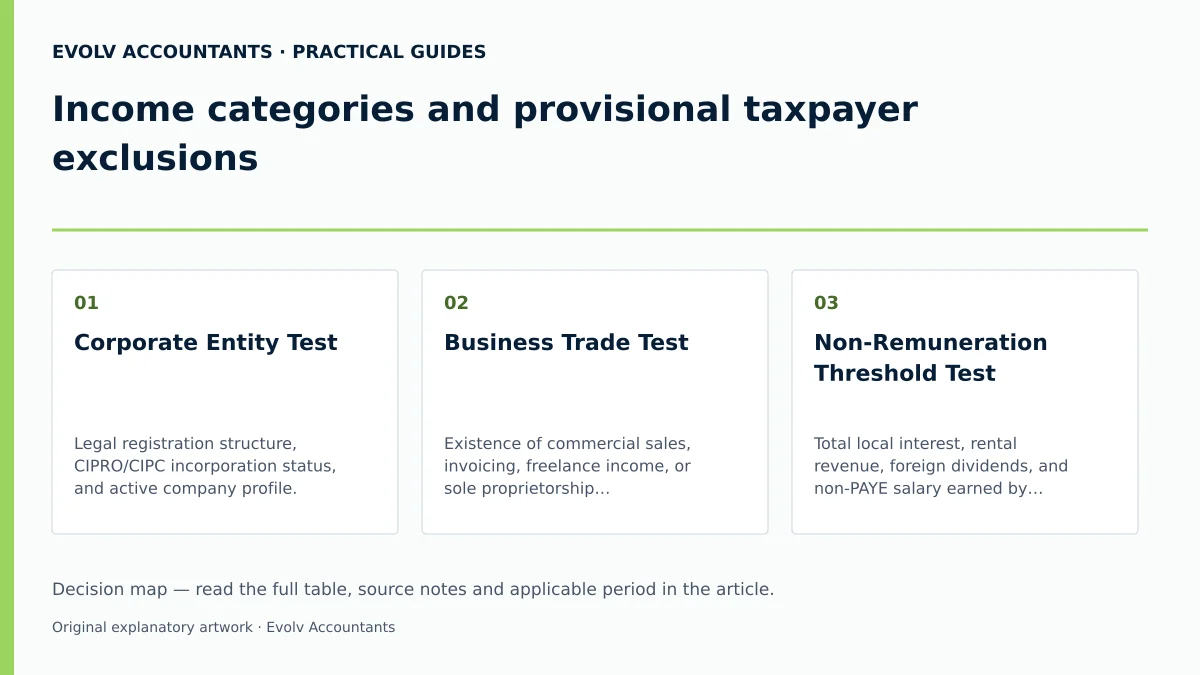
The qualification tests to check: income categories
Determining whether an entity or natural person must submit provisional tax returns requires applying a series of independent qualification tests across distinct income categories. Size labels or turnover figures alone cannot determine provisional tax status; each statutory test must be evaluated separately 1 2 8 9.
Test 1: The Corporate Entity Test
Under Paragraph 1 of the Fourth Schedule, every registered company, close corporation, or corporate entity residing in South Africa is defined as a provisional taxpayer 1 2. This applies irrespective of annual turnover or commercial operational status, unless the entity qualifies under a specific statutory entity exclusion 8 17.
Test 2: The Business Trade Test for Natural Persons
Any natural person who derives taxable income from carrying on any business, trade, freelance practice, or sole proprietorship is classified as a provisional taxpayer 2 8 17. Earning business trade income overrides standard employment exemptions, requiring the individual to submit biannual IRP6 returns regardless of whether employment salary is also received 1 2 7 8.
Test 3: The Non-Remuneration Investment Income Test
A natural person who does not carry on any business trade may still be classified as a provisional taxpayer if they earn investment or non-remuneration income 2 7 8 9. For the 2027 tax year of assessment (1 March 2026 – 28 February 2027), an individual who derives non-remuneration income (comprising local interest, foreign dividends, rental from letting fixed property, or salary from an employer not registered for PAYE) becomes a provisional taxpayer if either of the following conditions is met 8 9 18:
- Total taxable non-remuneration income exceeds R30 000 for the tax year 8 9; or
- Total taxable income from all sources exceeds the applicable statutory tax threshold for the tax year (for the 2027 tax year: R99 000 for individuals under 65; R153 250 for individuals aged 65 to 74; and R171 300 for individuals aged 75 and older) 8 9 18.
For context, in the 2026 tax year of assessment (1 March 2025 – 28 February 2026), the corresponding individual tax thresholds were R95 750 (under 65), R148 217 (aged 65 to 74), and R165 689 (aged 75 and older) 18.
Test 4: Statutory Entity Exclusions Test
The Income Tax Act explicitly excludes specific entities and individuals from provisional tax obligations 8 17. These statutory exclusions comprise 8 9 17:
- Approved Public Benefit Organisations (PBOs) approved under section 30 8 17;
- Approved recreational clubs approved under section 30A 8 17;
- Body corporates, share block companies, and associations of persons exempt under section 10(1)(e) 8 17;
- Non-resident owners or charterers of ships or aircraft required to make payments under section 33 8 9;
- Small business funding entities 8 9;
- Deceased estates 8 9; and
- Approved associations under section 30B(2) 8.
Distinguishing Provisional Tax from Corporate Tax Frameworks
It is essential to separate the provisional tax payment mechanism from specific tax rate frameworks 3 4 19 20:
- Ordinary Corporate Income Tax (CIT): Standard companies pay income tax at a flat rate of 27% for financial years ending on any date between 1 April 2026 and 31 March 2027 (and 27% for years ending 1 April 2025 to 31 March 2026) 19.
- Small Business Corporations (SBC): Qualifying SBCs under section 12E pay tax on a progressive sliding scale 20 21. For financial years ending between 1 April 2026 and 31 March 2027, the SBC tax rates are 20:
- R1 – R99 000: 0% of taxable income 20;
- R99 001 – R365 000: 7% of taxable income above R99 000 20;
- R365 001 – R550 000: R18 620 + 21% of taxable income above R365 000 20; and
- Above R550 000: R57 470 + 27% of taxable income above R550 000 20.
*(For the 2026 tax year ending between 1 April 2025 and 31 March 2026, the 0% bracket applied to taxable income up to R95 750) 20.*
- Provisional Tax: Regardless of whether a company pays ordinary 27% CIT or benefits from SBC progressive tax rates, it remains subject to provisional tax submission rules and deadlines 1 2 6 19 20.
Evidence behind the eligibility decision: provisional taxpayer exclusions
Every provisional tax status determination must be backed by formal evidence records maintained within the enterprise's accounting files. The Public Officer, Financial Director, or appointed Tax Practitioner is legally responsible for verifying these records prior to every IRP6 filing period 6 10 14.
| Test | Facts to obtain | Evidence | Applicable source | Result or unresolved question |
|---|---|---|---|---|
| Corporate Entity Test | Legal registration structure, CIPRO/CIPC incorporation status, and active company profile. | CIPC registration certificate (COR14.3), Memorandum of Incorporation, SARS tax reference record. | Fourth Schedule, Par 1; GEN-PT-01-G01 Par 2(a)(ii) 1 2 10 | Automatic provisional taxpayer status established unless statutory exclusion applies 1 2 6. |
| Business Trade Test | Existence of commercial sales, invoicing, freelance income, or sole proprietorship trading activities. | Annual financial statements, management accounts, client invoices, bank statements. | Fourth Schedule, Par 1; GEN-PT-01-G01 Par 2(b)(iv) 2 8 17 | Provisional taxpayer if business trade income exists 2 8 17. |
| Non-Remuneration Threshold Test | Total local interest, rental revenue, foreign dividends, and non-PAYE salary earned by a non-trading natural person. | IT3(b) interest certificates, IT3(c) capital gain records, rental lease agreements, bank statements. | Fourth Schedule, Par 1; Rates of Tax for Individuals 7 8 9 18 | Provisional taxpayer if taxable non-remuneration income exceeds R30 000 or total income exceeds age threshold 8 9 18. |
| Statutory Exclusion Test | Formal tax-exempt approval status issued by SARS Commissioner or non-resident status confirmation. | SARS Section 30/30A approval letter, Section 10(1)(e) exemption declaration, death certificate. | Fourth Schedule, Par 1; GEN-PT-01-G01 Par 2(b) 8 9 17 | Excluded from provisional tax obligations if valid statutory approval exists 8 9 17. |
| Director / CC Member Status Test | Directorship held in private companies or close corporations without independent business trade. | IRP5 employee tax certificates, CIPC directorship records, employment contracts. | Fourth Schedule, Par 1(g); GEN-PT-01-G01 Par 4 22 23 | Not automatically a provisional taxpayer solely due to directorship if remuneration is fully subject to PAYE 22 23. |
A qualifying case and an excluded case: income categories
To illustrate how these statutory qualification tests operate in practice, consider two reproducible hypothetical scenarios for the 2027 tax year of assessment.
Qualifying Case: Apex Commercial Solutions (Pty) Ltd
- Entity Profile: Private company registered in South Africa, with a financial year ending 28 February 2027 (2027 tax year of assessment) 1 2 19.
- Income & Activities: Conducts commercial IT consulting services, generating an estimated net taxable trading profit of R400 000 for the financial year 1 2 20. The company qualifies as a Small Business Corporation (SBC) under section 12E 20 21.
- Eligibility Decision: Under Paragraph 1 of the Fourth Schedule, Apex Commercial Solutions (Pty) Ltd is automatically a provisional taxpayer by virtue of being a registered company 1 2 6.
- Provisional Tax Calculation:
- Normal Tax on estimated R400 000 taxable income using 2027 SBC rates: R0 on first R99 000 + 7% on (R365 000 – R99 000 = R266 000) (R18 620) + 21% on (R400 000 – R365 000 = R35 000) (R7 350) = R25 970 total estimated normal tax liability 20.
- First Provisional Tax Payment (due 31 August 2026): 50% of total estimated tax liability = R12 985 6 24 25 26.
- Second Provisional Tax Payment (due 28 February 2027): 100% of estimated tax liability (R25 970) less first period payment (R12 985) = R12 985 6 24 26 27.
Excluded Case: Mr T. Mokoena (Salaried Individual)
- Individual Profile: Natural person aged 45 (under 65), employed full-time, with a tax year ending 28 February 2027 (2027 tax year of assessment) 7 9 18.
- Income & Activities: Receives a salary of R420 000 per annum (fully subject to PAYE employee tax) 1 2 7. Earns local taxable interest of R18 000 (after applying the s10(1)(i) local interest exemption of R23 800) 7 18. Does not carry on any business, freelance trade, or rental activity 8 9 17.
- Eligibility Decision: Applying Test 2 and Test 3:
- Business Trade Test: Carries on no business trade 8 9 17.
- Non-Remuneration Threshold Test: Total non-remuneration income derived is R18 000 interest 7 8 9.
- Outcome: Because Mr Mokoena carries on no business trade and his total taxable non-remuneration income (R18 000) does not exceed the statutory R30 000 threshold, he is explicitly excluded from being a provisional taxpayer for the 2027 tax year 8 9. He is not required to request or file IRP6 returns 6 8 9.
What changes the answer: provisional taxpayer exclusions
An entity or individual's provisional tax status is not static; it must be re-evaluated whenever underlying operational or financial circumstances change. Key triggers that alter provisional tax status include:
- Commencement of Independent Business Activity: A salaried individual who launches a part-time freelance consultancy or sole proprietorship during the tax year immediately becomes a provisional taxpayer 2 8 17.
- Breaching Investment Income Limits: An individual who purchases a residential rental property or earns foreign dividend/interest income exceeding R30 000 in net taxable value instantly enters the provisional tax system 8 9.
- Private Company Directorship Changes: Directors of private companies and members of close corporations are classified as employees under Paragraph 1(g) of the Fourth Schedule 22. While directorship alone does not automatically make an individual a provisional taxpayer if salary is fully subject to PAYE, taking on external consulting fees or non-employee business income triggers provisional tax liability 22 23.
- Cessation of South African Tax Residency: Under section 9H of the Income Tax Act, when a natural person ceases to be a South African tax resident during a year of assessment, two separate assessment periods are created within that single tax year 10 28. The taxpayer must manually complete specialized resident and non-resident IRP6 returns on eFiling to report income derived across the respective residence periods 10 28 29.
- Loss of Statutory Exemption Status: If a body corporate or PBO loses its tax-exempt status under section 10(1)(e) or section 30, it reverts to standard corporate provisional tax rules 8 17.
Next steps for Provisional tax
SME leadership and finance teams should execute the following structured action plan to maintain full provisional tax compliance:
- Conduct a Provisional Tax Status Audit: Review all revenue streams, corporate entity records, and non-remuneration income totals against Fourth Schedule qualification tests 1 2 8 9.
- Retrieve Historic Tax Assessments: Obtain the latest notice of assessment issued by SARS at least 14 calendar days prior to the IRP6 submission date to establish the official 'basic amount' 30 31 32. If the latest assessment was issued more than 18 months prior, increase the basic amount by 8% per annum 31 33.
- Log into SARS eFiling: Navigate to Returns -> Returns Issued -> Provisional Tax (IRP6), select the applicable tax period (e.g. 2027-01 or 2027-02), and request the return 34 35.
- Calculate Estimated Taxable Income: Estimate total taxable income for the year (excluding retirement lump sum benefits and severance payments) 23 30. Ensure estimates are justifiable, as SARS may request supporting documentation under Paragraph 19(3) 36 37 38.
- File IRP6 Return and Remit Payment: Submit the completed IRP6 return via eFiling 39. Ensure payment is made before the statutory deadline (31 August for the 1st period; 28/29 February for the 2nd period) using a valid 19-digit payment reference number and SARS beneficiary ID 24 26 40 41.
Frequently Asked Questions
Are directors of private companies automatically provisional taxpayers?
No. Under Paragraph 1(g) of the Fourth Schedule, directors of private companies and members of close corporations are defined as employees for tax purposes 22. They are not automatically classified as provisional taxpayers solely by virtue of holding a directorship, provided their remuneration is fully subject to PAYE employee tax and they derive no other independent business or non-remuneration income 22 23.
Must an SME submit an IRP6 return if no provisional tax payment is due?
Yes. Both corporate entities and individual provisional taxpayers are legally required to request and submit an IRP6 return for the first and second provisional periods, even if the resulting provisional tax calculation produces a 'Nil' (R0.00) liability 6 16 42. Failing to submit an IRP6 return allows the SARS Commissioner to estimate the taxpayer's taxable income and issue a binding assessment 43 44.
How is the 'basic amount' calculated, and when must the 8% adjustment be applied?
The basic amount is the taxable income assessed by SARS for the latest preceding year of assessment, excluding taxable capital gains, retirement lump sum benefits, and severance benefits 30 31. To be valid, the preceding assessment must have been issued at least 14 calendar days prior to the submission date of the current provisional tax return 30 31 32. If the estimate is submitted more than 18 months after the end of that latest assessed year, the basic amount must be increased by 8% per annum 31 33 37.
What penalties apply if a business underestimates its taxable income on the second IRP6 return?
Under Paragraph 20 of the Fourth Schedule, if an SME's estimated taxable income on its second IRP6 return is less than 90% of its actual taxable income determined on final assessment (for taxable income up to R1 million) and also less than its basic amount, a penalty of 20% is levied on the difference between the tax paid and the lesser of tax on 90% of actual income or tax on the basic amount 45 46 47. For taxable income exceeding R1 million, the 20% underestimation penalty is calculated against an 80% actual taxable income threshold 48 49. Additionally, Paragraph 27 imposes a 10% penalty on late provisional tax payments 50.
What is the voluntary third provisional tax payment, and when should it be made?
The third provisional tax payment (often called the top-up payment) is an optional payment made after the end of the tax year to settle any remaining income tax shortfall 3 4 6 51. For taxpayers with a February year-end, the voluntary payment must be made on or before the last business day of September (within six months of year-end for companies with other financial year-ends) 24 52 53. Making a third payment prevents or reduces interest charged by SARS on underpaid provisional tax under section 89quat 4 6 52 54 55.
Related guides
- Calculating a first provisional tax payment
- Calculating a second provisional tax payment
- The Proactive SARS Audit Guide: Keeping Your Business Ledger Sanitised
Sources
- Provisional Tax | South African Revenue Service
- https://www.sars.gov.za/wp-content/uploads/Ops/Guides/GEN-PT-01-G01-Guide-for-Provisional-Tax-External-Guide.pdf
- https://www.sars.gov.za/wp-content/uploads/Ops/Guides/GEN-PT-01-G02-How-to-eFile-your-Provisional-Tax-Return-External-Guide.pdf
- Rates of Tax for Individuals | South African Revenue Service
- Companies, Trusts and Small Business Corporations (SBC) | South African Revenue Service