
Calculating a first provisional tax payment
9 February 2025

Calculating a first provisional tax payment requires estimating annual taxable income and remitting half the resulting tax liability within six months of the financial year start.
South African companies and provisional taxpayers are required to forecast their total taxable income for the full year of assessment to determine their first provisional tax liability (IRP6/01). Provisional tax is not a distinct tax type, but a statutory mechanism to collect normal income tax in advance across the financial year. The first payment covers half of the estimated annual tax liability, less allowable employees' tax (PAYE) withheld and foreign tax credits.
Under statutory rules, the estimated taxable income submitted to the South African Revenue Service (SARS) must generally not fall below the basic amount—defined as the taxable income from the latest preceding assessment—unless SARS agrees to a lower estimate. Timeous calculation, reconciliation against prior assessments, and submission via eFiling are critical to prevent administrative penalties and interest under the Tax Administration Act.
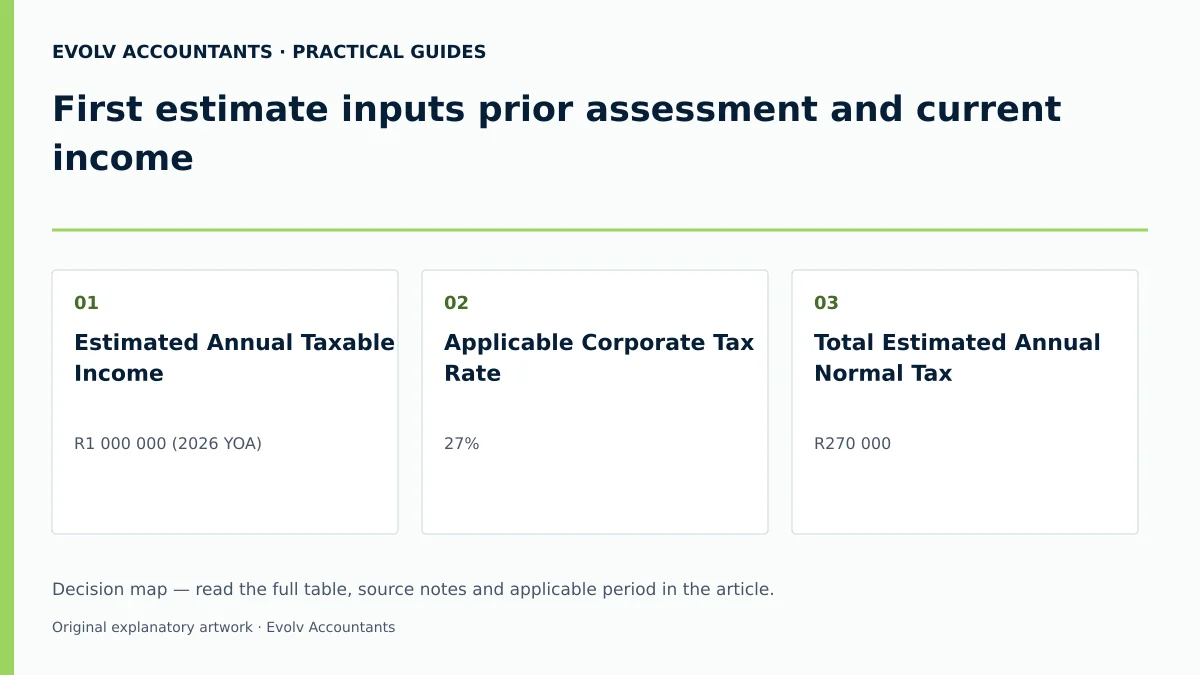
First estimate inputs prior assessment and current income
Regulatory tax frameworks and entity distinctions
Navigating business taxation in South Africa requires distinguishing between competing tax regimes and statutory obligations:
- Corporate Income Tax (CIT): Governed under the Income Tax Act No. 58 of 1962, standard companies are assessed at a flat corporate tax rate of 27% for years of assessment ending on any date between 1 April 2023 and 31 March 2027 1 2.
- Small Business Corporations (SBC): Qualifying SBCs under section 12E benefit from progressive tax brackets 3. For the 2026 year of assessment (financial years ending between 1 April 2025 and 31 March 2026), SBC taxable income is taxed at 0% on the first R95 750, 7% on R95 751 to R365 000, R18 848 plus 21% on R365 001 to R550 000, and R57 698 plus 27% on amounts exceeding R550 000 3. For the 2027 year of assessment (ending between 1 April 2026 and 31 March 2027), the 0% bracket increases to R99 000 3.
- Turnover Tax: Governed under the Sixth Schedule, turnover tax is a standalone, simplified tax system for eligible micro-businesses with annual qualifying turnover up to R1 million 4 5.
- Provisional Tax: Governed under the Fourth Schedule, provisional tax is not a separate tax, but "a method of paying the income tax liability in advance" 2 4 5. Companies automatically enter the provisional tax system upon incorporation and must request and submit IRP6 returns via SARS eFiling 6 7 8.
Defining the output, units, period, and accounting adjustments
The primary output of the first provisional tax return is the net first provisional tax payment due, measured in South African Rands (R) 7 9. The period covered is the first six months of the entity's year of assessment (for example, 1 March to 31 August for a company with a 28/29 February year-end) 10 11.
Distinguishing accounting profit from statutory taxable income is essential. Financial accounts record net accounting profit before tax according to financial reporting standards, whereas the IRP6 estimate requires statutory taxable income 12 13. Management must adjust accounting profit by adding back non-deductible accounting expenses, accounting depreciation, and provisions, while deducting statutory tax allowances, exempt income, and adjusting for taxable capital gains 14 15.
— Practical point from this guide
Inputs rates periods and exclusions: first estimate inputs prior assessment
Basic amount definitions and statutory rules
Statutory law and regulator guidance dictate how prior assessments govern current estimate inputs:
- Basic Amount Definition: The basic amount is the taxpayer’s taxable income assessed by SARS for the latest preceding year of assessment, LESS any taxable capital gains, severance benefits, or lump-sum retirement payments included in that assessment 15 16.
- The 14-Calendar-Day Rule: To qualify as the basic amount, the notice of assessment (ITA34) for the preceding year must have been issued by SARS at least 14 calendar days prior to the date the provisional tax return is submitted 15 17. If an assessment is issued less than 14 days before submission, the basic amount defaults to the taxable income of the year immediately preceding that assessment 17 18.
- The 18-Month 8% Uplift Rule: If an estimate is submitted more than 18 months after the end of the latest preceding year last assessed, statutory rules require the basic amount to be increased by 8% per annum for each year until the current year of assessment 16 19.
- Minimum Estimate Threshold: Paragraph 19(3) specifies that a taxpayer's estimate cannot be less than the basic amount unless SARS agrees to a lower figure based on justified operational circumstances 14 20.
- Exclusions from Provisional Tax: Excluded entities include Public Benefit Organisations (PBOs), approved recreational clubs, body corporates, share block companies, deceased estates, and small business funding entities 21 22 23. Natural persons without business income are excluded if their taxable income falls below personal tax thresholds (for example, R95 750 for under-65s in the 2026 tax year) or passive interest/rental income does not exceed R30 000 21 23 24. Directors of private companies and close corporation members are treated as employees for PAYE purposes and are not automatically provisional taxpayers unless they earn independent non-remuneration business income 13.
Identifying missing inputs explicitly
When preparing the first provisional tax estimate, management must explicitly identify missing inputs. If a company has not been assessed by SARS within the preceding five years (for instance, a newly incorporated enterprise), the historical basic amount is nil 25. In such cases, the basic amount input is absent, and the entity must rely entirely on a realistic 12-month budget forecast of current taxable income 14 25.
The calculation in a worked example: current income
Hypothetical scenario parameters
To illustrate the arithmetic for an SME company:
- Entity Type: Standard Corporate Income Tax entity 1 6.
- Year of Assessment: 2026 tax year (1 March 2025 to 28 February 2026) 1 11 26.
- First Period Due Date: 31 August 2025 11 26.
- Prior Assessment Record: 2024 tax year assessment (ended 29 February 2024) issued on 10 July 2025 (more than 14 calendar days prior to 31 August 2025) with assessed taxable income of R800 000 (zero capital gains) 15 16 17. Because 31 August 2025 is exactly 18 months from 29 February 2024, no 8% per annum basic amount uplift applies 16 27.
- Current Income Forecast: Full-year 12-month taxable income estimated at R1 000 000 (exceeding the R800 000 basic amount) 9 14.
- Corporate Tax Rate: 27% flat corporate rate 1.
Reproducible worked example
| Input | Value or verified-source placeholder | Formula or step | Result | Independent check |
|---|---|---|---|---|
| Estimated Annual Taxable Income | R1 000 000 (2026 YOA) | Full-year taxable income forecast | R1 000 000 | Exceeds basic amount (R800 000); no SARS permission required 14 15. |
| Applicable Corporate Tax Rate | 27% | Flat rate for companies (2026 YOA) 1 | 27.00% | Verified against SARS CIT rate schedule 1. |
| Total Estimated Annual Normal Tax | R270 000 | R1 000 000 × 27% | R270 000 | R1 000 000 × 0.27 = R270 000 1 9. |
| Gross First Provisional Tax (50%) | R135 000 | R270 000 ÷ 2 | R135 000 | Half of total estimated annual normal tax 7 9. |
| Less PAYE / Foreign Tax Credits | R0 | Allowable deductions for first 6 months 7 9 | R0 | Verified payroll and s6quat credit records 7 9. |
| Net First Provisional Tax Payable | R135 000 | Gross first tax less allowable credits | R135 000 | Payable via SARS eFiling by 31 August 2025 10 11. |
Reconcile the answer to the underlying records: first estimate inputs prior assessment
Step-by-step eFiling platform navigation
Reconciling first provisional tax calculations against underlying records requires systematic platform verification:
- Accessing Profile: Log into SARS eFiling and navigate to Returns → Returns Issued → Provisional Tax (IRP6) 28.
- Selecting Period: Select the applicable period (for example, 2026-01 for the first period of the 2026 tax year) and select Request Return 28 29.
- Verifying Pre-Populated Fields: The IRP6 return pre-populates registered entity details and historical basic amounts if assessed within five years 25 30.
- Capturing Income and Deductions: Capture gross turnover/sales and estimated full-year taxable income 30 31. Capture allowable PAYE withheld for the first six months and section 6quat foreign tax credits 31.
- System Calculations: eFiling automatically applies the applicable tax rate (27%) to compute total annual tax and divides by two to display net tax payable for the period 32.
- Filing the Return: Review the pre-populated declaration date, click Confirm, and select File Return 33.
- Initiating Payment: Navigate to Payments → Pay Now → Create Additional Payment → Provisional Tax (PROV) 34. Complete payment via eFiling Credit Push or EFT using the 19-digit Payment Reference Number (PRN) 34 35.
- Statement of Account Reconciliation: Navigate to the Provisional Tax Work Page and select Request Statement of Account (PTAX) to verify that the return has posted, the payment is credited, and the closing balance reconciles to zero 36 37.
Edge cases that change the calculation: current income
Variable periods and short financial years
Under Paragraph 21 of the Fourth Schedule, a first provisional tax return and payment are not required if the year of assessment does not exceed six months 38. This occurs when a company is newly incorporated during the financial year, when an entity ceases to be a tax resident, or when SARS approves a financial year-end change resulting in a short tax period 38.
SARS estimate adjustments and Paragraph 19(3) justification
If a taxpayer submits an estimate lower than the basic amount, SARS may issue a Paragraph 19(3) engagement letter via eFiling requesting supporting documents (such as year-to-date management accounts and financial forecasts) 20 39. The taxpayer must upload supporting evidence within 10 business days 39. If SARS is dissatisfied with the justification, the Commissioner may unilaterally increase the estimate to a reasonable amount 14 20. This adjustment by SARS is final and not subject to objection or appeal 14 20.
Statutory penalties and interest charges
Failing to calculate or submit provisional tax accurately incurs severe statutory consequences:
- Late Payment Penalty (Paragraph 27): A 10% penalty is levied under Paragraph 27 of the Fourth Schedule on any provisional tax paid late for the first period 40.
- Late Payment Interest (Section 89bis): Interest is charged under Section 89bis of the Tax Administration Act No. 28 of 2011 at prescribed interest rates from the due date until full settlement 2 41.
- Underestimation Penalty (Paragraph 20): Levied on the second provisional tax return if estimated taxable income falls below statutory thresholds 42 43 44. For taxable income exceeding R1 million, a 20% penalty applies if the estimate is less than 80% of actual taxable income 44. For taxable income up to R1 million, a 20% penalty applies if the estimate is less than 90% of actual taxable income and less than the basic amount 43.
- Underpayment Interest (Section 89quat): Interest is charged on tax underpayments from the effective date if actual normal tax exceeds provisional payments, provided taxable income exceeds R20 000 for companies 45. Section 167 instalment payment agreements apply only to assessed tax debt and cannot defer provisional tax obligations 46.
Next steps for Provisional tax
Checked action plan for SME management
To ensure complete compliance prior to submission, follow this checked sequence:
- Retrieve the latest SARS notice of assessment (ITA34) to confirm the statutory basic amount and verify that its issue date is at least 14 calendar days prior to submission 15 17.
- Finalise six-month management accounts and adjust accounting profit for non-deductible items and tax allowances to establish an accurate full-year taxable income forecast 7 9.
- Verify whether the prior assessment is older than 18 months from the year-end, applying an 8% per annum uplift if required 16 19.
- Request the IRP6/01 return on SARS eFiling, cross-check pre-populated historical data, capture the estimated taxable income, and deduct allowable first-period PAYE or foreign tax credits 28 29 31.
- File the IRP6 return and release the payment via eFiling Credit Push or EFT prior to the six-month deadline (or preceding business day if falling on a weekend/public holiday) 11 33 34 35 47.
Frequently Asked Questions
Is an IRP6 return required if no provisional tax is payable?
Yes. Provisional taxpayers must request and submit an IRP6 return for the first period even if the provisional tax calculation results in a nil payment liability 12 48.
What happens if SARS disagrees with our provisional tax estimate?
Under Paragraph 19(3), SARS may request supporting documents to justify any estimate 14 20. If the response is unsatisfactory, SARS may increase the estimate, and this adjustment is not subject to objection or appeal 14 20.
How does the 14-calendar-day rule affect the basic amount?
A notice of assessment issued by SARS less than 14 calendar days before the provisional tax submission date cannot be used as the basic amount; the basic amount defaults to the assessment of the year preceding that return 15 17 18.
How can a company make a provisional tax payment to SARS?
Payments can be made via eFiling Credit Push, internet banking EFT, or over the counter at approved commercial banks using the 19-digit Payment Reference Number (PRN) 34 35.
Are private company directors automatically provisional taxpayers?
No. Private company directors and close corporation members are treated as employees for PAYE purposes and are not automatically deemed provisional taxpayers unless they derive independent non-remuneration business income 13. Tell Evolv which estimate, payment period or income record you need help to review. Ask Evolv about first estimate inputs prior assessment and current income. Share the relevant records so the support required can be scoped.
Related guides
- Who is a provisional taxpayer in South Africa
- Calculating a second provisional tax payment
- The Proactive SARS Audit Guide: Keeping Your Business Ledger Sanitised
Sources
- Companies, Trusts and Small Business Corporations (SBC) | South African Revenue Service
- https://www.sars.gov.za/wp-content/uploads/Ops/Guides/GEN-PT-01-G01-Guide-for-Provisional-Tax-External-Guide.pdf
- Provisional Tax | South African Revenue Service
- Rates of Tax for Individuals | South African Revenue Service
- https://www.sars.gov.za/wp-content/uploads/Ops/Guides/GEN-PT-01-G02-How-to-eFile-your-Provisional-Tax-Return-External-Guide.pdf