
Calculating a second provisional tax payment
6 November 2025

Calculating a second provisional tax payment requires estimating total annual taxable income and submitting an accurate IRP6 return to SARS before the financial year end 1 2 3.
Provisional tax is an advance payment mechanism for normal income tax liabilities rather than a separate tax category 4 5. For South African small and medium enterprises (SMEs), the second provisional tax payment represents the final compulsory advance calculation for the year of assessment 1 6. It ensures that the enterprise settles its estimated tax liability incrementally across the tax year to avoid substantial lump-sum liabilities, penalties, and interest on final assessment 4 7.
The calculation takes the total estimated normal tax liability for the full 12-month period and deducts allowable tax credits, employees' tax withheld (PAYE), and any first provisional tax payment actually made 1 8 9.
Second estimate accuracy and year end information
Output, units, and period of assessment
The output of a second provisional tax calculation is the net Rand (R) tax amount payable to the South African Revenue Service (SARS) upon submitting the second-period IRP6 return 8 9 10. The relevant period of assessment is the full 12-month financial year 1 11. For individual provisional taxpayers and standard companies, the year of assessment ends on 28 February (or 29 February in a leap year) 2 11.
For companies with approved alternative financial year-ends, the period ends on the final business day of their chosen 12-month cycle 2 11.
Accounting profit versus taxable income
It is essential to distinguish between accounting profit and taxable income 3 12. Accounting profit reflects financial performance prepared under reporting standards, whereas taxable income is determined under the provisions of the Income Tax Act No. 58 of 1962 12 13.
In calculating the second provisional tax payment, year-end management accounts provide the baseline accounting data, but statutory tax adjustments—such as adding back non-deductible expenses, deducting capital allowances, and adding taxable capital gains—must be performed to arrive at the estimated taxable income 3 12.
Inputs rates periods and exclusions: second estimate accuracy
Entity categories and applicable tax rates
South African tax legislation separates entity types into specific tax structures, each subject to distinct rates and rules 14 15 16:
- Ordinary Corporate Income Tax: Standard private companies are subject to a flat corporate income tax rate of 27% for years of assessment ending on any date between 1 April 2023 and 31 March 2027 14.
- Small Business Corporations (SBC): Qualifying Small Business Corporations under section 12E of the Income Tax Act benefit from a progressive tax rate structure 15 17. For the 2026 year of assessment (financial years ending between 1 April 2025 and 31 March 2026), taxable income up to R95 750 is taxed at 0%; taxable income from R95 751 to R365 000 is taxed at 7% of the amount above R95 750; taxable income from R365 001 to R550 000 is taxed at R18 848 plus 21% of the amount above R365 000; and taxable income exceeding R550 000 is taxed at R57 698 plus 27% of the amount above R550 000 17. For the 2027 year of assessment (ending between 1 April 2026 and 31 March 2027), the 0% bracket increases to R99 000, with adjusted thresholds across higher bands 17.
- Turnover Tax: Qualifying micro-businesses with an annual qualifying turnover not exceeding R1 million may elect into the turnover tax regime under the Sixth Schedule, paying a simplified tax on turnover rather than provisional tax on net taxable income 18 19.
- Trusts: General trusts (other than special trusts) are assessed at a flat tax rate of 45% for years of assessment ending 28 February 2021 through 28 February 2027, and do not qualify for personal rebates or basic interest exemptions 15 20 21.
Exclusions and missing inputs
When calculating the estimated taxable income for a natural person, specific lump-sum receipts are excluded from the provisional tax estimate and basic amount calculations, including retirement fund lump sum benefits, retirement fund lump sum withdrawal benefits, and severance benefits 22 23 24.
Specific entities are excluded from provisional tax requirements altogether, including approved Public Benefit Organisations (PBOs), approved recreational clubs, body corporates, share block companies, and small business funding entities 25 26 27.
Unverified inputs—such as unposted year-end accruals, pending inventory write-downs, or unconfirmed foreign tax credits—must be explicitly flagged as provisional adjustments requiring verification against final general ledger balances prior to submitting the IRP6 return 3 8 9.
The calculation in a worked example: year end information
Hypothetical reproducible model
Consider a hypothetical private company registered in South Africa with a financial year ending 28 February 2026 (2026 year of assessment) 11 14. The company is assessed under ordinary corporate income tax at a flat rate of 27% 14. The company submitted a first provisional tax estimate six months into the tax year and actually paid R150 000 to SARS 1 8 9. The management accounts prepared at year end reflect an estimated annual taxable income of R1 200 000 3 9.
All numbers used in this model are illustrative values labelled for reproducible arithmetic and do not constitute statutory limits 28.
Calculation structure and verification
| Input | Value or verified-source placeholder | Formula or step | Result | Independent check |
|---|---|---|---|---|
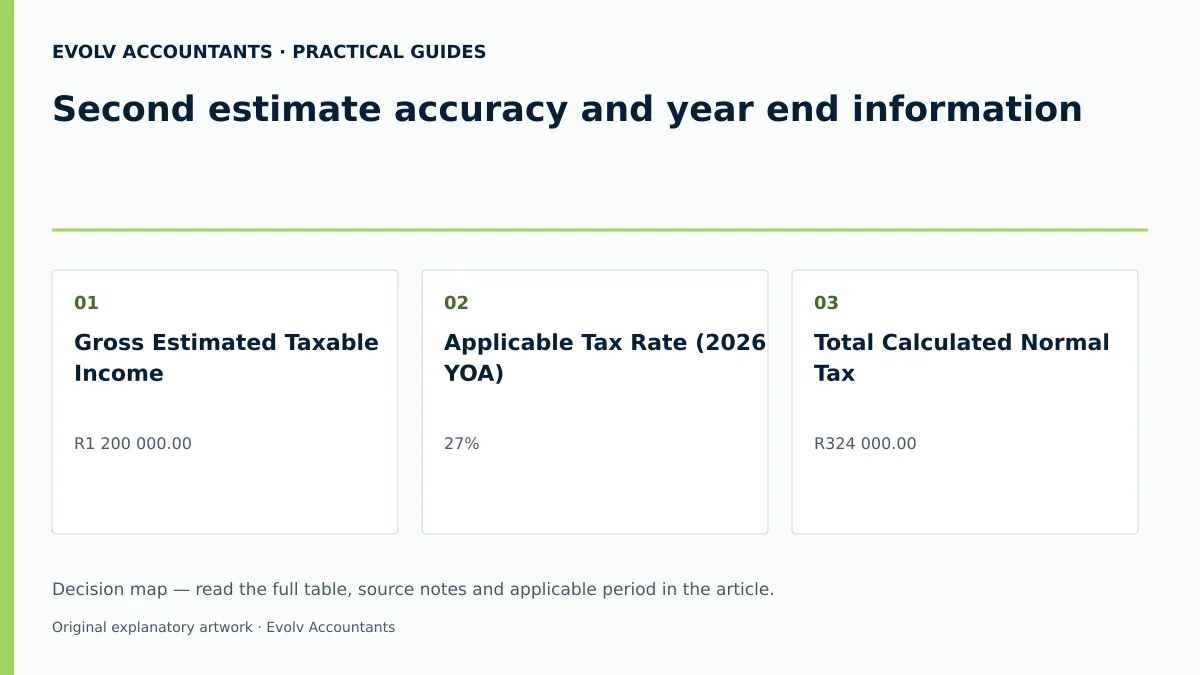
| Gross Estimated Taxable Income | R1 200 000.00 | Net profit adjusted for tax add-backs and allowances 3 12 | R1 200 000.00 | Verified against year-end management accounts 3 |
| Applicable Tax Rate (2026 YOA) | 27% | Flat corporate tax rate for 2026 YOA 14 | 27.00% | Primary source schedule rate check 14 |
| Total Calculated Normal Tax | R324 000.00 | R1 200 000.00 × 27% 9 14 | R324 000.00 | R1 200 000.00 × 0.27 = R324 000.00 14 |
| Less: Employees' Tax (PAYE) | R0.00 | PAYE withheld for full 12 months 8 9 | R0.00 | Reconciled to EMP501 annual payroll return 9 |
| Less: Foreign Tax Credits (s6quat) | R0.00 | Allowable section 6quat foreign tax credits 8 9 29 | R0.00 | Verified with foreign tax assessment proof 29 |
| Total Tax Liability for Year | R324 000.00 | Normal Tax less PAYE and foreign tax credits 8 9 | R324 000.00 | R324 000.00 - R0.00 = R324 000.00 9 |
| Less: First Provisional Tax Paid | R150 000.00 | Credit for first provisional payment actually paid 8 9 | R150 000.00 | Verified against SARS Statement of Account 9 30 |
| Net Second Provisional Tax Payable | R174 000.00 | Total Tax Liability less First Payment Paid 8 9 | R174 000.00 | R324 000.00 - R150 000.00 = R174 000.00 9 |
Reconcile the answer to the underlying records: second estimate accuracy
To ensure second estimate accuracy, the final figure captured on the IRP6 return must be reconciled to the business's primary records and SARS filing system 3 10 31:
— Practical point from this guide
- Revenue and Expense Totals: Reconcile gross turnover and operating expenditure from general ledger trial balances to ensure all taxable income streams and non-deductible items are correctly reflected 3 32.
- First Period Payment Records: Verify the actual cash amount paid for the first provisional tax period against the official SARS Provisional Tax Statement of Account (PTAX SOA) on eFiling 9 30 33. Statutory instructions explicitly state that only provisional tax amounts actually paid for the first period may be deducted on the second IRP6 return 8 9.
- Employees' Tax (PAYE) Reconciliation: Cross-check any claimed employees' tax deductions against EMP201 monthly declarations and EMP501 annual payroll reconciliations 8 9.
- Foreign Tax Credits: Confirm that foreign tax credits claimed under section 6quat are supported by documentary evidence of foreign taxes paid or payable on foreign-sourced income 8 9 29.
- Rounding and Mathematical Verification: Review automated calculations on eFiling before submission to ensure no rounding discrepancies or data entry errors exist in mandatory input fields 10 34 35.
Edge cases that change the calculation: year end information
Short assessment periods
Where a company is incorporated during the year, changes its financial year-end, or ceases tax residency, the year of assessment may span a period of six months or less 36. In such instances, a first provisional tax return is not required, but a second provisional tax return must be submitted at the end of the shortened period covering the full actual duration 36.
The basic amount rule and 8% uplift
The "basic amount" is defined as the taxable income assessed by SARS for the latest preceding year of assessment, provided the notice of assessment was issued at least 14 calendar days prior to the date of submitting the provisional tax estimate 23 37. Capital gains, retirement lump sums, and severance benefits are excluded from the basic amount calculation 23.
If the second provisional tax estimate is submitted more than 18 months after the end of the latest preceding year of assessment, statutory rules dictate that the basic amount must be increased by 8% per annum for each full year until the current period 38 39 40.
Underestimation penalties under Paragraph 20
Paragraph 20 of the Fourth Schedule to the Income Tax Act prescribes penalties for underestimating taxable income on the second provisional tax return 41 42 43:
- Taxable Income of R1 Million or Less: If the estimated taxable income on the second IRP6 is less than 90% of actual taxable income AND also less than the basic amount, SARS imposes a 20% penalty 42 44. The penalty is calculated as 20% of the difference between the lesser of (normal tax on 90% of actual taxable income or normal tax on the basic amount) and the total credits for PAYE and provisional tax paid by year end 42 44 45.
- Taxable Income Exceeding R1 Million: The basic amount safe harbour does not apply 43. A 20% penalty is levied on the difference between normal tax on 80% of actual taxable income and the total employees' tax and provisional tax paid by the end of the year of assessment 43 46.
- Interaction with Late Payment Penalties: A 10% penalty is imposed under Paragraph 27 for late payment of provisional tax 47. Any Paragraph 20 underestimation penalty levied on assessment is reduced by the amount of any Paragraph 27 late payment penalty imposed 24 45.
Next steps for Provisional tax
Pre-submission checklist for business owners
- [ ] Complete year-end management account reconciliations to establish a dependable taxable income baseline 3 12.
- [ ] Log in to SARS eFiling, navigate to Returns -> Returns Issued -> Provisional Tax (IRP6), and request the second-period return (e.g. 2026-02) 48 49.
- [ ] Verify prepopulated taxpayer particulars and year last assessed on the Provisional Tax Work Page 50 51.
- [ ] Confirm the exact basic amount reflected on the return and evaluate whether an 8% uplift applies 23 38 51.
- [ ] Request a SARS Statement of Account to confirm the exact first provisional tax payment amount actually credited 9 30.
- [ ] Capture Gross Income, Estimated Taxable Income, and allowable credits on the IRP6 form 10 32.
- [ ] Review eFiling tax recalculations for accuracy, complete the online declaration, and click "File Return" prior to the deadline 34 35.
- [ ] Authorise payment via eFiling Credit Push or EFT using the correct 19-digit payment reference number 52 53 54.
Frequently Asked Questions
What is the deadline for submitting the second provisional tax payment?
For taxpayers with a February financial year-end, the second provisional tax payment and IRP6 return must be submitted no later than the last business day of February 2 11. For companies with alternative financial year-ends, payment is due on the last business day of their 12-month financial year 2 11.
How is the second provisional tax payment calculated for a South African company?
The calculation requires estimating the total taxable income for the full 12-month year of assessment, applying the relevant corporate tax rate (e.g., 27% for ordinary companies), and deducting employees' tax (PAYE), allowable foreign tax credits, and the first provisional tax payment actually paid 1 9 14.
What happens if an SME underestimates its taxable income on the second IRP6 return?
If actual taxable income exceeds R1 million and the estimate is under 80% of actual taxable income, SARS levies a 20% penalty on the tax shortfall 43 46. For taxable income up to R1 million, a 20% penalty applies if the estimate is below 90% of actual taxable income and below the basic amount 42 44.
What is the basic amount rule and when is an 8% increase applied?
The basic amount is the taxable income assessed by SARS for the latest preceding year of assessment issued at least 14 days before submitting the estimate, excluding capital gains and lump sums 23 37. If the estimate is submitted more than 18 months after the end of that last assessed year, the basic amount must be increased by 8% per annum 38 39 40.
Can a company claim first provisional tax payments that were not actually paid?
No. Legislation explicitly stipulates that only first-period provisional tax amounts that were actually paid can be deducted when calculating the net amount due for the second provisional tax period 8 9.
Related guides
- Who is a provisional taxpayer in South Africa
- Submitting an IRP6 through eFiling
- The Proactive SARS Audit Guide: Keeping Your Business Ledger Sanitised
Sources
- Provisional Tax | South African Revenue Service
- https://www.sars.gov.za/wp-content/uploads/Ops/Guides/GEN-PT-01-G01-Guide-for-Provisional-Tax-External-Guide.pdf
- https://www.sars.gov.za/wp-content/uploads/Ops/Guides/GEN-PT-01-G02-How-to-eFile-your-Provisional-Tax-Return-External-Guide.pdf
- Companies, Trusts and Small Business Corporations (SBC) | South African Revenue Service
- Rates of Tax for Individuals | South African Revenue Service