
Building a 13 week cash flow forecast
14 December 2024

Building a 13-week cash flow forecast requires tracking weekly opening cash, receipts, payments, and closing balances from verified accounting records. 1 2
Rules reviewed: 20 October 2026. Read the linked primary sources for the applicable period, commencement dates and conditions.
A 13-week cash flow forecast provides South African small and medium enterprises (SMEs) with a rolling operational model to manage short-term liquidity and anticipate cash deficits before trading is impacted 3 4. Unlike statutory annual financial statements prepared under the Companies Act 71 of 2008 5 or income tax returns submitted to the South African Revenue Service (SARS) 6, an operational cash forecast focuses exclusively on cash receipts and disbursements rather than accrued revenues or accounting net profit 7 8.
All forecast figures represent hypothetical operational projections rather than guaranteed financial predictions 4.
Weekly opening cash receipts payments and closing cash
Reader decisions and horizon selection
Managing working capital requires SME executives to decide when to settle trade creditors, purchase inventory, or enforce customer collections 7 8. A 13-week horizon covers a standard operational quarter, enabling management to evaluate whether projected cash receipts will cover upcoming cash payments 3 8. According to IAS 7 Statement of Cash Flows, "Cash comprises cash on hand and demand deposits" 3.
In cash flow forecasting, opening cash reflects verified bank funds at week start, cash receipts cover customer collections, cash payments represent settled disbursements, and closing cash provides the net liquid buffer carried into the next week 3 7.
Distinguishing forecasts from predictions
A cash forecast is an operational management model based on factual accounting evidence and documented assumptions, whereas a prediction implies a guaranteed outcome 4. Evolv recommends treating every cash flow projection as an internal decision-making tool updated weekly as bank transactions settle 2 3.
— Practical point from this guide
While the Companies Act 71 of 2008 requires company directors to satisfy solvency and liquidity requirements—ensuring the business can pay its debts as they become due over 12 months 4—an operational cash forecast is an internal management methodology rather than a statutory filing or funder commitment 4 5.
Build assumptions from actual records: weekly opening cash receipts payments
Source balances and record-keeping rules
Accurate cash projections must be grounded in primary accounting records 1 2. Under Section 24 of the Companies Act 71 of 2008, companies must maintain accurate accounting records in an official South African language 2, retaining general ledgers and supporting documents for seven completed financial years 1 9. SARS requires taxpayers and Value-Added Tax (VAT) vendors to retain records, books of account, and bank statements for five years from the return submission date 10 11.
To build reliable forecast assumptions, managers must extract four primary inputs 1 8 12:
- Verified bank balances: Reconciled cash on hand and demand deposit accounts 3.
- Accounts receivable ledgers: Customer invoices with agreed credit terms and historical collection rates 8 13.
- Accounts payable ledgers: Supplier bills, purchase orders, and trade credit terms 8 12.
- Statutory tax obligations: Scheduled Pay-As-You-Earn (PAYE) deductions and VAT liabilities 14 15 16.
Accountable owners and tax deadlines
Every line item requires an accountable owner to validate operational assumptions 2. For example, the credit controller manages debtor collection timelines, while the procurement lead oversees supplier terms 8. Tax compliance dates must be hardcoded into the forecast schedule 14 17.
For the 2026/2027 tax year, 1 March 2026–28 February 2027, SARS lists an annual normal-tax threshold of R99,000 for individuals under 65. Employers must register for employees’ tax within 21 business days of becoming an employer unless none of their employees is liable for normal tax. Calculate PAYE using the applicable age, remuneration and payroll-period rules. EMP201 payments are due within seven days after month-end; if the due date is a weekend or public holiday, use the preceding business day. SARS employer guide: 2026/2027 tax year Registered VAT vendors must forecast payments using their assigned VAT periods and applicable accounting basis.
Construct the base scenario: closing cash
Schedule architecture and arithmetic
The base scenario projects the most probable cash trajectory using transparent arithmetic formulas 3 7:
- Net Cash Flow = Total Weekly Cash Receipts − Total Weekly Cash Payments
- Closing Cash = Weekly Opening Cash + Net Cash Flow
- Next Opening Cash = Preceding Week Closing Cash
Cash receipts include operational cash sales and debtor collections 7 8. Cash payments cover operating expenses, payroll, and statutory disbursements 8 14 20.
Reproducible hypothetical example
Consider a South African SME in the 2025/2026 period 6. All values are hypothetical operational figures in Rand (R) and do not constitute financial predictions 4:
- Week 1 Opening Cash: R150 000 (reconciled bank balance) 3.
- Week 1 Receipts: R85 000 (R35 000 cash sales + R50 000 debtor receipts) 8.
- Week 1 Payments: R60 000 (R30 000 trade creditors + R20 000 overheads + R10 000 minor equipment write-off) 8 21.
- Week 1 Net Cash Flow: R85 000 − R60 000 = +R25 000.
- Week 1 Closing Cash: R150 000 + R25 000 = R175 000.
- Week 2 Opening Cash: R175 000.
- Week 2 Receipts: R70 000 (debtor collections) 8.
- Week 2 Payments: R110 000 (R45 000 trade creditors + R40 000 salaries + R25 000 SARS PAYE EMP201 payment) 8 14 15.
- Week 2 Net Cash Flow: R70 000 − R110 000 = −R40 000.
- Week 2 Closing Cash: R175 000 − R40 000 = R135 000.
Test the downside and timing changes: weekly opening cash receipts payments
Stress-testing debtor lags and cost increases
Single-point models mask commercial risks 4. Downside scenario testing evaluates liquidity by altering key drivers 4 7:
- Debtor collection lags: Extending expected customer payment timelines from 30 days to 60 days 8 13.
- Revenue contractions: Decreasing weekly cash sales receipts by 20% due to market slowdowns 8.
- Supplier payment terms: Modeling early settlement demands or price increases 8 12.
Assessing liquidity buffers
Applying downside variables highlights the precise week when projected closing cash approaches zero 3 4. Under the Companies Act 71 of 2008, directors must ensure the company remains liquid 4. Identifying potential shortfalls six weeks in advance provides time to adjust supplier payments or defer capital outlays before default occurs 4 7.
Compare forecast with actual results: closing cash
Update rhythms and version control
Evolv recommends a weekly variance review discipline:
- Freeze baseline versions: Save the quarterly projection as Version 1.0.
- Log actual movements: Record actual weekly bank receipts and disbursements 2 3.
- Calculate variances: Measure differences between actual and projected closing cash 7 8.
- Roll forward: Remove the completed week and add Week 14 to maintain a rolling 13-week view 3.
Cash flows versus accounting profit
SMEs must distinguish cash liquidity from accounting net profit 7 8. Net profit in an income statement represents gross sales minus cost of sales and operating expenses under accrual accounting 8 22. An enterprise can be profitable on paper while experiencing a cash crisis if receivables are uncollected 7 8. In contrast, cash flow tracking strictly monitors cash on hand and demand deposits as defined under IAS 7 3 7.
Next steps for Cash flow forecasting
Actionable checked checklist
To establish a robust 13-week cash flow forecasting system, SME managers should execute this checked checklist:
- [ ] Verify opening cash balances: Confirm cash on hand and demand deposit balances from reconciled bank statements 3.
- [ ] Compile receivables and payables ledgers: Extract aged invoice schedules, maintaining records per Companies Act seven-year rules 1 8 9.
- [ ] Map statutory tax payment dates: Schedule monthly EMP201 PAYE remittances (due within 7 days of month-end) and assigned VAT dates 14 15 16.
- [ ] Populate the 13-week base scenario: Calculate projected weekly closing cash using net cash flow formulas 3 7.
- [ ] Run downside stress tests: Model 30-day debtor delays and 20% revenue reductions to identify liquidity pinches 4 8.
- [ ] Perform weekly variance reviews: Compare bank statements against forecast closing cash and update assumptions 2 3.
Scenario and variance schedule artefact
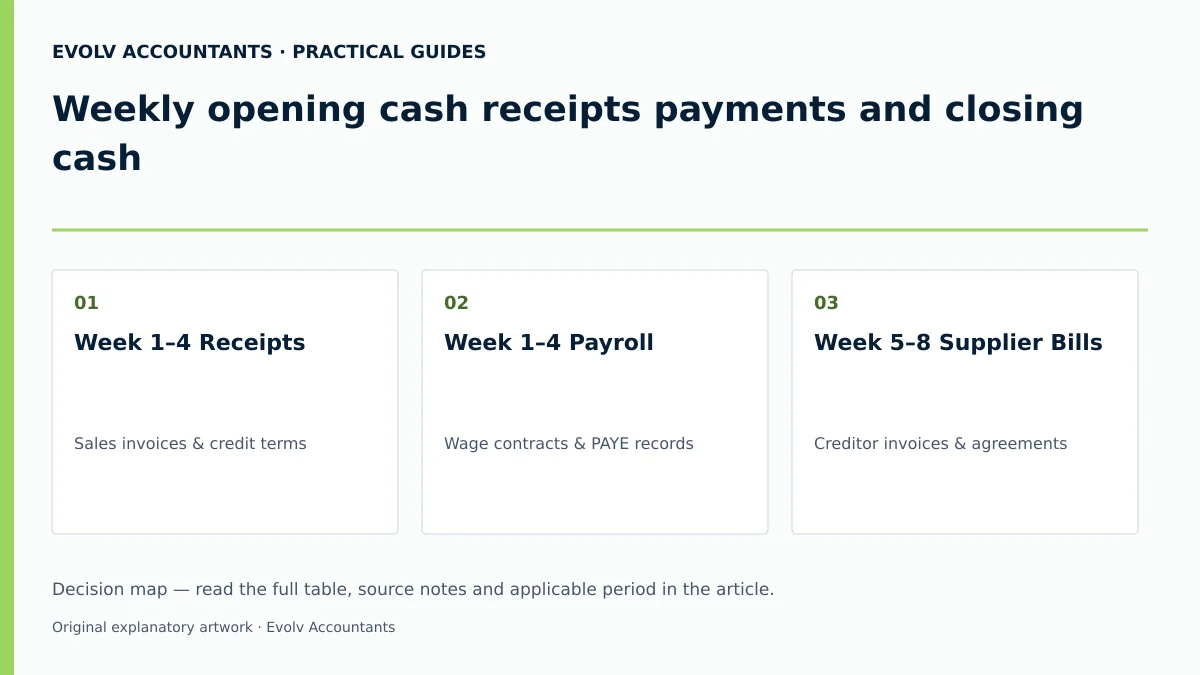
| Period or driver | Evidence based input | Base case | Downside assumption | Action or review trigger |
|---|---|---|---|---|
| Week 1–4 Receipts | Sales invoices & credit terms 8 12 | Invoices collected in 30 days 8 | Collections delayed to 60 days 8 | Receipts fall >10% below base case; escalate collections 8 |
| Week 1–4 Payroll | Wage contracts & PAYE records 14 15 | Fixed payroll & EMP201 payment by 7th 15 | Unchanged fixed statutory liability 14 15 | Closing cash drops below 1.5x payroll; freeze non-essentials 4 |
| Week 5–8 Supplier Bills | Creditor invoices & agreements 8 12 | Settlement on 30-day terms 8 | Cash-on-delivery enforced by suppliers 12 | Disbursements exceed base by >15%; renegotiate terms 8 |
| Week 9–13 VAT Remittance | SARS VAT 201 returns 16 23 | Scheduled payment on tax period date 16 | Higher output tax post peak sales 16 24 | Cash headroom below R50 000 before tax date; arrange reserve 4 16 |
| Closing Cash Buffer | Reconciled demand deposits 3 | Minimum liquidity buffer of R100 000 3 | Buffer contracts to R20 000 in Week 6 3 4 | Projected buffer below threshold; review credit options 4 |
Frequently Asked Questions
How does a 13-week cash forecast differ from an IAS 7 Statement of Cash Flows?
An IAS 7 statement reports historical cash movements across operating, investing, and financing activities for annual financial statements 3 7. A 13-week forecast is an internal, forward-looking operational tool used to project short-term weekly liquidity 3 4.
What record-keeping rules govern cash forecasting inputs in South Africa?
Companies Act 71 of 2008 requires keeping accounting records for seven completed financial years 1 9. SARS requires retaining accounting books, invoices, and bank statements for five years from return submission 10 11.
When must PAYE be included in the cash forecast schedule?
For the 2026/2027 tax year, 1 March 2026–28 February 2027, SARS lists an annual normal-tax threshold of R99,000 for individuals under 65. Employers must register for employees’ tax within 21 business days of becoming an employer unless none of their employees is liable for normal tax. Calculate PAYE using the applicable age, remuneration and payroll-period rules. EMP201 payments are due within seven days after month-end; if the due date is a weekend or public holiday, use the preceding business day. SARS employer guide: 2026/2027 tax year
How do VAT accounting methods affect projected cash receipts and payments?
Under the invoice basis, vendors account for output tax when invoices are issued, requiring cash payment to SARS regardless of collection status 13 16. Under the payments basis (for eligible natural persons/partnerships with turnover up to R2,5 million), VAT is accounted for only when cash is received or paid 19.
Does a 13-week cash flow forecast guarantee business solvency or loan approvals?
No. A cash flow forecast is an internal operational model based on hypothetical assumptions 4. While it supports solvency and liquidity evaluations under Section 4 of the Companies Act 71 of 2008 4, it is not a financial guarantee or lender promise 4 5.
Related guides
- The Importance of Financial Forecasting for Business Growth
- Cash flow forecast versus profit forecast
- Reading the Financials: Cash Flow and the Balance Sheet for Directors